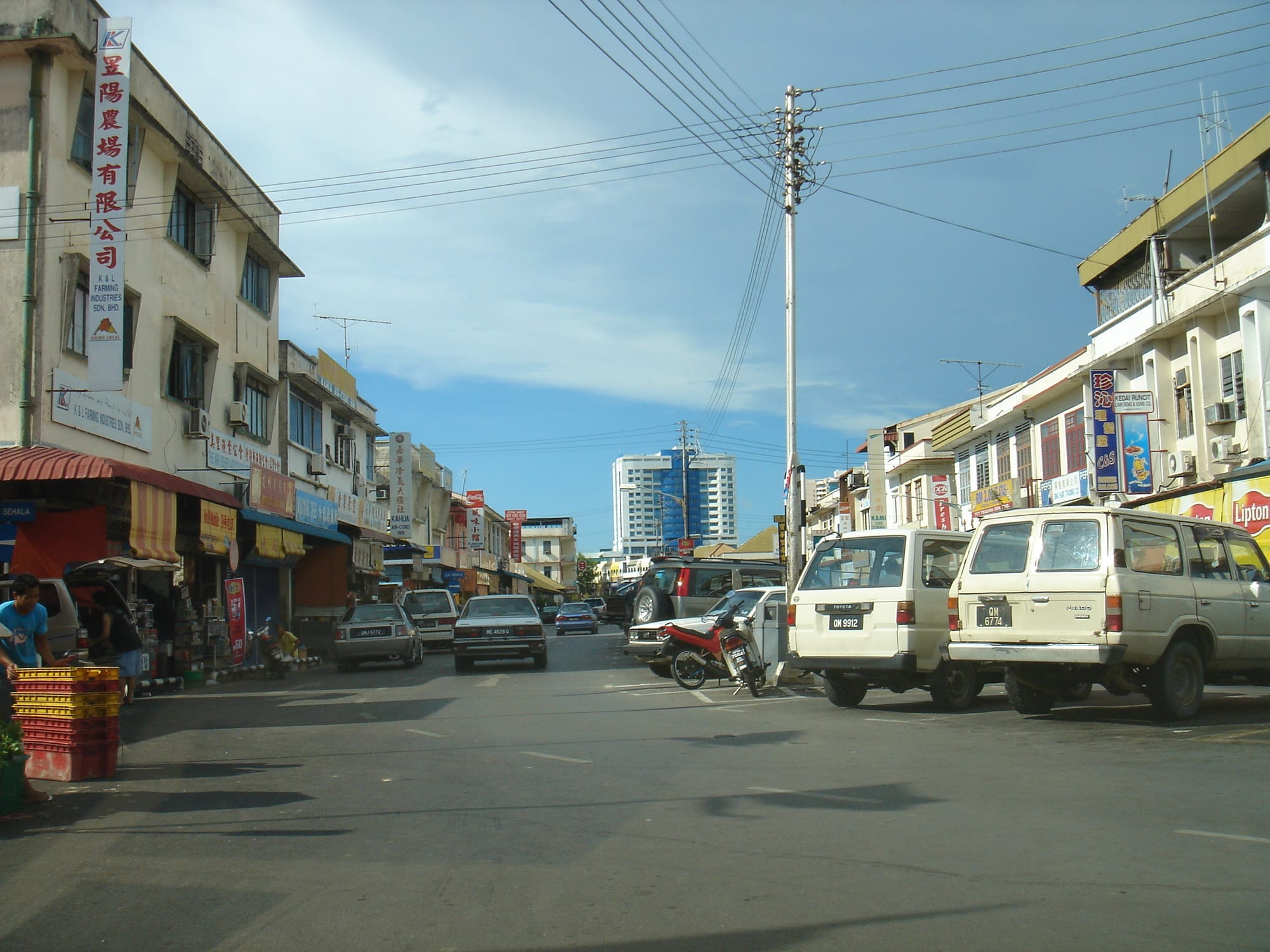
A wide street in Miri's older shophouse district, with shop signs in Chinese and English, parked cars and four-wheel drives, and tower blocks further down the road

Sarawak, Malaysia

Miri

Shophouse streets in the older part of Miri, Sarawak. (mailer_diablo / Wikimedia Commons · CC BY-SA 3.0)

Sarawak's northern coastal city, close to the Brunei border, built on oil: the first well in Malaysia was drilled on the hill above it in 1910. It is a flat, modern place of shophouses, markets and beaches, and the usual staging point for the Niah caves, the Lambir Hills and flights into Mulu and the Kelabit Highlands.

Neighbourhoods

  • The old town
    • First-time visitors
    • Best for food
    • Markets

    The original grid of shophouses around Jalan China and the nearby markets, with Chinese temples, coffee shops, hardware stores and the fish and vegetable halls. Most of the budget hotels are here, and the streets are busiest early in the morning.

    Open in Maps
  • Marina Bay and the waterfront
    • Waterfront
    • Best for food
    • Views

    Reclaimed land north-west of the centre with a marina, a seafront park, seafood restaurants and a long view west over the South China Sea. Locals come out in the late afternoon for the sunset and the cooler air.

    Open in Maps
  • Canada Hill
    • Views
    • Walks and viewpoints

    The low ridge behind the town where oil was first struck, now a park with the preserved well, a museum, walking paths and a view over the whole city to the sea. Housing estates climb its lower slopes.

    Open in Maps
  • Piasau and Luak
    • Beaches
    • Quiet and residential

    Coastal suburbs north and south of the centre, built around the oil industry's housing and now a mix of estates, a nature reserve and long sandy beaches with parks and seafront cafés.

    Open in Maps
  • Pujut and Krokop
    • Local life
    • Best for food

    Inland residential districts where most of the city actually lives, with shopping rows, hawker centres, schools and night markets. They are functional rather than picturesque, and the food is what draws visitors out to them.

    Open in Maps

Things to do

Oil-town landmarks

  • Petroleum Museummuseum

    A museum on Canada Hill beside the Grand Old Lady, the first oil well drilled in Malaysia in 1910, explaining how oil forms, how it is found and what it has meant to Sarawak.

    Open in Maps

Beaches and parks

  • Miri-Sibuti Coral Reefs National Parkpark

    A marine park protecting reefs and wrecks along the coast off the city, dived from Miri on day boats.

    Open in Maps

Markets

  • Tamu Muhibbahmarket

    The city's native and jungle-produce market near the bus terminal, where growers sell ferns, bamboo shoots, wild fruit, honey and river fish beside a general produce section.

    Open in Maps
  • Miri Handicraft Centremarket

    A centre on Brooke Road selling beadwork, basketry, cloth and carvings made by indigenous, Chinese and Malay artisans.

    Open in Maps

Short trips from the city

  • Niah National Parkpark

    A UNESCO World Heritage Site since 2024, limestone caves south of the city where archaeologists found human remains tens of thousands of years old, reached on a plank walk through forest, with cave paintings and boat-shaped coffins in the Painted Cave.

    Open in Maps
  • Lambir Hills National Parkpark

    A park of forested sandstone hills about 20 kilometres south of the city, exceptionally rich in tree species, with waterfall pools and a network of trails.

    Open in Maps
  • Loagan Bunut National Parkpark

    A park gazetted in 1990 around a shallow lake inland from the coast, known for its aquatic life and birds, and fished by the communities along its shore.

    Open in Maps
  • Gunung Mulu National Parkpark

    A UNESCO World Heritage Site of vast limestone caves — the Deer Cave, Clearwater Cave and the Sarawak Chamber — and the Pinnacles on Gunung Api, reached by small aircraft from Miri.

    Open in Maps
  • Barioattraction

    A cluster of villages on a highland plateau near the Indonesian border, known for its fragrant rice, cool air and walking routes between longhouses, reached by small plane from Miri.

    Open in Maps
  • Marudiattraction

    The old administrative town upriver on the Baram, with Fort Hose, a Brooke-era outpost, and boats and roads on towards the interior.

    Open in Maps

Seasonal events

  • Borneo Jazz Festivalmid-year

    One of the region's longer-running jazz festivals, held in Miri since 2006, with local and international bands over two nights.

  • Gawai Dayak1 June

    The Dayak harvest festival, a public holiday when many residents travel upriver to longhouses and those who remain hold open houses with tuak.

  • Chinese New YearJanuary or February

    Lion dances, temple crowds and family open houses across the old town, where much of the city's commerce is Chinese-run.

Eat and drink

Long-standing places and food districts in Miri. Hours, ratings and directions come from your maps app, always current.

Miri classics

  • Old town coffee shopsneighborhood

    Kopitiam around Jalan China and the central market serving Sarawak laksa, kolo mee and strong sweet coffee from early morning.

    Open in Maps
  • Seafood restaurants at the waterfrontneighborhood

    Open-sided restaurants near the marina and along the coast road, cooking the day's catch with pepper, butter or chilli, and midin fern with garlic.

    Open in Maps

Markets and night food

  • Tamu Muhibbahmarket

    The jungle-produce market, where stalls sell ferns, wild fruit, honey, river fish and packets of Bario rice alongside cooked snacks.

    Open in Maps
  • Miri night marketsneighborhood

    Evening markets that move between districts through the week, with grilled chicken wings, satay, noodles, cut fruit and layer cake sold from stalls.

    Open in Maps

Experience Miri

History

The Baram coast was inhabited long before any town stood here: the caves at Niah, south of the modern city, have yielded human remains and tools tens of thousands of years old, making them among the most important archaeological sites in Southeast Asia. In historic times the area lay at the edge of Brunei's sultanate, and the Baram river was a route inland for the Kayan, Kenyah and Berawan peoples, brought under Brooke rule in the late 19th century after the territory was transferred from Brunei.

Miri was a fishing village until oil seepages drew prospectors. In 1910 the first well in Malaysia was drilled on the ridge behind the village, on the initiative of Charles Hose and with Shell's backing, and the Grand Old Lady, as the well became known, produced until 1972. A refinery was built at Lutong, a company town grew around it, and Miri became the headquarters of the oil business in Sarawak. Japanese forces landed here in December 1941, in one of their first moves against Borneo, because of the oil; the fields were sabotaged before they arrived and the town was bombed heavily later in the war.

Production moved offshore from the 1960s and 1970s, and the city changed from an oil camp to a service and trading centre for northern Sarawak, with timber and palm oil adding to its trade. Miri was declared a city in 2005, the tenth in Malaysia and the first that was not a state capital, and has grown steadily since, driven by cross-border traffic with Brunei, education and its role as the gateway to Mulu and the interior.

Culture & Customs

Miri's population is unusually mixed even by Sarawak's standards. Chinese communities dominate the old town's commerce, Malay and Melanau families live along the coast, and large numbers of Iban, Kayan, Kenyah, Kelabit and Lun Bawang people have moved down from the Baram and the highlands for work and schooling, keeping ties with longhouses upriver. The oil industry has brought workers from the peninsula and abroad for a century, giving the city an outward-looking, transient layer on top of that.

Festivals follow the mixture: Chinese New Year in the shophouse streets, Hari Raya open houses, Christmas in a state where Christianity is the largest religion, and Gawai Dayak on 1 June, when the city empties towards the longhouses. The Borneo Jazz Festival has been held here since 2006 and is the event that puts Miri on the regional cultural map, and the handicraft trade keeps Orang Ulu beadwork, basketry and sape playing visible in the city.

Everyday manners are relaxed and practical. Sarawak Malay and English are the common languages, with Hokkien, Hakka, Iban and Kelabit heard as well, and people identify strongly as Sarawakian. Proximity to Brunei shapes weekends in both directions: Bruneians cross to shop and eat, and Mirians cross for the beaches and the quiet.

Daily Life

About 357,000 people live in the city's administrative area, which makes Miri Sarawak's second city, and it sprawls over flat coastal land in low estates rather than rising upward. Oil and gas remain the largest employers, now through offshore fields, service companies and engineering firms rather than the refinery that built the place, and government offices, hospitals, colleges, timber and palm oil provide much of the rest. Retail matters more here than in most Malaysian cities of its size, because Bruneian shoppers cross the border in large numbers.

Life is car-centred. People live in Pujut, Krokop, Luak and the outer estates, drive to work and to the malls, and gather at hawker centres and the seafront in the evening. The coastal parks fill after five o'clock, the night markets move around the districts through the week, and Sunday mornings are quiet while churches are full.

The city's concerns are those of a place whose founding industry has moved offshore: what replaces oil jobs, how to keep young people from leaving for Kuala Lumpur or Singapore, coastal erosion along its beaches, and flooding after monsoon rain. Its role as the gateway to Mulu, Bario and the Baram gives it a steady stream of visitors that the tourism trade depends on.

Food

Miri eats much as the rest of Sarawak does, with a stronger coastal accent. Breakfast is Sarawak laksa, rice vermicelli in a spiced coconut and tamarind broth with prawns, chicken and omelette, or kolo mee, egg noodles tossed dry with shallot oil and char siu. Coffee shops in the old town serve both from early morning, with kopi and kaya toast.

Seafood is the city's evening meal: prawns fried with butter and curry leaves, fish steamed with ginger or grilled with sambal, squid, and crab cooked in Sarawak pepper, the state's most famous export. Midin, the crisp jungle fern, is stir-fried with garlic or belacan on nearly every table, and umai, the Melanau salad of raw fish with lime, chilli and shallot, appears as a starter. From the interior come manok pansoh, chicken cooked in bamboo with tapioca leaves, and Bario rice, the fine fragrant grain grown in the Kelabit Highlands and flown down to the city.

The markets fill in the rest. Tamu Muhibbah sells jungle ferns, bamboo shoots, wild honey, terung Dayak and river fish brought down the Baram; night markets grill chicken wings and satay; and bakeries sell kek lapis Sarawak, the bright layered cake cut into small squares for festivals. Cendol, iced teh c peng special and fresh coconut are the usual drinks against the heat, and tuak is poured at Gawai.

Planning tools

Budget

Miri is inexpensive for food and ordinary hotels, and oil-industry traffic keeps a good supply of mid-range rooms. The costs are in the excursions: park fees, guided cave walks and, above all, the flights and packages for Mulu and Bario, which are the main reason many visitors come. Diving trips to the offshore reefs add to it.

Daily Budget Midrange
USD 75–170 (business hotel, restaurant meals, guided park trips, domestic flights to Mulu or Bario)
Daily Budget Shoestring
USD 20–40 (guesthouse, hawker food and markets, local buses, one park entry)

Book Mulu and Bario flights early, since the aircraft are small and fill quickly, and check what a cave or park package includes before paying.

Best Time to Visit

March to October is generally the drier half of the year and the best for the caves, the coastal reefs and the trails at Lambir. The north-east monsoon from November to February brings heavy rain, rougher seas and more cancelled small-plane flights. The jazz festival falls in the middle of the year.

Suggested Number of Days

The city itself takes a day or two. Most stays are longer because of what is around it: the national parks inland are half-day or full-day trips, and the places reached by small aircraft need several days including the flights. Weather can add time.

First Visit
1–2 days
With Surroundings
4–6 days

Transportation

Miri is spread out and built for driving, with the old town the only part comfortably covered on foot. Ride-hailing is cheap and the usual way to get about, taxis wait at the hotels and terminal, and city buses run infrequently. Long-distance buses leave from the Miri Sentral terminal for Brunei, Bintulu, Sibu and Kuching, and hire cars are widely used for the parks.

Hire a car or a driver for Niah and Lambir if time matters, and allow for border formalities on the road into Brunei.

Airport & Station Connections

Miri Airport lies about 10 kilometres south-east of the centre, with flights to Kuching, Kota Kinabalu and Kuala Lumpur and the small turboprops that serve Mulu, Bario, Marudi and Limbang. Buses run along the Pan Borneo Highway to Bintulu, Sibu and Kuching, and across the border to Brunei. Sarawak runs its own immigration control, so arrivals from elsewhere in Malaysia pass a passport check and receive a separate entry stamp.

Walkability

The old town's grid is flat and walkable, and the markets, temples and coffee shops there are close together. Elsewhere the city is low-density and laid out along wide roads with patchy pavements, so walking between districts is unpleasant in the heat. The seafront parks and Canada Hill are the places people actually walk for pleasure.

Safety

Miri is a calm city with low levels of serious crime; petty theft and thefts from vehicles are the usual complaints. The real hazards are outdoors: strong currents and undertow on the open coast, slippery cave walkways and forest trails, heat, and crocodiles in the rivers and estuaries inland.

Swim only where local people do and heed warning flags, take a guide into the caves and on longer trails, and keep clear of river banks where crocodiles are reported. The UK government advises against all but essential travel to all islands and dive sites off the coast of eastern Sabah, from Sandakan to Tawau, because of the threat of kidnapping; mainland Sabah is not included in that warning. Check current official travel advice before travelling.

Climate

Hot and humid all year, close to the equator, with rain in every month and a marked wet season during the north-east monsoon. Sea breezes make the coast a little more comfortable than the interior, and heavy storms usually pass through quickly.

Summer
hot and humid, generally 23–33°C, with afternoon thunderstorms and calmer seas
Winter
wettest from November to February, around 23–31°C, with long downpours, rough seas and occasional flooding

Local Customs

Miri mixes Chinese, Malay, Iban, Kayan, Kenyah, Kelabit and other communities, with a long-standing expatriate presence from the oil industry. Tipping is not expected. Shoes are removed in homes and religious buildings, modest dress is appreciated away from the beach, and alcohol is sold openly in restaurants and shops. Brunei, next door, is dry, which shapes weekend traffic in both directions.

Ask before photographing people at the markets, use the right hand when giving or receiving, and accept a little tuak if it is offered at a Gawai open house.

Common Payment Methods

The currency is the Malaysian ringgit. Cards and QR payment are accepted in hotels, malls and larger restaurants, while markets, hawker stalls and small coffee shops prefer cash. ATMs are common in the city and absent at Mulu and in the highlands, so cash should be drawn before flying inland. Brunei dollars are sometimes accepted near the border.