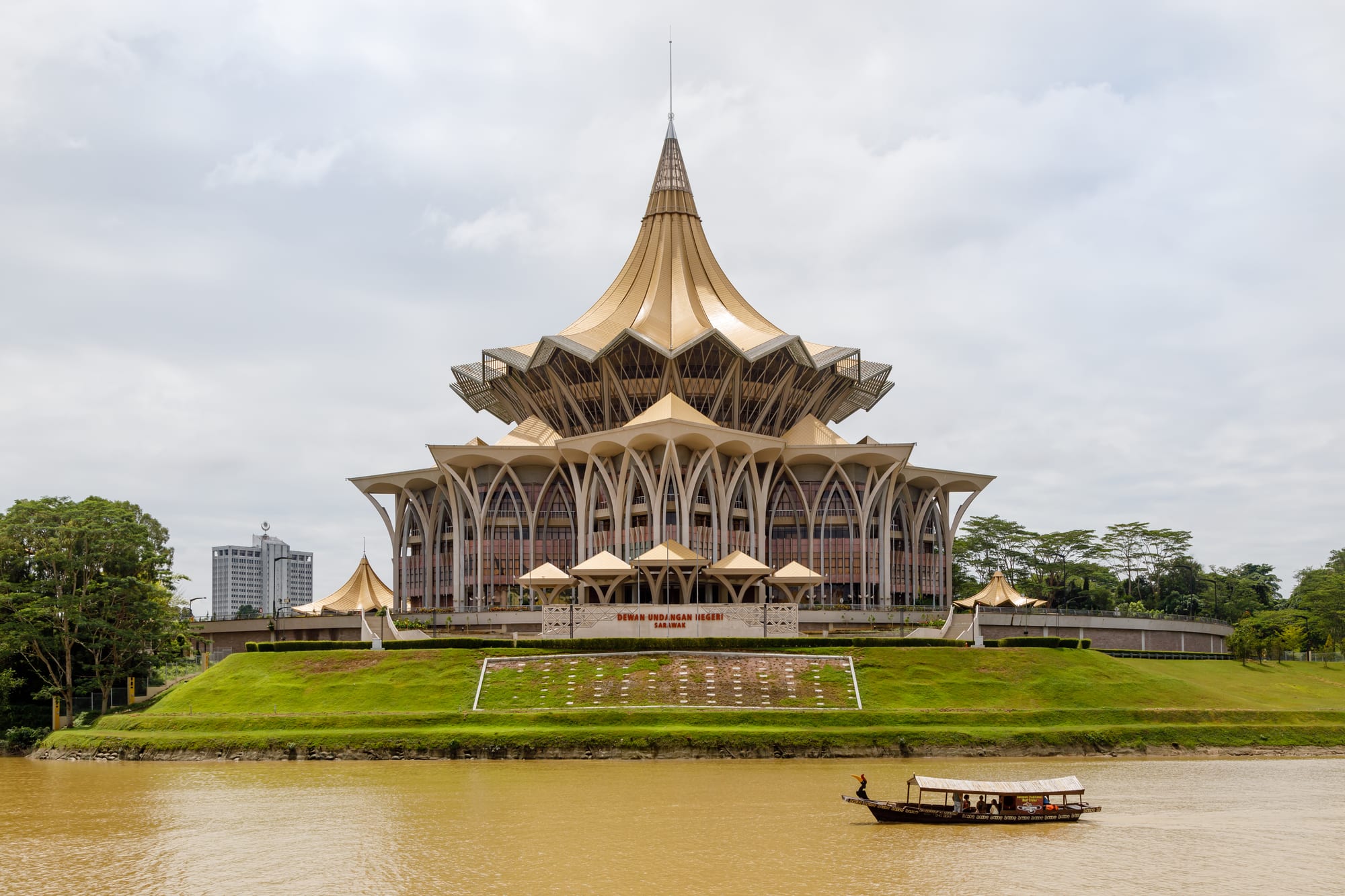
The tiered golden roof and spire of the Sarawak State Legislative Assembly building above a green riverbank, with a small wooden boat crossing the brown river

Sarawak, Malaysia

Kuching

The Sarawak State Legislative Assembly building on the north bank of the Sarawak River at Kuching, with a river taxi crossing. (CEphoto, Uwe Aranas / Wikimedia Commons · CC BY-SA 4.0)

The capital of Sarawak, on the Sarawak River about thirty kilometres from the sea. It grew as the seat of the Brooke rajahs, who ruled the state for a century, and kept their forts, palace and courthouse alongside a Chinese bazaar and Malay villages on the far bank. It is now a low-rise city of museums, food and easy access to rainforest parks.

Neighbourhoods

  • The Waterfront and old Kuching
    • First-time visitors
    • Historic district
    • Best for food

    The paved riverside promenade and the streets behind it hold most of what visitors come for — the old courthouse, the Square Tower, the Main Bazaar's antique and craft shops and the museums a short walk uphill. Hotels, cafés and evening crowds concentrate here.

    Open in Maps
  • Chinatown and Carpenter Street
    • Best for food
    • Historic district

    A grid of two-storey shophouses one street back from the river, with Chinese temples, clan associations, coffee shops and noodle houses. It is the oldest commercial quarter of the city and the place to eat kolo mee in the morning.

    Open in Maps
  • Padungan
    • Nightlife
    • Best for food

    The south-eastern extension of the old town along Jalan Padungan, lined with 1920s and 1930s shophouses, cafés, bars and restaurants, and marked by the large cat statue at its end. Quiet by day and busy after dark.

    Open in Maps
  • The north bank kampungs
    • Local life
    • Quiet and residential

    Malay villages of wooden houses — among them Kampung Boyan and Kampung Bintawa — face the old town across the water, reached by the pedestrian bridge or by small motorised sampans that run all day. The Astana and Fort Margherita stand among them.

    Open in Maps
  • Petra Jaya
    • Architecture
    • Quiet and residential

    The administrative district spread across the north bank, with state offices, the golden-roofed legislative assembly, the state mosque and suburban housing. It is a driving district rather than a walking one.

    Open in Maps
  • Satok and Jalan Ban Hock
    • Markets
    • Local life

    West and south of the centre, a residential area around the big weekend market, with hotels, hawker centres and shopping streets used more by residents than by visitors.

    Open in Maps

Things to do

Riverfront landmarks

  • Kuching Waterfrontlandmark

    A promenade of nearly two kilometres along the south bank, laid out on former wharves, with food stalls, benches and views across to the palace and forts.

    Open in Maps
  • The Astanalandmark

    The white palace built in 1870 by Charles Brooke as a wedding gift to his wife, Margaret, standing in gardens on the north bank and now the official residence of the governor of Sarawak.

    Open in Maps
  • Fort Margheritalandmark

    A fort of 1879 built by Charles Brooke in the style of an English castle to guard the river against pirates, named after his wife Margaret and now housing the Brooke Gallery on the family's rule.

    Open in Maps
  • Sarawak State Legislative Assembly Buildinglandmark

    The state parliament on the north bank, opened in 2009, nine floors on the plan of a nine-pointed star, shaped after the Bidayuh baruk roundhouse and capped with a roof in the form of a royal umbrella.

    Open in Maps
  • Darul Hana Bridgelandmark

    A curving pedestrian bridge opened in November 2017, the only one that links the waterfront with the north bank kampungs, popular at sunset.

    Open in Maps
  • Square Towerlandmark

    A small white fort on the waterfront, built in 1879 as a prison and later put to other uses.

    Open in Maps

Museums

  • Borneo Cultures Museummuseum

    The largest museum in Malaysia, opened in March 2022 on the old museum grounds, with galleries on Sarawak's peoples, objects and natural history on its upper four floors.

    Open in Maps
  • Sarawak Museummuseum

    The oldest museum in Borneo, founded in 1888 and opened in 1891 in a Queen Anne-style building on the museum hill, closed for refurbishment in 2017.

    Open in Maps
  • Cat Museummuseum

    A museum founded in 1993 by the city's northern council and housed in its headquarters on a hill across the river, the first in the world devoted entirely to cats in art, history and advertising.

    Open in Maps
  • Chinese History Museummuseum

    A small museum in the former Chinese Chamber of Commerce on the waterfront, tracing the settlement of Sarawak's Chinese communities.

    Open in Maps

Temples, mosques and markets

  • Tua Pek Kong Templelandmark

    The oldest temple in the city, its history traceable to 1843, standing at the end of the waterfront opposite the Chinese History Museum and busiest at Chinese New Year.

    Open in Maps
  • Chinatown and the Main Bazaarneighborhood

    The row of 19th-century shophouses facing the river, now antique shops, craft dealers, cafés and galleries selling pua kumbu textiles and beadwork.

    Open in Maps

Short trips from the city

  • Bako National Parkpark

    Sarawak's oldest national park, established in 1957 about 40 kilometres away by road and then reached by boat, with sandstone sea stacks, beaches, seven forest ecosystems, proboscis monkeys and bearded pigs.

    Open in Maps
  • Mount Santubongtrail

    A forested peak on the Damai peninsula about 30 kilometres north, the highest point of Kuching, climbed on a demanding trail with ropes and ladders near the top.

    Open in Maps
  • Sarawak Cultural Villageattraction

    A living museum at Damai, about 35 kilometres north at the foot of Mount Santubong, where traditional houses of Sarawak's peoples stand together with craft and dance performances; the Rainforest World Music Festival is held in its grounds.

    Open in Maps
  • Semenggoh Nature Reservepark

    A forest reserve a short drive south of the city whose wildlife centre runs an orangutan rehabilitation programme, with semi-wild animals coming in to feeding platforms.

    Open in Maps
  • Kubah National Parkpark

    A park of sandstone hills about 20 kilometres west of the city, gazetted in 1989 for a palm flora of some 98 species and known also for its frogs, with waterfall trails and night walks.

    Open in Maps

Seasonal events

  • Rainforest World Music Festivalmid-year, usually June or July

    A three-day festival of traditional and world music held at the Sarawak Cultural Village below Mount Santubong, with daytime workshops and evening concerts.

  • Gawai Dayak1 June

    The Dayak harvest festival, a public holiday when the city empties towards the longhouses and those who stay hold open houses with tuak and food.

  • Sarawak Regattaannual, dates announced each year

    Longboat races on the Sarawak River in front of the waterfront, a contest between river communities that goes back to boat races instituted under James Brooke in 1872.

  • Chinese New YearJanuary or February

    Two weeks of lion dances, temple crowds and open houses in Chinatown and across the city, ending with the lantern festival.

Eat and drink

Long-standing places and food districts in Kuching. Hours, ratings and directions come from your maps app, always current.

Kuching classics

  • Chinatown coffee shopsneighborhood

    The kopitiam of Carpenter Street and the lanes around it are where Kuching eats breakfast — Sarawak laksa, kolo mee and kopi at marble-topped tables.

    Open in Maps
  • Top Spot Food Courtneighborhood

    A rooftop cluster of seafood stalls on a car park in the centre, where fish, prawns, crab and midin fern are chosen from ice and cooked to order.

    Open in Maps
  • Main Bazaar cafésneighborhood

    The riverfront shophouses hold coffee roasters, cake shops selling kek lapis and small restaurants, with the promenade a few steps away.

    Open in Maps

Markets and street food

  • Satok Weekend Marketmarket

    Jungle ferns, bamboo shoots, wild honey, river fish and layer cake sold by growers from the villages, with cooked-food stalls alongside.

    Open in Maps
  • Kuching Waterfront food stallsneighborhood

    Stalls and open-air restaurants along the promenade serving grilled fish, satay, noodles and cold drinks as the river traffic goes by.

    Open in Maps
  • Padungan cafés and barsneighborhood

    Old shophouses along Jalan Padungan converted into coffee bars, craft-beer places and restaurants serving both Sarawak and international food.

    Open in Maps

Experience Kuching

History

Kuching began as a small settlement on the Sarawak River, trading antimony — the ore that may have given the river and the state their name — with Brunei, under whose sultanate the area lay. In 1839 the English adventurer James Brooke arrived on his schooner, helped the Brunei court put down a rebellion, and in 1841 was made Rajah of Sarawak. He moved the seat of government to Kuching and began a century of rule by his family, the only white dynasty of its kind.

Under James, Charles and Vyner Brooke the town acquired the shape it still has. Charles built the Astana in 1870, Fort Margherita in 1879, the courthouse, the Square Tower and a row of stone shophouses along the Main Bazaar, and he encouraged Chinese merchants and Hakka farmers to settle, while Malay kampungs kept the north bank. The Brookes expanded Sarawak by stages at Brunei's expense, suppressed headhunting, and ruled with a mixture of paternalism and indirect authority through local leaders.

Japanese forces occupied Kuching from December 1941 and interned civilians and prisoners of war at Batu Lintang camp, on the edge of the town, until liberation in 1945. Vyner Brooke ceded Sarawak to Britain in 1946, a decision opposed by an anti-cession movement, and the state joined Malaysia in 1963. Kuching became a city on 1 August 1988 and, unusually for Malaysia, is run by two separate city authorities, one north of the river and one south of it. Oil, gas, timber and palm oil funded its growth, and the riverfront was rebuilt as a promenade in the years after.

Culture & Customs

The city is a meeting point for the state's peoples. Chinese Sarawakians — Hokkien, Teochew, Hakka and Foochow — make up a large share of the population, alongside Malays, Bidayuh from the hills to the south, Iban from the rivers, and Melanau and Orang Ulu communities. Churches, mosques and Chinese temples stand within a few streets of one another, and the calendar carries Gawai Dayak, Hari Raya, Chinese New Year and Christmas, each marked with open houses to which neighbours of any faith are invited.

Craft and music are the visible parts of that mixture. Pua kumbu, the Iban ceremonial cloth, and Orang Ulu beadwork and carving fill the shops of the Main Bazaar; the sape, the boat-shaped lute of the interior, has become the state's musical emblem and is heard at the Rainforest World Music Festival each year at Damai. Kuching keeps a local identity distinct from Peninsular Malaysia, with its own immigration control, holidays and dialect of Malay, and Sarawakians tend to speak of the peninsula as somewhere else.

The cats are the city's running joke and brand: kucing is Malay for cat, and whatever the true origin of the name, large cat statues stand at road junctions and a municipal museum is devoted to them. Manners are unhurried and friendly, conversation happens over coffee, and the evening riverfront walk is the closest thing the city has to a civic ritual.

Daily Life

About 610,000 people were counted in Kuching's two city council areas in 2023, which makes it Sarawak's largest city but a modest one by Malaysian standards, and it is low-rise and spread out. Government is a major employer, as the state capital, alongside services, education, tourism and retail, with oil and gas, timber and palm oil money circulating through the economy from elsewhere in the state.

Most residents live in suburbs away from the old town, in terraced houses and low flats, and commute by car; traffic at the bridges and main junctions is the daily frustration. The kampungs on the north bank keep their wooden houses and village character within sight of the office towers, connected by sampans whose boatmen have worked the crossing for generations. Rents and house prices in the centre have risen with tourism, and old shophouses are steadily becoming cafés.

The day begins early with breakfast at a coffee shop, offices open by eight, and the heat and afternoon storms slow things until the evening, when the waterfront fills with families and hawker stalls. Floods after prolonged monsoon rain, water supply and the state's share of federal revenue are the recurring public concerns, along with the condition of the roads that link the city to the rest of Borneo.

Food

Kuching's most famous dish is Sarawak laksa: rice vermicelli in a broth built from sambal, tamarind, garlic, galangal, lemongrass and coconut milk, topped with shredded chicken, prawns, omelette strips and coriander, and eaten for breakfast rather than later in the day. Its everyday companion is kolo mee, springy egg noodles tossed in shallot oil and lard with minced pork and char siu, ordered dry with a bowl of soup on the side. Both are found in the coffee shops of Chinatown and in every suburb.

Local vegetables and river food give the city its character. Midin, a crisp jungle fern, is stir-fried with garlic or belacan; terung Dayak, a sour round aubergine, goes into soups; umai, the Melanau salad of raw fish with lime, chilli and shallot, appears on many menus; and manok pansoh, chicken cooked in a bamboo tube with tapioca leaves, comes from the longhouse kitchen. Seafood is eaten at stalls and rooftop food courts, with butter prawns, steamed fish and crab in Sarawak pepper sauce — the state's pepper being one of its best-known exports.

Sweet things and drinks round it out. Kek lapis Sarawak, the layered cake baked in bright patterns for festivals, is sold by the slice all over town; Foochow kompia buns and Chinese pastries fill the bakeries; and cendol, teh c peng special with its bands of tea, milk and palm sugar, and kopi from local roasters are the standard refreshments. Tuak, the rice wine of the Dayak communities, is poured at Gawai and offered to guests in the longhouses upriver.

Planning tools

Budget

Kuching is one of the cheaper Malaysian cities for food and rooms, and a good breakfast costs very little. Costs rise with the excursions: park fees and boats for Bako, transport to Semenggoh and the Cultural Village, and guided trips upriver. Hotel prices climb around the Rainforest World Music Festival, when rooms are scarce.

Daily Budget Midrange
USD 75–170 (riverfront hotel, restaurant meals, guided day trips, a hire car or driver)
Daily Budget Shoestring
USD 20–40 (guesthouse, hawker food, buses and river sampans, one park entry)

Book rooms early for the festival period, and use the small river ferries, which cost only small change, to cross to the north bank.

Best Time to Visit

March to October is generally drier and better for the parks and boat trips, with the Rainforest World Music Festival and Gawai bringing the busiest weeks in the middle of the year. The heaviest rain falls from about November to February, when the sea can be rough enough to disrupt the boat to Bako.

Suggested Number of Days

Two or three days suit the city itself, its museums and the riverfront. Four to six allow the national parks, the wildlife centre and the coast as well, since each of those is a half-day or full-day trip. Wet weather can delay boats.

First Visit
2–3 days
With Surroundings
4–6 days

Transportation

The old town is small and best covered on foot, with small motorised sampans crossing the river all day for a few coins and the Darul Hana Bridge as the walking alternative. Beyond the centre, ride-hailing is cheap and widely used, buses reach the suburbs and the parks slowly, and tour vans serve Bako, Semenggoh and Damai. Hiring a car makes the wider area easy.

Use ride-hailing rather than waiting for buses to the parks, and agree with any driver when they will return for the trip back.

Airport & Station Connections

Kuching International Airport is about 11 kilometres south of the centre, a short drive by taxi or ride-hailing, with frequent flights to Kuala Lumpur, Singapore, Kota Kinabalu and other Borneo towns. Long-distance buses run along the Pan Borneo Highway to Sibu, Bintulu and Miri, and on towards Brunei. Most Western passport holders enter visa-free for up to 90 days and must complete a Malaysia Digital Arrival Card before travelling. Sarawak runs its own immigration control, so arrivals from anywhere else in Malaysia pass a passport check and receive a separate entry stamp.

Walkability

The historic core is flat, compact and one of the most walkable in Malaysia: the waterfront, Chinatown, the Main Bazaar and the museum hill are within twenty minutes of one another. Heat and sudden downpours are the limits rather than distance, and covered five-foot ways in front of the shophouses give shade. Outside the centre, roads are wide and pavements patchy, so most journeys are driven.

Safety

Kuching is a quiet city with low levels of crime, and the usual problems are opportunistic — bag snatching, theft from parked cars and occasional scams. The greater risks are natural: heat and dehydration, slippery trails and cave walkways in the parks, strong currents and rough seas on the boat to Bako, and saltwater crocodiles in the rivers and estuaries.

Heed crocodile warning signs and keep away from river edges, take water and rain gear into the parks, and use metered taxis or ride-hailing at night. Check current official travel advice before travelling.

Climate

Equatorial, hot and among the wettest places in Malaysia, with rain in every month and roughly a couple of hundred rainy days a year. Days are warm and humid with heavy afternoon storms; the north-east monsoon from November to February brings the longest downpours.

Summer
hot and humid, generally 23–33°C, with thunderstorms building in the afternoon
Winter
wettest from November to February, around 22–31°C, with prolonged heavy rain and occasional local flooding

Local Customs

Sarawak is mixed in faith and relaxed about it, and Kuching shows that: mosques, churches and Chinese temples stand close together and each community's festivals are widely joined. Tipping is not customary. Shoes come off in homes, mosques and temples, and modest dress is appreciated in religious buildings. Alcohol is sold freely in Chinese restaurants, coffee shops and bars.

Ask before photographing people in the kampungs, use the right hand to give and receive, and accept at least a sip of tuak if it is offered at a celebration.

Common Payment Methods

The currency is the Malaysian ringgit; Sarawak uses the same notes as the rest of the country. Cards and QR payment work in hotels, malls and larger restaurants, while hawker stalls, markets, sampans and small coffee shops run on cash. ATMs are plentiful in the centre and scarce at the parks.