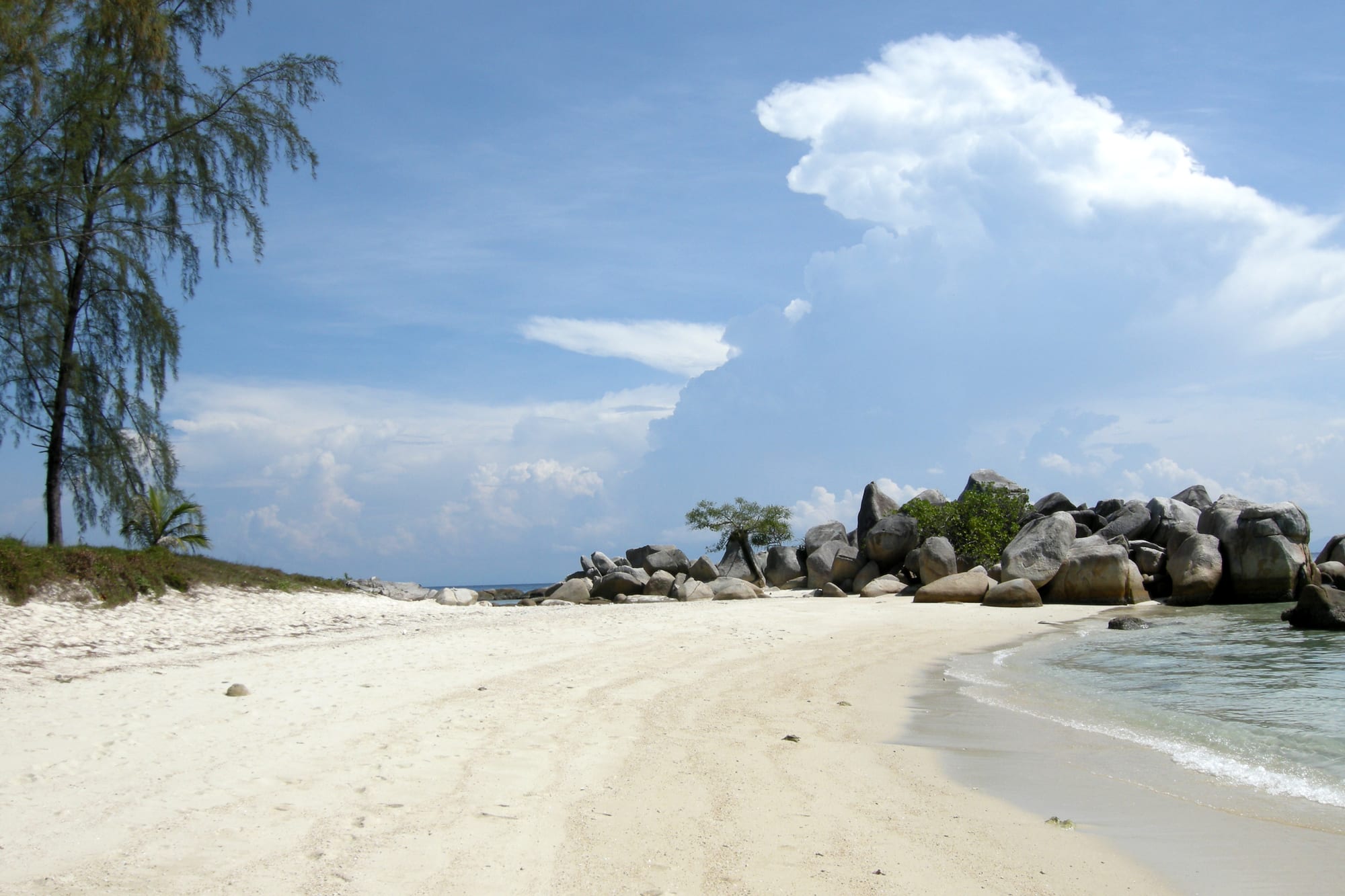
A white sand beach with a casuarina tree, granite boulders and clear shallow water under a blue sky with clouds

Malaysia

The East Coast

A white-sand beach with granite boulders on Perhentian Besar, off the coast of Terengganu. (Vyacheslav Argenberg / Wikimedia Commons · CC BY 4.0)

The eastern side of Peninsular Malaysia, facing the South China Sea, made up of Kelantan and Terengganu in the north and the large state of Pahang, which reaches inland to the Titiwangsa mountains. It is the Malay heartland of the peninsula, with coral islands offshore and old rainforest and cool highlands in the interior.

Explore The East Coast

History

The east coast looks outwards to the South China Sea, and its early history connects it with the trading world of the Gulf of Siam and southern China. The Terengganu Inscription Stone, a carved text in Jawi script dated to the 14th century, is one of the earliest records of Islam in the Malay world. Pahang was drawn into the Malacca sultanate in the 15th century and later into the orbit of Johor, while Kelantan and Terengganu developed as their own sultanates, long sending tribute to Siam.

Pahang's ruling line of bendaharas made themselves sultans in the 19th century, and when Britain placed a Resident there in 1888, local chiefs including Dato' Bahaman and Mat Kilau rose in the Pahang uprising of the 1890s, a revolt now remembered as an early act of resistance. Pahang then joined the Federated Malay States, and tin mining at Sungai Lembing and gold at Raub drew settlers. Kelantan and Terengganu passed from Siamese to British influence under the 1909 Anglo-Siamese Treaty and remained among the least changed parts of the peninsula.

Japanese troops landed near Kota Bharu on 8 December 1941, the opening of the Malayan campaign. After independence the east coast stayed rural and strongly Malay; oil and gas off Terengganu brought new wealth, and Kelantan has been governed by the Islamic party PAS since 1990, with Terengganu also under PAS for much of the recent past. Kuantan replaced Kuala Lipis as Pahang's capital in 1955.

Culture & Customs

Kelantan and Terengganu are the most traditional Malay states. Kelantanese speak a dialect that other Malaysians find hard to follow, and the region is known for crafts and performing arts: songket cloth woven with gold thread, batik, silverwork, carved wooden boats, giant kites called wau, and spinning tops. Kelantan's mak yong dance-theatre is recognised by UNESCO as intangible heritage, and the state is also the home of wayang kulit shadow puppetry and the call-and-response singing of dikir barat, though state religious policy has restricted some of these performances.

Islam shapes daily life. Friday is a day of worship, alcohol is restricted, and modest dress is expected. Yet Kelantan also has a long-established Siamese Buddhist minority near the Thai border, with temples and large reclining Buddhas in Tumpat district, and Chinese communities in Kota Bharu and Kuala Terengganu whose families have lived here for generations.

Pahang is more mixed, with Malay villages, Chinese towns, the Orang Asli peoples of the interior — including the Batek around Taman Negara — and the Indian and Chinese farming communities of the Cameron Highlands.

Daily Life

Kelantan's people are overwhelmingly Malay, with Kota Bharu the main city. Terengganu has about 1.2 million, centred on Kuala Terengganu, and Pahang, the largest state on the peninsula by area, about 1.6 million, with Kuantan its capital and main port and Temerloh, Bentong and Raub inland.

The economy leans on farming, fishing, palm oil, rubber and small trade, with oil and gas processing around Kerteh in Terengganu and industry at Kuantan's port. Incomes in Kelantan are among the lowest in the country, and many Kelantanese work in Kuala Lumpur, returning home for the festivals. Pahang's Cameron Highlands are a major vegetable-growing area, and Raub is known for its durian orchards.

Mornings start at the market, where Kelantan's women traders run many of the stalls. Friday prayers mark the week, and floods in the monsoon regularly displace thousands. Development, jobs for young people and the East Coast Rail Link are the issues of the moment.

Food

The east coast cooks with rice, fish and coconut. Kelantan's nasi kerabu is rice tinted blue with butterfly-pea flowers, served with herbs, grated coconut, fish crackers and salted egg; nasi dagang, rice steamed with coconut milk and eaten with tuna curry, is a breakfast in both Kelantan and Terengganu. Laksam, thick rolled rice noodles in a rich fish-and-coconut gravy, and ayam percik, chicken grilled with a spiced coconut sauce, are Kelantan staples, and budu, a fermented anchovy sauce, is the region's signature condiment.

Terengganu is known for keropok lekor, a chewy fish sausage served fried or boiled with chilli sauce, and for fish crackers sold along the coast roads. Sweet cakes, known as kuih, are made from rice flour, coconut, eggs and palm sugar and sold in every market.

Pahang's classic dish is gulai tempoyak ikan patin, freshwater catfish cooked in a curry of fermented durian. The Cameron Highlands grow tea, flowers and vegetables, and its tea rooms serve scones with local jam, while Raub's Musang King durians are sought out across Malaysia and beyond.

Attractions & Natural Wonders

The islands are the region's main draw. The Perhentian Islands, Besar and Kecil, off Kuala Besut, have white beaches, clear water, coral reefs and turtles in the marine park; Redang, a larger island further south, has resorts and some of the peninsula's best snorkelling, with Lang Tengah and Kapas nearby. Pahang adds Tioman, a larger mountainous island with jungle trails and dive sites, and the long beach at Cherating near Kuantan.

Kota Bharu's markets are its liveliest sights — the Siti Khadijah central market and the stalls around it — along with the royal museums near the old palace and cultural performances at the craft centres. Nearby Tumpat has Siamese temples with large Buddha statues. Kuala Terengganu has the Pasar Payang market, the old shophouses of Kampung Cina, the Crystal Mosque on Wan Man island and the floating mosque of Tengku Tengah Zaharah.

Inland, Taman Negara, founded in the late 1930s and spreading across Pahang, Kelantan and Terengganu, has the canopy walkway and trails at Kuala Tahan, boat trips on the Tembeling river and the long trek to Gunung Tahan, the highest peak of the peninsula. Pahang's highlands include the Cameron Highlands, with tea estates, vegetable farms and the mossy forest of Gunung Brinchang, and the quieter colonial hill station of Fraser's Hill. The lakes of Tasik Chini and Tasik Bera lie in the lowlands.

Cities in The East Coast

Planning basics

Budget

The east coast is among the cheapest parts of Malaysia. Food in Kota Bharu and Kuala Terengganu costs very little, and beach chalets on the Perhentians range from simple to comfortable, though prices on the islands are higher than on the mainland. Redang is mostly package resorts, and Taman Negara costs rise with guided trips and park fees. Alcohol is hard to find in Kelantan and Terengganu.

Daily Budget Midrange
USD 60–130 (island resort or highland hotel, guided trips, snorkelling or diving)
Daily Budget Shoestring
USD 20–40 (chalet or guesthouse, market food, buses and shared boats)

Bring enough cash for the islands, where cash machines are scarce or absent, and budget for boat transfers and marine-park fees.

Safety

The region is generally safe, with less petty crime than the big cities. The main hazards are monsoon floods, rough seas and boat safety, currents and boat traffic at island beaches, leeches and slippery trails in the rainforest, and winding highland roads. Kelantan and Terengganu are conservative, and some religious rules apply to Muslims.

Dress modestly off the beach, wear a life jacket on boats, and hire licensed guides for jungle treks. Check current official travel advice before travelling.

Climate

The east coast takes the full north-east monsoon from about November to February, when heavy rain, rough seas and floods — sometimes severe in Kelantan and Pahang — close most island resorts and boat services. From March to October the weather is hot and mostly settled. The Cameron Highlands, at around 1,500 metres, are much cooler all year.

Summer
hot and humid on the coast, 25–33°C, calm seas; 15–25°C in the Cameron Highlands
Winter
monsoon rain and rough seas from about November to February; cool and misty in the highlands

Transportation

Kota Bharu, Kuala Terengganu and Kuantan have airports with flights from Kuala Lumpur. Boats to the Perhentians leave from Kuala Besut, and to Redang from Merang and Kuala Terengganu. Taman Negara is reached by road to Kuala Tahan or by river boat from Kuala Tembeling, and the Cameron Highlands by road from Tapah or Ipoh. The slow interior railway runs from Gemas to Tumpat near Kota Bharu, and the East Coast Rail Link is under construction.

Check that island boats and resorts are operating before travelling at the edges of the monsoon, and allow a full day to reach Taman Negara.

Best Time to Visit

March to October for the Perhentians, Redang and the coast, with the best diving visibility and calmest seas from about April to August. Taman Negara is also easiest in the drier months, and the Cameron Highlands can be visited all year, though weekends and school holidays bring traffic jams on the hill roads. Ramadan changes opening hours in Kelantan and Terengganu.