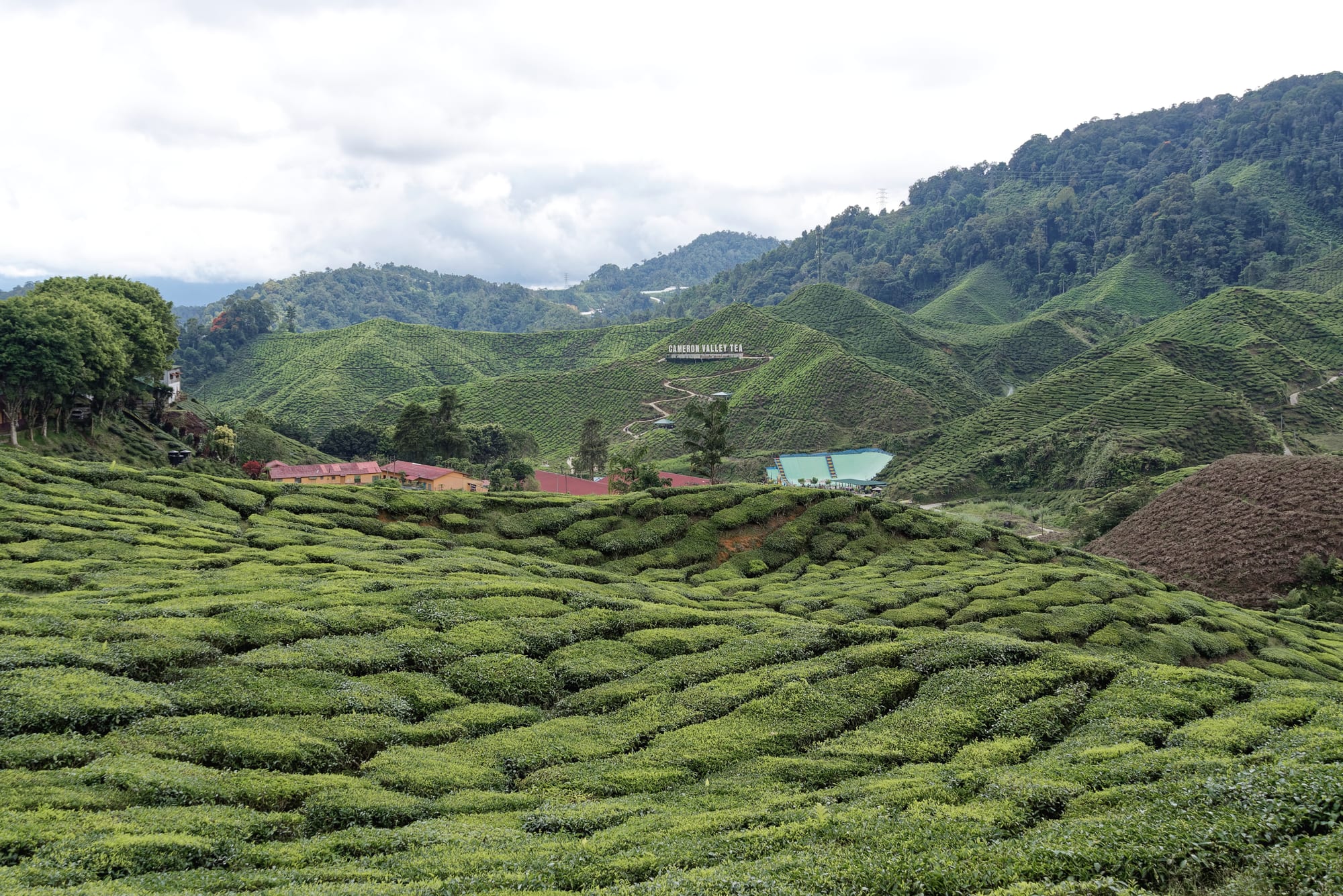
Rows of clipped tea bushes covering steep green hills in the Cameron Highlands, with forested ridges and low cloud behind

The East Coast, Malaysia

Cameron Highlands

Tea bushes covering the hills of the Cameron Highlands in Pahang. (Jakub Hałun / Wikimedia Commons · CC BY 4.0)

A hill district in the Titiwangsa range in northwestern Pahang, its towns lying between about 1,400 and 1,600 metres, made up of a string of small settlements along one winding road. Opened as a British hill station in the 1930s, it is the coolest place most Malaysians can reach by car, and lives on tea estates, vegetable and strawberry farms, and weekend visitors.

Neighbourhoods

  • Tanah Rata
    • First-time visitors
    • Budget stays
    • Close to public transport

    The main town and the usual base, a single street of shops, restaurants, guesthouses and hotels with the bus terminal, the hospital and the district offices. Trails into the forest start at the edge of town, and it is the quieter and greener of the two main centres.

    Open in Maps
  • Brinchang
    • Night markets
    • Families
    • Shopping

    A few kilometres north and a hundred metres higher, busier and more commercial than Tanah Rata, with hotels, the well-known weekend night market now held at Golden Hills just outside the town, and the road up towards the high ridge. Most of the farms and nurseries open to visitors lie just beyond it.

    Open in Maps
  • Ringlet
    • Local life
    • Tea estates
    • Quiet and residential

    The southernmost town of the highlands and the first on the way up from that side, lower and warmer than the others, with workers' housing, the smaller settlements of Boh, Habu and Bertam Valley nearby, and tea estates on the hillsides around it.

    Open in Maps
  • Kampung Raja and the northern valleys
    • Farms
    • Local life
    • Quiet and residential

    The northern end of the district, where valley after valley is covered in plastic-roofed greenhouses growing vegetables and flowers for the whole country. Few visitors stay here, and the villages are working farm settlements rather than resorts.

    Open in Maps

Things to do

Tea estates and farms

  • The tea estatesattraction

    Clipped bushes covering the hillsides around Habu, Sungai Palas and Bharat, several with visitor centres, walkways among the bushes and tea rooms looking out over the slopes.

    Open in Maps
  • Strawberry farmsattraction

    Greenhouses of strawberries grown in raised troughs, open for picking and selling jam, ice cream and fresh fruit — a fixture of a Malaysian visit to the highlands.

    Open in Maps
  • Flower and cactus nurseriesattraction

    Commercial nurseries of roses, chrysanthemums, orchids and cacti, grown for the lowland markets and open to walk through.

    Open in Maps
  • Bee farms and vegetable farmsattraction

    Smallholdings on the slopes around Brinchang and Kea Farm growing cool-climate vegetables and keeping hives, with roadside stalls selling honey and produce.

    Open in Maps

Forest, walks and viewpoints

  • The Mossy Foresttrail

    A stunted, permanently damp cloud forest on the highest ridge, where trees, branches and ground are covered in moss, ferns and pitcher plants, crossed by a raised boardwalk.

    Open in Maps
  • Mount Brinchangviewpoint

    At 2,032 metres, the second-highest peak in the Cameron Highlands and the highest in the region that can be reached by road, with a narrow climbing lane to a lookout tower above the cloud forest.

    Open in Maps
  • Mount Irautrail

    The highest mountain in the Cameron Highlands at 2,110 metres, reached by a long, muddy ridge walk of three to four hours through mossy forest, usually done with a guide.

    Open in Maps
  • The jungle trailstrail

    A network of numbered paths starting at the edge of Tanah Rata and running through dense forest to waterfalls, ridges and Orang Asli villages, some short and easy, others steep and muddy.

    Open in Maps

Towns, markets and temples

  • Brinchang night marketmarket

    Stalls of strawberries, corn, steamboat ingredients, grilled food and souvenirs, held at Golden Hills a couple of kilometres from the town centre at weekends and in the Malaysian school holidays.

    Open in Maps
  • Sam Poh Templelandmark

    A large Chinese Buddhist temple on a hillside above Brinchang, with Buddha statues, prayer halls and views down the valley.

    Open in Maps
  • The old hill-station buildingslandmark

    Mock-Tudor hotels, bungalows and a golf course laid out between Tanah Rata and Brinchang in the 1930s, the most visible remains of the British hill station.

    Open in Maps

Short trips from the highlands

  • Ipohattraction

    The old tin-mining capital of Perak down on the plain, known for its limestone hills, cave temples, colonial core and its coffee and noodle shops.

    Open in Maps
  • Tapahattraction

    The small town at the foot of the original winding road up from the expressway, with waterfalls on the climb above it and Orang Asli settlements in the forest nearby.

    Open in Maps

Seasonal events

  • School holidays and long weekendsMalaysian school breaks and public holidays through the year

    The district fills with cars from Kuala Lumpur and Penang, rooms are booked out and the single road through the towns can take hours to drive.

  • Chinese New YearJanuary or February

    One of the busiest periods of the year in the highlands, with family trips up from the lowlands, full hotels and reunion dinners in the towns.

  • ThaipusamJanuary or February

    Marked by the Tamil community descended from the estate workforce, with temple observances on the plantations and in the towns.

Eat and drink

Long-standing places and food districts in Cameron Highlands. Hours, ratings and directions come from your maps app, always current.

Highland classics

  • Steamboat restaurantsrestaurant

    A simmering pot of stock at the table with locally grown vegetables, mushrooms, noodles, meat and seafood cooked in it — the standard highland dinner, eaten because the evenings are cold.

    Open in Maps
  • Tea rooms on the estatescafe

    Estate cafés looking over the tea slopes, serving pots of local black tea with scones or cake — a habit inherited from the hill station.

    Open in Maps
  • Strawberry stalls and farm shopsmarket

    Fresh strawberries, strawberry jam, honey, ice cream and cordials sold from farm shops and roadside stands across the district.

    Open in Maps

Towns and markets

  • Tanah Rata's main streetneighborhood

    Indian and Malay restaurants, Chinese coffee shops and backpacker cafés along a single row of shops — roti canai, banana leaf rice, noodles and curries at everyday prices.

    Open in Maps
  • Brinchang market stallsmarket

    Grilled corn, steamed sweet potatoes, fried noodles, sausages and cups of hot tea sold from the night-market stalls outside Brinchang at weekends and in the school holidays.

    Open in Maps

Experience Cameron Highlands

History

The plateau was known to the Orang Asli peoples of the Titiwangsa range long before it appeared on any map. It takes its English name from William Cameron, a government surveyor who reported a stretch of gentle highland country during an 1885 survey, though he did not fix its position and the plateau was not relocated for years afterwards. Serious interest came only in the 1920s, when the colonial administration looked for a hill station where Europeans could escape the heat of the lowlands.

A road was pushed up from Tapah, and from the early 1930s the district was developed as a retreat of bungalows, a golf course, a convalescent hospital and mock-Tudor hotels, alongside something more commercially important: tea. BOH Plantations was founded at Habu in 1929 by the British-born businessman J. A. Russell, the first hill-country estate in Malaya, and others followed; the work was done largely by Tamil labourers recruited from South India, whose descendants still live in the estate villages. Chinese smallholders followed, growing vegetables and flowers in a climate that suited European crops.

After independence the hill station became a Malaysian holiday destination rather than a colonial one, and the district is also remembered for the disappearance of the American silk businessman Jim Thompson, who walked out of a bungalow here in March 1967 and was never found. From the 1990s the vegetable and flower industry expanded enormously, covering whole valleys in plastic greenhouses, while hotels and apartment blocks went up in Brinchang and Tanah Rata. That growth has come with landslides, water problems and a long-running argument about land clearing on the slopes.

Culture & Customs

The highlands are unlike anywhere else in Malaysia, and the differences begin with the weather: people wear jackets, drink hot tea by choice, and eat steamboat in the evening because it is cold. The British legacy is visible in the mock-Tudor architecture, the scones served on the tea estates and the old bungalow names, which sit oddly among the greenhouses and the temples.

The population is unusually mixed for a rural district. Tamil families descended from the estate workforce keep Hindu temples on the plantations and mark Thaipusam and Deepavali; Chinese Malaysian farming families run much of the vegetable and flower industry and the hotels; Malay communities live in the towns and the northern valleys. Orang Asli groups, mainly Semai, live in villages in the surrounding forest and sell forest produce, honey and handicrafts, and a large migrant workforce from Bangladesh, Nepal and Indonesia does much of the farm labour.

Visitor culture here is domestic rather than international. Most people who come are Malaysian and Singaporean families on a weekend away, photographing strawberry rows and tea slopes, buying vegetables and honey to take home, and eating at the night market. Foreign backpackers make up a smaller, older stream, drawn by the walking trails around Tanah Rata. Dress and manners follow ordinary small-town Malaysian norms, and the district is quiet after dark.

Daily Life

The district has a population of about 33,000, spread between Ringlet, Tanah Rata, Brinchang, Kampung Raja and the farming settlements along the valleys, with Chinese Malaysians and Bumiputera communities the largest groups and a sizeable non-citizen workforce. Agriculture is the backbone: cool-climate vegetables — cabbages, lettuces, tomatoes, capsicums — flowers, strawberries and tea, grown in greenhouses and on terraced slopes and trucked down to Kuala Lumpur, Singapore and beyond, often overnight.

Tourism is the other half of the economy, and the two overlap: farms charge admission, estates run tea rooms, and the weekend traffic keeps hotels, restaurants and tour vans in business. Work on the farms is done largely by migrant labourers living in quarters on the smallholdings, a subject of periodic public debate along with the amount of forest cleared for new planting.

The working day starts early and in the cold, with produce loaded before dawn and the markets stocked by mid-morning. Afternoons are misty and quiet; evenings are short, and the towns shut early. Water supply, landslides after heavy rain, traffic on the single road and the legality of land clearing on the slopes are the recurring local issues, and enforcement operations against illegal farms make the national news from time to time.

Food

Steamboat is the local institution: a pot of stock kept simmering at the table while diners cook vegetables picked that morning, mushrooms, noodles, tofu, meat and seafood in it. Almost every restaurant in Tanah Rata and Brinchang serves one, and the quality of the vegetables is the point. Alongside it, the district's farms supply the sweetcorn eaten grilled at the night market, the mushrooms sold in boxes at roadside stalls, and the salad vegetables that reach the rest of the country.

Tea is the other signature. The estates produce black tea drunk plain, with milk or as the sweet, condensed-milk teh tarik found across Malaysia, and the estate tea rooms serve it English fashion with scones and cake. Strawberries appear in every possible form — fresh, in jam, in ice cream, in chocolate and in cordials — and honey from the highland hives is sold beside them.

Everyday eating in the towns is standard Malaysian, with an Indian slant inherited from the estates: roti canai and teh tarik for breakfast, banana leaf rice and curries at lunch, Chinese noodle shops and Malay warungs serving nasi lemak and fried rice. Hot soups, ginger drinks and bak kut teh, the peppery pork rib broth, have an obvious appeal in the cold, and the night market adds grilled sausages, steamed sweet potatoes and cups of hot soya milk.

Planning tools

Budget

The highlands are inexpensive on weekdays and considerably dearer at weekends and in school holidays, when room rates can double. Guesthouses in Tanah Rata are cheap, apartment hotels in Brinchang suit families, and a few colonial-era hotels charge much more. Farm entry fees are small, but they add up, and most visitors spend on a guided trip and on transport.

Daily Budget Midrange
USD 60–130 (hotel or highland resort, restaurant meals, guided trips, a hire car)
Daily Budget Shoestring
USD 20–35 (guesthouse, town restaurants, local buses and shared tours)

Come midweek for lower rates and empty roads, and book a room ahead for any Malaysian public holiday.

Best Time to Visit

The highlands can be visited all year, since the temperature barely changes. Rain is heaviest between about October and December and again around April and May, and mist closes in on most afternoons whatever the season. Weekends, school holidays and Chinese New Year bring heavy traffic on the hill roads; weekdays are much calmer.

Suggested Number of Days

Two days covers the farms, the estates and the high ridge. Three or four suit walkers, who will want time for the forest trails, or anyone combining the district with the towns on the plain below. Travel time up and down the mountain roads should be counted separately.

First Visit
2 days
With Surroundings
3–4 days

Transportation

One main road runs the length of the district, linking Ringlet, Tanah Rata, Brinchang and the northern valleys, with local buses and shared taxis between the towns. Most visitors take a guided tour or hire a car and driver for the farms and the high ridge, since the last stretch up Mount Brinchang is a narrow single lane best driven in a four-wheel drive. Ride-hailing is limited.

Traffic on the single road backs up badly at weekends and holidays, so set out early for the ridge and the mossy forest.

Airport & Station Connections

The highlands are reached by road only, either by the newer road from Simpang Pulai near Ipoh or the older, tighter climb from Tapah on the North–South Expressway. Buses run to Tanah Rata from Kuala Lumpur in about four hours, from Ipoh in roughly two and from Penang in five or six. The nearest airports are Ipoh and Kuala Lumpur, and the nearest railway station is Tapah Road, down on the plain.

Walkability

Tanah Rata and Brinchang are each small enough to walk around in a few minutes, and a network of numbered jungle trails links the towns with waterfalls and ridges, some easy and some steep, muddy and poorly marked. Between the towns, though, the road is narrow, winding and busy with lorries and tour vans, with little verge, so walking from one to another is unpleasant.

Safety

A safe district with little crime. The hazards are the roads — steep, winding and often wet, with heavy lorry traffic — and the forest, where trails become slippery, mist arrives quickly and walkers have gone missing on the higher ridges. Landslides after prolonged rain occasionally close roads, and leeches are common on the trails.

Take a guide for the longer ridge walks, start early to avoid afternoon mist, and carry a warm layer and a waterproof. The specific caution is eastern Sabah: the UK government advises against all but essential travel to all islands and dive sites off the coast of eastern Sabah, from Sandakan to Tawau, because of the threat of kidnapping; mainland Sabah is not included in that warning. Check current official travel advice before travelling.

Climate

Cool and damp all year at around 1,500 metres, with little seasonal variation and a daily pattern of bright mornings, cloud building by midday and rain or mist in the afternoon. Nights are genuinely cold by Malaysian standards, and few buildings are heated. Rainfall peaks around October to December and again in April and May.

Summer
mild days and cool nights, about 15–25°C, with afternoon cloud and showers
Winter
much the same, about 14–24°C, with mist, damp and the heaviest rain around October to December

Local Customs

The district's population mixes Malay, Chinese and Indian Malaysians with Orang Asli communities in the surrounding forest and a large migrant workforce on the farms. Warm clothing is normal here in a way it is not elsewhere in Malaysia. Modest dress is expected in the towns, shoes come off in temples and mosques, and farms and estates are working businesses whose staff should not be photographed without asking.

Tipping is not expected; ask before entering greenhouses or picking fruit, and take litter off the trails, which are heavily used.

Common Payment Methods

The currency is the Malaysian ringgit. Cash machines are in Tanah Rata, Brinchang and Ringlet, hotels and larger restaurants take cards, and QR payment is widely used, but farm stalls, market traders and small guesthouses often want cash. Drawing money in town before a day on the farms is sensible.