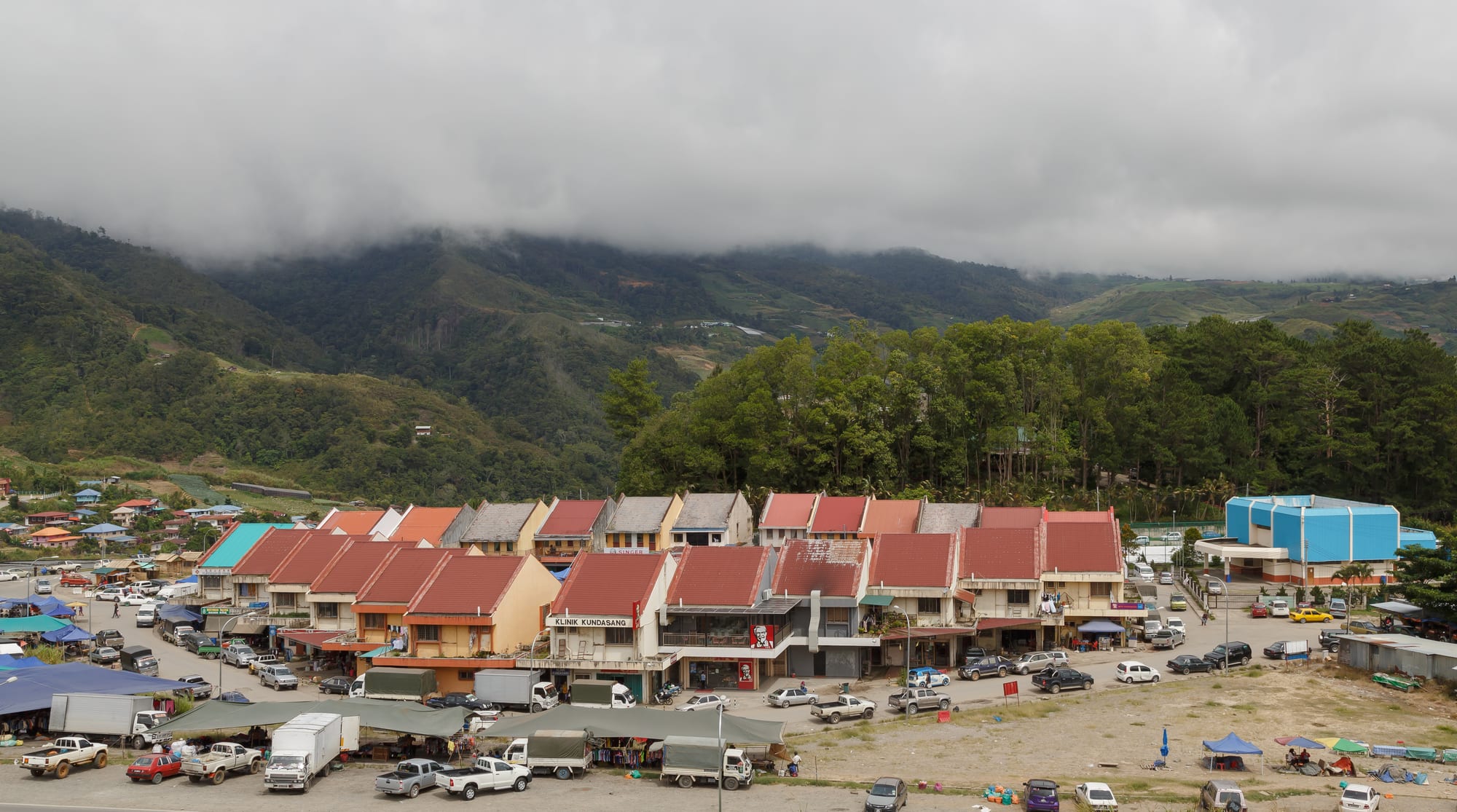
A row of red-roofed shophouses along a road in Kundasang, with parked pick-up trucks, market awnings and cloud lying on the green hills behind

Sabah, Malaysia

Kundasang

The shophouse row and roadside market stalls of Kundasang, in the hills of Sabah's Ranau district. (CEphoto, Uwe Aranas / Wikimedia Commons · CC BY-SA 3.0)

A highland town in Sabah's Ranau district, strung along the road below Mount Kinabalu at nearly 1,900 metres, the highest settlement in Malaysia. Cool air and volcanic soil made it a vegetable-growing district, and its roadside market sells the produce; the headquarters of Kinabalu Park, a wartime memorial garden and views of the mountain bring most visitors.

Neighbourhoods

  • The town and the market strip
    • First-time visitors
    • Markets
    • Best for food

    Kundasang is essentially one road: a row of shophouses with a clinic, banks and coffee shops, and beside it the long line of stalls selling vegetables, fruit and honey. Buses and shared vans stop here, and the view down the valley opens between the buildings.

    Open in Maps
  • Kinabalu Park headquarters
    • Walks and trails
    • Quiet and residential

    About six kilometres west along the main road, at the park gate, with an information centre, botanical trails and accommodation inside the park boundary. Climbers register here, and day visitors walk the forest paths around it.

    Open in Maps
  • Mesilau and the farm roads
    • Views
    • Quiet and residential

    Side roads climb north-east from the town past terraced vegetable plots, dairy pasture and scattered guesthouses towards the foot of the mountain. This is where most of the resorts and hillside cabins with mountain views are, reached by steep, narrow lanes.

    Open in Maps
  • Ranau
    • Local life
    • Transport connections

    The district's main town, lower and warmer, about fifteen kilometres east. It has the larger shops, a weekly tamu market, the hospital and the bus connections, and serves as the practical centre for the highland villages above it.

    Open in Maps

Things to do

The mountain and the park

  • Mount Kinabalulandmark

    The granite massif that rises to about 4,095 metres above the town, climbed over two days with a licensed guide and a booked bed on the mountain; the number of climbing permits issued each day is limited.

    Open in Maps
  • Kinabalu Parkpark

    A UNESCO World Heritage Site surrounding the mountain, protecting forest that runs from lowland rainforest to alpine scrub, with orchids, pitcher plants and marked trails from the headquarters.

    Open in Maps
  • Poring Hot Springsattraction

    Sulphur hot springs in lowland forest about 40 kilometres from the park headquarters, in the lower country of the Ranau district, with a canopy walkway strung high between tall menggaris trees, an orchid centre and a butterfly farm.

    Open in Maps

History and views

  • Kundasang War Memoriallandmark

    Opened in 1962, a memorial to the 2,428 Australian and British prisoners who died at the Sandakan camp and on the death marches to Ranau, and to the suffering of Sabah's own people, laid out as linked walled gardens below the mountain.

    Open in Maps
  • Kundasang Vegetable Marketmarket

    The long line of grower-run stalls along the main road, selling highland vegetables, strawberries, fruit and forest honey, and the busiest place in town most mornings.

    Open in Maps

Short trips from the town

  • Ranauattraction

    The district town east of Kundasang, with a tamu market, the Sabah tea country north of it and the road on towards Sandakan.

    Open in Maps

Seasonal events

  • KaamatanMay

    The Kadazan-Dusun harvest festival, celebrated through May in villages across the highlands with ceremonies, dancing, rice wine and a public holiday at the end of the month.

  • ClimbathonOctober

    An international skyrunning race up and down Kinabalu, held inside the park each October and first run in 1987.

Eat and drink

Long-standing places and food districts in Kundasang. Hours, ratings and directions come from your maps app, always current.

Kundasang classics

  • The roadside vegetable marketmarket

    Stalls along the main road heaped with highland cabbage, carrots, leeks, tomatoes, strawberries, wild honey and packets of dried mushrooms, sold by the growers and their families.

    Open in Maps
  • Town centre coffee shopsneighborhood

    Simple kopitiam and Malay eating houses in the shophouse row, serving noodle soups, fried rice, roti and sweet hot coffee — welcome in the cool air.

    Open in Maps

Dairy and highland produce

  • Desa Dairy Farm and the hill pasturesneighborhood

    The pasture on the slopes above the town supports Sabah's fresh-milk industry, the Desa Dairy Farm among it, and shops and cafés in the area sell milk, yoghurt, soft ice cream and cheese made from it.

    Open in Maps

Experience Kundasang

History

The slopes below Kinabalu were settled long before anyone drew a road there. Dusun villages farmed rice, fruit and buffalo on the ridges, and the mountain itself was regarded as the resting place of the dead, approached with ceremony rather than sport. In March 1851 the colonial administrator and naturalist Hugh Low, guided by the Dusun Lemaing of Kampung Kiau, made the first recorded ascent of the summit plateau, though the highest point was not reached until 1888, by the zoologist John Whitehead; Low's name is carried by the peak and the gully. British North Borneo Chartered Company officials later used the highlands for their cooler air and experimented with temperate crops.

The war brought Kundasang its darkest association. Ranau, just down the valley, was the destination of the death marches of 1945, when prisoners of war were forced from Sandakan across the mountains; almost none survived, and villagers who helped them risked execution. After the war an Australian officer promoted the idea of a memorial garden at Kundasang, opened in 1962, and the marches are commemorated there and at Ranau each year.

Kinabalu Park was gazetted in 1964, protecting the mountain and its forests and opening it to guided climbing; it became Malaysia's first UNESCO World Heritage Site in 2000. Alongside the park, commercial vegetable growing spread across the cleared hillsides from the 1960s and 1970s, and dairy cattle were introduced to the pastures above the town. The road up from Kota Kinabalu turned Kundasang into the service village for all three: farms, park and memorial.

Culture & Customs

Kundasang is Kadazan-Dusun country. The language is heard in the market alongside Sabah Malay, and the district is split almost evenly between Muslim and Christian families, so mosque and church both anchor village life. Kaamatan, the harvest festival that runs through May, is the great event of the year, with thanksgiving ceremonies for the rice spirit, the sumazau dance to gongs, and homemade rice wine offered to visitors; the highland villages keep the older forms of it more closely than the towns do.

Mount Kinabalu stands at the centre of local belief. Its name is commonly explained as coming from Aki Nabalu, the revered place of the dead, and ceremonies of respect have long accompanied ascents; mountain guides, most of them local men and women from villages around Kundasang, treat the climb as work carrying obligations as well as wages.

Everyday manners are gentle and informal. Bargaining at the vegetable stalls is mild, hospitality is warm, and visitors are expected to accept at least a little of what is offered. The memorial garden gives the town a second, quieter identity: Australian families come to it in numbers each year, and the relationship between those visitors and the villages whose grandparents helped the prisoners is remembered locally with pride.

Daily Life

Kundasang itself is a small town of a few thousand people, part of the Ranau district, which has roughly 90,000 residents spread through the surrounding valleys. Work is farming above all: terraced plots of cabbage, carrot, leek, tomato and chilli worked by family smallholdings, strawberry and flower nurseries, and the dairy pastures on the higher slopes that supply fresh milk across Sabah. Lorries take produce down to Kota Kinabalu overnight, and much of it returns as the vegetables sold in city markets.

The second economy is the mountain. Guides, porters, drivers, cooks and guesthouse staff live in the villages around the park gate, and a season of poor weather or a drop in climbing permits is felt quickly in household incomes. Tourism has also raised land prices and filled the ridges with resorts and hillside cabins, and the clearing of slopes for vegetables and building has brought erosion and landslip worries.

Daily rhythm starts early and cold: the market sets up at first light, school runs follow, and the afternoon usually brings cloud and rain. Evenings are quiet and the town is largely shut by mid-evening. Water supply, road maintenance and the condition of the highway down to the coast are the standing local complaints, along with the price farmers get for a crop that has to travel.

Food

Kundasang's food is defined by what grows in the cool air. Highland cabbage, carrots, leeks, broccoli, spring onions, tomatoes and chillies are piled at the roadside stalls, along with strawberries, passion fruit and jars of forest honey, and the same vegetables turn up in the local kitchens — stir-fried with garlic, or simmered in the clear soups that suit the climate. Sayur manis, the sweet leaf of Sabah, is everywhere, and highland ginger goes into tea.

Dairy is the other local product. The pastures above the town supply fresh milk, and cafés sell it warm, as yoghurt, or as soft ice cream, an unusual thing in Malaysia and a standard stop for visitors from the coast. Corn on the cob grilled at the roadside and roast sweet potato are the cold-weather snacks.

Kadazan-Dusun cooking appears at home and at festivals more than in restaurants: hinava, raw fish cured in lime with ginger, chilli and shallot; pinasakan, fish braised with sour fruit and turmeric; linopot, rice mixed with tapioca or yam and wrapped in a leaf; and bambangan, the sour wild mango, pickled as a relish. Tapai, the fermented rice wine, and its stronger distilled relative are poured at Kaamatan. In the shophouses the everyday options are Chinese and Malay: noodle soups, ngiu chap with sliced beef and tripe, fried rice, roti canai and strong sweetened coffee.

Planning tools

Budget

Rooms and food cost little in the town itself, where guesthouses and homestays are the norm. The expense is the mountain: the Kinabalu climb requires a permit, a licensed guide and a booked bed on the mountain, all bought together, and park entry and transport add to it. Hillside resorts with mountain views charge considerably more than the town.

Daily Budget Midrange
USD 85–200 (hillside resort or park lodge, guided walks, a hired car or driver, a share of climb costs)
Daily Budget Shoestring
USD 25–45 (homestay or hostel, market food and coffee shops, shared vans, park entry)

Book the Kinabalu climb months ahead, as daily places are limited, and bring a warm layer even if the coast was hot.

Best Time to Visit

March to September is generally drier and gives the best chance of a clear summit view, and mornings are the most reliable time for it in any month. Rain increases from about October to January. The mountain is cold and exposed all year, and cloud can close in at any season.

Suggested Number of Days

A day or two covers the town, the market, the memorial and a walk in the park. Climbing the mountain adds two days with a night on it, and the lower valleys and hot springs are worth another. Weather can hold plans up.

First Visit
1–2 days
With Surroundings
3–4 days

Transportation

The town strings along the main road between Kota Kinabalu and Ranau, and minibuses and shared vans use it, dropping passengers on request. Within the town everything is within walking distance of the market, but the farms, resorts and park gate are spread along steep side roads, so most visitors hire a car with a driver or take taxis arranged by their accommodation.

Agree a price for a taxi or driver in advance, and treat the steep side lanes with care in the rain and mist.

Airport & Station Connections

Kota Kinabalu is about 90 kilometres west by road, a climb of roughly two hours through the Crocker Range, and its international airport is the usual point of arrival in Sabah. Minibuses and shared vans run from the city, and buses between Kota Kinabalu and Sandakan or Ranau pass through. Travellers arriving in Sabah from Peninsular Malaysia pass a state immigration check and receive a separate entry stamp.

Walkability

The market strip and shophouse row are walkable end to end in a few minutes, but the road is busy with lorries and has little pavement. Beyond it, everything climbs: farm lanes and resort driveways are steep, and distances between the town, the park gate and the memorial are too far to walk comfortably. Trails inside the park are the pleasant walking here.

Safety

This is one of the calmer parts of Sabah, and crime is not a common problem. The risks are the mountain and the weather: cold, wind and altitude on Kinabalu, where climbs are made only with a licensed guide, slippery trails in the rain, mist on steep narrow roads, and landslips after heavy downpours.

Climb only with a licensed guide and turn back if conditions worsen, carry warm and waterproof clothing, and drive the hill roads slowly in mist. The UK government advises against all but essential travel to all islands and dive sites off the coast of eastern Sabah, from Sandakan to Tawau, because of the threat of kidnapping; mainland Sabah is not included in that warning. Check current official travel advice before travelling.

Climate

At nearly 1,900 metres the climate is cool and damp rather than tropical. Days are mild, nights are cold by Malaysian standards, cloud often fills the valley by afternoon, and rain falls in most months. The summit area of the mountain can approach freezing before dawn.

Summer
mild and often clear in the morning, roughly 15–25°C, with cloud and showers building in the afternoon
Winter
similar temperatures but wetter from October to January, around 14–23°C, with cold nights and frequent mist

Local Customs

The highlands are mainly Kadazan-Dusun, with Muslim and Christian families in roughly equal numbers, so both Friday prayers and Sunday services empty the shops for a while. Greetings are informal and unhurried. Shoes come off when entering a house, modest dress is normal, and rice wine is offered at celebrations in non-Muslim households, above all during the Kaamatan season in May.

Ask before photographing farm workers or market sellers, treat Mount Kinabalu with respect as a place of spiritual importance to Kadazan-Dusun people, and stay on marked trails in the park.

Common Payment Methods

The currency is the Malaysian ringgit. Market stalls, minibuses, small guesthouses and roadside stalls are cash businesses, while resorts and larger shops take cards and QR payment. There are a few ATMs in the town and more in Ranau, so it is wise to arrive with cash.