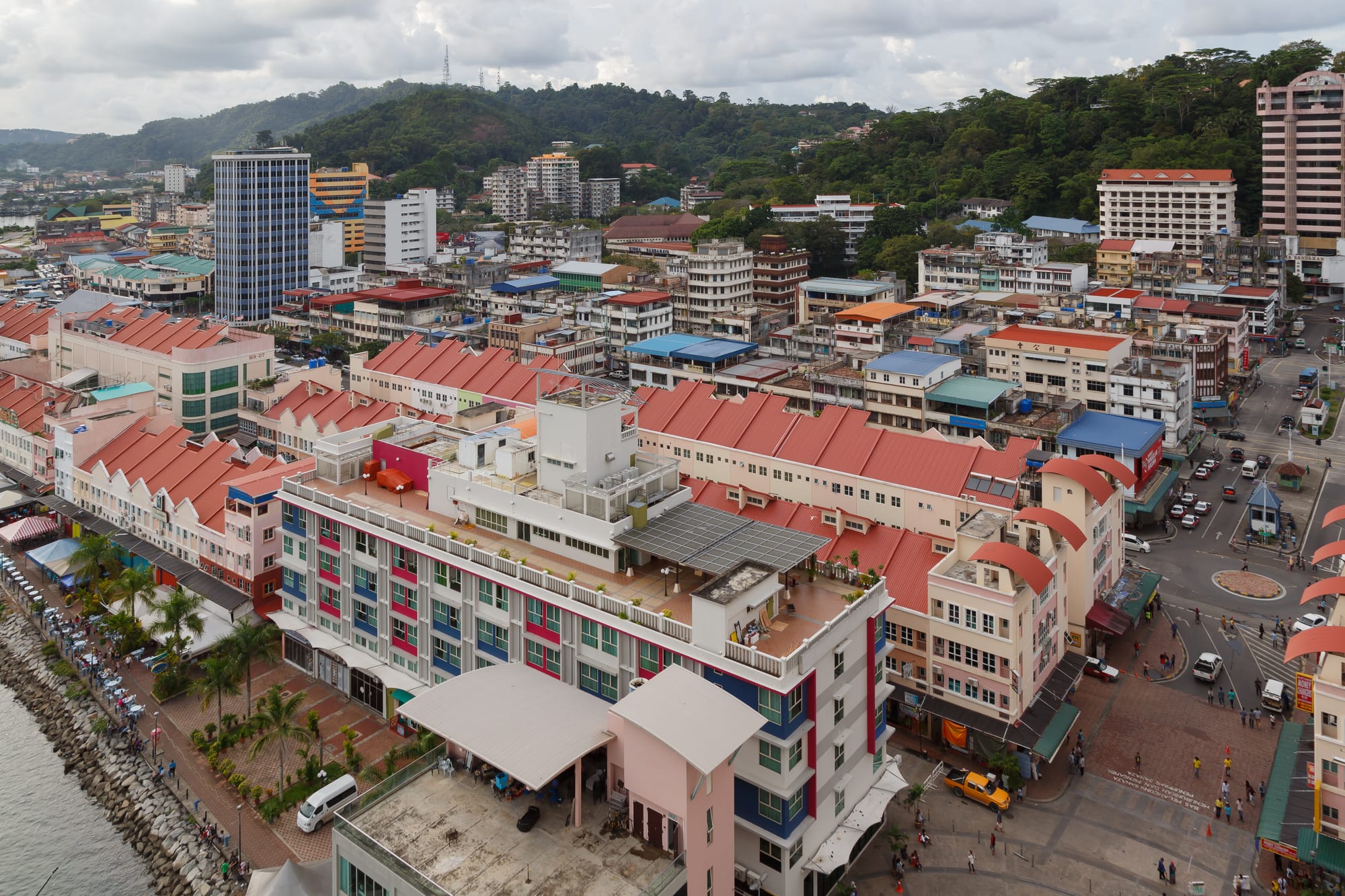
Red-roofed shophouses and low blocks along Sandakan's waterfront, with taller buildings and forested hills rising behind the town

Sabah, Malaysia

Sandakan

The centre of Sandakan seen from above the waterfront, with the forested ridge behind the town. (CEphoto, Uwe Aranas / Wikimedia Commons · CC BY-SA 4.0)

A port city on the east coast of Sabah, on a deep natural harbour facing the Sulu Sea. Founded as a trading settlement in the 1870s, it was the capital of British North Borneo until the Second World War destroyed it, and rebuilt afterwards as a timber and palm-oil port. Today it is best known as the base for Sepilok, the Kinabatangan and the Turtle Islands.

Neighbourhoods

  • Town centre and the waterfront
    • First-time visitors
    • Best for food
    • Historic district

    A grid of post-war shophouses between the harbour and the ridge, with the central market, the fish market, banks, hotels and coffee shops within a few blocks. A set of steps known as the Sandakan Heritage Trail climbs the hillside past colonial-era buildings to viewpoints over the bay.

    Open in Maps
  • Buli Sim Sim
    • Local life
    • Waterfront

    The stilt village at the eastern end of the bay, where the settlement began — wooden houses and walkways built over the water, linked by boardwalks, with a mosque and small jetties. Boats leave from here for the islands in the bay.

    Open in Maps
  • Sepilok
    • Wildlife
    • Quiet and residential

    A forest area about 20 kilometres west of the town, off the road to Kota Kinabalu, where the orangutan centre and the sun bear centre stand side by side in the Kabili-Sepilok Forest Reserve. Lodges and guesthouses here are set among trees rather than streets, and many visitors stay out here rather than in town.

    Open in Maps
  • Bandar Indah and the Mile suburbs
    • Best for food
    • Nightlife

    Sandakan's addresses are still counted in miles out along the main road, and the newer commercial districts sit along it. Bandar Indah, at Mile 4, is a block of shophouses known for seafood restaurants and late-night coffee shops.

    Open in Maps

Things to do

Wildlife centres

  • Sepilok Orangutan Rehabilitation Centreattraction

    A rehabilitation centre opened in 1964, the first official project of its kind, set in a forest reserve west of town, where orphaned and rescued orangutans are taught to live in the wild and are watched at feeding platforms.

    Open in Maps
  • Bornean Sun Bear Conservation Centreattraction

    Next door to the orangutan centre, a rescue centre for the world's smallest bear, with walkways over forest enclosures.

    Open in Maps

History and landmarks

  • Sandakan Memorial Parklandmark

    The site of the prisoner-of-war camp from which the death marches to Ranau began in 1945, now a quiet garden with rusted machinery and a small memorial pavilion.

    Open in Maps
  • Agnes Keith Housemuseum

    A restored colonial wooden house on the ridge above town, home of the American writer Agnes Newton Keith, who described North Borneo and her internment in 'Land Below the Wind' and 'Three Came Home'.

    Open in Maps
  • St Michael's and All Angels' Churchlandmark

    The oldest stone church in Sabah, its foundation stone laid in 1893 and the building finished decades later; Japanese forces dynamited it in 1945, but the shell stood and it was rebuilt after the war.

    Open in Maps
  • Puu Jih Shih Templelandmark

    A large Buddhist temple on a hilltop at Tanah Merah, with red columns, gilded statues and a wide view over the bay.

    Open in Maps
  • Sandakan Airporttransit hub

    The town's airport north-west of the centre, built on the site of the airfield that prisoners of war were forced to construct during the occupation.

    Open in Maps
  • Berhala Islandattraction

    A small island in Sandakan Bay with sandstone cliffs and a beach, used in turn as a leper colony and a wartime prison camp, and now reached by short boat trips.

    Open in Maps

Short trips from the city

  • Turtle Islands Parkpark

    Three small islands in the Sulu Sea north of Sandakan where green and hawksbill turtles come ashore to nest; visitor numbers on Selingan are limited and trips are arranged through licensed operators.

    Open in Maps
  • Kinabatangan Riverattraction

    Sabah's longest river, whose lower reaches near Sukau and Bilit hold forest full of proboscis monkeys, hornbills, orangutans and pygmy elephants, visited by boat from riverside lodges.

    Open in Maps
  • Tabin Wildlife Reservepark

    A large reserve of lowland forest on the Dent Peninsula east of Lahad Datu, a long journey south of Sandakan, known for elephants, mud volcanoes that draw animals to the salt, and night drives.

    Open in Maps
  • Gomantong Cavesattraction

    Limestone caves inland from the coast where swiftlet nests are harvested on rattan ladders, with a vast bat population and a floor of cockroaches.

    Open in Maps

Eat and drink

Long-standing places and food districts in Sandakan. Hours, ratings and directions come from your maps app, always current.

Sandakan classics

  • Sandakan Central Marketmarket

    The waterfront market building, with a fish hall downstairs and hawker stalls above serving noodles, rice dishes and coffee to the morning crowd.

    Open in Maps
  • Sim Sim seafood housesneighborhood

    Wooden restaurants on stilts out along the water village's boardwalks, where fish, prawns and crab are cooked to order above the bay.

    Open in Maps

Food districts

  • Bandar Indah, Mile 4neighborhood

    The suburb's grid of shophouses, lined with seafood restaurants, barbecue stalls and coffee shops that stay busy into the night.

    Open in Maps
  • Harbour Square and the town centre coffee shopsneighborhood

    Kopitiam after kopitiam around the central streets, serving kopi, kaya toast, noodles and the town's egg tarts, with seating spilling onto the pavement.

    Open in Maps

Experience Sandakan

History

Sandakan grew from a natural harbour that Sulu traders had long used to export beeswax, birds' nests, camphor and rattan from the forests behind it. An earlier settlement in the bay, founded in the 1870s by the Scottish arms smuggler William Clark Cowie, burned down in 1879, and that June William Pryer moved the administration to a new site near Buli Sim Sim, which the British North Borneo Company built up as a town. It became the capital of British North Borneo, and for decades the hinterland's timber and tobacco made it one of the busiest small ports in the region.

The war ended that town. Japanese forces occupied Sandakan in 1942 and built an airfield with prisoner labour, holding Australian and British prisoners at a camp outside the town. In 1945 those prisoners were forced to march inland to Ranau, across some 260 kilometres of mountain country. In all 2,434 Allied prisoners died at Sandakan, on the marches or at Ranau, and of the men held at the two camps only six Australians survived, all of them escapers. Allied bombing left the town in ruins, and when North Borneo became a British crown colony in 1946 the capital moved west to Jesselton, now Kota Kinabalu.

Sandakan was rebuilt in plain concrete shophouses and returned to the export trade, first timber, then palm oil, cocoa and fish. The felling of the lowland forests that made its fortune also cost it the resource, and wildlife tourism grew as a second economy. The town today is Sabah's second city, a working port that most visitors treat as a gateway to the forest and the coast.

Culture & Customs

Sandakan's population is an east-coast mixture. Chinese families, many of Cantonese and Hakka descent, run much of the commerce and maintain temples, clan associations and Chinese-medium schools; Malay, Bajau and Suluk communities live around the bay and in the water villages; Kadazan-Dusun and other Indigenous Sabahans have moved in from the interior; and long-established Filipino and Indonesian communities give the town a strong link to the Sulu Sea beyond the border. Mosques, churches and Chinese temples stand within a short distance of one another, and the calendar carries Ramadan and Hari Raya, Christmas, Chinese New Year and the Kaamatan harvest festival in May.

The war is part of local identity in a way it is not elsewhere in Malaysia. Australian visitors come to the Memorial Park each year, and the story of the marches is taught and commemorated rather than left to history books. Agnes Newton Keith's books, written from the same hillside, keep the pre-war town in print.

Manners are Sabahan: informal, unhurried, and conducted in a mix of Sabah Malay, Hakka, Cantonese, Suluk and English. Conversation and business alike happen over coffee in a kopitiam, and the morning market is as much a social round as a shopping trip. Conservation work has given the town a local vocabulary of its own, and many families have a member employed at a reserve, a lodge or a plantation.

Daily Life

About 440,000 people lived in the Sandakan municipal area at the 2020 census, with the town itself holding a good share of them along the bay and out past the mile markers. The port handles palm oil, timber products and fish; oil-palm estates cover much of the countryside inland; and tourism, government offices, schools and hospitals provide the rest of the work. Fishing remains a large employer, and the fleet unloads in front of the market at first light.

Housing runs from the shophouses and flats of the centre to suburban estates along the road west and the stilt villages over the water at Buli Sim Sim and Sim Sim, where walkways rather than streets connect the houses. Life in those villages is closely tied to the sea, and questions of documentation and statelessness among families with roots in the southern Philippines are a long-running local issue, as they are across eastern Sabah.

The day begins early — the market before dawn, school runs and offices by half past seven — and slows in the heat of the afternoon, picking up again in the evening when the seafood restaurants and coffee shops at Mile 4 fill. Rain shapes plans in the last months of the year, when flooding along the Kinabatangan can cut roads. Palm-oil prices, the state of the port and the future of the surrounding forest are the recurring subjects of local debate.

Food

Sandakan is a seafood town. Boats land fish, prawns, squid, crab and shellfish daily, and the standard meal is steamed fish with ginger and spring onion, butter prawns, or crab cooked with chilli or salted egg, eaten in a noisy open-fronted restaurant with rice and stir-fried vegetables. Sayur manis, the sweet leaf that grows all over Sabah, is fried with garlic on almost every table. The stilt restaurants at Sim Sim and the shophouse rows at Bandar Indah are where most of this eating happens.

Chinese cooking dominates the everyday menu. Breakfast is kopi and kaya toast, or a bowl of noodles: wonton or beef noodles, Sabah's own ngiu chap of sliced beef, tripe and meatballs in a clear broth, or Tuaran mee, fried egg noodles from the west coast. Sandakan is also known across Sabah for its egg tarts, sold from bakeries and coffee shops in the centre, and for cakes and biscuits made for Chinese New Year.

Malay, Bajau and Suluk kitchens add grilled fish with sambal, rice cooked in coconut milk, and cassava eaten with seafood in the coastal villages. Kadazan-Dusun dishes reach the town as well — hinava, raw fish cured in lime juice with ginger, chilli and shallot, and pinasakan, fish braised with a sour fruit and turmeric. Tropical fruit from the interior is sold at the central market: durian, langsat, rambutan and the sour wild mango called bambangan, which is pickled and eaten as a relish.

Planning tools

Budget

The town itself is cheap — market meals, kopitiam breakfasts and simple hotels cost little. What raises the bill is the wildlife: lodges at Sepilok and on the Kinabatangan, boat trips, park entry and the overnight trip to the Turtle Islands are usually bought as packages, and the flight from Kota Kinabalu is far easier than the long road journey.

Daily Budget Midrange
USD 85–200 (hotel or forest lodge, guided river and wildlife trips, domestic flights)
Daily Budget Shoestring
USD 25–45 (guesthouse, market and hawker food, town minibuses, entry to one wildlife centre)

Compare Kinabatangan and Turtle Islands packages before booking, and note that places on Selingan Island are limited and go early.

Best Time to Visit

March to September is generally the driest stretch and the easiest for river trips, when lower water on the Kinabatangan brings animals to the banks. Turtles nest on the Turtle Islands in every month, with more of them between about July and October. Rain is heaviest from October to January, when the east-coast rivers can flood.

Suggested Number of Days

Two or three days cover the town and the wildlife centres just outside it. Four to six allow a river or island stay as well, since those are usually sold with at least one night away from the town. Wet weather and boat schedules can stretch any of it.

First Visit
2–3 days
With Surroundings
4–6 days

Transportation

The town centre is small enough to cross on foot, and everything else runs along the road west, measured in miles from the harbour. Minibuses and shared vans leave from the central terminal for Sepilok and the outer suburbs, taxis wait at the market and hotels, and ride-hailing works patchily. Lodges on the Kinabatangan and at Sepilok almost always include transfers, and boats to the islands leave from the harbour jetties.

Fix a taxi price before setting off, and let a river or island lodge arrange the transfer rather than piecing the journey together.

Airport & Station Connections

Sandakan Airport lies a short drive west of the centre, with several flights a day to Kota Kinabalu, taking under an hour, and links to Kuala Lumpur. Buses from Kota Kinabalu cross the state in roughly six to eight hours, and buses also run from Tawau and Lahad Datu. Passengers arriving in Sabah from Peninsular Malaysia pass a state immigration check and receive a separate entry stamp.

Walkability

The grid between the harbour and the hillside is compact and flat, and the market, waterfront and older shophouse streets are an easy walk from most town hotels. The heritage steps up the ridge are steep and hot. Beyond the centre there is little provision for walking along the main road, so the wildlife centres and the outer suburbs mean a minibus or taxi.

Safety

The town itself is ordinarily safe, with petty theft the usual concern. The wider issue on this coast is security at sea: the waters and islands off eastern Sabah lie inside a special security zone, set up in 2013 and overseen by a dedicated security command. Boat trips are run by licensed operators under those rules. Heat, strong sun and river and sea currents are the everyday risks.

Use licensed operators for boat and river trips, keep valuables out of sight in the market crowds, and follow local security instructions. The UK government advises against all but essential travel to all islands and dive sites off the coast of eastern Sabah, from Sandakan to Tawau, because of the threat of kidnapping; mainland Sabah is not included in that warning. Check current official travel advice before travelling.

Climate

Hot, humid and wet in every month, close to the equator and sheltered from typhoons. Mornings are often bright and rain falls in heavy afternoon bursts. The wettest period runs from about October to January.

Summer
hot and humid, generally 23–32°C, with afternoon showers and high humidity all day
Winter
similar temperatures, 23–31°C, but wetter from October to January, when rivers can flood

Local Customs

Sandakan mixes Chinese, Malay, Bajau, Suluk and Kadazan-Dusun communities, and the town is used to visitors. Tipping is not expected, though small change is appreciated for guides and drivers. Modest dress is normal away from resorts, and shoes come off at the door of a home, a mosque or a temple. Alcohol is sold in Chinese restaurants, coffee shops and supermarkets but not in Muslim eating places.

Ask before photographing people in the water villages or at the mosque, keep a respectful quiet at the Memorial Park, and follow the no-touching and no-flash rules at the wildlife centres.

Common Payment Methods

The currency is the Malaysian ringgit. Cards work in hotels, supermarkets and larger restaurants, and QR payment is common, but markets, minibuses, small coffee shops and boatmen want cash. ATMs are easy to find in the town centre and rare at Sepilok and along the Kinabatangan, so cash is best drawn before leaving town.