Attractions & Natural Wonders · Azerbaijan
Why does a hillside in Azerbaijan burn without ever going out?
Yanar Dag burns on a steady leak of natural gas from beneath the Absheron Peninsula, though nobody knows for certain how long it has been alight.
By Globeway Editorial · 2 November 2026
The short answer
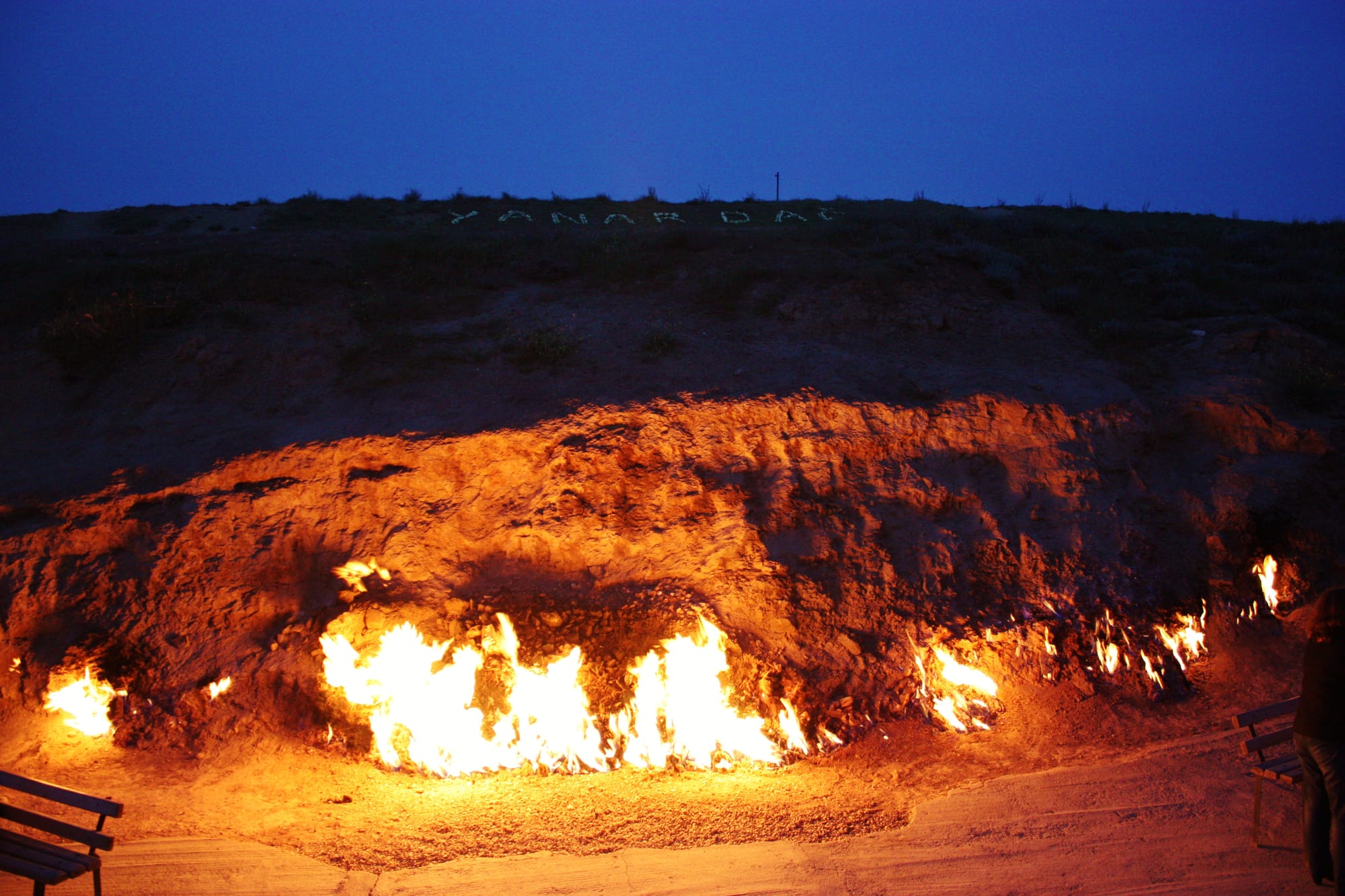
Yanar Dag, whose name means "burning mountain", is a strip of flame along the foot of a low hillside on the Absheron Peninsula, the finger of land around Baku that juts into the Caspian Sea. It burns because natural gas is leaking steadily out of the ground there, seeping up along a geological fault and escaping through a thin, porous layer of sandstone. Once lit, the gas keeps burning for as long as it keeps flowing, and so far it has never stopped.
How long it has been burning is another matter. Some say the fire has burned for 4,000 years, but according to other local accounts it was only discovered in the 1950s, when a shepherd accidentally set it alight. Neither claim can be proved. What is certain is that natural gas fires like this one have flared across the Absheron Peninsula for as long as people have written about it, which is why Azerbaijan calls itself the Land of Fire.
A leak along a fault
Natural gas is a fossil fuel made mostly of methane, formed from the remains of ancient organisms buried in the rock. Beneath the Absheron Peninsula there is a great deal of it. Usually it stays trapped underground, but where the rock is cracked, some finds its way up to the surface.
At Yanar Dag that crack is a fault scarp, a small step in the land where two blocks of rock have shifted against each other. The Geological Survey of Azerbaijan describes it as about 200 metres long and 2 to 4 metres high, with intense flames running for 15 metres along its base. Other descriptions put the flames at up to 3 metres tall along a 10-metre stretch. Geologists who measured gas leaking from the soil found the strongest flow at the top of the scarp, right where the flames come from, and concluded that gas is probably escaping all along the fault, well beyond the burning section. The fault is thought to be part of a larger underground structure known as the Balakhany-Fatmai formation.
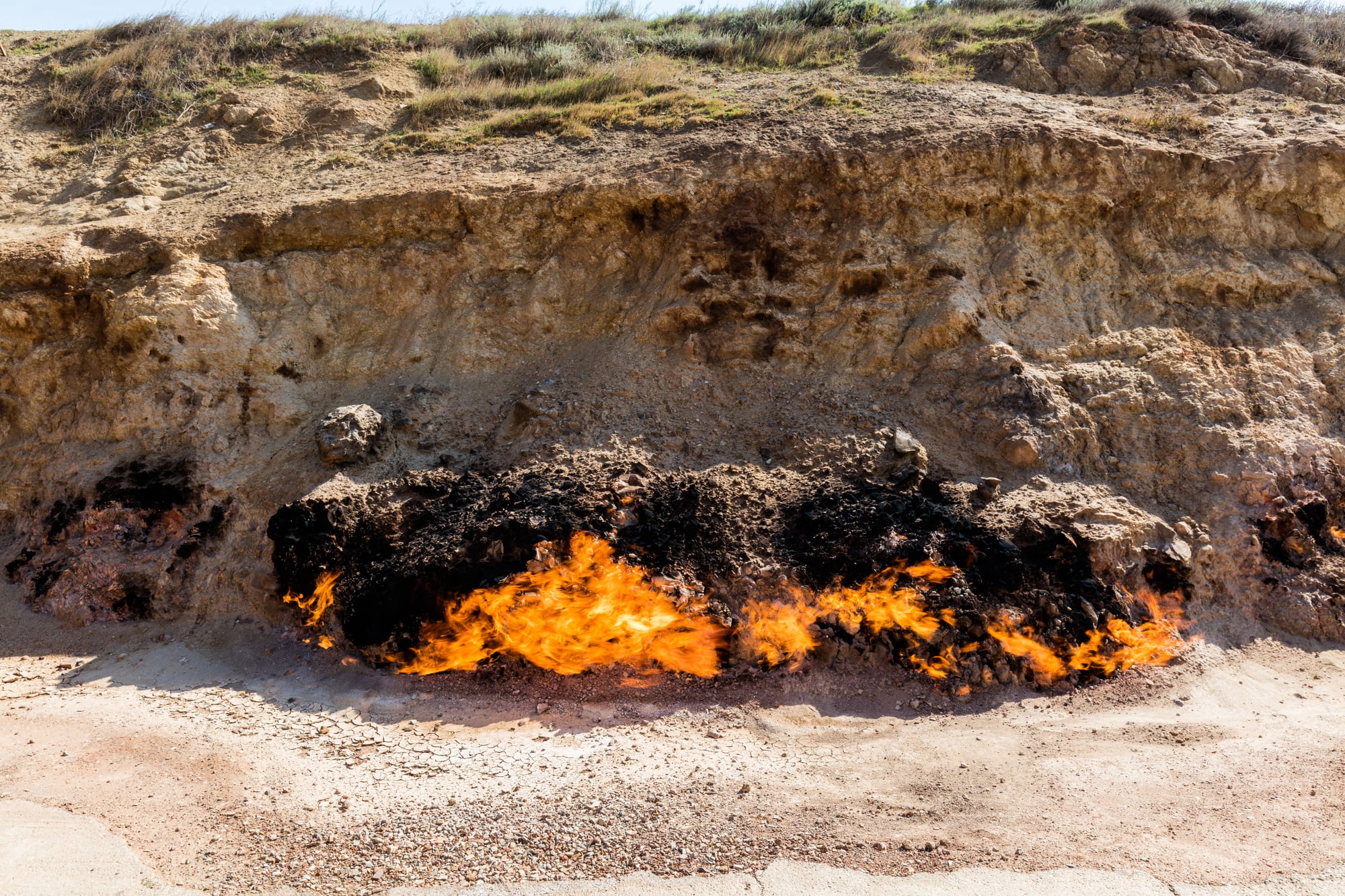
The rock around the vents has been scorched black by the constant heat.
Because the gas seeps out continuously, the fire burns day and night. Unlike the nearby mud volcanoes of Lokbatan and Gobustan, Yanar Dag gives off no mud or water, only gas.
A land of mud volcanoes and gas
Yanar Dag is one sign of an unusually gassy corner of the world. Azerbaijan and its Caspian coast are home to nearly 400 mud volcanoes, more than half of all those found on land worldwide. These are mounds built by mud, water and gas forced up from deep underground, and the gas they release is mostly methane. Some in Azerbaijan stand more than 200 metres high, and large eruptions can throw up flames on a similar scale. In July 2021 an eruption on Dashli Island in the Caspian Sea produced a fireball visible from Baku, 74 kilometres away.
The same geology made the region an early oil centre. A 1593 inscription at Balakhani records a hand-dug oil well 35 metres deep, and the German traveller Engelbert Kaempfer, who visited in 1683, described a "flaming steppe" near Baku, where some cracks in the ground blazed with large flames and others with small ones. Today the oil and gas beneath the peninsula and the Caspian are the foundation of Azerbaijan's economy.
Fire temples and fire worship
Long before anyone drilled for gas, people treated these flames as sacred. Zoroastrianism, the ancient religion of Iran, was practised in the region from the first millennium BCE or earlier, and for its followers fire is the most important symbol of purity. Zoroastrians do not see themselves as fire worshippers; they regard fire as a connection to God, a symbol of truth that helps them focus their thoughts on Ahura Mazda, their supreme God. The very name Azerbaijan is traced to Atropates, a Persian governor in the time of Alexander the Great, whose name is thought to mean "protected by the holy fire".
The best-known shrine is the Ateshgah, the fire temple at Surakhany on the outskirts of Baku. Kaempfer recorded "seven holes with eternal fires" there. The present pentagonal complex, with monks' cells around a courtyard and an altar in the middle, was built in the 17th and 18th centuries and became a place of pilgrimage for worshippers from the northwestern Indian subcontinent, who traded with the Caspian region. It was abandoned in the late 19th century, as the Indian community declined and petroleum plants were built nearby.
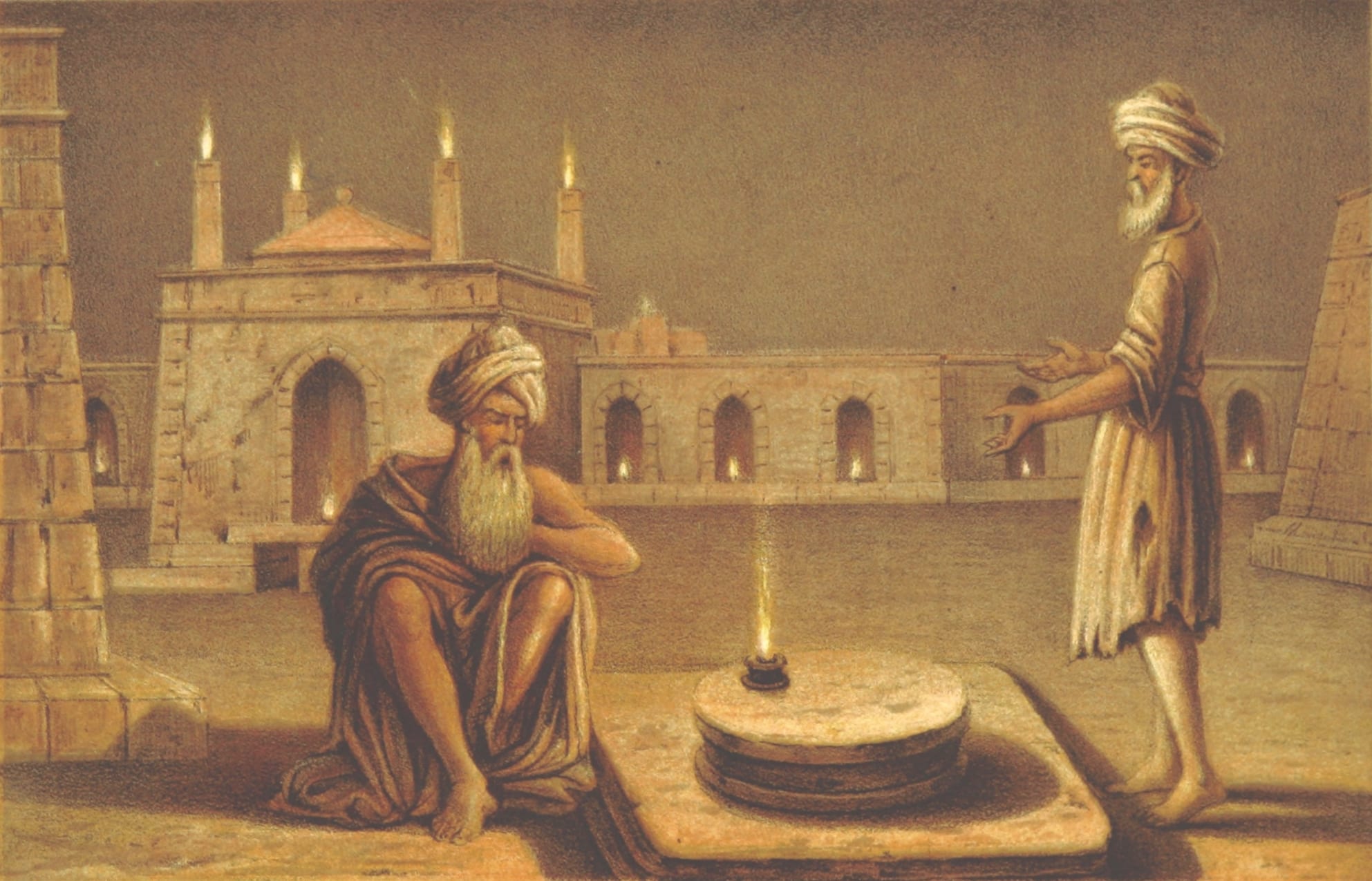
Natural gas once rose through the ground beneath the temple, feeding its flames without any pipe.
When an eternal flame goes out
The Ateshgah shows that these fires are not truly eternal. Its natural flame was fed by gas seeping up from a natural gas field directly beneath the site, but after nearly a century of oil and gas extraction in the area, the flow failed, and in 1969 the flame went out. The temple became a museum in 1975, and the fire visitors see there today comes from a gas main.
That makes Yanar Dag rare. Natural fires were once common in Azerbaijan; only a few remain, and Yanar Dag is the most notable one still burning on its own gas. Fires like it elsewhere in the world have been lit by lightning or by people, and some have burned for hundreds or even thousands of years. Whether Yanar Dag is one of the ancient ones, or a mid-20th-century accident that has simply never been put out, no one can say for certain.
Seeing the fire today
Yanar Dag lies at the village of Mammadli in the Absheron District, near Baku. In 2007 it became the Yanardag State Historical, Cultural and Natural Reserve, run by the State Tourism Agency, covering 64.55 hectares. After renovation between 2017 and 2019, the site gained a museum, an exhibition of ancient standing stones and a 500-seat open-air amphitheatre for concerts, and the reserve also includes ancient burial mounds and graves. The flames burn in all seasons, but they are most striking after dark, when they light up the whole slope.