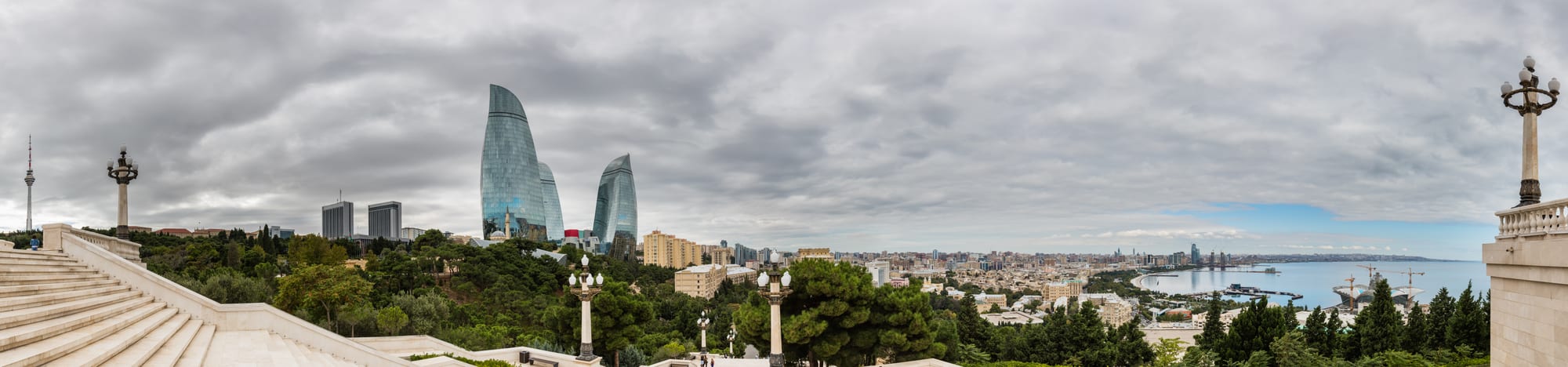
A wide panorama of Baku, low stone Old City walls in the foreground giving way to modern towers and the three curved Flame Towers

Azerbaijan

Baku, where the walled medieval Old City sits below the Flame Towers and a skyline built on Caspian oil and gas. (Diego Delso / Wikimedia Commons · CC BY-SA 4.0)

An oil-rich republic on the Caspian Sea where a Turkic, mostly Muslim but strongly secular society meets a landscape of mud volcanoes, ancient fire, and Caucasus peaks.

Explore Azerbaijan

History

The land was Zoroastrian before it was Muslim — the name is often linked to fire, and natural gas seeps have burned on its hillsides for millennia. It was ruled from Persia for long stretches, with local dynasties such as the Shirvanshahs, whose palace still stands in Baku's Old City. In the early nineteenth century the Russian Empire absorbed the northern khanates, splitting historic Azerbaijan along a line that still leaves a large Azerbaijani population in northwestern Iran.

Baku's first oil boom, around 1900, made the city a cosmopolitan boomtown producing a large share of the world's oil, with fortunes built by the Nobels and Rothschilds. The short-lived Azerbaijan Democratic Republic of 1918–1920 was the first secular parliamentary republic in the Muslim world and an early adopter of women's suffrage, before the Red Army ended it. Soviet rule lasted until 1991.

Since independence, the defining issue has been Nagorno-Karabakh, a mostly-Armenian region inside Azerbaijan's borders. After losing control of it and surrounding districts in a war in the early 1990s, Azerbaijan retook most of the territory in a 44-day war in 2020 and took the rest of it in an offensive on 19–20 September 2023, after which almost the whole Armenian population of the region fled to Armenia. In August 2025 the two countries' leaders initialled a peace agreement in Washington; it has yet to be signed and ratified. The country has been ruled by the Aliyev family since 1993.

  • Azerbaijan: The Land of Fire — Caucasian Albania, Persian and Turkic layers, the world's first oil boom, a partitioned nation, and two wars over Karabakh

Culture & Customs

Azerbaijani culture layers Turkic and Persian traditions over a strong secular Soviet inheritance. The population is majority Shia Muslim, but religious observance is light in the cities, headscarves are uncommon, and alcohol is freely available. Hospitality is elaborate and food-centred, and guests are pressed to eat and drink well beyond comfort.

Tea is the social ritual. It is served strong and black in small pear-shaped armudu glasses, taken with jam, sugar, and sweets, and the çayxana tea house is a fixture of every town. Mugham, a modal, improvised classical vocal music recognised by UNESCO, and the intricate craft of carpet-weaving are the classic cultural markers.

Novruz, the spring new-year festival with roots in Zoroastrianism, is the biggest celebration of the year, marked with bonfires, jumping over flames, sprouted wheat grass, and trays of pastries. Chess has a strong following, and Baku has hosted Formula 1 street races since 2016.

  • Azerbaijan: Elders First, Guests Always — A secular state with a Muslim heart, greetings that begin with the oldest in the room, bonfires to leap over in spring, and a code of hospitality in which even the sugar in the tea can carry a message

Daily Life

About a quarter of the population lives in Greater Baku, a city of oil-boom mansions, Soviet blocks, and a glassy new skyline curving around the bay, with the pedestrianised Old City and a seaside boulevard at its heart. The rest of the country is regional towns and farming villages on the plains and in the Caucasus and Talysh foothills.

The state and the economy are built on oil and gas, exported through the Baku–Tbilisi–Ceyhan pipeline, and the wealth is unevenly shared. Outside the capital, life is slower and more traditional, organised around agriculture — tea and citrus in the southeast around Lankaran, and grain, cotton and livestock elsewhere.

Politics is tightly controlled, with no meaningful opposition or independent press, and public life carries a strong element of state ceremony around the ruling family.

Food

Azerbaijani cooking is fragrant and rice-heavy, close to Persian and Turkish kitchens. The celebratory centrepiece is plov — rice served beside gara, a separate platter of fried meat, dried fruit or fish, and a plate of fresh herbs; there are more than 200 kinds. Kebabs and shashlik, among them minced lülə kebab, are the everyday grill.

Soups are substantial: piti, a mutton-and-chickpea soup baked and served in individual crocks, with a chestnut version from Sheki, and dovga, a yoghurt soup with herbs. Qutab (thin stuffed flatbreads), dolma (stuffed vine leaves or vegetables), and dushbara (tiny dumplings in broth) are everyday dishes.

Pomegranates are eaten fresh and reduced to the tart narsharab sauce for grilled fish and meat. Sheki is famous for its halva of rice flour, hazelnuts and saffron, quite unlike the Middle Eastern kind, and every meal ends with black tea.

  • Azerbaijan: Food and the National Dish — Saffron rice with a crackling golden crust, dozens of kinds of stuffed leaves, and tea served in a glass shaped to keep it at the right temperature

Attractions & Natural Wonders

Baku's walled Old City, a UNESCO World Heritage Site, holds the enigmatic Maiden Tower and the Palace of the Shirvanshahs, and is ringed by oil-boom architecture and the three sail-shaped Flame Towers. Nearby, Zaha Hadid's white, wave-like Heydar Aliyev Center is the landmark of the modern city.

Gobustan, south of the capital, is another World Heritage Site: thousands of prehistoric rock carvings on a hillside, next to a field of gurgling mud volcanoes — Azerbaijan has more of them than any other country. On the Absheron peninsula, Yanar Dağ is a slope of natural gas that has burned for centuries, and the Ateshgah is a temple built around a flame tended for centuries by Hindu, Sikh and Zoroastrian pilgrims; the natural flame died out in 1969 and is now fed by a gas pipe.

In the Caucasus foothills to the northwest, Sheki has a summer palace decorated with coloured shebeke lattice windows, old caravanserais, and a walkable historic centre, all UNESCO-listed. Higher up, the stone village of Xınalıq sits among the peaks above the town of Quba, Lahıc in Ismayilli district is known for its copper craft, and the far southeast around Lankaran is green with tea gardens and citrus.

Planning basics

Budget

Azerbaijan is moderately priced. Baku has expensive hotels and restaurants aimed at business and Gulf visitors, but transport, tea houses, and the regions are cheap. Cards work in the capital; carry cash in Sheki, the mountain villages, and for shared taxis.

Source
Traveller reports and price observation, 2023–2024 — verify against a current source.
Pot Of Tea
USD 1–2 with jam and sweets
Daily Budget Midrange
USD 70–140 (mid-range Baku hotel, restaurants, a hired car for regional trips)
Daily Budget Shoestring
USD 30–50 (guesthouse, tea-house and canteen food, shared transport)

Baku prices spike around the Formula 1 weekend; book accommodation well ahead for it.

Source: Traveller reports and price observation, 2023–2024 — verify against a current source.

Visa Requirements

Most nationalities apply through the government ASAN e-visa portal — a straightforward online form, usually a 30-day single entry, approved within a few days, with an express option. A number of countries get visa-free entry.

Typical Validity
30 days, single entry, via the ASAN e-visa

Travellers who have entered Nagorno-Karabakh without Azerbaijan's permission may be refused entry, and Azerbaijan prohibits entry to Armenian citizens and to people of Armenian descent. Stays of more than 15 days must be registered with the State Migration Service. The border with Armenia is closed, and most of Azerbaijan's other land crossings have been shut to travellers since 2020, so most visitors arrive and leave by air; check the current rules before planning an overland trip.

Safety

Baku and the tourist regions are safe, with low street crime and a heavy police presence. The firm cautions are political and territorial: do not approach the militarised border and former conflict zones with Armenia, where there are troops and landmines; public protest is effectively banned; and photographing security or government sites is unwise. The 2026 war involving Iran has reached the region: in March 2026 drones from Iran struck the Nakhchivan exclave, damaging an airport, and regional flights and airspace can be disrupted.

Source
US Department of State and UK FCDO travel advisories — check for the latest wording.
Lgbt Travellers
Azerbaijan is socially hostile to LGBT people; discretion is advised.

Avoid any discussion or display touching on Armenia, Nagorno-Karabakh, or domestic politics.

Source: US Department of State and UK FCDO travel advisories — check for the latest wording.

Climate

Unusually varied for the country's size. Baku and the Caspian coast are semi-arid — hot, humid summers, cool winters, and persistent wind. The northern Caucasus mountains are alpine with heavy snow; the far southeast around Lankaran is humid subtropical; the central plain is dry.

Mountains
cold and snowy in winter; cool in summer
Baku Summer
hot and humid, around 30–33°C, and windy
Baku Winter
cool, around 3–9°C, occasional rain

Transportation

Baku has a modern metro and is walkable in the centre. Trains link the capital with Ganja, and a passenger service to Tbilisi in Georgia resumed in May 2026, though not every traveller may use it; the line on into Turkey carries freight only. Intercity buses and shared taxis reach the regions; a hired car with driver is the easiest way to see Gobustan, the fire sites, and Sheki.

Main Airport
Heydar Aliyev International Airport, Baku

Roads to the main regional towns are good; mountain roads to villages such as Xınalıq are rough and slow.

Best Time to Visit

April–June and September–October are the most pleasant, with spring greenery, the Novruz spring festival in March, or mild autumn light. Summer is very hot on the coast and the plains but the season for the mountain villages. Winter brings skiing at Shahdag and Tufandag.

Novruz
Around 20–21 March — bonfires, sprouted wheat, sweets, and public celebration

Currency

The currency is the Azerbaijani manat (AZN), roughly pegged to the US dollar. It cannot easily be obtained outside the country; exchange offices in Baku are plentiful and fair.

Cards
Fine in Baku; cash needed in the regions
Symbol
₼
Currency Code
AZN — Azerbaijani manat

Language

Azerbaijani (Azeri) is the official language, a Turkic tongue written in the Latin alphabet and partly intelligible with Turkish. Russian is widely spoken, especially by older people and in Baku; English is increasingly common among younger people in the capital.

English
Growing in Baku; limited elsewhere
Widely Spoken
Russian
Official Language
Azerbaijani (Azeri)