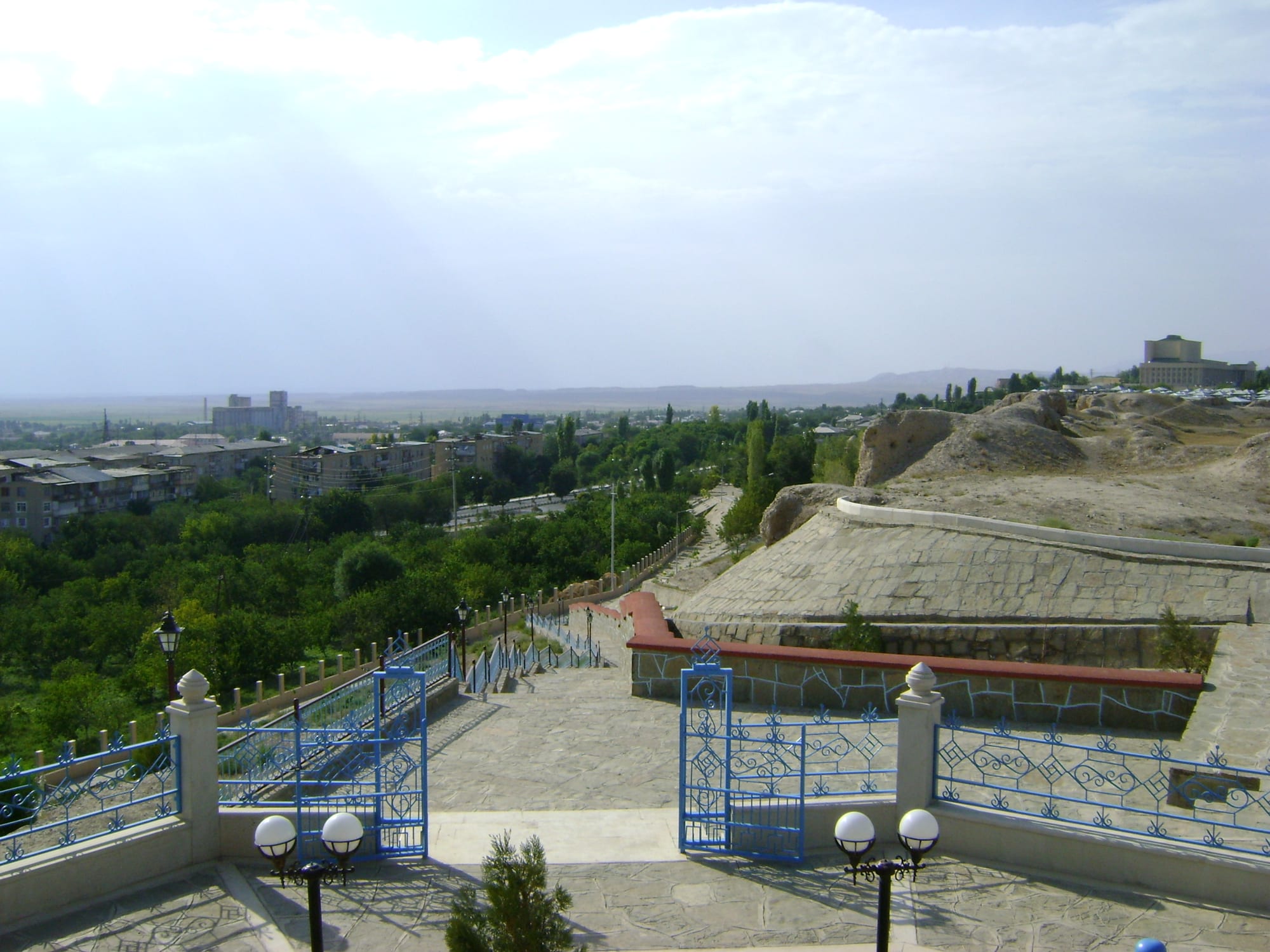
A city of low blocks and trees seen from a stone terrace on a bare hill, with a dusty plain and mountains beyond

Nakhchivan, Azerbaijan

Nakhchivan

Nakhchivan city seen from the old fortress hill on its southern edge. (Самый древний / Wikimedia Commons · Public domain)

The capital of the Nakhchivan Autonomous Republic, an Azerbaijani exclave in the dry Aras valley, separated from the rest of the country by Armenian territory. A medieval seat of the Eldiguzid atabegs, it keeps the brick mausoleums their architect built in the 12th century, and is now a quiet, orderly city of boulevards and parks ringed by bare mountains.

Neighbourhoods

  • The centre
    • First-time visitors
    • Close to public transport

    Wide rebuilt boulevards, government buildings, parks and fountains around the main square, with the hotels, restaurants and museums of the city close together. Almost everything a visitor sees is within walking distance here.

    Open in Maps
  • The Momine Khatun quarter
    • Historic district
    • Architecture

    The ground around the great brick tomb tower, set in a park with a statue of its architect and the older Yusif ibn Kuseyir mausoleum not far off. It is the oldest part of the city in spirit if not in fabric.

    Open in Maps
  • The old fortress hill
    • Viewpoints
    • Quiet and residential

    On the southern edge of town, where the shrine associated with Noah stands beside the eroded remains of the old fortress. Terraces and steps give the best overview of the city, the valley and the mountains beyond.

    Open in Maps
  • The Aras valley outskirts
    • Countryside
    • Drivers

    Beyond the built-up area the land flattens into irrigated fields, orchards and villages along the river, with the airport, the salt mine road and the highways to Julfa and Sharur leading out through them.

    Open in Maps

Things to do

Medieval monuments

  • Momine Khatun Mausoleumlandmark

    A ten-sided brick tomb tower of 1186, covered in geometric patterns and Quranic inscriptions, built by the architect Ajami Nakhchivani for the mother of the Eldiguzid ruler Jahan Pahlavan.

    Open in Maps
  • Yusif ibn Kuseyir Mausoleumlandmark

    A smaller brick tomb tower of 1161–1162 by the same architect, the earlier of his two surviving works in the city.

    Open in Maps
  • Noah's Mausoleumlandmark

    A domed shrine on the old fortress hill, built in 2006 over the remains of an older structure and an underground vault, marking the grave that local tradition assigns to Noah.

    Open in Maps
  • Nakhchivan Khan Palacemuseum

    The late 18th-century residence of the khans of Nakhchivan, restored and in use since 1998 as the Nakhchivan Carpet Museum.

    Open in Maps

Museums and city sights

  • Huseyn Javid Mausoleumlandmark

    A white marble tomb built for the poet and playwright Huseyn Javid, who was born in the city and died in Siberian exile in 1941.

    Open in Maps

Short trips from the city

  • Alinja Castlelandmark

    A fortress on a steep isolated summit in Julfa district, whose defenders are said to have held out against Timur's armies for fourteen years; a long stepped climb reaches the ruins.

    Open in Maps
  • Garabaghlar Mausoleumlandmark

    A 14th-century tomb tower about 30 kilometres north-west of the city, its faceted cylinder faced with interlaced brickwork, standing near a pair of older minarets linked by a portal.

    Open in Maps
  • Ordubadneighborhood

    An old town of shaded lanes, mosques and orchard quarters in the eastern corner of the exclave, long known for its fruit and silk.

    Open in Maps
  • Julfaneighborhood

    A town on the Aras river at the Iranian border, the crossing point for the road south and the base for visiting Alinja.

    Open in Maps

Seasonal events

  • Novruzlate March

    The spring new year is the biggest festival of the year, kept with bonfires, sweets such as pakhlava and shekerbura, and family visiting.

  • Ramazan and Gurban holidaysvaries with the lunar calendar

    The two Muslim festivals are public holidays, and observance is somewhat more visible here than in Baku.

  • The fruit harvestlate summer and autumn

    Apricots, mulberries, grapes, quinces and pomegranates come in from the valley orchards, and dried fruit is sold by the sackful in the markets.

Eat and drink

Long-standing places and food districts in Nakhchivan. Hours, ratings and directions come from your maps app, always current.

Nakhchivan classics

  • Kebab housesrestaurant

    Lamb, liver and vegetables grilled over vine wood, served with tandir bread, raw onion, sumac and herbs, are the standard meal out in the city.

    Open in Maps
  • The city bazaarmarket

    Fresh and dried fruit from the Aras valley, sheep's cheese, walnuts, honey and herbs, with sacks of dried apricots and mulberries a local speciality.

    Open in Maps
  • Tea housescafe

    Strong black tea in pear-shaped armudu glasses, taken with jam or a lump of sugar, is the afternoon habit and the way guests are received.

    Open in Maps
  • Badamli and Sirab mineral watersmarket

    The exclave's mountain springs are bottled and drunk across Azerbaijan, and the local brands are on every table.

    Open in Maps

Experience Nakhchivan

History

The city stands on one of the oldest inhabited stretches of the Aras valley, where Bronze Age settlement is attested and where the rock-salt seams at Duzdag have been worked since antiquity. Local tradition ties the place to Noah, reading the name as the place of the first descent after the flood, and a shrine on the southern hill marks the grave assigned to him; the same hill carried the fortress that guarded the crossroads below.

Its high point came in the 12th century, when Nakhchivan served as a capital of the Eldiguzid atabegs, who governed much of the region under the Seljuks. Their court architect Ajami Nakhchivani built the Yusif ibn Kuseyir mausoleum in 1162 and the Momine Khatun mausoleum in 1186, and the two brick towers, with their patterned surfaces and Kufic bands, remain the finest medieval monuments in the exclave. Mongol, Timurid, Safavid and Ottoman armies passed through afterwards, and a local khanate held the city in the 18th century before Russia annexed the territory in 1828 under the Treaty of Turkmenchay.

The early 20th century brought war and upheaval to the whole region, and in 1921 the Treaty of Kars made Nakhchivan an autonomous territory under Azerbaijan. The Soviet decades left it a provincial capital of wide avenues and apartment blocks. Heydar Aliyev, later president of Azerbaijan, was born in the city and led the exclave in 1991–93. The war of the early 1990s cut its rail and road links through Armenia, and the city has lived with that isolation ever since, rebuilt in recent decades with new boulevards, museums and public buildings.

Culture & Customs

Nakhchivan's population is almost entirely Azerbaijani, and being cut off has sharpened a strong local identity. Nakhchivanis have a national reputation for orderliness and for loyalty to the Aliyev family, which comes from here, and public life is tidier and more tightly managed than on the mainland; open political argument is rare.

The city's cultural claims rest on poetry and craft. Huseyn Javid, the playwright and poet whose work is part of the school curriculum across Azerbaijan, was born here, and his marble tomb in the centre is the closest thing the city has to a civic shrine. Carpet weaving is the other old craft, and the khans' palace in the centre now holds the carpet museum, while mugham and ashiq minstrel music are heard at weddings, which are large and loud even here.

Turkey's presence is felt in trade, television and the bridge over the Aras at Sadarak, while the Iranian border a short drive south brings the other great neighbouring influence. Shia Islam predominates and observance is somewhat more visible than in Baku, though the pattern of relaxed, private practice holds. Novruz, the spring new year, is the festival that matters most, with bonfires, sweets and visits to relatives. Guests are received with tea, fruit and sweets almost before they are seated, and hospitality is regarded as a point of regional pride.

Daily Life

Around 64,000 people were counted in the city at the turn of the century, in a capital of rebuilt boulevards, parks, government offices and low apartment blocks. Ordubad, Julfa, Sharur and Shahbuz are the other towns, and the rest of the exclave is villages along the irrigated valley.

The economy rests on farming and the public sector. Grain, vegetables, livestock and the valley's fruit and silk are the mainstays, together with rock salt from Duzdag, mineral water bottled at Badamli and Sirab, construction and government employment. Because the land route to Baku is closed, trade runs mostly through Turkey and Iran, which makes many goods dearer than on the mainland and ties families to flights and the long road south.

The rhythm of the day is quiet: markets in the morning, tea houses through the afternoon, a walk in the parks in the evening and early nights. Summer heat pushes activity to the ends of the day. Emigration to Baku, Turkey and Russia is common among the young, and the money they send home matters to many households. The hope most often voiced is that transit routes will reopen and end the exclave's long separation from the rest of the country.

Food

The table here is Azerbaijani with a strong Iranian Azerbaijani accent, carried across the Aras. Lamb is the main meat: kebabs grilled over vine wood, bozbash, a lamb and chickpea soup often thickened with the valley's fruit, and dolma of vine or cabbage leaves. Bread is baked in clay tandir ovens, and rice dishes appear at celebrations rather than every day. Yoghurt and sheep's cheese from the mountain villages turn up at most meals, and dovga, a yoghurt soup with herbs and rice, is eaten warm or cold.

Fruit is what the region is known for. The dry, sunny valley produces apricots, mulberries, grapes, quinces, peaches and pomegranates in quantity, eaten fresh in season and dried for the winter; sacks of dried apricots and mulberries stand in the markets, and Ordubad is celebrated for the number of grape varieties grown in its gardens. Walnuts, honey and fruit leathers made from pressed plum or apricot pulp are sold alongside them.

Two mineral waters, Badamli and Sirab, are bottled at springs in the mountains and drunk throughout Azerbaijan, so the local brand is usually on the table. Tea closes everything: strong, black, in armudu glasses, with jam, sliced lemon or a lump of sugar, and sweets such as pakhlava and shekerbura at festivals.

Planning tools

Budget

Nakhchivan is inexpensive once reached. Hotels in the city are few but moderately priced, meals, taxis and entry fees cost little, and there is almost nothing to spend money on beyond food, rooms and transport. The main expense is arrival, since the only practical routes from Baku are the flight or a long road journey through Iran.

Daily Budget Midrange
USD 65–130 (good city hotel, restaurant meals, a car with driver to Alinja and Ordubad)
Daily Budget Shoestring
USD 30–50 (simple hotel, canteen meals, shared taxis)

Book the Baku flight early, especially around public holidays, and carry cash, as cards are accepted in fewer places than in the capital.

Best Time to Visit

April to early June and September to October are the comfortable seasons, with warm days, blossom in spring and the fruit harvest in autumn. July and August are very hot and dry in the valley, though the mountains stay mild. Winter is cold and quiet, with snow on the hills, while the salt-cave treatment centre draws visitors all year.

Suggested Number of Days

The city's monuments and museums are close together and fit into a day or two. Three or four days suit the wider exclave, where distances are long, roads are slow and the mountain sites take most of a day each.

First Visit
1–2 days
With Surroundings
3–4 days

Transportation

The city is compact enough to walk, and cheap taxis cover the rest. Buses and shared taxis link it with Julfa, Ordubad, Sharur and Shahbuz, though services thin out in the afternoon. The mountain sites are not served by public transport, so a hired car with a driver is the usual way to reach them, and hotels can arrange one.

Agree the price with a driver before setting off, and allow a full day for a trip to Alinja or Ordubad, as the roads are slow.

Airport & Station Connections

Land borders with Armenia are closed, so the exclave is reached from the rest of Azerbaijan by air or by road through Iran. Flights from Baku to Nakhchivan International Airport, a few kilometres from the centre, take a little over an hour and are the usual choice. There are also crossings to Iran at Julfa and to Turkey at Sadarak, and a road link across southern Armenia has been discussed but is not open.

Walkability

The centre is flat, quiet and pleasant on foot, with wide pavements, shade trees and the main monuments and museums within a kilometre or so of each other. The climb to the shrine and the old fortress on the southern hill is short but steep. Summer heat is the limiting factor, and there is little to walk to beyond the built-up area.

Safety

Nakhchivan has little street crime, but it is one of the most tightly controlled parts of Azerbaijan. The border with Armenia is militarised and must not be approached, the police and security services are highly visible, and photographing border posts, military sites and government buildings can lead to questioning. Summer heat is a real hazard on the Alinja climb. In March 2026, during the war involving Iran, drones from Iran struck the area of Nakhchivan airport.

Keep well away from the Armenian border, avoid photographing security sites, and carry water and start early at Alinja. Check current official travel advice before travelling.

Climate

The Aras valley is dry and strongly continental, with low rainfall, hot sunny summers and cold winters, and a wide gap between day and night temperatures. The mountains around the city are several degrees cooler and hold snow well into spring.

Summer
hot and dry, typically 30–38°C by day in the valley, cooler in the mountains at 18–25°C
Winter
cold, often around 0–5°C by day and below freezing at night, with snow in the surrounding hills

Local Customs

Hospitality follows the national pattern of tea, sweets and an insistent host, and refusing food outright is awkward. Public life here is more conservative and more formal than in Baku: dress modestly, particularly at shrines and mosques, where shoes come off and women cover their heads. Shia observance is somewhat more visible than on the mainland, and political subjects are best left alone in conversation.

Ask before photographing people and never photograph police, soldiers or government buildings; tipping is not expected, though rounding up a bill is normal; alcohol is sold but drunk discreetly.

Common Payment Methods

The currency is the Azerbaijani manat. Hotels and larger restaurants take cards, but the bazaar, taxis, tea houses and most small shops are cash only, and cards are accepted in fewer places than in Baku. ATMs are available in the city centre and scarce in the smaller towns, so draw cash before heading out to Ordubad or the mountains.