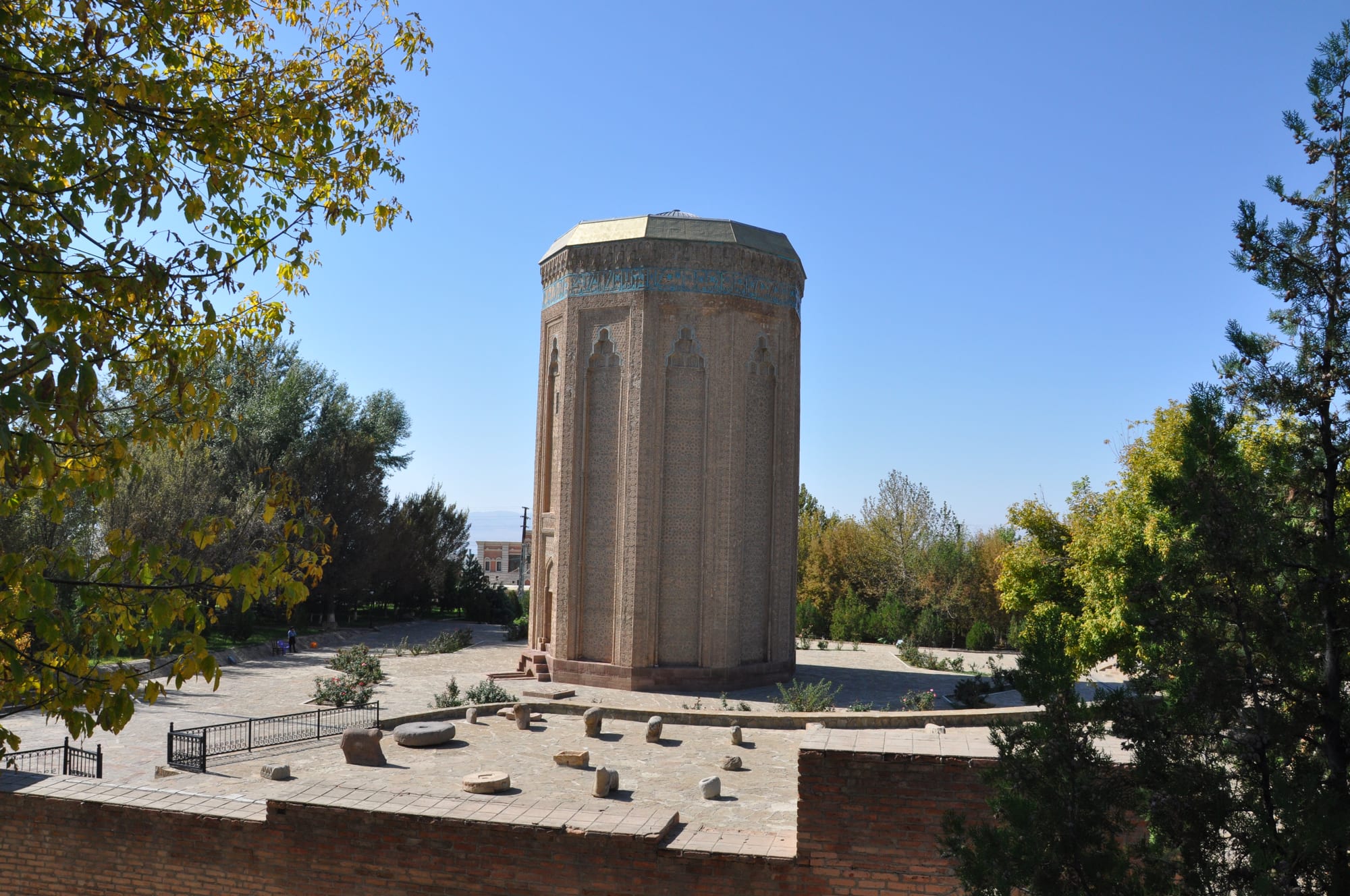
A tall many-sided brick tomb tower with carved panels and a turquoise band, in a paved park among autumn trees

Azerbaijan

Nakhchivan

The 12th-century Momine Khatun mausoleum in Nakhchivan city, built by the architect Ajami Nakhchivani. (Toghrul Rahimli / Wikimedia Commons · CC BY-SA 4.0)

Azerbaijan's exclave beyond Armenia, an autonomous republic of dry mountains and river valleys wedged between Armenia, Iran and Turkey — a land of Noah legends, medieval Eldiguzid tombs, mountain fortresses and salt caves, cut off from the rest of the country by land since the early 1990s.

Explore Nakhchivan

History

Nakhchivan's valleys have been settled since prehistory: the Gamigaya rock carvings in the Ordubad mountains and Bronze Age sites along the Aras valley are among its earliest remains. Local tradition links the land with Noah — one popular story interprets the name as "place of the first descent" — and Nakhchivan city keeps a mausoleum said to be his.

The medieval high point came in the 12th century, when Nakhchivan was a capital of the Eldiguzid atabegs, who ruled much of the region under the Seljuks. Their architect Ajami Nakhchivani built the Yusuf ibn Kuseyir mausoleum in 1162 and the Momine Khatun mausoleum in 1186 for the mother of the ruler Jahan Pahlavan. Mongols, Timurids — whose armies besieged Alinja for years — Safavids and Ottomans followed. In the 18th century a local khanate formed, and Russia took it in 1828 under the Treaty of Turkmenchay.

The years 1918–21 brought war between Armenians and Azerbaijanis, with outside powers also involved; the Treaty of Kars of 1921 made Nakhchivan an autonomous territory under Azerbaijan. In the Soviet era its once-large Armenian minority dwindled, and the medieval Armenian cemetery at Julfa, with its carved cross-stones, was destroyed between the late 1990s and 2006, according to satellite images and international observers; Azerbaijan denies this.

Heydar Aliyev, born in Nakhchivan, led the exclave in 1991–93 before returning to power in Baku. Since the war of the early 1990s its rail and road links through Armenia have been cut; a transit route across southern Armenia was agreed in principle in 2025 but has not yet opened.

Culture & Customs

Nakhchivan's population is almost entirely Azerbaijani, and its isolation has bred a strong local identity: Nakhchivanis are known across the country for their loyalty to the Aliyev family, which comes from here, and for a disciplined, orderly public life. The exclave is tidier and more tightly controlled than the mainland, and political dissent is rare in public.

Turkey's influence is felt everywhere, from trade goods and television to the bridge over the Aras at Sadarak that links the two countries. Shia Islam predominates, and religious observance is somewhat more visible than in Baku.

Culture centres on poetry, carpets and music: Nakhchivan carpets belong to the Tabriz–Nakhchivan weaving school, the region has produced a long line of writers and scholars, and mugham and ashiq minstrel music are heard at weddings. Novruz is celebrated with bonfires, and hospitality follows the national pattern of tea, sweets and an insistent host.

Daily Life

About 450,000 people live in the autonomous republic, with around 90,000 in Nakhchivan city, a neat capital of rebuilt boulevards, parks and government buildings. Ordubad, Julfa, Sharur and Shahbuz are the other towns.

The economy is agriculture — grain, fruit, vegetables, livestock and silk in the Ordubad area — together with salt, mineral water from springs such as Badamli and Sirab, construction and a large public sector. Trade runs mostly through Turkey and Iran, since the land route to Baku is closed, which makes many goods more expensive and ties families to flights and the long road through Iran.

Daily routines are quiet: markets in the morning, tea houses in the afternoon, and early nights. Emigration to Baku, Turkey and Russia is common among the young, and many hope that reopened transit routes will end the exclave's long isolation.

Food

Nakhchivan's cooking follows the Azerbaijani table, with a strong link to Iranian Azerbaijan across the Aras. Lamb dominates: bozbash soup with chickpeas, kebabs grilled over vine wood and dolma of vine or cabbage leaves are staples, and flatbread is baked in clay tandir ovens in village yards.

The dry valleys produce excellent fruit. Apricots, mulberries, grapes, quinces and pomegranates are eaten fresh or dried for winter, and dried apricots and mulberries are sold by the sackful in the markets; Ordubad is known for its many varieties of grapes. Sheep's cheese and yoghurt are made in the mountain villages.

The local mineral waters, Badamli and Sirab, are drunk across Azerbaijan, and tea, strong and black with jam, closes every meal.

Attractions & Natural Wonders

Nakhchivan city holds the finest medieval monuments: the Momine Khatun mausoleum, a tall tomb tower covered in brick patterns and Kufic inscriptions, and nearby the smaller Yusuf ibn Kuseyir mausoleum by the same architect. Noah's Mausoleum, the khan's palace and a string of museums complete the city. A short drive away, the Duzdag salt cave, an old salt mine, houses a physiotherapy treatment centre.

Southeast of the city in Julfa district, Alinja fortress crowns a steep rocky summit; the climb to its ruins is hard but rewarding, with views over the Aras valley. Ilandag, the notched peak associated with Noah's Ark, rises near the road towards Julfa.

Further east, Ordubad keeps its old quarters, Friday mosque and shaded streets, with the Gamigaya rock carvings in the mountains of the district. In the north, Shahbuz district has the Batabat lakes on the high pastures, and the mountains along the Armenian border rise to Gapıjıq, the highest peak of the exclave.

Cities in Nakhchivan

Planning basics

Budget

Nakhchivan is inexpensive once there: hotels in Nakhchivan city are few but moderately priced, meals and local taxis are cheap, and the sights charge small entry fees. The main cost is getting in, since the only practical routes from Baku are flights or a long road journey through Iran.

Daily Budget Midrange
USD 65–130 (good city hotel, restaurant meals, a car with driver to Alinja and Ordubad)
Daily Budget Shoestring
USD 30–50 (simple hotel, canteen meals, shared taxis)

Book the Baku–Nakhchivan flight early, especially around holidays, and carry cash — cards are less widely accepted than in Baku.

Safety

Nakhchivan has little street crime, but it is one of the most tightly controlled parts of Azerbaijan. The border with Armenia is militarised and must not be approached, the police and security services are highly visible, and photographing border posts, military sites and government buildings can lead to questioning. Summer heat is a real hazard on the Alinja climb. In March 2026, during the war involving Iran, drones from Iran struck the area of Nakhchivan airport.

Keep well away from the Armenian border, avoid photographing security sites, and carry water and start early at Alinja. Check current official travel advice before travelling.

Climate

Nakhchivan is much drier and more continental than the rest of Azerbaijan. Summers in the Aras valley are hot and sunny, winters are cold and can be snowy, and rainfall is low throughout. The mountains along the Armenian border are far cooler, with snow for much of the year on the highest peaks and pleasant summers at Batabat.

Summer
hot and dry in the valleys, 30–38°C; mild in the mountains, 18–25°C
Winter
cold, often below freezing at night in the valleys; heavy snow in the mountains

Transportation

Land borders with Armenia are closed, so Nakhchivan is reached from the rest of Azerbaijan by air, with regular flights from Baku, or by road through Iran. There are road crossings into Turkey at Sadarak and into Iran at Shahtakhti. Inside the exclave, taxis and buses link Nakhchivan city with Julfa, Ordubad and Shahbuz; Alinja and Batabat need a car.

Check Iranian transit rules before planning an overland route, and allow a full day to reach Alinja and make the climb.

Best Time to Visit

April to June and September to October bring warm, clear days, fruit blossom in spring and harvest in autumn. July and August are hot in the valley towns but the time for Batabat and the high pastures. Winter is cold and quiet, though the Duzdag salt cave is visited year-round.