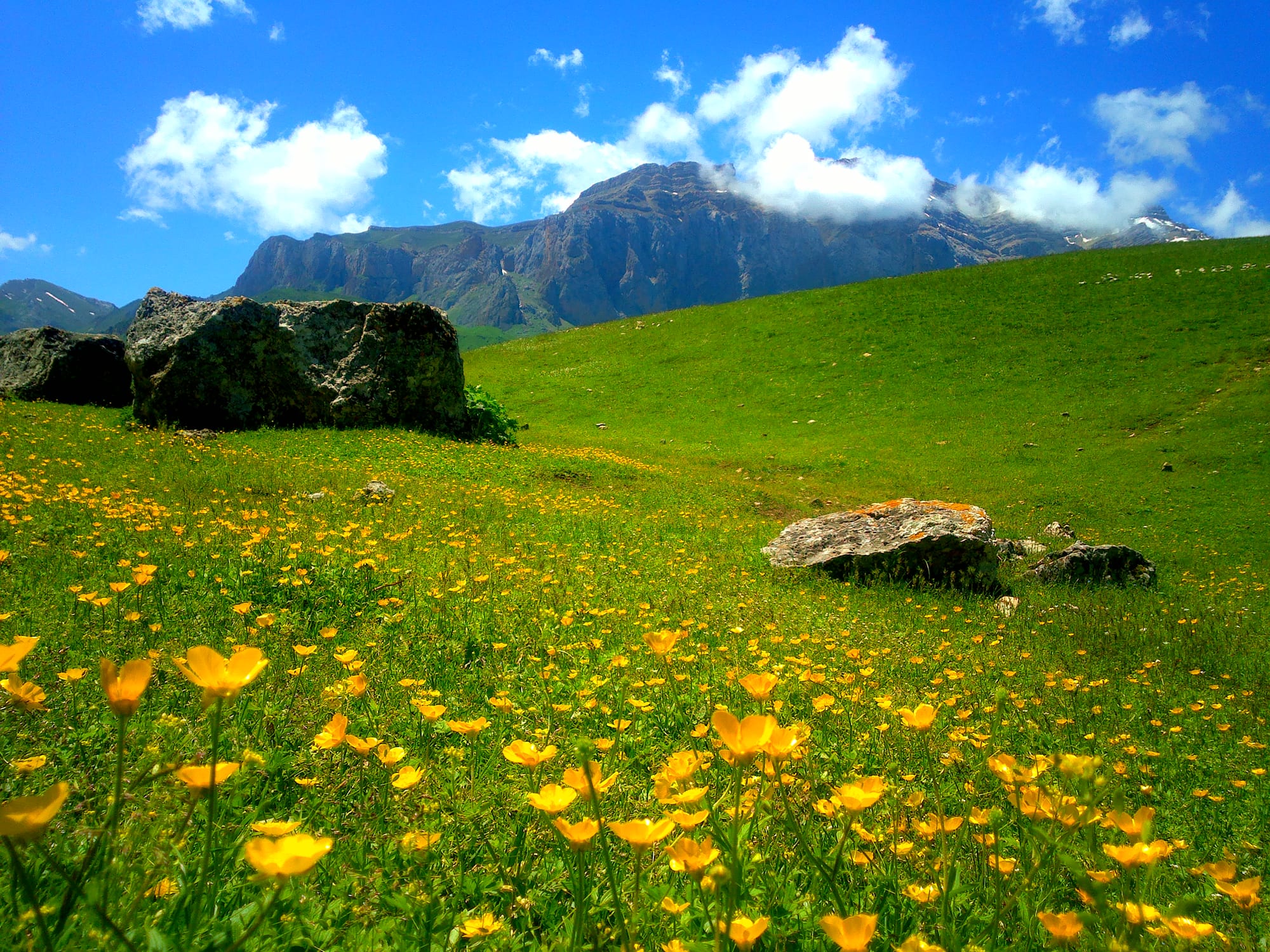
A green alpine meadow full of yellow wild flowers and boulders below grey cliffs and cloud-topped peaks

Azerbaijan

Guba & the Northeast

Spring meadows below the Shahdag massif in the Qusar district of northern Azerbaijan. (Khagani Hasanov1988 / Wikimedia Commons · CC BY-SA 4.0)

Azerbaijan's northeastern corner, running from the Caspian shore at Khachmaz and Nabran up through the apple orchards of Guba to the high Caucasus villages of Khinalig and Laza beneath Shahdag — a region of Lezgin, Tat and Mountain Jewish communities, carpet-weaving and the country's main ski resort.

Explore Guba & the Northeast

History

The northeast lies on the narrow corridor between the Caucasus and the Caspian, the main land route between the steppes to the north and Persia to the south, and it has been fortified for as long as that road has been used. Sasanian Persian rulers built defensive walls across the coastal strip in late antiquity, and the stone fortress of Chiraggala on its ridge in Shabran district belongs to that line of defences. The mountain peoples of the interior — the ancestors of today's Lezgins, the Khinalig villagers and the Budukh and Kryz communities — kept their own languages in valleys that invaders passed by.

In the 18th century, as Persian authority weakened, Guba became the seat of a semi-independent khanate. Its most ambitious ruler, Fatali Khan, extended his power over Derbent, Baku and much of the Caspian coast in the second half of the century, making Guba briefly one of the strongest states in the eastern Caucasus. Russia absorbed the khanate in the early 19th century, and Guba became a quiet district town of orchards and carpet looms.

The town has also long been home to the Mountain Jews, who settled on the far bank of the river under the protection of the khans. The upheavals of 1918 brought killings here as across the region, and a memorial complex opened in Guba in 2013 over a mass grave found in 2007. In Soviet times the district became a fruit-growing centre; since independence better roads, the Shahdag resort and Nabran's beach hotels have turned it into the capital's favourite escape.

Culture & Customs

This is the most ethnically mixed part of Azerbaijan. Lezgins form the majority in Qusar district and speak their own Caucasian language alongside Azerbaijani; Tats, who speak an Iranian language, live in villages around Guba and Siyazan; and the Mountain Jews of the Red Village, Qırmızı Qəsəbə, speak Juhuri, a related Iranian tongue. High above them, the people of Khinalig speak Khinalug, a language found in no other village. Most people are Muslim, but the Red Village keeps its synagogues, and the village is the principal settlement of Azerbaijan's Mountain Jews.

Guba's great craft is the carpet. Guba belongs to the Kuba-Shirvan school, one of the classic Azerbaijani carpet groups, and looms still work in village homes. Khinalig's culture is built on transhumance: families drive their sheep between summer pastures in the high Caucasus and winter grazing in the lowlands along the Köç Yolu migration route, which UNESCO added to the World Heritage List in 2023 together with the village's cultural landscape.

Manners are conservative in the mountains. Guests are fed first and at length, women in the villages dress modestly, and a visitor is expected to accept tea before any business. Novruz in March is celebrated with bonfires in every village, and Lezgin dances and music feature at weddings and festivals in Qusar.

Daily Life

Guba, with around 47,000 people, is the regional centre: a low town of brick houses, a covered market, tea houses on the main square and new apartment blocks towards the highway. Qusar, Khachmaz, Shabran and Siyazan are smaller district towns, and the rest of the population lives in villages that range from large lowland farming settlements to hamlets of a few dozen families in the mountains.

The economy runs on fruit, above all apples, together with hazelnuts, vegetables and livestock. Refrigerated warehouses along the highway store the harvest for sale in Baku and Russia, and roadside stalls sell apples, jams and dried fruit through the autumn. Siyazan has oilfields, and tourism — the Shahdag resort, second homes in the Guba woods, summer hotels at Nabran — now provides many of the region's new jobs.

Life keeps a rural rhythm: markets in the morning, long tea-house afternoons for the men, and families gathering in the orchards at harvest. In summer the population swells with Baku families escaping the heat, and in Khinalig the year is still divided between the months on the high pastures and the long, snowbound winter. Young people continue to leave for Baku and Russia in search of work.

Food

The northeast eats from its orchards and its pastures. Guba's apples are the most famous in the country, sold fresh, dried and cooked into jams, and preserves of quince, cherry and cornelian cherry fill the market stalls. Mountain honey, walnuts and hazelnuts come down from the foothills, and roadside sellers offer lavash, the thin flatbread baked on a curved iron sheet.

Mountain cooking is based on lamb and dairy. Motal, a sharp sheep's cheese matured in a sheepskin, and fresh curd cheese are made in the high villages, and lamb is grilled as kebab or stewed with herbs. Qutab — thin folded flatbreads filled with greens, pumpkin or minced meat — are an everyday dish, and Guba and Qusar have their own version of khingal, squares of boiled dough served with meat and a garlic and yoghurt sauce.

On the coast, Caspian fish such as kutum is grilled, often served with narsharab, the sour pomegranate sauce. Meals end, as everywhere in Azerbaijan, with strong black tea in pear-shaped glasses, taken with jam rather than milk.

Attractions & Natural Wonders

Guba itself has a handsome old centre with a mosque, bathhouses and a carpet workshop, and the Red Village across the Gudyalchay river, with its synagogues and brick houses, is a short walk over the bridge. Nearby are the Tengi canyon, a narrow gorge on the road into the mountains, and the Afurja waterfall in the forests of Guba district.

Higher up, Khinalig sits at more than 2,000 metres on a bare ridge, its terraced stone houses stacked one above the other beneath the peaks; it is one of the highest permanently inhabited villages in the Caucasus and a base for walks onto the summer pastures. Beyond it rise Shahdag and Bazarduzu, Azerbaijan's highest mountain, on the border with Russia's Dagestan, within and around Shahdag National Park.

In Qusar district, the Shahdag ski resort offers lifts, hotels and pistes in winter and cable-car rides and hiking in summer, and the nearby village of Laza sits beneath cliffs streaked with waterfalls that freeze in winter.

Down on the Caspian coast towards Khachmaz, forest runs almost to the sand at Nabran, the region's main beach resort, and the Samur-Yalama National Park protects the coastal forest near the river mouth. Further south, the coast road passes the crags of Beshbarmag, a pilgrimage site near Siyazan, and the ruined walls of Chiraggala on a ridge in Shabran district.

Cities in Guba & the Northeast

Planning basics

Budget

The northeast is cheaper than Baku. Guba and Qusar have modest hotels and guesthouses, Khinalig and Laza have simple homestays, and roadside restaurants and tea houses are inexpensive. The exceptions are the hotels at the Shahdag resort in the ski season and the family resorts at Nabran in July and August, both priced for Baku weekenders.

Daily Budget Midrange
USD 70–150 (resort or good hotel, restaurant meals, a car with driver to the mountain villages)
Daily Budget Shoestring
USD 30–50 (guesthouse or homestay, tea-house meals, shared taxis and buses)

Carry cash for the villages, and book Shahdag accommodation early for winter weekends and the New Year holidays.

Safety

The northeast is calm and hospitable. The real hazards are the mountains themselves — rapid weather changes, rockfall on the Khinalig road, cold at altitude — along with fast driving on the coastal highway. The border with Russia's Dagestan along the Samur river and the high ridge is a controlled zone and should not be approached.

Carry warm layers even in summer at altitude, keep away from the border zone, and use registered ski instructors at Shahdag. Check current official travel advice before travelling.

Climate

The coastal lowland around Khachmaz and Nabran is milder and greener than Baku, with warm summers and cool, damp winters. Guba's foothills are temperate and good orchard country, while Khinalig and the Shahdag massif lie above 2,000 metres, where summers are cool and winters bring deep snow that can close the high roads.

Summer
warm on the coast and in Guba, 25–30°C; cool in the mountains, 15–22°C, with afternoon storms
Winter
cool and damp on the coast, around 0–8°C; cold and snowy in the mountains, well below freezing at night

Transportation

Guba is roughly two and a half to three hours by road from Baku along the coastal highway, with buses and shared taxis from the capital; a railway follows the coast north through Siyazan and Khachmaz towards Russia. Khinalig is reached by a mountain road from Guba, and the Shahdag resort by road from Qusar. A hired car with driver is the easiest way to combine the villages.

Take a driver who knows the mountain roads for Khinalig and Laza, and allow extra time after rain or snow.

Best Time to Visit

June to September for Khinalig, Laza and walking in the mountains, when the high roads are clear and flocks are on the summer pastures; July and August for the Nabran beaches. September and October bring the apple harvest around Guba, and December to March is the ski season at Shahdag.