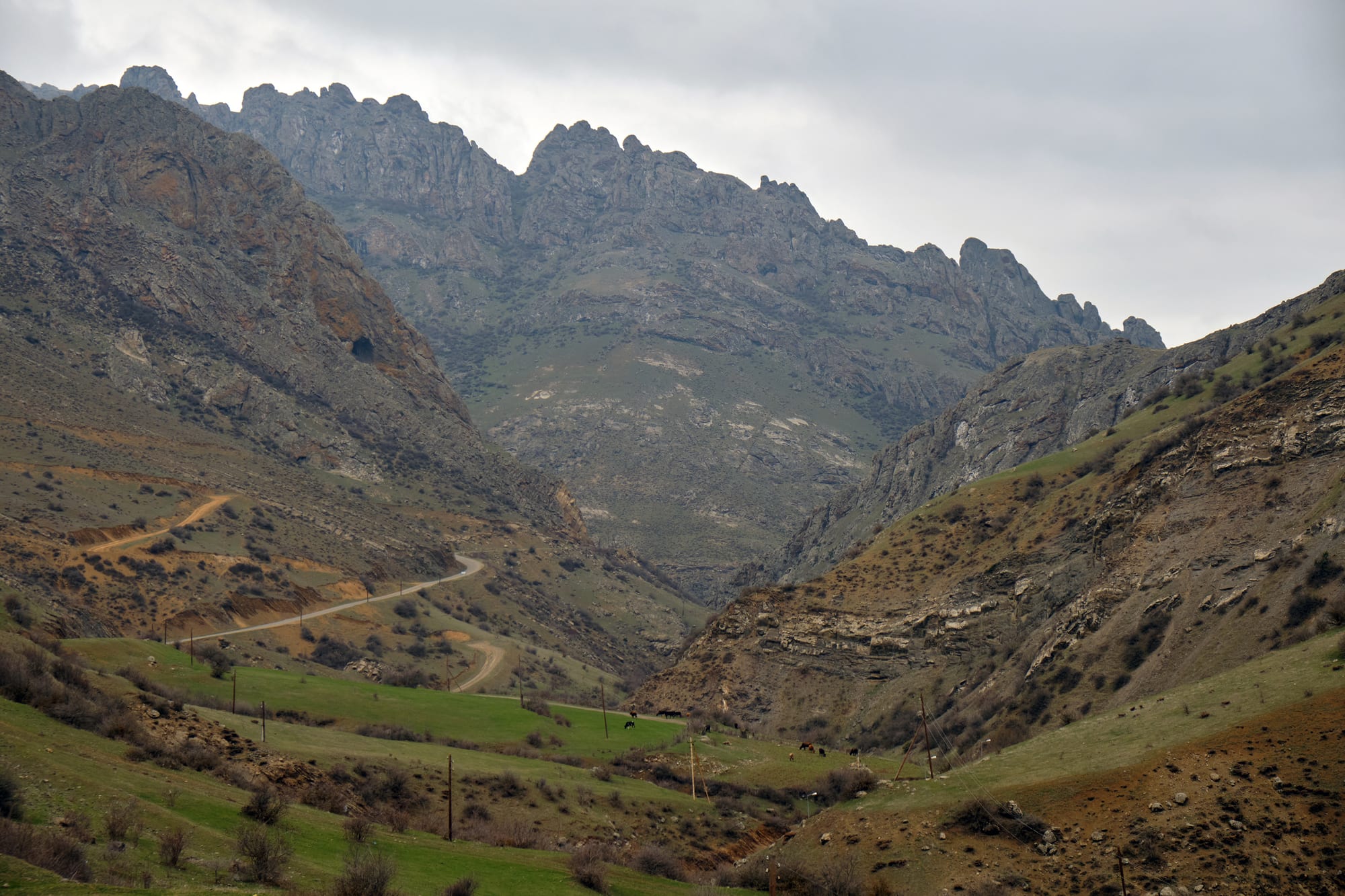
Jagged grey mountain ridges above a green valley with a winding road, power lines and grazing horses

Azerbaijan

Lankaran & the South

The Talysh Mountains in Lerik district, in the highlands of southern Azerbaijan. (AlexFirstov / Wikimedia Commons · CC BY-SA 4.0)

Azerbaijan's humid far south, a strip of Caspian lowland and the forested Talysh Mountains between the Mughan plain and the Iranian border — tea and citrus country around Lankaran and Astara, home of the Talysh people, with ancient Hyrcanian forest on the slopes and dry highland villages around Lerik above them.

Explore Lankaran & the South

History

The far south is the old land of Talysh, a mountain and coastal country that for most of its history looked towards Persia. Its forests and the narrow coastal strip between the Talysh Mountains and the Caspian kept it somewhat apart from the rest of today's Azerbaijan, and its people, the Talysh, speak an Iranian language related to Persian.

In the 18th century the Talysh khanate emerged with its capital eventually at Lankaran. Squeezed between Persia and an advancing Russia, it became a battleground in the Russo-Persian wars: Russian troops stormed Lankaran's fortress in 1813, and the khanate passed to Russia in the treaties that followed, with the border drawn along the Astarachay river, where it still runs.

Under Russian and Soviet rule the region became a subtropical farm for the empire. Tea was introduced in the late 19th century and expanded greatly in Soviet times, along with citrus, vegetables and rice. In the summer of 1993, amid the turmoil of the Karabakh war, a military officer declared a short-lived Talysh-Mughan Autonomous Republic in Lankaran, which collapsed within weeks. Since independence the region has depended on its farms, on migrant work in Russia and on a growing trade and transit role, with the route to Iran through Astara central to the North–South transport corridor.

Culture & Customs

The Talysh are the defining people of the south, living in the mountains and in many lowland villages alongside Azerbaijanis; most speak both Talysh and Azerbaijani. Religious observance, Shia Islam, is generally stronger here than in Baku, and the region's customs — close family networks, conservative dress in the villages, elaborate hospitality — reflect its rural character and its long ties with Iranian Talysh and Gilan across the border.

Tea is more than a drink here: it is the local crop, and every household has its own view on brewing and on the jams that go with it. Lerik is known across Azerbaijan for longevity, and its museum celebrates villagers said to have lived to extraordinary ages, including Shirali Muslimov, whose claimed age of more than 160 years made him a Soviet celebrity.

Weddings are large and loud, with zurna and drums, and Novruz is celebrated with bonfires, painted eggs and trays of sweets. Crafts include basketry and woodwork from the forests.

Daily Life

Lankaran is the regional capital and market town, with Masalli, Jalilabad, Astara, Lerik and Yardimli the district centres. Most people live in large lowland villages among tea gardens, citrus groves and greenhouses, and the mountain villages above are small and ageing.

The economy is agriculture: tea, citrus, early vegetables grown under plastic for the Baku and Russian markets, rice and livestock. Fishing on the Caspian, small-scale forestry and cross-border trade with Iran through Astara add to incomes, and many families depend on money sent back by relatives in Russia.

The day follows the farm and the weather: early work in the fields before the humidity builds, long afternoons in tea houses, and evenings in the town squares. Summer brings Baku families to the coastal resorts, while the region's main concerns are jobs, emigration and the condition of rural roads.

Food

Southern cooking is among the most distinctive in Azerbaijan. Its signature is lavangi, a chicken or fish stuffed with walnuts, onions and a sour paste of dried plums, then baked; it is served at celebrations throughout the region. Rice from the lowland paddies goes into plov, often with fish or chicken rather than lamb, and Caspian kutum is grilled, smoked or stuffed in the same way as lavangi.

Lankaran kulcha is the town's best-known sweet pastry, eaten with tea. Markets sell lemons and mandarins from the groves, persimmons and pomegranates in autumn, jams of citrus peel and fig, and honey from the Talysh forests.

Tea itself is the local drink, grown, dried and packed in the region and served strong and black in armudu glasses with lemon, jam or a lump of sugar held in the mouth.

Attractions & Natural Wonders

Lankaran's tea and citrus country fills the coastal plain, and a visit to a tea estate or roadside grove is the simplest introduction to the region. In the town, the round fortress tower, the old lighthouse, the old Khan's House and the market are the main sights.

Inland, the Talysh Mountains rise quickly. Their lower slopes are covered by Hyrcanian forest, a relict woodland of Persian ironwood, chestnut-leaved oak and silk trees that has survived since before the ice ages; Hirkan National Park protects much of it, and in 2023 UNESCO extended the Hyrcanian Forests World Heritage Site into Azerbaijan. Waterfalls and forest villages lie along the roads into the hills.

Higher up, the road climbs to Lerik, where the forest gives way to dry, rocky valleys, stone villages and summer pastures, and the Museum of Longevity is the town's curiosity. The Yardimli highlands continue along the Iranian border to the west.

On the coast, the Gizilagach wetlands draw flamingos and great flocks of ducks and geese in winter, and Astara, on the Iranian border at the country's southern tip, has beaches and forest running up into the hills behind it.

Cities in Lankaran & the South

Planning basics

Budget

The south is among the cheapest parts of Azerbaijan. Lankaran has modest hotels and a few resort complexes, Lerik and the mountain villages have simple guesthouses, and tea houses, markets and shared taxis cost little. Summer resort hotels on the coast are the main exception.

Daily Budget Midrange
USD 60–120 (resort or good hotel, restaurant meals, a car with driver into the mountains)
Daily Budget Shoestring
USD 25–45 (simple hotel or guesthouse, tea-house and market food, buses and shared taxis)

Carry cash throughout the region, and buy tea and preserves directly from growers and market stalls.

Safety

The south is calm and hospitable. The main hazards are landslides and washed-out roads in the wet season, slippery forest paths, and fast driving on the coastal highway. The frontier with Iran is a controlled border zone, and photography near it and near military sites is unwise.

Keep away from the Iranian border zone except at the official crossing, and check road conditions before heading into the mountains after rain. Check current official travel advice before travelling.

Climate

The lowlands are humid subtropical and the wettest part of Azerbaijan, with warm, muggy summers and mild, rainy winters — the reason tea and citrus grow here. The forested lower slopes of the Talysh Mountains catch much of the rain, while the high valleys around Lerik, in their rain shadow, are dry, sunny and cold in winter.

Summer
warm and humid on the coast, 25–32°C; cooler and drier in Lerik, 20–27°C
Winter
mild and wet on the coast, around 3–10°C; cold with snow in the Lerik highlands

Transportation

Lankaran is roughly four hours by road from Baku, along a highway across the Kura and Mughan plains, and the railway south from Baku reaches Lankaran and Astara, on the Iranian border. Lankaran also has an airport. Buses and shared taxis link the towns; Lerik is about an hour up a winding road from Lankaran, and forest villages need a local driver.

Allow a full day for the drive from Baku with stops, and use a local driver for the mountain roads, which are slow and can be damaged after heavy rain.

Best Time to Visit

May to June and September to October: the tea harvest runs through the warm months, citrus ripens from late autumn, and the forests are at their greenest in spring and most colourful in October. July and August are humid on the coast, while winter is the season for birdwatching on the Caspian wetlands.