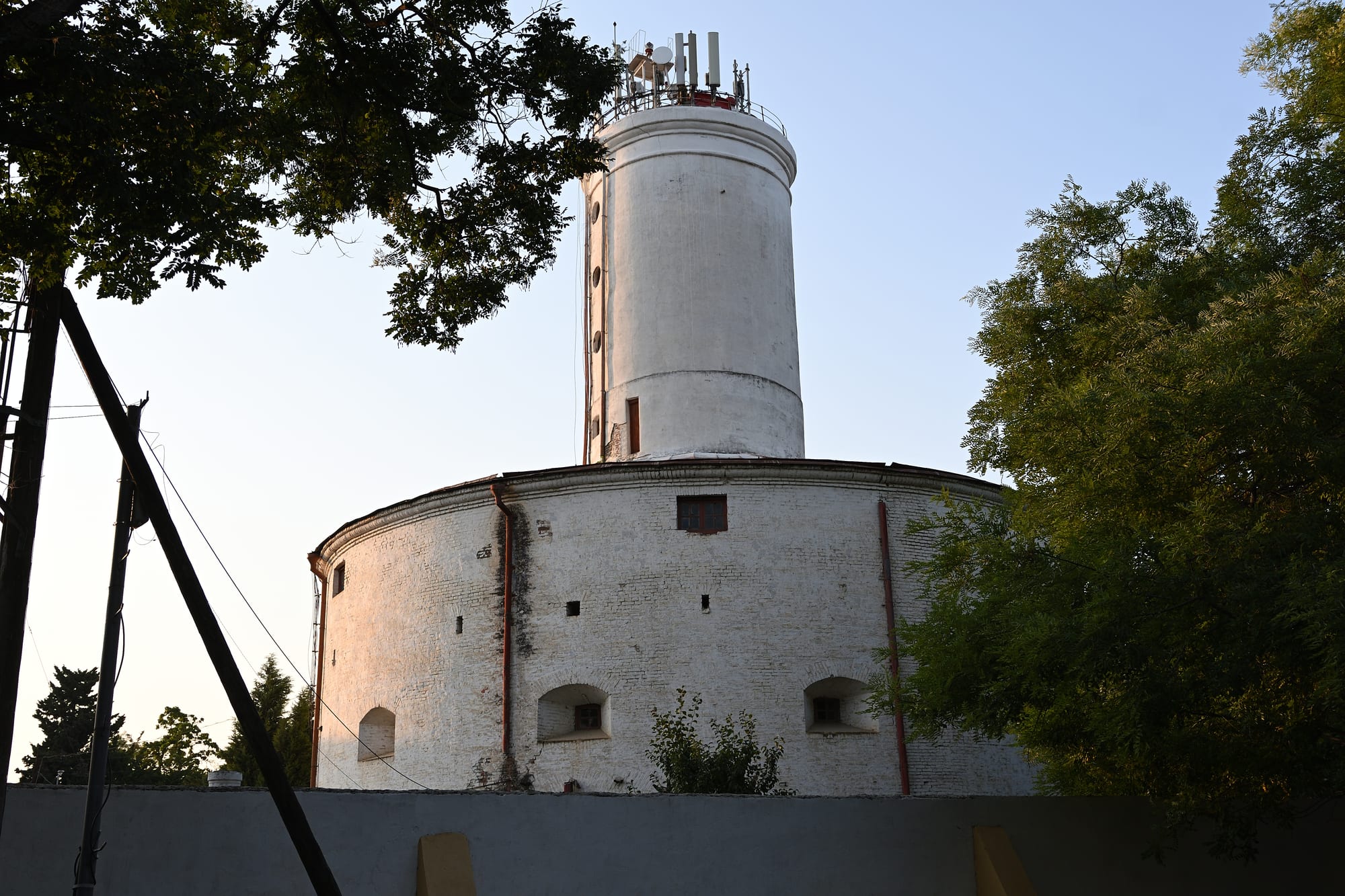
A white round tower rising from a wide brick drum, framed by dark trees against a clear pale sky

Lankaran & the South, Azerbaijan

Lankaran

The old lighthouse of Lankaran, built on a round brick tower in the centre of the city. (KeuleKeulmann / Wikimedia Commons · CC BY-SA 4.0)

Azerbaijan's main southern city, on the Caspian shore between the Talysh Mountains and the sea, close to the Iranian border. Once the capital of the Talysh khanate, it became a Russian garrison town and then the centre of the country's tea and citrus growing. It is humid, green and low-rise, with a market at its heart.

Neighbourhoods

  • The centre and the bazaar
    • First-time visitors
    • Best for food
    • Close to public transport

    The heart of the city, where the covered market, the shops, the tea houses and most hotels sit within a few streets of one another. The old round tower with its lighthouse stands close by, and the bus and shared-taxi stands are within walking distance.

    Open in Maps
  • The seafront
    • Beaches
    • Quiet and residential

    A low, sandy shore east of the centre where the city meets the Caspian, backed by scattered houses, cafés and a few resort hotels. The water is shallow and the beaches are busiest with Baku families in July and August.

    Open in Maps
  • The northern approach
    • Drivers
    • Close to public transport

    The road in from Baku passes the railway station, the airport turning and roadside stalls selling citrus, tea and preserves. Several of the larger hotels and resort complexes stand along this side of the city.

    Open in Maps
  • The tea and citrus villages
    • Countryside
    • Local life

    Beyond the built-up edge the plain is a patchwork of tea gardens, lemon and mandarin groves and plastic greenhouses, with large villages strung along the roads. This is where most people of the district actually live.

    Open in Maps

Things to do

In the city

  • Zindan Fortresslandmark

    A round brick stronghold of the 18th-century Lankaran fortress, used as a prison from 1869 until 1959; the matching tower nearby carries the city's lighthouse.

    Open in Maps

Forest and mountains

  • Hirkan National Parkpark

    Protected relict Hyrcanian forest of Persian ironwood and chestnut-leaved oak on the slopes just inland from the city.

    Open in Maps
  • Hyrcanian forestspark

    The relict broadleaf woodland of the Caspian's southern shore, inscribed as a UNESCO World Heritage Site, whose Azerbaijani stands lie on the slopes above the city.

    Open in Maps

Up into the highlands

  • Talysh Mountainsviewpoint

    The forested range that rises steeply behind the coastal plain and carries the road up to the highland villages.

    Open in Maps
  • Lerikneighborhood

    A highland district centre about an hour up a winding road, where the forest gives way to dry stone villages and summer pastures.

    Open in Maps

Short trips from the city

  • Astaraneighborhood

    The border town at Azerbaijan's southern tip, with beaches and wooded hills behind it and a crossing into Iran.

    Open in Maps
  • Masallineighborhood

    A market town north of Lankaran at the foot of the mountains, a starting point for the roads into the Talysh highlands.

    Open in Maps

Seasonal events

  • Novruzlate March

    The spring new year, kept with bonfires, painted eggs and trays of pastries, and marked across the Talysh villages as well as the city.

  • The tea harvestlate spring to early autumn

    Picking in the tea gardens around the city runs through the warm months, the busiest season on the plain.

  • The citrus harvestlate autumn and early winter

    Lemons, mandarins and persimmons come in from the groves from about November, and the market and roadside stalls fill with them.

  • Ramazan and Gurban holidaysvaries with the lunar calendar

    The two Muslim festivals are public holidays, marked with family visits, shared food and fuller mosques.

Eat and drink

Long-standing places and food districts in Lankaran. Hours, ratings and directions come from your maps app, always current.

Lankaran classics

  • Lavangi kitchensrestaurant

    The southern speciality is lavangi, chicken or Caspian fish stuffed with a paste of ground walnuts, onion and sour dried plum, then baked; most restaurants in the city cook it.

    Open in Maps
  • Lankaran kulchamarket

    A round, layered sweet pastry associated with the town, sold by bakeries and market stalls and eaten with tea.

    Open in Maps
  • Fish grills on the shorerestaurant

    Kutum and other Caspian fish are grilled, smoked or stuffed and served with narsharab, the sour pomegranate sauce.

    Open in Maps

Markets and tea houses

  • The central bazaarmarket

    Tea packed in the district, lemons and mandarins, persimmons and pomegranates in autumn, forest honey, herbs and jams of citrus peel and fig.

    Open in Maps
  • Tea housescafe

    Locally grown black tea is served in pear-shaped armudu glasses with jam or lemon, and the afternoon tea house is the centre of social life.

    Open in Maps

Experience Lankaran

History

Lankaran grew on the narrow, wet strip between the Talysh Mountains and the Caspian, a corridor that has always faced south towards Persia. It came into its own in the 18th century, when the collapse of Persian central authority allowed a Talysh khanate to form, with Lankaran as its seat. Caught between Russia and Persia, the khans manoeuvred between the two until the wars of the early 19th century settled the question: Russian troops stormed the fortress at Lankaran at the very start of 1813, and the Treaty of Gulistan later that year confirmed Russian control. The khanate was abolished within a generation.

Under the Russian Empire the town became a garrison and administrative centre with a small port, exporting fish, rice and timber. Its remoteness also made it a place of exile. In 1919, during the collapse of empire, a short-lived Mughan Soviet Republic was proclaimed here before being overtaken by events, and Soviet power followed in 1920.

The Soviet decades reshaped the economy rather than the town. Tea was planted on the humid plain and became the region's signature crop, citrus groves and vegetable greenhouses spread alongside it, and canneries and tea factories gave the city its industry. In 1993, amid the disorder of the early independence years, a Talysh-Mughan Autonomous Republic was declared in Lankaran; it lasted from June to August. Since then the city has lived on agriculture and trade, with a road, a railway and an airport tying it to Baku and the Iranian border an hour to the south.

Culture & Customs

The south is the homeland of the Talysh, an Iranian-speaking people whose language is heard in the mountain villages and many lowland ones, and most Talysh speakers are bilingual in Azerbaijani. That double inheritance colours the city: place names, songs, dishes and turns of phrase all carry it, and families keep ties with relatives across the border in Iranian Talysh country and Gilan. Shia Islam predominates, and observance here is somewhat more visible than in Baku without being strict.

Tea is more than a crop. It is the medium of hospitality and the reason the tea house, where men gather through the long humid afternoon over black tea in armudu glasses, is the city's real public institution. Guests are offered tea almost before they sit down, and a refusal has to be managed carefully.

Weddings are large and loud, held in banqueting halls with zurna and drum, and Novruz is the festival everyone keeps, with bonfires and trays of sweets. The region has a long-standing reputation for longevity: the shepherd Shirali Muslimov, from a village in the Lerik highlands above the city, was a Soviet-era celebrity whose claimed age of 168 was never verified and is disputed. Crafts run to basketry, woodwork and carpet weaving, and the forest, the sea and the gardens supply most of what local identity is built on.

Daily Life

Close to 90,000 people live in the city and many more in the surrounding district, most of them in large villages among the tea gardens and citrus groves. Lankaran is low-rise and green, with the market as its centre of gravity: mornings are busy with produce coming in from the plain, afternoons slow in the heat, and evenings fill the squares and the seafront.

Agriculture drives the economy. Tea, lemons, mandarins and persimmons, rice, early vegetables grown under plastic for Baku and Russia, and livestock support most households, along with Caspian fishing, small-scale forestry and cross-border trade through Astara. Processing plants, the market trade and public-sector jobs make up much of the city's own employment, and summer tourism from Baku adds to it.

Humidity shapes the rhythm of the day, with work done early and the afternoon taken slowly. Money sent home by relatives working in Russia matters to many families, and emigration of the young is a common worry, together with rural jobs, the state of village roads and the reliability of the harvests. The Iranian border an hour south is a fact of daily life, bringing trade, traffic and a steady flow of visitors through the city.

Food

Southern cooking is among the most distinctive in Azerbaijan, and its emblem is lavangi: a chicken or a Caspian fish stuffed with a dense paste of ground walnuts, fried onion and sour dried plum or alcha, then baked until the skin crisps. It appears at every celebration and on most restaurant menus in the city. Rice from the lowland paddies goes into plov, often made with fish or chicken rather than lamb, and kutum, the local Caspian fish, is grilled, smoked or stuffed in the same way, served with narsharab, a thick sour pomegranate sauce.

The gardens supply the rest. Lemons, mandarins and persimmons come in through late autumn, pomegranates and figs before them, and the market sells jams made from citrus peel, walnut and fig, along with honey from the Talysh forests and pickled vegetables. Herbs are used by the handful, in stuffed vine leaves, in kuku, a thick herb omelette, and in dovga, the yoghurt soup eaten warm or cold. Bread comes from clay tandir ovens.

Tea is the drink and the local product in one. Grown, dried and packed within the district, it is served strong and black in armudu glasses with lemon, a spoonful of jam or a lump of sugar held between the teeth, and Lankaran kulcha, a layered sweet pastry, is its usual companion.

Planning tools

Budget

The south is among the cheapest parts of the country, and Lankaran is no exception. Modest city hotels, guesthouses in the villages, market food and tea houses all cost little, and shared taxis between towns are inexpensive. The exceptions are the coastal resort complexes in July and August and the cost of hiring a car with a driver for the mountain roads.

Daily Budget Midrange
USD 60–120 (resort or good hotel, restaurant meals, a car with driver into the mountains)
Daily Budget Shoestring
USD 25–45 (simple hotel or guesthouse, market and tea-house food, buses and shared taxis)

Carry cash for markets, village stalls and taxis, and buy tea, honey and preserves directly from growers rather than in city shops.

Best Time to Visit

May to June and September to October are the most comfortable, with warm days, green forest and the tea gardens in full work. July and August are hot and very humid, though that is when the beaches and resorts are busy. Late autumn brings the citrus harvest, and winter is mild, wet and the season for birdwatching on the coastal wetlands.

Suggested Number of Days

The city itself is small and a day or two covers it comfortably. Three or four days allow the forests, the mountain road to the highlands and the coast to the south as well, all of which need slow driving.

First Visit
1–2 days
With Surroundings
3–4 days

Transportation

Lankaran is about four hours south of Baku by road on the coastal highway, and trains from Baku run down the line towards Astara on the Iranian border. Buses and shared taxis connect the towns of the region through the day, and city taxis are cheap. The mountain roads inland are narrow and slow, and forest villages are best reached with a local driver.

Agree a taxi fare before setting off, and check road conditions after heavy rain, when hill roads can be washed out or blocked by landslides.

Airport & Station Connections

Most visitors drive or take a shared taxi from Baku, roughly 270 kilometres north across the Kura and Mughan plains, a journey of about four hours. The railway from Baku also serves the city, and Lankaran International Airport, a few kilometres from the centre, has held international status since 2008. Astara, on the Iranian border, is about an hour further south.

Walkability

The centre is flat, compact and easy to walk, with the market, the shops, the tower and the main hotels close together. Pavements are uneven in places and traffic is fast on the through roads. The beach is a walk or a short taxi ride from the centre, and anything beyond the city needs a vehicle. Summer humidity makes walking hard work in the middle of the day.

Safety

The south is calm and hospitable, with little street crime, and visitors are usually treated as guests. The practical hazards are traffic on the coastal highway, slippery forest paths, landslides and washed-out roads in the wet season, and summer heat and humidity. The frontier with Iran is a controlled border zone, and photography near it and near military sites is unwise.

Keep away from the Iranian border zone except at the official crossing, check road conditions before heading into the mountains after rain, and ask before photographing people. Check current official travel advice before travelling.

Climate

Lankaran has a humid subtropical climate and is among the wettest parts of Azerbaijan, with most rain falling between autumn and spring. Summers are warm and muggy, winters mild and damp, and the greenery of the plain and the forests behind it is the direct result.

Summer
warm and humid, typically 25–32°C by day, with high humidity off the Caspian
Winter
mild and wet, around 3–10°C, with rain rather than snow on the coast and snow in the mountains above

Local Customs

Hospitality is emphatic: tea arrives within minutes of an arrival and guests are pressed to eat. Many people here are Talysh and speak Talysh at home as well as Azerbaijani, and interest in the language is taken as a courtesy. Dress is more conservative than in Baku, and modest clothing is appropriate in the market and the villages; shoes come off indoors and in mosques, where women cover their heads.

Ask before photographing people, especially women and near the border; tipping is not expected, though rounding up a bill is normal; alcohol is sold openly but is drunk less publicly here than in the capital.

Common Payment Methods

The currency is the Azerbaijani manat. Hotels, supermarkets and larger restaurants take cards, but the bazaar, roadside stalls, tea houses and taxis are cash only. ATMs and bank branches are easy to find in the city centre and scarce in the mountain villages, so draw cash before leaving.