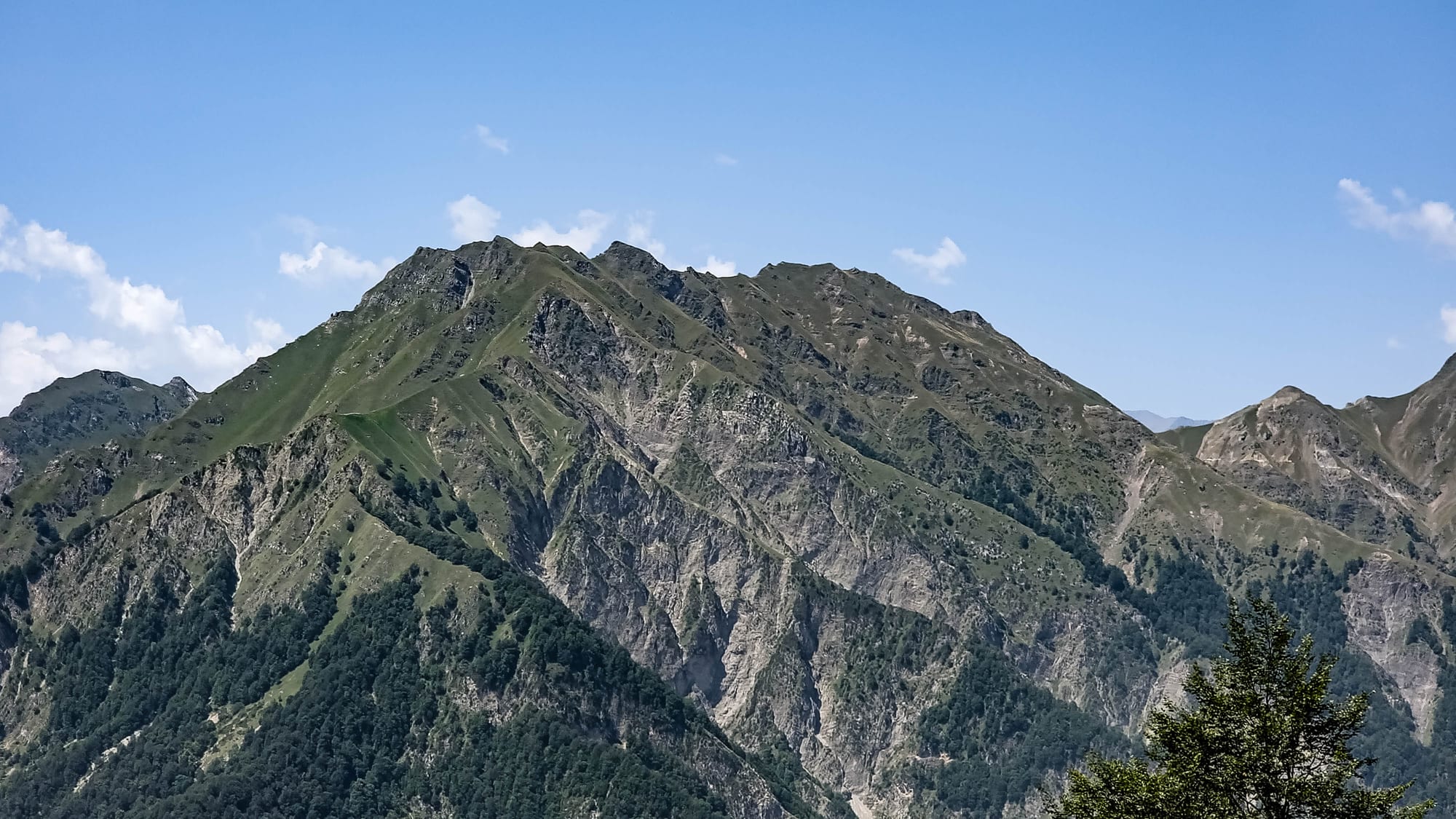
A rugged green mountain with rocky cliffs and forested lower slopes under a blue sky with a few small clouds

Azerbaijan

Sheki, Gabala & the Northwest

Mount Tufandağ above Gabala, seen from a station of the Gabala cable car. (ProCreeper 2000 / Wikimedia Commons · CC BY-SA 4.0)

Azerbaijan's green northwest, a strip of forested foothills along the southern flank of the Greater Caucasus from Gabala and Sheki to Zagatala and the Georgian border — silk and khans' country, with a painted palace, old caravanserais, the Christian Udi village of Nij and hazelnut orchards below the snowline.

Explore Sheki, Gabala & the Northwest

History

The foothills of the northwest were the heartland of Caucasian Albania, the ancient Christian kingdom that ruled much of today's Azerbaijan before the Arab conquests. Its capital stood at Gabala, whose earthworks and walls survive outside the modern town. Arab, Seljuk, Mongol and Persian rulers followed, while the local Christian communities slowly converted to Islam — all except the Udi of Nij, who still keep their church.

Sheki rose on silk. The mulberry groves of the foothills and the caravan roads between Persia, Russia and Georgia made it a trading town, and in the 1740s, in a revolt against Nader Shah's governors, a local ruler, Haji Chalabi, made it the seat of an independent khanate. After a catastrophic flood destroyed the old town in the 1770s, the khans moved to the present site higher up the valley, where the palace and the fortress walls were built.

Russia took the khanate in the early 19th century and abolished it a few years later. Under the Russian and Soviet name of Nukha the town kept its silk industry; it was renamed Sheki in 1968. Since independence Gabala has become a resort, a Soviet-era radar station there leased by Russia closed in 2012, and in 2019 UNESCO listed Sheki's historic centre with the Khan's Palace as a World Heritage Site.

Culture & Customs

The northwest has the most varied population in Azerbaijan after the northeast. Azerbaijanis are the majority, but Avars and Tsakhurs, Dagestani peoples, live in Zagatala and Balakan; the Ingiloys of Gakh are Georgian-speaking, mostly Sunni Muslim with an Orthodox Christian minority; and the Udi of Nij speak one of the languages descended from ancient Caucasian Albania and worship in their own church. Sunni Islam is more common here than in the Shia-majority south and east.

Sheki is the craft capital of the region. Its masters make shebeke, windows of coloured glass set in wooden lattice held together without nails or glue, and the town is one of the centres of kelaghayi, the patterned silk headscarf whose making and wearing is inscribed on UNESCO's intangible heritage list. Pottery, embroidery and copper also survive in small workshops.

Sheki is known for its comic tales, above all the jokes about Hacı dayı, and has its own dialect of Azerbaijani. Hospitality follows the national pattern — tea first, food pressed on guests — and village weddings and Novruz celebrations are big communal events. Gabala has hosted an international classical music festival each summer since 2009.

Daily Life

Sheki, with around 65,000 people, is the region's main town: an old upper town of walled courtyard houses and mulberry trees climbing the valley, and a lower Soviet-era town with the market and bus station. Zagatala, Gabala, Gakh, Oghuz and Balakan are smaller district centres, and much of the population lives in large villages strung along the foothill road.

Farming dominates. Hazelnuts are the region's great cash crop, grown in orchards from Gabala to Balakan and exported widely; chestnuts, walnuts, tobacco and livestock follow. Sheki's old silk trade lives on in sericulture, and tourism — Sheki's old town, Gabala's hotels and resort — is now the growth business.

The rhythm is rural: early markets, men in the tea houses through the afternoon, families in the orchards at the late-summer nut harvest. In summer Gabala fills with visitors from Baku and the Gulf, while in the upland villages the young leave for Baku or Russia and the old stay behind.

Food

Sheki is one of Azerbaijan's great food towns. Its piti is cooked for hours in individual clay crocks — mutton, chickpeas, chestnuts and a piece of tail fat, coloured with saffron — and is eaten in two stages: the broth first, poured over torn bread, then the meat and chickpeas. Sheki halva is the other speciality: a lattice of rice-flour pastry filled with chopped hazelnuts and soaked in syrup, sold by weight in the town's shops. Sheki's sweet shops also sell nabat, crystallised sugar that is taken with tea.

The foothills supply the rest. Hazelnuts, walnuts and chestnuts go into sweets and stews, persimmons and quinces into preserves, and lamb, veal and river trout come to the table grilled as kebab. Qutab stuffed with herbs and lavash baked on a curved iron sheet are everyday fare, and mountain honey and sheep's cheese are sold along the Gabala road.

Tea is served, as everywhere, strong and black in armudu glasses with jam, and the region's hazelnuts often come with it.

Attractions & Natural Wonders

Sheki is the reason most visitors come. The Khan's Palace, set inside the old fortress walls, is small but covered in painted battle scenes, flowers and hunting motifs, with shebeke windows that throw coloured light across its rooms. Below it, the Upper and Lower Caravanserais preserve the courtyards and arched galleries of the silk-trade era, and the upper town's lanes of courtyard houses are part of the UNESCO-listed historic centre. A short drive above the town, the village of Kish has its restored medieval church.

Gabala, to the east, is the base for the forested foothills of the Greater Caucasus: the Tufandag mountain resort with its cable cars, Nohur lake, the ruins of ancient Gabala outside town, and the Udi village of Nij, with its church, to the southwest.

West of Sheki, the foothill road runs through Gakh — where the stone village of Ilisu sits in a mountain valley near the Ilisu nature reserve — to Zagatala, with its 19th-century Russian fortress and giant plane trees, and on to Balakan and the Georgian border; the Zagatala nature reserve protects the high forests and meadows behind.

Cities in Sheki, Gabala & the Northwest

Planning basics

Budget

The northwest is noticeably cheaper than Baku. Sheki has good-value guesthouses and a caravanserai hotel, and meals of piti and kebab cost little. Gabala is the exception: its resort hotels are priced for Baku and Gulf weekenders, especially in summer. Zagatala, Gakh and Balakan are cheap but have few hotels.

Daily Budget Midrange
USD 70–140 (good hotel or Gabala resort, restaurant meals, a car with driver)
Daily Budget Shoestring
USD 30–50 (guesthouse, tea-house and canteen meals, buses and shared taxis)

Carry cash outside Sheki and Gabala, and ask the price before ordering halva by weight in Sheki's shops.

Safety

The northwest is one of the calmest parts of Azerbaijan. The main hazards are narrow mountain roads, flash floods after heavy rain in the river beds that cross the foothills, and bears in the forests of the reserves. The high ridge along the Russian border is a controlled zone.

Stay on marked trails in the reserves, avoid riverbeds in stormy weather, and keep away from the border zone. Check current official travel advice before travelling.

Climate

The region is wetter and greener than the rest of Azerbaijan: the Caucasus catches the rain, and the foothills are covered in beech, oak and chestnut forest. Summers are warm rather than hot, winters are cool with snow in the hills, and the higher valleys above Gabala and Zagatala stay snowbound for months.

Summer
warm, 25–32°C in the towns, cooler in the forests and mountains, with thunderstorms
Winter
cool and damp in the towns, around 0–8°C; snow in the foothills and heavy snow higher up

Transportation

Sheki is roughly five hours by road from Baku, with buses and shared taxis from the capital; Gabala has an airport, and a railway line serves the region from the south. The main road runs along the foothills from Gabala through Sheki to Zagatala and on to the Georgian border at Balakan, a popular route between the two countries.

Sheki and Gabala combine easily in two or three days by road; mountain villages such as Ilisu need a car and a local driver.

Best Time to Visit

May to June and September to October are the best months: green forests in spring, the hazelnut and chestnut harvest and autumn colour in the foothills later in the year. July and August are busy in Gabala with Baku holidaymakers, and winter brings skiing at Tufandag above Gabala.