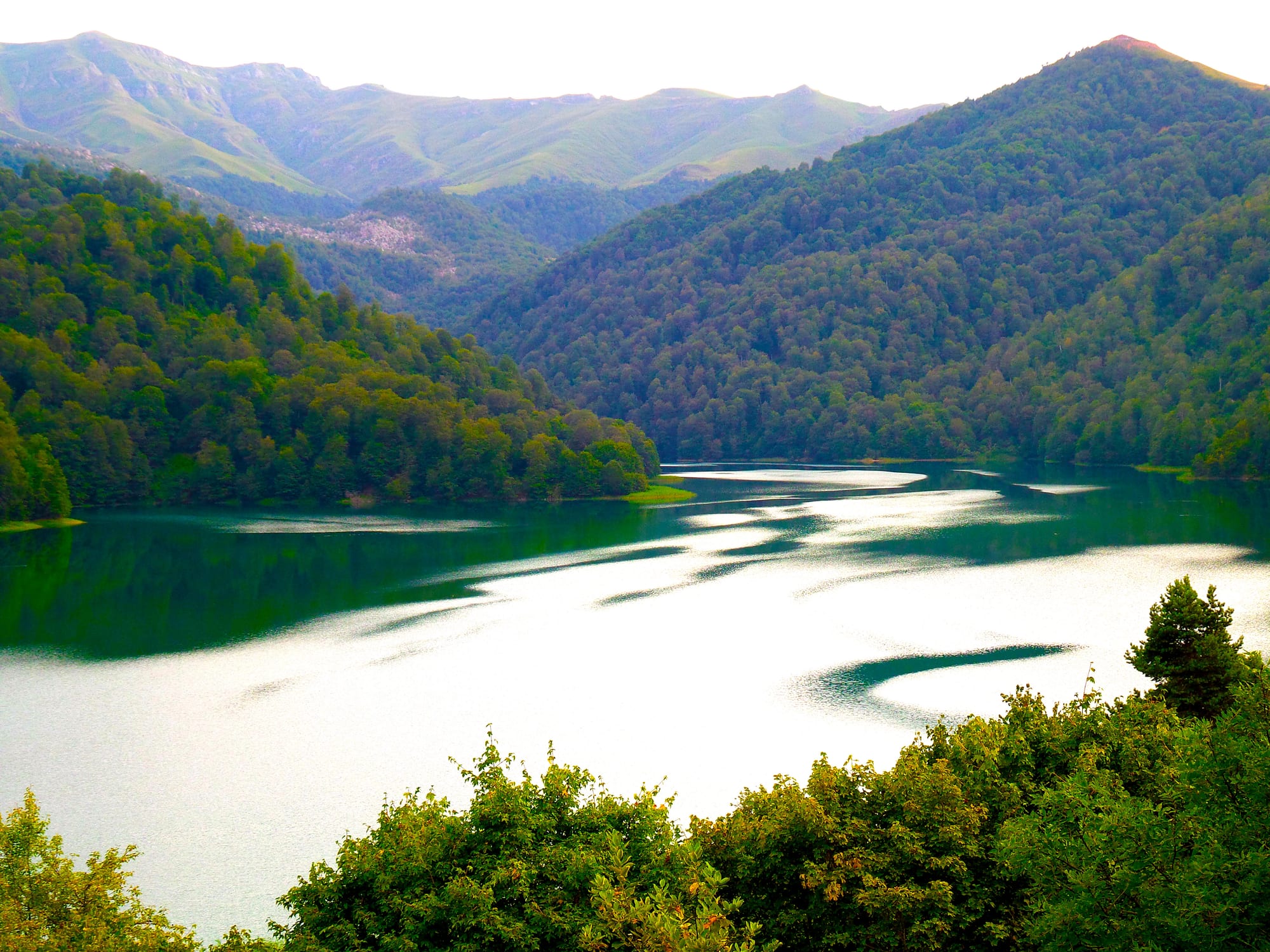
A winding green lake between steep hills covered in dense forest, with grassy mountain ridges behind

Azerbaijan

Ganja, Karabakh & the West

Lake Göygöl in the forested Lesser Caucasus south of Ganja, the centre of Göygöl National Park. (Ilkin M-zade / Wikimedia Commons · CC BY-SA 4.0)

Western Azerbaijan, from Ganja, the country's third-largest city, and the forested Lesser Caucasus around Lake Göygöl to the highlands of Karabakh, Kalbajar and Lachin — a region shaped by the long conflict with Armenia, retaken by Azerbaijan in 2020–23 and still largely closed to ordinary visitors.

Explore Ganja, Karabakh & the West

History

Ganja is one of the oldest cities of the Caucasus, a medieval trading town on the road between the Kura valley and the Lesser Caucasus. Its golden age came in the 12th century under the Seljuks and the Eldiguzids, when the poet Nizami Ganjavi wrote his Persian romances here; an earthquake in 1139 that levelled the city also brought down the flank of Mount Kapaz and dammed the river that formed Lake Göygöl. Later the city was a Safavid stronghold, and in the 18th century the seat of the Ganja khanate, whose last khan, Javad Khan, was killed defending it against Russian troops in 1804. Russia renamed it Elisavetpol; the Soviets called it Kirovabad.

In 1819 Swabian German settlers founded Helenendorf, today's Göygöl, and planted the vineyards that made it a wine town until the Soviet deportation of its Germans in 1941. In 1918 Ganja served as the temporary capital of the new Azerbaijan Democratic Republic.

Karabakh has a longer and more contested story. In the mid-18th century Shusha became the fortress-capital of Panah Ali Khan's Karabakh khanate, and grew into a mixed Azerbaijani and Armenian town famous for music. In the war of the early 1990s Armenian forces took Nagorno-Karabakh and the surrounding districts — including Shusha, Aghdam, Kalbajar and Lachin — and hundreds of thousands of Azerbaijanis were displaced; Aghdam was left in ruins. Azerbaijan regained control of most of the territory in 2020, when Ganja was also hit by missiles that killed civilians, and the rest in September 2023, after which almost all of the region's Armenian population fled to Armenia. The state is now rebuilding towns and resettling former residents, under a programme it calls the Great Return.

Culture & Customs

Ganja carries a strong literary identity built around Nizami, whose name appears on streets, schools and the city's mausoleum, and around the medieval poet Mahsati Ganjavi. Gazakh and Tovuz, towards the Georgian border, are known for their carpets — the Gazakh school, with its bold geometric designs, is among the best-known groups of Caucasian rugs — and for a local pride in the poets and teachers they produced.

Shusha holds a special place in Azerbaijani culture. It is celebrated as a cradle of mugham, the classical vocal art, and as the home of the poet Khurshidbanu Natavan, the singer Bulbul and the composer Uzeyir Hajibeyov, who grew up there. In 2021 it was declared the country's cultural capital, and the Kharibulbul festival of music has been revived there. The kharibulbul, a small orchid of the Shusha meadows, has become a national symbol of the region.

The Karabakh horse, a golden-coated breed raised in the region for centuries, is another emblem. The conflict remains the dominant emotional subject: for Azerbaijanis, the return to Karabakh is framed as the end of three decades of displacement, while the Armenian churches and monuments in the region, such as Shusha's Ghazanchetsots Cathedral, are the subject of continuing international dispute.

Daily Life

Ganja, with around 335,000 people, is Azerbaijan's third-largest city: a grid of broad avenues, tree-lined squares and Soviet housing, with a university population and industries ranging from aluminium to textiles. Shamkir, Tovuz, Gazakh and Goranboy are farming towns, Dashkasan grew up around iron ore mining, and the Kura lowlands produce grapes, cotton, grain and livestock.

Karabakh is in the middle of reconstruction. Former residents displaced in the 1990s — many of whom spent decades in Baku, Ganja and the camps and hostels of the central plain — are being resettled into new villages and rebuilt towns in Aghdam, Shusha and elsewhere, but progress is slowed by landmine clearance. Khankendi (Stepanakert in Armenian) lost almost all its Armenian population in 2023 and is being resettled.

In Ganja itself daily life follows the national pattern of long tea-house afternoons, family gatherings and evening walks in the central park, and people take pride in their city's own identity rather than being an outpost of Baku.

Food

The west is grape and orchard country. Vineyards around Göygöl, Shamkir and Tovuz make the west one of Azerbaijan's main wine areas, and Göygöl's winemaking goes back to Helenendorf's German settlers. Ganja's markets sell pomegranates, quinces, persimmons, walnuts and chestnuts from the Lesser Caucasus foothills, and preserves of cornelian cherry and figs.

The table is built on lamb. Bozbash, a lamb and chickpea soup, and kebabs grilled over vine wood are standard, as are dolma of vine leaves and qutab stuffed with herbs or meat. Plov is served at every celebration, often with dried fruit and chestnuts, and tendir bread comes hot from clay ovens in the villages.

The Karabakh highlands are known for mountain honey, dairy and lamb, and the mineral springs of Istisu in Kalbajar fed a spa resort of all-Union importance in Soviet times. Meals end, as everywhere, with black tea and jam.

Attractions & Natural Wonders

Ganja's centre holds the Shah Abbas mosque of the early 17th century, the tomb of Javad Khan, the quirky Bottle House decorated with thousands of glass bottles, and, on the edge of town, the Nizami mausoleum in its gardens. Göygöl town, under an hour south, keeps the Lutheran church and stone houses of German Helenendorf.

Beyond it lies Lake Göygöl, the "blue lake", in Göygöl National Park, with Mount Kapaz above; a string of smaller lakes created by the same 1139 earthquake lies further up the valley. Naftalan, to the east, is a spa town whose sanatoriums offer baths in Naftalan oil, a form of alternative medicine.

Shusha and the highland districts of Karabakh, retaken in 2020–23, are still largely closed to visitors apart from official and organised trips. Shusha's sights include the fortress walls, the Yukhari Govhar Agha mosque, the houses of Natavan and Bulbul, and the Jidir Duzu plateau above the cliffs. In Aghdam, the 19th-century mosque stands amid the ruined city, while Kalbajar and Lachin contain high mountain pastures, mineral springs and gorges now being opened by new roads.

Cities in Ganja, Karabakh & the West

Planning basics

Budget

Ganja and the Göygöl area are cheaper than Baku, with modest hotels, cheap canteens and inexpensive local transport. Naftalan's sanatoriums sell treatment packages by the week, which is a different kind of spending. Karabakh cannot be visited independently at present: trips there are organised and priced by approved operators, and prices are set by them.

Daily Budget Midrange
USD 65–130 (good Ganja hotel, restaurant meals, a car with driver to Göygöl)
Daily Budget Shoestring
USD 25–45 (simple hotel or guesthouse, canteen meals, buses and trains)

Carry cash beyond Ganja city centre; for Naftalan, compare full treatment packages rather than nightly rates.

Safety

Ganja, Göygöl and the western towns are calm. Karabakh, Kalbajar and Lachin are a different matter: they are among the most heavily mined areas of the former Soviet Union, access is controlled, troops are stationed there, and the border with Armenia remains militarised. Photography of military and security sites is unwise, and the conflict is a highly sensitive subject in conversation.

Enter the Karabakh districts only with official permission and a guide, never leave paved roads or marked paths there, and avoid the Armenian border zone. Check current official travel advice before travelling.

Climate

Ganja and the Kura lowlands are hot and dry in summer and mild in winter, much like the central plain. The forested Lesser Caucasus around Göygöl is cooler and wetter, and the Karabakh uplands around Shusha, at about 1,400 metres, have mild summers and cold, snowy winters; Kalbajar and Lachin are higher and harsher still.

Summer
hot in Ganja, 30–36°C; pleasant around Göygöl and Shusha, 20–27°C
Winter
mild in Ganja, around 0–8°C; cold with snow in the mountains and in Shusha

Transportation

Ganja is about four to five hours from Baku by road or train and has its own airport; the main highway and railway to Georgia continue west through Shamkir, Tovuz and Gazakh. Göygöl lake is under an hour's drive south of Ganja. In Karabakh, Azerbaijan has built new highways and airports at Fuzuli and elsewhere, but entry to the districts is by official permission, usually on organised trips.

Use the train or shared taxis for Ganja; do not try to drive into the Karabakh districts without prior official permission.

Best Time to Visit

May to June and September to October are the best months for Ganja and Göygöl, with green forests in spring and autumn colour later. Midsummer is hot on the plain but cool at the lake, and Göygöl's road can close after heavy snow in winter. Any visit to Karabakh depends on current access rules rather than on the season.