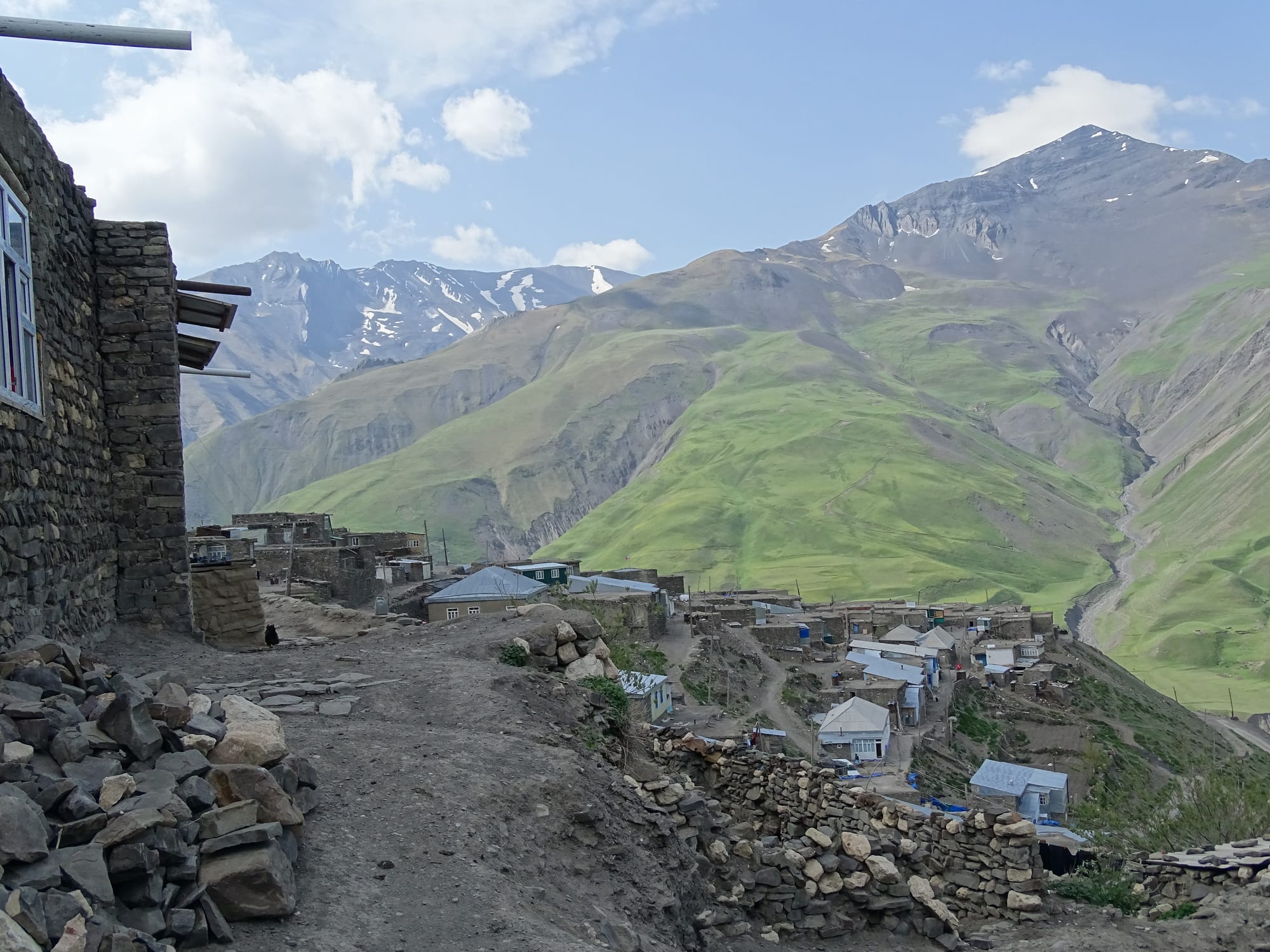
Stone houses with metal roofs stepping down a bare slope above a green valley, with snow-streaked peaks behind

Guba & the Northeast, Azerbaijan

Khinalug

The terraced stone houses of Khinalug below the peaks of the Greater Caucasus. (Adam Jones from Kelowna, BC, Canada / Wikimedia Commons · CC BY-SA 2.0)

A stone village on a bare ridge high in the Greater Caucasus, at about 2,180 metres and reached by a long mountain road from Quba. Its flat-roofed houses stand in terraces one above another, its people speak Khinalug, a language spoken nowhere else, and their seasonal migration with flocks between mountain and lowland pastures is recognised by UNESCO.

Neighbourhoods

  • The old upper village
    • First-time visitors
    • Historic district
    • Walks and viewpoints

    The heart of Khinalug, where stone houses are stacked so closely up the slope that one roof serves as the yard of the house above. Lanes are narrow, steep and unsurfaced, and the views over the valley open at every turn.

    Open in Maps
  • The lower village and the road
    • Close to transport
    • Quiet and residential

    The newer part of the settlement, near where the road from Quba arrives. School, shop and administrative buildings stand here, along with several of the guesthouses, and it is the flattest ground in the village.

    Open in Maps
  • The slopes and summer pastures
    • Walking
    • Quiet and residential

    Beyond the houses the ground rises to open grazing crossed by shepherds' paths, with stone folds and summer huts. It is walking country rather than a place to stay, and weather changes here without much warning.

    Open in Maps

Things to do

In and around the village

  • Shahdag National Parkpark

    The largest national park in Azerbaijan, covering the high meadows, forests and bare ridges of the Greater Caucasus around the village.

    Open in Maps
  • Bazardüzüviewpoint

    The highest mountain in Azerbaijan, on the ridge that forms the border with Russia's Dagestan, visible from the high ground above the village.

    Open in Maps

Short trips from the village

  • Qusarattraction

    A district town on the far side of the range, centre of Azerbaijan's Lezgin community and the road junction for the ski slopes.

    Open in Maps
  • Lazaattraction

    A Lezgin mountain village under cliffs streaked with waterfalls, on the far side of the range in Qusar district.

    Open in Maps
  • Shahdag Mountain Resortattraction

    Azerbaijan's main winter sports resort, with lifts and hotels on the slopes above Qusar and cable cars running in summer too.

    Open in Maps
  • Qubaattraction

    The district town down in the foothills, with its market, carpet tradition and the Mountain Jewish settlement across the river.

    Open in Maps

Seasonal events

  • The move to the summer pastureslate spring

    Families and flocks leave for the high grazing as the snow retreats, the most important moment of the village year.

  • The return from the pasturesautumn

    Sheep come down from the mountains before the first heavy snow, and the village fills again for the winter.

  • NovruzMarch

    The spring new year, marked with bonfires, sweets and visits between households, though snow often still lies around the houses.

Eat and drink

Long-standing places and food districts in Khinalug. Hours, ratings and directions come from your maps app, always current.

Khinalug classics

  • Guesthouse tablesrestaurant

    There is no restaurant district; meals are eaten where visitors stay, usually lamb or chicken, dairy, bread and whatever the household has preserved.

    Open in Maps
  • Village dairy and mountain cheesemarket

    Sheep's and cows' milk becomes butter, curd and sharp matured cheese in the households; small shops in the village carry basic supplies.

    Open in Maps

Experience Khinalug

History

Khinalug's age is hard to fix, but its people, held to descend from the ancient populations of Caucasian Albania, have occupied the same exposed ridge for many centuries. Its position explains its survival: the site is high, difficult to reach and easy to watch from, and the armies that moved along the Caspian corridor below had little reason to climb to it. That isolation preserved the Khinalug language, a member of the Northeast Caucasian family with no close relatives even in the neighbouring valleys.

Islam came late to these heights: local accounts date the preaching that converted the village to the 12th century, and the people, Shafi'i Sunni today, are said to have followed Zoroastrianism before it, with traces of those older beliefs still pointed out in the oldest part of the village. Under the Quba khanate and then Russian rule Khinalug was taxed and counted but largely left to itself, and its shepherds continued to drive flocks between summer grazing in the high Caucasus and winter pastures on the lowland plains, along the route known as the Köç Yolu.

The Soviet period brought a school, a clinic and collective farming, but no road fit for vehicles; until the 2000s the village was reached on horseback or on foot along the gorge. A driveable road transformed daily life and brought the first visitors, along with electricity and better supplies. In 2023 UNESCO inscribed the cultural landscape of the Khinalug people and the Köç Yolu route as a World Heritage Site, recognising a way of life that has continued through all of it.

Culture & Customs

The language is the centre of local identity. Khinalug is spoken by the villagers and by those who have moved away, and it is unrelated to Azerbaijani; most residents use both, and many also have Russian. The language has no long written tradition, and passing it to children at home is how it survives.

Life is organised around sheep. The annual movement of flocks and families between high and low pastures shapes the calendar, the division of labour and the architecture: flat roofs are used for drying dung fuel and hay as well as for sitting, and houses are built into the slope so that the roof of one is the terrace of the next. Wool supports weaving, and carpets and thick felt work have long been made here.

Hospitality is close to obligatory. A visitor is given tea and food before being asked their business, and refusing outright is awkward. Elders are consulted and deferred to, mosque attendance is normal among men, and weddings and funerals draw the whole village. Novruz is celebrated with bonfires in March, when snow often still lies on the ground. Villagers are used to photographers and interviewers and are generally patient with them, but asking first is expected, and paying attention to the flocks and the weather earns more goodwill than admiring the view.

Daily Life

About 2,000 people live in Khinalug, in a few hundred households, and the number rises and falls with the seasons and with work in Baku and Russia. The village has a school, a clinic, a mosque, small shops and a growing number of guesthouses, and almost everything else comes up the road from Quba.

Sheep and cattle remain the basis of the economy. Men spend long spells with the flocks on the pastures; households keep cows for milk, butter and cheese; and dung is dried and stacked as winter fuel, since there is no woodland at this altitude. Wool, cheese and meat are sold down in Quba. Tourism has become the second source of income, with guesthouses, guiding and horse hire, concentrated in the summer months.

The day starts early and ends early. Water, fuel and animals set the rhythm, and in winter, when snow can cut the road for days, life narrows to the house and the stove. Young people leave for education and work and many do not return permanently, which the village discusses as its central problem, alongside the pressures that come with more visitors: waste, water and the wish to keep the old houses standing rather than replaced with concrete.

Food

Khinalug eats what the flocks and the short growing season provide. Lamb and mutton are boiled, stewed with onions and dried herbs or grilled, and every part is used, with tail fat saved for cooking. Milk from sheep and cows is turned into butter, thick yoghurt, curd cheese and sharp matured cheese, among it a crumbly sheep's cheese packed into a skin and left to ripen through the winter.

Bread is central: thin flatbread baked on a curved iron sheet over the stove, torn and eaten with everything. Qutab, thin folded breads filled with greens, cheese or minced meat, are made at home, and xəngəl — boiled dough served with meat and a garlic yoghurt sauce — is the dish most often set before guests. Herbs gathered on the mountainside go into fillings and soups, and dovğa, a warm yoghurt soup with rice and herbs, appears in many kitchens.

Fruit and vegetables come up from the lowlands, so preserves matter: jams of cornelian cherry and other fruit, dried apple and pear, and honey from the foothills below. Meals end with strong black tea in pear-shaped armudu glasses, taken with jam or a lump of sugar, and offered again as soon as the glass is empty.

Planning tools

Budget

Khinalug is cheap to stay in and expensive to reach. Homestays and simple guesthouses charge little, usually including meals, and there is almost nothing else to spend money on in the village. The cost of the visit is the transport: a car with driver from Quba for the mountain road, or a seat in a shared vehicle when one is running.

Daily Budget Midrange
USD 70–150 (better guesthouse room, meals, a car with driver from Quba and a guide for walks)
Daily Budget Shoestring
USD 30–50 (homestay with meals, a seat in a shared vehicle from Quba)

Bring enough cash for the whole stay, agree the price of a car and a guide before leaving Quba, and expect to pay more if snow or rain makes the road harder.

Best Time to Visit

June to September, when the road is reliably clear, the meadows are green and the flocks are on the high pastures. May and October can be fine but turn cold and wet quickly. From late autumn to spring the village is snowbound for long spells and the road may be closed altogether.

Suggested Number of Days

A night in the village is worth more than a day trip, since the light and the quiet after the visitors leave are much of the point. Two or three days allow longer walks onto the pastures. Weather is the main variable and can add a day.

First Visit
1–2 days
With Surroundings
2–3 days

Transportation

There is no public transport worth relying on. A shared vehicle occasionally runs between Quba and the village for residents, but most visitors hire a car with a driver, and a four-wheel-drive vehicle is the usual choice. Within Khinalug everything is done on foot, along steep unsurfaced lanes; horses and small trucks do the heavy carrying.

Use a driver experienced on the mountain road, set out early rather than late in the day, and confirm the return arrangement before being dropped off.

Airport & Station Connections

The village lies at the end of a single mountain road that climbs from Quba, south-west of the town, following a river gorge and then a series of high bends. The drive commonly takes about two hours and longer in poor weather. Quba is some three hours by road from Baku, so most visitors break the journey there.

Walkability

The village is small and can be crossed on foot in a quarter of an hour, but every route is steep, and the lanes are stone, mud or loose earth. The altitude of more than 2,000 metres makes climbs harder than they look, and walking onto the pastures beyond means open ground with no shelter. Sturdy shoes matter more here than anywhere in the lowlands.

Safety

Crime is effectively unknown, and hospitality is strong. The hazards are environmental: sudden weather, cold at altitude, thin air, unfenced drops beside the lanes and rockfall on the road in and out. Livestock guard dogs work loose around the flocks and should be given a wide berth. The high ridge to the north is a controlled border zone.

Carry warm and waterproof layers even in summer, keep well clear of shepherds' dogs and the border zone, take a local guide for walks onto the pastures, and allow for the road closing in bad weather. Check current official travel advice before travelling.

Climate

A high mountain climate. The village sits above 2,000 metres, so it is markedly colder than Quba below, with cool summers, rapid changes of weather, frequent cloud and a long winter of deep snow.

Summer
cool, often around 15–22°C by day with cold nights and afternoon cloud or storms
Winter
cold and snowbound, often around -8 to 0°C by day and considerably colder at night

Local Customs

Village manners are conservative and hospitable in equal measure. Guests are given the best place and fed generously, and payment is settled discreetly rather than discussed at the table. Modest dress is expected, particularly for women, and shoes are removed indoors. People speak Khinalug among themselves and Azerbaijani with outsiders; a few words of greeting are appreciated.

Permission should be asked before photographing people, houses or flocks, modest clothing worn, shoes removed indoors, and small gifts rather than cash offered to children.

Common Payment Methods

The currency is the Azerbaijani manat, and Khinalug runs on cash. There are no bank branches or cash machines, and card payment is not to be expected, so enough money for accommodation, meals, guiding and transport should be drawn in Quba before setting off.