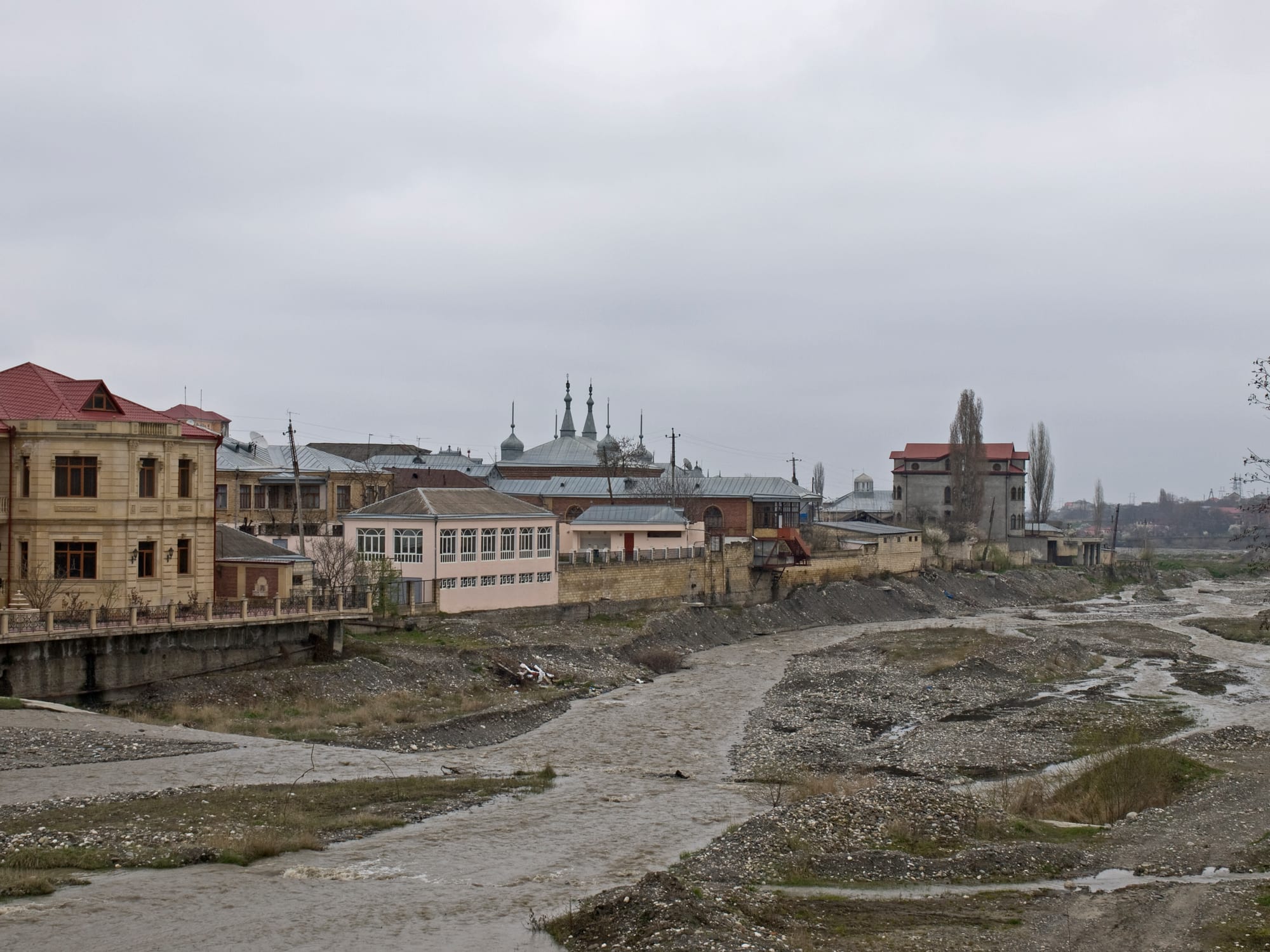
Houses with red and grey roofs and a minareted building above the wide stony bed of a shallow river under a grey sky

Guba & the Northeast, Azerbaijan

Quba

Qırmızı Qəsəbə seen from the bridge across the Gudyalchay river at Quba. (Ymblanter / Wikimedia Commons · CC BY-SA 4.0)

A foothill town in north-eastern Azerbaijan, set above the wide stony bed of the Gudyalchay river where the Greater Caucasus meets the Caspian lowland. Capital of a powerful 18th-century khanate and long a centre of carpet weaving and apple growing, it now serves as the gateway to the mountain villages, the Shahdag slopes and the Mountain Jewish settlement across the river.

Neighbourhoods

  • The town centre and bazaar
    • First-time visitors
    • Markets
    • Close to public transport

    The low streets around the main square, the covered market and the bus station, where the tea houses, bakeries and carpet and fruit sellers are. Most of the town's hotels and guesthouses stand within a few minutes' walk, and the mosques and parks of the old quarter are just behind.

    Open in Maps
  • Qırmızı Qəsəbə
    • Historic district
    • Quiet and residential

    The settlement on the far bank of the Gudyalchay, reached by a footbridge, and the principal home of Azerbaijan's Mountain Jews. Brick and plastered houses line straight streets behind garden walls, with synagogues among them and a hillside road looking back over the town.

    Open in Maps
  • The riverside and upper streets
    • Walks and viewpoints
    • Quiet and residential

    Above the river bank the streets climb into orchards and gardens, with older courtyard houses, poplars and views across to the mountains. It is residential and quiet, a short walk from the centre and the crossing to the far bank.

    Open in Maps

Things to do

In the town

  • Qırmızı Qəsəbəneighborhood

    The settlement across the river that is the main centre of the Mountain Jews in Azerbaijan, with synagogues, a Juhuri-speaking community and a long connection to the Quba khans.

    Open in Maps
  • Quba Genocide Memorial Complexlandmark

    A memorial opened in 2013 over a mass grave found in the town in 2007, commemorating those killed in the violence of 1918.

    Open in Maps

Short trips from the town

  • Khinalugattraction

    A stone village high in the Greater Caucasus with a language of its own, reached by a mountain road that climbs from Quba.

    Open in Maps
  • Shahdag National Parkpark

    The largest national park in Azerbaijan, covering high forest, meadow and bare ridges of the Greater Caucasus above the town.

    Open in Maps
  • Shahdag Mountain Resortattraction

    Azerbaijan's main winter sports resort, on the slopes of the Shahdag massif above Qusar, with cable cars running in summer as well.

    Open in Maps
  • Lazaattraction

    A small Lezgin village under cliffs streaked with waterfalls, in a mountain valley beyond Qusar.

    Open in Maps
  • Qusarattraction

    The neighbouring district town, the centre of Azerbaijan's Lezgin community and the road junction for the mountains.

    Open in Maps

Seasonal events

  • NovruzMarch

    The spring new year, marked with bonfires, sweets and visits between households in the town and the surrounding villages.

  • The apple harvestSeptember and October

    Quba's orchards are picked in early autumn, and stalls along the roads sell apples, dried fruit and preserves.

  • Ramadan and Eidvaries with the lunar calendar

    Fasting, evening meals and holiday visiting shape the month and the feast that closes it in this mostly Muslim town.

Eat and drink

Long-standing places and food districts in Quba. Hours, ratings and directions come from your maps app, always current.

Quba classics

  • The town bazaarmarket

    Apples, quinces, cornelian cherries, walnuts, mountain honey, sheep's cheese and jars of preserves, alongside bread baked on curved iron sheets.

    Open in Maps
  • Tea houses of the centrecafe

    Black tea in pear-shaped armudu glasses, taken with jam and sugar crystals, in the tea houses around the square and by the river.

    Open in Maps

Food districts

  • Qırmızı Qəsəbəneighborhood

    The Mountain Jewish settlement across the river, where bakeries and small eating places keep a cooking tradition distinct from the town's.

    Open in Maps
  • The Quba highway stallsmarket

    Stands along the approach roads selling the district's apples, jams and dried fruit, busiest through the autumn.

    Open in Maps

Experience Quba

History

Quba grew where the road along the Caspian meets the valleys of the eastern Caucasus, a crossing point between the lowland and the mountain peoples of the interior. The settlement took its modern importance in the 18th century, when Persian authority in the region weakened and a local dynasty established the Quba khanate, moving its seat here from Khudat on the coastal plain. Under Fatali Khan, who ruled in the second half of the century, Quba extended its power over Derbent, Baku and much of the Caspian shore and became one of the strongest states in the eastern Caucasus.

Mountain Jews, who had long lived in the region, settled in numbers on the far bank of the Gudyalchay under the protection of the khans, and their settlement, now Qırmızı Qəsəbə, grew into the country's largest community of Mountain Jews. The Russian Empire absorbed the khanate early in the 19th century and abolished it, after which Quba settled into the role of a provincial district town living on its orchards, its looms and its market.

The collapse of imperial rule brought violence to the town in 1918, as it did across the region; a mass grave was uncovered in Quba in 2007, and a memorial complex was built over it and opened in 2013. Soviet policy turned the district into a fruit-growing centre, with orchards, canneries and cold stores. Since independence, better roads to Baku, the building of the Shahdag resort and the appeal of the mountain villages have made the town a base for visitors as well as a market centre.

Culture & Customs

Quba is one of the most mixed towns in Azerbaijan. Azerbaijani is the common language, but Tats, who speak an Iranian language, live in villages around the town; Lezgins are numerous towards Qusar; and the Mountain Jews of Qırmızı Qəsəbə speak Juhuri, another Iranian tongue, and keep their synagogues across the river. That the two communities have lived on opposite banks for centuries is a point of local pride, and the bridge between them is as much a social landmark as a practical one.

The town's craft reputation rests on carpets. Quba rugs are one of the classic groups of Caucasian weaving, the town remains a centre of the carpet industry, and looms still work in village houses around the district. Azerbaijani carpet weaving as a whole was recognised by UNESCO as intangible cultural heritage in 2010.

Manners follow the conservative pattern of the north-east. Guests are fed first and at length, tea comes before business, elders are deferred to, and modest dress is expected of women in the villages. Novruz in March is the great communal festival, marked with bonfires, sweets and visiting; weddings fill whole streets; and the tea house remains the centre of male social life, where the news of the district is exchanged over long afternoons.

Daily Life

About 47,000 people live in Quba itself, with well over a hundred thousand more in the surrounding district of villages. It is a low town of brick and plastered houses with gardens, apartment blocks towards the highway, a covered market, a bus station and a scatter of hotels built for the traffic heading into the mountains. Qırmızı Qəsəbə, across the river, functions as part of the same town while keeping its own character.

The economy is built on fruit. Quba apples are the best known in Azerbaijan, and the orchards also yield quinces, cherries, plums and walnuts; refrigerated warehouses along the road store the crop for Baku and for export, and canning and juice making follow the season. Carpet weaving, livestock and small trade fill in around it, and tourism — traffic to Khinalug, Laza and the Shahdag slopes — now provides a growing share of the work.

Days begin early with the market and end with long hours in the tea houses. The town swells in summer with families escaping the heat of the capital and with weekend visitors, and again at the harvest, when villages empty into the orchards. As across rural Azerbaijan, younger people leave for Baku or for work abroad, and money sent home supports many households; keeping them in the district is a standing local concern.

Food

Quba eats from its orchards. Apples appear fresh, dried, pressed into juice and above all boiled into mürəbbə, the thick whole-fruit preserve eaten by the spoonful with tea rather than spread on bread; quince, cherry, walnut and cornelian cherry preserves sit beside them on market stalls. Mountain honey, walnuts and hazelnuts come down from the foothills, and lavash, thin flatbread baked on a curved iron sheet, accompanies almost everything.

Meat cooking is that of the mountains. Lamb is grilled over charcoal as kebab or stewed slowly with herbs, and dovğa, a warm yoghurt soup with herbs and rice, is common in households. Xəngəl, boiled dough served with meat and a garlic yoghurt sauce, is eaten across the Caucasus, and qutab — thin folded flatbreads filled with greens, pumpkin or meat — are made everywhere. Sharp sheep's cheese matured in a skin, and fresh curd cheese, come from the high villages, and the Caspian supplies fish such as kutum, often served with narsharab, the sour pomegranate syrup.

Qırmızı Qəsəbə keeps a distinct kitchen, observing Jewish dietary rules with the same regional ingredients. Meals everywhere end with strong black tea in pear-shaped armudu glasses, drunk through a lump of sugar or with a spoon of jam.

Planning tools

Budget

Quba is inexpensive by Azerbaijani standards. Guesthouses and small hotels in the town cost far less than Baku, meals in tea houses and kebab restaurants are cheap, and the market is the cheapest way to eat well. The costs that add up are transport — a car with driver for Khinalug, Laza or the waterfalls — and the resort hotels on the Shahdag slopes, which are priced for weekenders from the capital.

Daily Budget Midrange
USD 70–150 (good hotel or resort room, restaurant meals, a car with driver to the mountain villages)
Daily Budget Shoestring
USD 30–50 (guesthouse or homestay, tea-house and canteen meals, shared taxis and buses)

Carry cash, agree the fare with a driver before setting out for the mountains, and expect higher room rates on summer weekends and in the ski season.

Best Time to Visit

Late spring to early autumn suits the town best: the orchards are in blossom in April, the mountain roads above are clear from June, and September and October bring the apple harvest and colour in the hills. Winter is cold and often snowy, quiet in the town but busy on the Shahdag slopes an hour away.

Suggested Number of Days

The town itself is small enough for a day, with a second for the settlement across the river and the nearer hills. Three or four days allow the high mountain villages and the Shahdag area as well, and bad weather on the upper roads can stretch any plan.

First Visit
1–2 days
With Surroundings
3–4 days

Transportation

Buses and shared taxis run between Baku and Quba through the day, and the town is compact enough to cross on foot. Local minibuses serve the surrounding villages on their own rhythms, and most visitors hire a car with a driver for the mountain roads, which are narrow, unpaved in places and hard going after rain or snow.

Arrange mountain trips through a guesthouse or a local driver, and allow far more time than the distance suggests for the road to the high villages.

Airport & Station Connections

Quba lies roughly 170 kilometres north of Baku, about three hours by road along the Caspian highway and then inland. Buses and shared taxis leave from Baku's northern bus station, and a railway runs along the coast through Khachmaz, some distance from the town. The nearest airport of any size is in Baku.

Walkability

The centre is easily walked: the market, the square, the mosques and the river crossing are all within about a kilometre of one another, and the footbridge to the far bank takes a few minutes. Streets are low and shaded by trees, though pavements are uneven and the climb up from the river bank is steep in places. Anything beyond the town needs transport.

Safety

Quba is a calm town with little crime, and visitors are treated with considerable hospitality. The practical risks lie outside it: fast driving on the highway, rockfall and sudden weather on the mountain roads, and cold at altitude even in summer. The border zone towards Russia along the high ridge is controlled and should not be approached.

Take warm layers for any trip into the mountains, use a driver who knows the high roads, keep away from the border zone, and check the weather before setting out. Check current official travel advice before travelling.

Climate

The town sits at around 600 metres in the foothills, cooler and wetter than the Caspian lowland below it. Summers are warm rather than hot, autumn is long and settled, and winter brings frost and snow, with far deeper snow on the mountain roads above.

Summer
warm, generally around 25–30°C by day, with cooler evenings and afternoon storms in the hills
Winter
cold, around 0–6°C by day with frost at night and periods of snow

Local Customs

Hospitality is taken seriously: tea is offered before any conversation of substance, and refusing food outright can cause offence. Dress is conservative, particularly in the villages and at mosques, where heads are covered and shoes removed. Elders are greeted first. The town's Muslim, Mountain Jewish and Lezgin and Tat communities live closely together, and questions about religion or politics are best left alone.

Permission should be asked before photographing people, shoulders and knees covered at religious sites, shoes removed indoors when the host does so, and at least one glass of tea accepted.

Common Payment Methods

The currency is the Azerbaijani manat. Cards work in hotels, larger shops and petrol stations in the town, but the market, tea houses, village guesthouses and drivers expect cash. There are ATMs in central Quba; there are effectively none in the mountain villages, so draw out what is needed before leaving town.