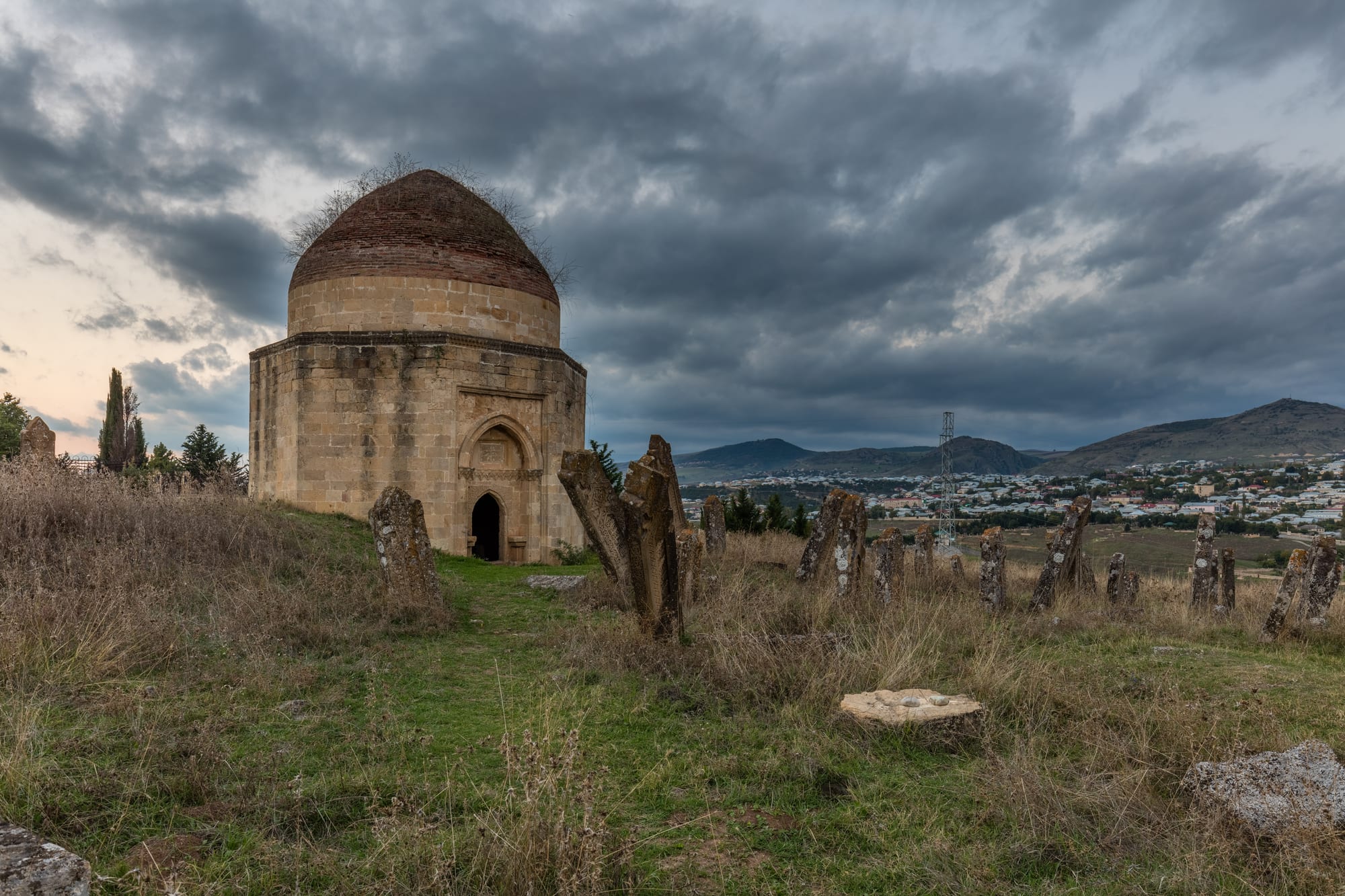
A stone domed tomb among leaning carved gravestones on a grassy ridge, with the town and bare hills behind under heavy cloud

Baku, Shirvan & Central Azerbaijan, Azerbaijan

Shamakhi

The Yeddi Gumbaz tombs on the ridge above Shamakhi, with the town in the valley behind. (Diego Delso / Wikimedia Commons · CC BY-SA 4.0)

An old hill town about 120 kilometres west of Baku, on the southern slopes of the Greater Caucasus. For centuries it was the capital of Shirvan and a silk-trading centre on the routes between Persia and Russia, until repeated earthquakes reduced it. Today it is a quiet district centre among vineyards, orchards and forested ridges.

Neighbourhoods

  • The town centre
    • First-time visitors
    • Historic district
    • Close to public transport

    A compact grid of low buildings around the main square, the bazaar and the Juma Mosque, with the bus stand and most of the town's shops and tea houses within a few minutes' walk. Almost everything a short visit covers is here or on the slope just above.

    Open in Maps
  • The Yeddi Gumbaz ridge
    • Historic district
    • Quiet and residential

    The rising ground on the southern edge of town, where the old cemetery and the domed tombs of the khans of Shamakhi stand among leaning gravestones. Houses and gardens climb the slope below, and the view takes in the whole valley.

    Open in Maps
  • The Baku road and the eastern approach
    • Roadside food
    • Drivers

    The highway in from the Caspian passes kebab houses, fruit and honey stalls and small hotels before reaching the town. Most visitors arrive this way, and it is the usual base for anyone touring the district by car.

    Open in Maps
  • The Pirgulu road and the wine hills
    • Countryside
    • Vineyards

    North of town the road climbs into forest and pasture towards the observatory, past vineyards and villages that supply the district's wineries. Guesthouses and small resorts are scattered along it, cooler than the town in summer.

    Open in Maps

Things to do

Landmarks and monuments

  • Juma Mosque of Shamakhilandmark

    The town's Friday mosque, founded in the 8th century and rebuilt many times after earthquakes and fires, with twin minarets and a domed prayer hall.

    Open in Maps
  • Yeddi Gumbaz Mausoleumlandmark

    A group of domed stone tombs built for the family of the last khan of Shamakhi, standing in an old cemetery on rising ground about a kilometre and a half south of the town.

    Open in Maps

Short trips from the town

  • Shamakhi Astrophysical Observatoryattraction

    Azerbaijan's main astronomical observatory, founded in the 1950s in the forested hills at Pirgulu north of the town, with a large telescope under a white dome.

    Open in Maps
  • Diri Baba Mausoleumlandmark

    A two-storey tomb of the early 15th century built into the face of a cliff at Qobustan, formerly Maraza, on the road between Shamakhi and Baku.

    Open in Maps
  • Basqalneighborhood

    A hillside village in Ismayilli district long associated with kelaghayi, the patterned silk headscarves of Azerbaijan.

    Open in Maps

Seasonal events

  • Novruzlate March

    The spring new year, marked with bonfires, sweets such as shekerbura and pakhlava, and family visiting across the district.

  • Ramazan and Gurban holidaysvaries with the lunar calendar

    The two Muslim festivals are public holidays; families gather, mosques fill and food is shared with neighbours.

  • The grape harvestlate summer and early autumn

    Picking in the district's vineyards runs from August into October, the busiest weeks of the year in the villages around the town.

Eat and drink

Long-standing places and food districts in Shamakhi. Hours, ratings and directions come from your maps app, always current.

Shamakhi classics

  • Shamakhi bazaarmarket

    The town market, where growers from the district bring grapes, apples, walnuts, hill honey, sheep's cheese and herbs, and bakers sell bread from tandir ovens.

    Open in Maps
  • Kebab houses on the Baku roadrestaurant

    Roadside grill houses on the eastern approach cook lamb, liver and vegetables over vine wood and serve them with flatbread, herbs and pickles.

    Open in Maps
  • Tea houses in the town centrecafe

    Men gather through the afternoon over black tea in pear-shaped armudu glasses, taken with jam, lemon or a lump of sugar.

    Open in Maps

Wine country

  • The district's wineriesneighborhood

    Several modern wineries work the hills around the town, the best known of them using the local Madrasa red grape, which takes its name from a village in the district.

    Open in Maps

Experience Shamakhi

History

Shamakhi is one of the oldest towns in Azerbaijan, identified with a settlement first recorded, as Kamachia, by the geographer Ptolemy in the 1st or 2nd century AD, and it grew where the routes between the Caspian plain and the mountain passes met. From the early medieval centuries it was the seat of the Shirvanshahs, the dynasty that ruled Shirvan from the 9th century to the 16th, and its Friday mosque was founded in the 8th century, among the earliest in the Caucasus. The town lived on silk: Venetian, Russian and English merchants all came for it, and in 1562 Anthony Jenkinson, an agent of the Muscovy Company, described the town, an early link between England and Persia.

Earthquakes shaped the place as much as trade did. Shocks destroyed the town repeatedly, more than once pushing the Shirvanshahs to move their court to Baku, and the mosque and the khans' tombs were rebuilt again and again on the same ground. Safavid and Ottoman armies fought over Shirvan, and in the 18th century a Shamakhi khanate emerged from the collapse of Persian control, before the Russian Empire absorbed it in the early 19th century.

Under Russian rule Shamakhi was at first the capital of the province, but the earthquake of 1859 prompted the administration to move to Baku, and a second severe earthquake in 1902 levelled much of what remained. Oil was meanwhile making Baku rich, and the old capital of Shirvan became a provincial town. It was rebuilt in the Soviet period as a district centre, and the Juma Mosque was restored early in this century.

Culture & Customs

Shamakhi's reputation rests on craft and poetry. The town may have given its name to the Soumak rugs, and the Shirvan carpets woven across the district, small and tightly knotted, are among the best known Azerbaijani designs, and the town's silk supplied looms far beyond the Caucasus. The satirist Mirza Alakbar Sabir was born here in 1862 and wrote the verses that made him a national figure, and Seyid Azim Shirvani, poet and educator, also came from the town; both are part of local identity in a way that plaques and school names make plain.

Mugham, the modal art music of Azerbaijan, and ashiq minstrel songs are still heard at weddings, which are large, loud affairs with zurna and drum outside the hall. Shamakhi was known in the 19th century for its dancers and musicians, who performed for visitors and travellers passing through Shirvan.

Life follows Shia Muslim observance in most households, but as elsewhere in Azerbaijan practice is relaxed and largely private: the mosque fills on Fridays and at the two Bayram festivals, while Novruz, the spring new year, is the occasion everyone keeps, with bonfires, painted eggs and trays of sweets. Wine has been made in the district for centuries, and its presence alongside religious observance is one of the contradictions that Azerbaijanis themselves point out. Visitors are received with tea and an insistent host.

Daily Life

About 30,000 people live in the town, the centre of a district of villages spread through the hills, and its population has grown slowly as rural families move in. The centre is low-rise and unhurried: shops along the main street, a bazaar busiest in the morning, government offices, a bus stand where shared taxis fill for Baku, and tea houses that stay busy all afternoon.

The district economy is farming. Vineyards, orchards of apples, walnuts and pomegranates, grain and sheep occupy most families, and several wineries buy the local crop, the Madrasa grape above all. Hill honey, dairy and carpet weaving add income, and tourism has grown as Baku families take rooms in the cooler hills in summer and stop on the way to Lahij and Gabala. Many households also depend on a member working in Baku or abroad.

The day begins early with farm and market work, slows through a long hot afternoon and revives in the evening, when the squares fill and children play late in summer. Seismic risk shapes building rules and local memory alike, and the concerns people voice are familiar across rural Azerbaijan: jobs for the young, the state of village roads, water for the orchards and the steady pull of the capital two hours down the road.

Food

Shamakhi eats the food of the Shirvan hills, which leans on lamb, dairy and the produce of the orchards. Kebabs grilled over vine wood are the standard meal out, often cooked with tomato and aubergine and served with lavash, raw onion, sumac and a bundle of herbs; sadj, a dish of meat and vegetables cooked on an iron griddle at the table, is shared by several people. Bozbash, a lamb and chickpea soup, and dovga, a warm or cold yoghurt soup with herbs and rice, are home cooking. Dolma of vine leaves comes into its own where the vines are, and bread is baked in clay tandir ovens in village yards.

The hills supply the rest. Sheep's cheese and yoghurt come down from the summer pastures, honey from forest hives is sold along the roads, and autumn brings grapes, apples, walnuts, quinces and pomegranates to the bazaar, much of it dried or made into jam for winter. Preserves of walnut and white cherry are spooned straight into a saucer beside the tea.

Wine is the town's distinctive product. The Madrasa grape, named after a village in the district, makes the red most associated with Shamakhi, and wineries in the surrounding hills also work international varieties. Tea, strong and black in armudu glasses, closes every meal and fills every afternoon.

Planning tools

Budget

Shamakhi is much cheaper than Baku. Simple hotels and guesthouses in and around the town cost little, market food and tea-house meals are inexpensive, and the sights charge small entry fees or none at all. The largest single cost for most visitors is transport: a car with a driver from Baku for the day, or the hire of a vehicle to reach the observatory and the hill villages.

Daily Budget Midrange
USD 70–140 (hotel or hillside resort room, restaurant meals, a car with driver for the district)
Daily Budget Shoestring
USD 25–45 (guesthouse room, market and tea-house food, buses and shared taxis)

Carry cash, since cards are accepted in fewer places than in Baku, and agree the price of a taxi or a driver before setting off.

Best Time to Visit

May to June and September to October are the most comfortable months, with green hills in late spring and the vintage in early autumn. July and August are warm but noticeably cooler than Baku, which is why city families take rooms in the hills. Winter brings snow, closed mountain tracks and short days, though the town itself stays accessible.

Suggested Number of Days

The town itself is easily seen in a day, and many people come from Baku and return the same evening. Staying two or three nights makes sense for the surrounding hills, the wineries and the villages further west, which need a car and slow driving.

First Visit
1 day
With Surroundings
2–3 days

Transportation

Shamakhi is roughly two hours west of Baku by road, and buses and shared taxis run between the two through the day, continuing west towards Ismayilli and Gabala. The town has no railway. Within Shamakhi everything central is walkable; beyond it, local taxis and a hired driver are the practical options, as village services are infrequent.

Hire a driver for the observatory, the wine villages and the mountain roads, which are narrow, winding and slow after rain or snow.

Airport & Station Connections

Most visitors arrive by road from Baku, about 120 kilometres east, on the highway that climbs from the Caspian plain into the hills; the drive takes around two hours. Buses and shared taxis leave from Baku's main bus terminal, and drivers can be hired for the day. The nearest airport is in Baku.

Walkability

The centre is small and easy on foot, with the mosque, the bazaar and the bus stand within a few minutes of each other. The ground rises at the edges of town, so the walk out to the Yeddi Gumbaz tombs and the old cemetery is a climb, and pavements thin out at the edges of town. Anything beyond the town needs a vehicle.

Safety

Shamakhi is quiet, with little street crime, and visitors are treated with hospitality. The everyday hazards are traffic on the main road, fast driving on mountain bends, loose ground on the climb to the cemetery ridge and summer sun with little shade. Snow and ice make the hill roads difficult in winter. Public protest is effectively banned in Azerbaijan, and photographing police, military or government sites is unwise.

Wear proper shoes for the cemetery slopes, check the state of mountain roads in winter, and ask before photographing people. Check current official travel advice before travelling.

Climate

The town sits high enough in the hills to be several degrees cooler than Baku and the plains, with more rain, green slopes in spring and reliable winter snow. Cloud often sits on the ridges above the town, and evenings are cool even in high summer.

Summer
warm rather than hot, typically 25–30°C by day and pleasantly cool at night
Winter
cold, roughly 0–6°C by day and below freezing at night, with snow on the town and heavier falls in the hills

Local Customs

Hospitality is taken seriously: tea is offered almost at once, refusing it outright can seem brusque, and guests are pressed to eat more than they want. Dress in the town is more conservative than in Baku, and modest clothing with covered shoulders and knees is appropriate; women cover their heads inside the mosque, and shoes come off at the door. Greetings between men are a handshake, and elders are greeted first.

Ask before photographing people, especially women and at the cemetery; tipping is not expected, though rounding up a restaurant bill is normal; alcohol is sold openly and wine is a local product, but drinking in the street is not the custom.

Common Payment Methods

The currency is the Azerbaijani manat. Cards are taken in hotels, supermarkets and the larger restaurants, but the bazaar, village stalls, tea houses and most taxis are cash only. There are bank branches and ATMs in the town centre; withdraw enough before heading into the hills, where there are few machines.