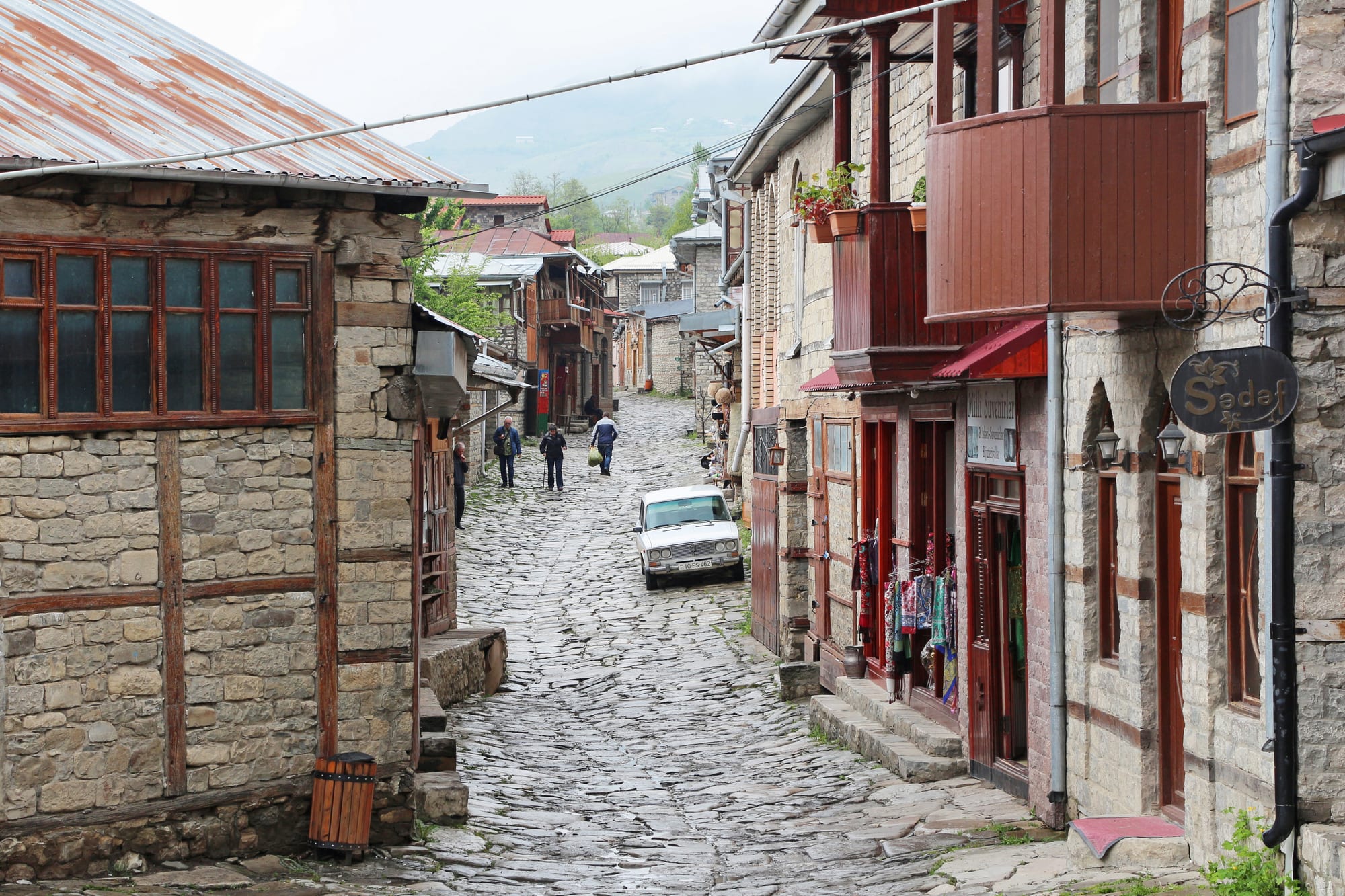
A cobbled street in Lahic running between stone houses with wooden balconies and craft shops, with green hills at the end

Baku, Shirvan & Central Azerbaijan, Azerbaijan

Lahic

The cobbled main street of Lahic, lined with stone houses and craft workshops. (Bernard Gagnon / Wikimedia Commons · CC BY 4.0)

A stone-built mountain village in Ismayilli district, about 1,200 metres up in the southern foothills of the Greater Caucasus and reached by a narrow road through the gorge of the Girdimanchay. Its people speak Tat, an Iranian language, and it has been known for centuries for coppersmithing, carpets and leatherwork, sold from workshops along its cobbled main street.

Neighbourhoods

  • The main street
    • First-time visitors
    • Crafts and shopping
    • Best for food

    The paved spine of the village, where the coppersmiths, carpet sellers and leather workers have their workshops in stone-fronted houses with wooden balconies. Guesthouses, tea houses and small restaurants line the same stretch, and it is where almost everything happens.

    Open in Maps
  • The old quarters
    • Quiet lanes
    • Historic district

    The village is divided into named quarters, each traditionally with its own mosque, spring and small square. The lanes are steep and cobbled, roofed with sheet metal and stone, and largely residential, with vines and fruit trees behind the walls.

    Open in Maps
  • The gorge and the river
    • Walks
    • Views

    Below the village the ground falls away to the Girdimanchay, the river that cuts the gorge the access road follows. Paths lead down to the water and up the opposite slopes towards summer pastures and forest.

    Open in Maps

Things to do

In the village

  • Coppersmiths' workshopsattraction

    Open-fronted workshops along the main street where copper trays, jugs and pots are hammered and engraved by hand, a craft added to UNESCO's Representative List of the Intangible Cultural Heritage of Humanity in 2015.

    Open in Maps
  • The cobbled streets and old water systemlandmark

    Stone-paved lanes laid over kurabandis, subterranean channels built of river stones that carry water and drainage and are reckoned among the oldest such systems anywhere.

    Open in Maps
  • Lahij Museum of Local Historymuseum

    A local museum with more than a thousand exhibits — copperware, smelting bellows, pottery and household objects — housed in a mosque of 1914 that was converted in 1987.

    Open in Maps

Walks and the gorge

  • Girdimanchay gorgetrail

    The river gorge that the access road follows, with walking routes along the water below the village and up into the beech forest on the slopes above.

    Open in Maps

Short trips from the village

  • Ismayilliattraction

    The district town down on the main road, with markets, wineries in the surrounding hills and the junction for the gorge road up to the village.

    Open in Maps
  • Basqalattraction

    A hillside settlement in the same district known for kelaghayi, the silk headscarf whose making is on UNESCO's intangible heritage list.

    Open in Maps
  • Shamakhiattraction

    The old capital of Shirvan to the east, with its much-rebuilt Juma Mosque, the domed mausoleums below the Gulustan fortress and vineyards around the town.

    Open in Maps

Seasonal events

  • NovruzMarch

    The spring new year, marked in the village with bonfires, sprouted wheat on the table, and pastries shared between households over several days.

  • Gurban Bayramivaries with the lunar calendar

    The feast of sacrifice, a public holiday when families gather, meat is shared with neighbours and relatives return from the cities.

Eat and drink

Long-standing places and food districts in Lahic. Hours, ratings and directions come from your maps app, always current.

Mountain cooking

  • Village restaurants and guesthouse tablesrestaurant

    Most eating is done where visitors sleep or in a handful of small places on the main street, serving lamb, bozbash, dolma, dovga and bread from the clay oven.

    Open in Maps
  • Tea housescafe

    Black tea in pear-shaped glasses with mountain honey or thick fruit preserve, drunk slowly at tables on the street.

    Open in Maps
  • Local produce and preservesmarket

    Honey from high pastures, walnuts, hazelnuts, cornelian cherry and white cherry preserves, dried fruit and sheep's cheese, sold from shops along the main street.

    Open in Maps

Experience Lahic

History

Lahic's origins are traced in local tradition to settlers from the Persian region of Lahijan, which would explain the Tat language still spoken in its streets, an Iranian tongue unrelated to Azerbaijani. Whatever its beginnings, the village was established in the hills of Shirvan long before the modern era, and its position was its protection: a shelf of level ground high above the Girdimanchay, reached only through a gorge, defensible and far from the armies that crossed the plain.

Its wealth came from metalwork. By the 18th and 19th centuries Lahic was one of the main craft centres of the South Caucasus, with streets of workshops producing copper vessels, weapons, armour and tools that were traded across the region and beyond it. Travellers described a village of hundreds of smiths, with its own quarters, mosques, bathhouses and caravanserais, and a piped water and drainage system built of stone channels that was remarkable for a settlement of its size and altitude. Carpets, leather and dyeing supported the same trade.

Russian rule from the early 19th century, and then industrial production, undercut the handmade metal trade, and the village declined through the 20th century as younger people left for Baku and for jobs on the plain. The Soviet period preserved it partly by neglect: little was rebuilt, and the stone houses, balconies and cobbles survived. Lahic was declared a historical and cultural reserve in 1980 and has been revived by tourism, with the copper craftsmanship of the village added to UNESCO's intangible cultural heritage list in 2015, and its crafts sold again from the same shopfronts.

Culture & Customs

The first thing visitors notice is the language. The people of Lahic are Tats and speak a form of Persian at home, while using Azerbaijani outside, a survival that gives the village a distinct identity within Shirvan. It is one of several mountain communities in the region — alongside the Molokan Russians of Ivanovka and the silk weavers of Basqal — that have kept a separate tradition in a small area.

Craft is the core of that identity. Copperworking is passed down within families, with apprentices learning to raise, hammer and engrave vessels by hand, and the patterns used on trays and jugs belong to a recognised local repertoire. Carpet weaving, leatherwork, knitting and woodwork have long been practised alongside it, and the village has always had a reputation for careful, exacting work, which is part of how it describes itself.

Social life follows the pattern of the Azerbaijani mountains: the quarters and their mosques as points of belonging, tea offered at every encounter, elders consulted, and weddings and funerals attended by the whole village. Observance is Shia Muslim and generally quiet, with Novruz the biggest occasion of the year, when bonfires are lit in the lanes. Many families now divide their time between the village and Baku, returning for the summer and for holidays, and it is common to find houses opened only in the warm months.

Daily Life

Lahic is home to about 860 people, a fraction of the population it had when the metal trade was at its height. The permanent residents are older on average than the national norm, and much of the working-age population has moved to Ismayilli, Shamakhi or Baku, returning in summer when visitors come and guesthouses fill.

The economy now rests on three things: crafts sold from the workshops, tourism, and smallholder farming on the slopes — cattle and sheep taken up to summer pasture, orchards, beehives and vegetable plots behind the houses. Most households combine all three with money sent home from the cities. The season is short and sharply defined, busy from May to October and very quiet through the winter, when snow closes the road from time to time and life turns inward.

Day-to-day concerns are those of a remote mountain village: the state of the gorge road, which is the single link to everything; the reliability of water, power and mobile signal; the school and the clinic; and whether enough young people stay for the crafts to be handed on. Restoration work is a steady presence, since the village is a protected historical reserve and repairs to houses, paving and channels are regulated and continuing.

Food

Cooking here is mountain cooking, with lamb and dairy at the centre and little that does not come from the surrounding slopes. Lamb is grilled over wood or stewed in bozbash, a broth with chickpeas, chestnuts, plums or quince; dolma is made from vine leaves in summer and from cabbage in winter; and dovga, a soup of yoghurt, herbs and rice served hot or cold, appears at most tables. Plov, rice steamed with saffron and served with a separate meat and fruit stew, marks weddings and holidays.

Bread is baked in the tendir, a clay oven sunk into the ground, and the hot flat rounds are eaten with sheep's cheese, butter and honey. Qutab — thin folded pancakes filled with greens, pumpkin or cheese and cooked on a griddle — are a common quick meal, and pickles and preserves line the shelves of every house against the winter.

The produce of the district is what visitors take home: honey from the high meadows, walnuts and hazelnuts, mulberries fresh or dried, and thick preserves of cornelian cherry, white cherry and walnut eaten by the spoonful with tea. Down in the valley, Ismayilli and Shamakhi are wine country, and bottles from their wineries turn up on village tables. Tea itself is constant, poured black into pear-shaped armudu glasses, sweetened with jam rather than milk, and drunk from early morning until late.

Planning tools

Budget

The village is inexpensive by Azerbaijani standards: guesthouse rooms, simple meals and tea cost little, and the main expenses are transport up the gorge road and whatever copperware or carpets tempt a visitor. Prices in Ismayilli and the surrounding district are lower again than in Baku, which sets the benchmark for the region.

Daily Budget Midrange
USD 95–190 (mid-range hotel in the region, restaurant meals, a car with driver from Baku or Shamakhi)
Daily Budget Shoestring
USD 25–45 (guesthouse room, home-cooked meals, shared transport from Ismayilli)

Bring cash from Baku, Shamakhi or Ismayilli, as card payment and cash machines are not to be relied on in the village.

Best Time to Visit

May to October. Late spring brings flowers and full rivers, summer is warm but far cooler than Baku and the plain, and September and October give clear air and autumn colour in the beech forest. Winter is cold and snowy, several guesthouses close, and the gorge road can be blocked after heavy snow or landslides.

Suggested Number of Days

A day is enough for the village itself, and many people drive up from the plain and return the same evening. Staying overnight adds the quiet hours after the coach parties leave, and two or three days suit anyone who wants walks in the mountains and the other craft villages of the district.

First Visit
1 day
With Surroundings
2–3 days

Transportation

There is no useful public transport into the mountains beyond occasional minibuses from Ismayilli, so most visitors arrive by hired car, with a driver, or on an organised trip from Baku. The single road up from the main valley is narrow, unfenced in places and cut into the side of the gorge. Within the village everything is on foot.

Arrange the return journey before arriving, as transport out is not always available on demand, and avoid driving the gorge road after dark or in heavy rain.

Airport & Station Connections

Lahic lies about 190 kilometres north-west of Baku, a drive of roughly three to four hours, and around 20 kilometres up a mountain road from Ismayilli, the district town on the main valley route. Most visitors come by car from Baku or from Shamakhi, often combining the village with the wine country and the Shirvan towns along the way.

Walkability

The village is small enough to cross on foot in twenty minutes and is best seen that way, but the ground is steep and the cobbles are uneven and slippery when wet, so sturdy shoes matter. Walks down into the gorge and up towards the pastures are rough and unsignposted. There is no vehicle traffic to speak of on the lanes.

Safety

The village is safe and crime is rare. The real hazards are the mountain road, which is narrow with steep drops and prone to rockfall and landslides in wet weather, and the terrain itself: slippery cobbles, unfenced drops above the river and sudden weather changes at altitude. The region lies in an earthquake zone.

Check road conditions before setting out in rain or snow, take warm and waterproof clothing even in summer, and keep to marked paths on walks into the gorge. Check current official travel advice before travelling.

Climate

A mountain climate at about 1,200 metres, much cooler and wetter than the Kura plain and the Caspian shore. Summers are warm by day and cool at night, with thunderstorms; spring and autumn are green and damp; winter brings frost and snow that can lie for weeks.

Summer
warm rather than hot — daytime temperatures usually 25–30°C, with cool nights and frequent afternoon showers
Winter
cold and snowy — often around or below 0°C by day, with snow on the road and in the lanes

Local Customs

This is a conservative mountain village where most people speak Tat at home as well as Azerbaijani, and modest dress is appreciated: covered shoulders and knees, and covered hair for women entering a mosque. Hospitality is insistent, tea is offered constantly, and elders are greeted first. Bargaining over crafts is normal but should stay good-humoured.

Ask before photographing people at work in the workshops or women in the lanes, remove shoes when entering a home, and accept the tea that is offered.

Common Payment Methods

The currency is the Azerbaijani manat, and the village runs largely on cash. Card terminals are uncommon and cash machines unreliable, so money should be drawn in Baku, Shamakhi or Ismayilli before the drive up. Craft workshops and guesthouses generally expect cash in small notes.