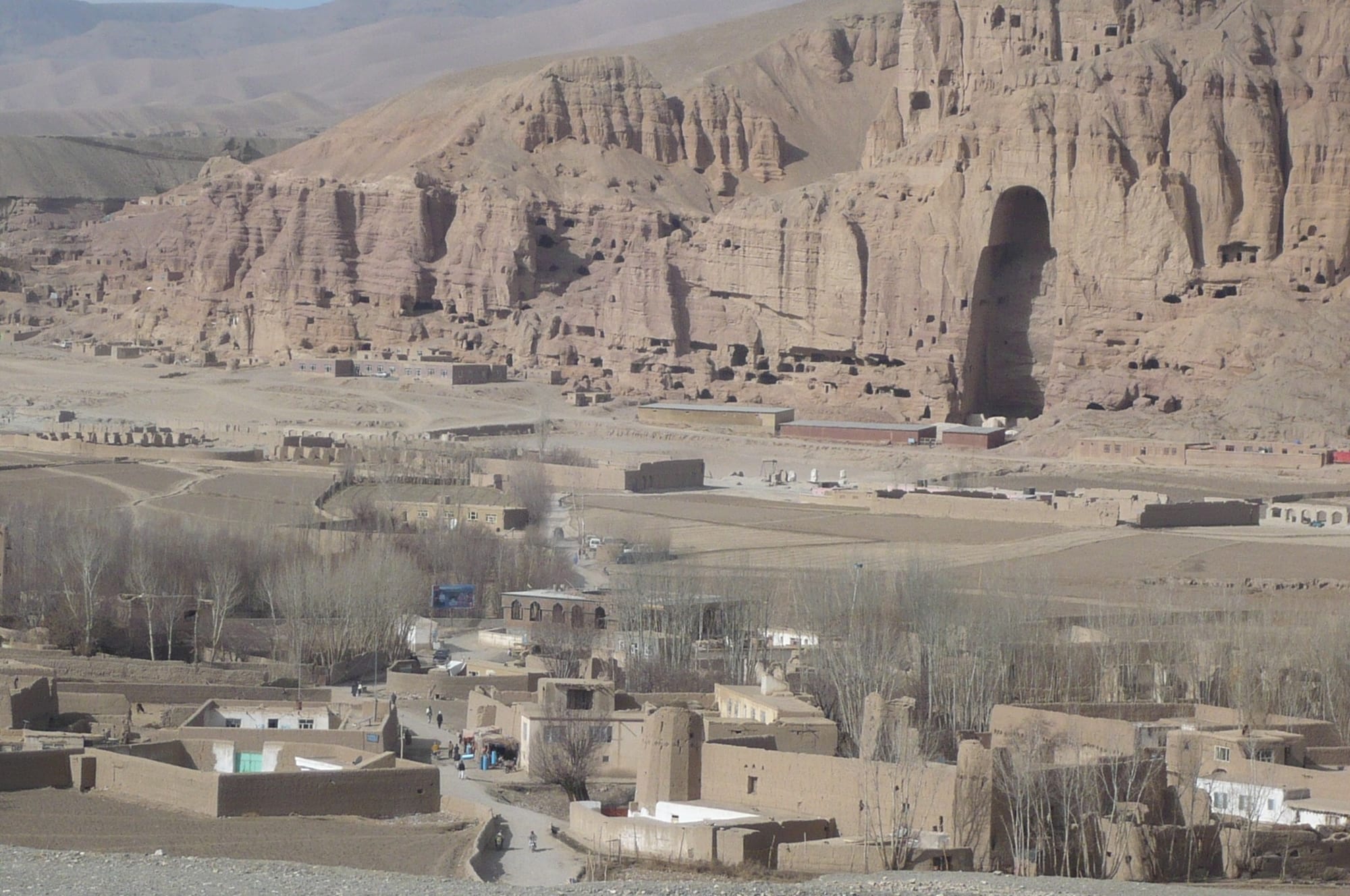
Mud-brick houses and bare poplars on a valley floor below a long sandstone cliff riddled with caves and a tall empty niche

Kabul & the East, Afghanistan

Bamyan

The town of Bamyan on its valley floor below the cave-pierced cliff and the larger empty Buddha niche. (Roland Lin / Wikimedia Commons · CC BY-SA 3.0 igo)

A small highland town in the central Afghan mountains, strung along a green valley at about 2,500 metres below a sandstone cliff pierced with monks' caves and the two empty niches where giant Buddhas stood until 2001. It is the main town of the Hazarajat and the gateway to the Band-e Amir lakes. This page is written to explain the town, not to encourage travel.

Neighbourhoods

  • The bazaar and town centre
    • First-time visitors
    • Shops and food
    • Central

    A single main street of one- and two-storey shops, bakeries, mechanics and transport offices on the south side of the valley. Almost everything in Bamyan is bought and arranged here, and most of the town's simple guesthouses are within walking distance of it.

    Open in Maps
  • Below the cliff
    • Monuments
    • Walking

    The band of fields, mud-brick compounds and poplar stands between the bazaar and the foot of the sandstone cliff, directly under the caves and the two empty niches. Families lived in the caves themselves for decades before the site was cleared and protected.

    Open in Maps
  • Foladi valley
    • Quiet and residential
    • Countryside

    A side valley running south-west from the town, farmed in narrow terraced strips and holding further groups of carved Buddhist caves in its cliffs. It gives a quick sense of how people in the Hazarajat live off small fields, walnut trees and livestock.

    Open in Maps
  • Dragon Valley
    • Countryside
    • Walks

    The valley west of the town, named for a long rock fissure that local legend explains as a slain dragon. Villages and irrigated plots line the stream, and the road through it leads on towards the Band-e Amir plateau.

    Open in Maps

Things to do

The cliff and the caves

  • Buddhas of Bamiyanlandmark

    The two enormous standing Buddhas, about 55 and 38 metres tall, carved into the cliff in the 6th and early 7th centuries and destroyed by explosives in March 2001; the niches, the stairways and hundreds of painted monks' caves remain.

    Open in Maps

Fortresses and ruins

  • Shahr-e Gholgholalandmark

    The 'city of screams', a hilltop citadel above the valley floor destroyed by Genghis Khan's army in 1221, whose mud-brick walls give the widest view over Bamyan.

    Open in Maps
  • Shahr-e Zuhaklandmark

    The 'red city', a fortress of red mud-brick towers and ramparts at the eastern end of the Bamyan valley, on cliffs above the meeting of the Kunduz and Kalu rivers, guarding the approach to the valley.

    Open in Maps

Short trips from the town

  • Band-e Amir National Parkpark

    Afghanistan's first national park, about 75 kilometres north-west, where six deep blue lakes are held back by natural travertine dams on a dry limestone plateau.

    Open in Maps
  • Bamyan Universityattraction

    The provincial university on the edge of the town, founded in 1996, which became one of the visible signs of Bamyan's post-2001 growth.

    Open in Maps

Seasonal events

  • Nowruzaround 21 March

    The Persian new year and the start of spring, marked with family visits, special dishes and outings once the snow begins to clear from the valley.

  • Ramadanvaries by the lunar calendar

    The month of fasting, when the bazaar is quiet by day and comes back to life after sunset.

  • Eid al-Fitrat the end of Ramadan

    Days of visiting, new clothes and sweets at the end of the fast, with mass prayers in the town.

Eat and drink

Long-standing places and food districts in Bamyan. Hours, ratings and directions come from your maps app, always current.

Bamyan basics

  • Bamyan bazaar eating housesrestaurant

    Plain rooms along the main street serving rice with lamb, mutton broth with bread torn into it, and kebabs grilled at the door, with pots of green tea.

    Open in Maps
  • Bamyan bazaarmarket

    The town's market street, where the valley's potatoes, wheat flour, dried mulberries, walnuts and qurut, hard dried yoghurt, are sold alongside imported goods brought over the passes.

    Open in Maps
  • Guesthouse kitchensrestaurant

    Most of the town's small guesthouses cook for their guests, which in Bamyan usually means potato and bean dishes, bread from the tandoor and whatever fruit is in season.

    Open in Maps

Experience Bamyan

History

Bamyan owes everything to its position on a route across the Hindu Kush linking India, Central Asia and the Iranian plateau. From about the 3rd century AD it was a Buddhist centre, and by the 6th and early 7th centuries monks had cut hundreds of cells, halls and sanctuaries into its soft sandstone cliff and carved two colossal standing Buddhas, the taller about 55 metres, painted and gilded and visible far down the valley. The Chinese pilgrim Xuanzang, who passed through in the 630s, described a thriving community of monasteries and thousands of monks.

Islam reached the valley in stages, and by the 11th and 12th centuries Bamyan was a minor capital under a branch of the Ghurid dynasty, when the fortress towns of Shahr-e Zuhak and Shahr-e Gholghola were built above the river. In 1221 Genghis Khan's army besieged Gholghola after a grandson of his was killed nearby and destroyed it; the valley's population and irrigation never fully recovered, and the place became a remote farming district on a road that mattered less than before.

The modern town grew as the administrative centre of the Hazarajat. Bamyan was fought over in the 1990s, and in March 2001 the two Buddhas were dynamited over several days, an act condemned worldwide. Since 2003 the valley has been a UNESCO World Heritage Site, listed as the Cultural Landscape and Archaeological Remains of the Bamiyan Valley and placed at the same time on the List of World Heritage in Danger, and international teams have worked to stabilise the cliff, the niches and the surviving wall paintings. Whether the statues should be rebuilt has been debated ever since.

Culture & Customs

Bamyan is the centre of the Hazarajat, the mountain homeland of the Hazara, a Shia Muslim people who speak Hazaragi, a dialect of Persian close to Dari. Hazara history has been marked by persecution — mass killings and displacement under Emir Abdur Rahman Khan in the 1890s, and repeated attacks on Hazara communities in recent decades — and that history shapes a strong communal identity. Shia observance gives the year its rhythm, and Muharram, when the martyrdom of Husayn is mourned, is marked with processions and gatherings.

The town's culture is rural and practical: family compounds of mud brick with flat roofs, wheat and potato fields divided among relatives, and an economy of mutual help at harvest and at weddings. Poetry and song in Hazaragi, often accompanied by the dambura, a two-stringed long-necked lute, are the characteristic local music, and their melodies are plainer and more insistent than the classical music of Kabul.

Bamyan has also carried a reputation for openness. After 2001 it had one of the country's higher rates of girls' schooling, a provincial university, a growing domestic tourist trade around the cliff and the lakes, and Afghanistan's first female provincial governor. Restrictions since 2021 on women's education, work and travel have fallen heavily on a town where much of that progress was recent and visible. Manners follow the wider Afghan pattern: unhurried greetings, the right hand for eating and giving, and hospitality treated as an obligation.

Daily Life

Bamyan town has roughly 100,000 people in its wider district and is small enough to cross on foot, though it serves a province of scattered mountain villages. Most households farm: wheat and barley on the valley floor, and above all potatoes, which grow well at this altitude and are trucked to Kabul in autumn. Sheep, goats and a few cows graze the slopes, and walnut and mulberry trees mark the irrigated strips.

Work beyond farming means the bazaar, transport, government offices, the university and, before 2021, a small but real tourism economy built on domestic visitors to the cliff and to Band-e Amir. Money sent home by relatives working in Iran or in Kabul supports many families. Poverty is deep, winters are expensive in fuel, and drought in recent years has cut harvests and pushed people to move.

The day starts early and ends early. Bread comes from tandoors in the morning, the bazaar is busiest in the middle of the day, and in winter life contracts into heated rooms while snow closes the higher roads. Friday is for prayer and family. Electricity has long been patchy, with solar panels on many roofs, and the town's isolation — a full day's drive from Kabul over passes that snow can shut — remains the single biggest fact of life here.

Food

Food in Bamyan is plainer and more filling than in Kabul, shaped by altitude and a short growing season. Potatoes are the local staple and a point of pride: boiled, fried, cooked into stews or sold hot from stalls in the bazaar. Wheat bread from a clay tandoor accompanies everything, and shorwa, a thin mutton broth with bread torn into it, is the everyday winter meal. Rice dishes, including Kabuli palaw, appear for guests and at weddings rather than on ordinary days.

Dairy does much of the work of a mountain diet. Qurut, yoghurt dried into hard white balls and later crushed and soaked, gives a sharp, salty sauce poured over bread, dumplings or potatoes; fresh yoghurt, butter and clotted cream are made at home. Hazara kitchens are known for dumplings — mantu filled with minced meat and onion, and aushak filled with chives or leeks — both served under yoghurt and a meat or lentil sauce, and for kichiri, a thick porridge of rice and pulses.

The valley's fruit and nuts are eaten fresh in late summer and dried for the winter: mulberries, apples, apricots and walnuts. Dried mulberries ground with walnuts into a sweet paste are a traditional highland food. Green tea, drunk with rock sugar or a sweet held in the mouth, is served constantly and offered to anyone who arrives; alcohol is prohibited.

Planning tools

Budget

Bamyan is cheap even by Afghan standards, with simple guesthouses aimed mainly at domestic visitors and bazaar meals costing very little. The real expense is getting there and moving about: the roads from Kabul take a full day and almost everyone travels by hired car with a driver.

Daily Budget Midrange
USD 40–100 (better guesthouse, hired car with driver for the valley and Band-e Amir)
Daily Budget Shoestring
USD 15–30 (simple guesthouse, bazaar meals, shared transport)

There is no reliable way to draw money here; bring afghanis in cash, changed in Kabul, and keep small notes.

Best Time to Visit

May to October, when the passes are open, the valley is green and Band-e Amir is at its most colourful. Late spring and early autumn are mild and clear. Winter is long, hard and snowy from about November to March, the roads over the passes may close, and the lakes freeze.

Suggested Number of Days

Two days cover the cliff, the caves and the two fortresses at an unhurried pace. Three or four allow the lakes to the west and the side valleys. Road conditions and the long drive from Kabul matter more than the number of sights.

First Visit
2 days
With Surroundings
3–4 days

Transportation

Everything in the town itself is close enough to walk, and shared taxis and minibuses run along the valley road. Reaching the fortresses, the side valleys and the lakes means a hired car, usually a four-wheel drive, since several of the roads are unpaved and rough.

Mountain roads to Bamyan and the Panjshir can close in winter; allow spare days and travel only in daylight.

Airport & Station Connections

Bamyan lies west of Kabul over high passes, a drive of roughly 180 to 240 kilometres depending on the route and most of a day in good conditions; the northern road through the Shibar pass and the southern road through Wardak are both long and partly unpaved. The town has a small airport that has at times had domestic flights, but road transport is how nearly everyone arrives, and snow can close the passes in winter.

Walkability

The town is small and flat along its valley floor, and the bazaar, the fields and the foot of the cliff are all within an easy walk. Paths up to the fortresses and along the cliff are steep, rough and unshaded, and the altitude of about 2,500 metres makes climbing harder than it looks. In winter snow and mud make walking slow.

Safety

Most governments advise against all travel to Afghanistan, and that applies fully here. Bamyan has been quieter than much of the country, but the Hazara community of the central highlands has repeatedly been the target of attacks, kidnapping and the wrongful detention of foreigners are real risks, and there is no consular help. Landmines and unexploded ordnance remain a hazard on unused ground, medical facilities are very limited, and the mountain roads are themselves dangerous.

Most governments advise against all travel to Afghanistan, and that applies fully here. Anyone still considering a visit should read their government's full advisory, avoid crowds, government sites and border areas, and never step off used paths. Check current official travel advice before travelling.

Climate

A cold, dry mountain climate at about 2,500 metres, with a short summer, a long winter and very large differences between day and night temperatures. Precipitation is low and falls mostly as snow between December and March, and the sun is strong at this altitude in every season.

Summer
mild and dry — daytime highs usually around 25°C, with cold nights
Winter
long and severe — daytime temperatures often below 0°C, nights far colder, and snow lying for months

Local Customs

Bamyan is a Hazara and Shia town, conservative in dress and public behaviour. Women are required to cover their hair and body in public, and rules on dress and on women travelling without a male relative have tightened since 2021. Hospitality is pressed on guests: tea and bread will be offered and should be accepted. Shoes come off at the door of a house or a mosque, and permission should be asked before entering a shrine.

Alcohol is prohibited. Never photograph people, especially women, without clear permission, and avoid photographing checkpoints and official buildings. Climbing on the Buddha niches and the cave paintings is forbidden — the site is protected.

Common Payment Methods

The currency is the afghani, and Bamyan runs on cash. Foreign cards and ATMs cannot be relied on, and visitors change US dollars with money changers in Kabul before travelling; small notes are needed for bazaar purchases, drivers and guesthouses.