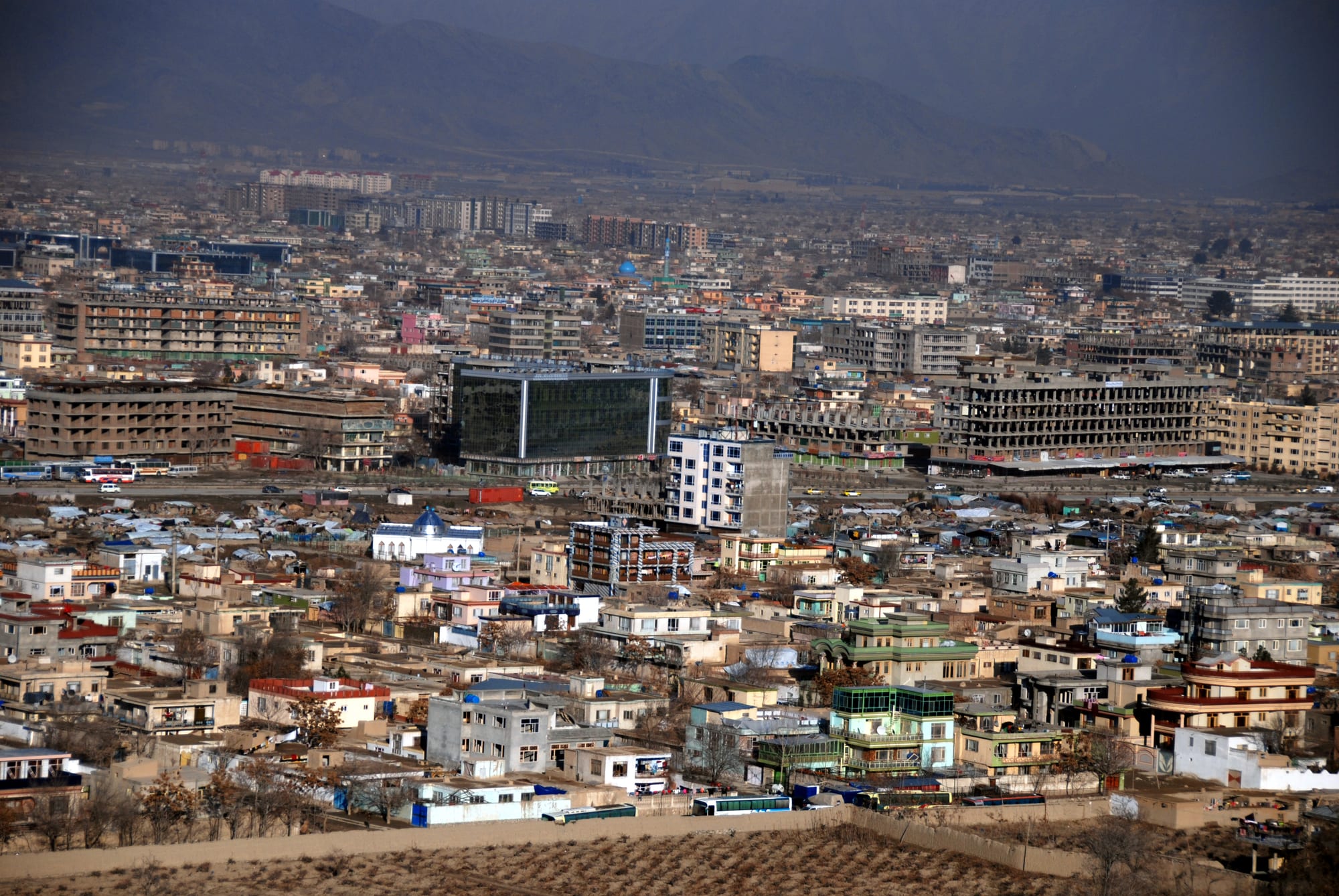
Dense low houses and mid-rise blocks filling a wide valley floor, with bare brown mountains rising behind in haze

Kabul & the East, Afghanistan

Kabul

The centre of Kabul seen from a hillside, with the mountains that ring the valley behind. (Olgamielnikiewicz / Wikimedia Commons · CC BY-SA 4.0)

Afghanistan's capital, set in a bowl of bare mountains at about 1,800 metres where routes from India, Iran and Central Asia meet. A Mughal garden city that became a modernising capital in the 20th century, it was shelled in the 1990s, rebuilt and hugely expanded after 2001, and now spreads far up its hillsides. This page is written to explain the city, not to encourage travel.

Neighbourhoods

  • Shahr-e Naw
    • First-time visitors
    • Shops and restaurants
    • Central

    The 'new city' laid out north of the river in the 20th century, and still the commercial centre, with the main shopping streets, offices, money changers and most of the city's restaurants. Shahr-e Naw Park is a rare patch of green in the middle of it.

    Open in Maps
  • Wazir Akbar Khan
    • Quiet and residential
    • Embassies and offices

    A grid of wide streets and large walled houses north-east of the centre, built from the 1960s for officials and later given over to embassies, international organisations and guarded compounds. It is the most heavily fortified part of the city, with blast walls along many of its roads.

    Open in Maps
  • The Old City and Murad Khani
    • Historic district
    • Bazaars
    • Walking

    The oldest surviving quarter, on the north bank of the Kabul river, with narrow lanes, courtyard houses and timber-framed façades. Much of Murad Khani was buried under rubbish and derelict by 2000 and has since been restored by a conservation trust; the bird market of Ka Faroshi is close by.

    Open in Maps
  • Macroryan
    • Local life
    • Architecture

    Blocks of Soviet-designed flats east of the centre, built from the 1960s with Soviet assistance and long considered desirable for their piped water and heating. The estates have tree-lined courtyards and small shops, and give a clear picture of Kabul's mid-century modernisation.

    Open in Maps
  • Darulaman
    • Monuments
    • Museums

    The south-western edge of the city, laid out in the 1920s as a planned government quarter along a long avenue. The restored Darul Aman Palace stands at the end of it, with the National Museum of Afghanistan opposite and the Kabul University campus not far away.

    Open in Maps
  • Khair Khana
    • Quiet and residential
    • Local life

    A large residential district in the north-west, spread over a pass and the slopes beyond, which grew enormously after 2001 as returning refugees and rural migrants settled in Kabul. It is mainly a place of family compounds, small markets and new concrete housing.

    Open in Maps

Things to do

Famous landmarks

  • Gardens of Baburlandmark

    The terraced Mughal garden on the slopes of Sher Darwaza where Babur, founder of the Mughal empire, is buried; it was restored in the 2000s and is the city's main public garden.

    Open in Maps
  • Bala Hissarlandmark

    The ancient fortress on a ridge above the old city, whose walls and the long Sher Darwaza wall running up the mountain behind it are among Kabul's oldest surviving structures.

    Open in Maps
  • Darul Aman Palacelandmark

    The neoclassical palace built for King Amanullah in the 1920s, burnt and shelled during the wars and rebuilt in a restoration carried out between 2016 and 2020.

    Open in Maps
  • Shah-Do Shamshira Mosquelandmark

    A two-storey mosque of the 1920s on the bank of the Kabul river, unusual for its Italianate yellow façade and its setting beside the bazaars.

    Open in Maps
  • Id Gah Mosquelandmark

    The large open-air prayer ground and mosque built under Emir Abdur Rahman Khan and his son Habibullah Khan, used for the Eid prayers and for major public occasions.

    Open in Maps
  • Abdul Rahman Mosquelandmark

    A very large modern mosque near Zarnegar Park in the centre, begun in the 2000s and among the biggest built in Afghanistan.

    Open in Maps

Museums and culture

  • National Museum of Afghanistanmuseum

    The country's main museum, opposite the Darul Aman Palace, whose collections were looted and damaged in the 1990s, with about 70 per cent of the objects then on display lost and some later recovered; the Bactrian gold came through the war years in a vault at the central bank.

    Open in Maps
  • OMAR Mine Museummuseum

    A small museum of landmines and unexploded ordnance run by an Afghan demining organisation, explaining the scale of contamination across the country.

    Open in Maps
  • Kabul Zooattraction

    A modest riverside zoo founded in 1967, badly damaged in the 1990s fighting and rebuilt with foreign help; it remains a popular outing for Kabul families.

    Open in Maps

Bazaars and open spaces

  • Chicken Streetmarket

    A narrow street in Shahr-e Naw long known for carpets, lapis lazuli, antiques and handicrafts, and a fixture of the old overland route through Afghanistan.

    Open in Maps
  • Qargha Reservoirpark

    A dammed lake about 15 kilometres west of the city, long used by Kabulis for picnics, boating and weekend escapes from the dust.

    Open in Maps

Short trips from the city

  • Paghmanattraction

    A hill town about 20 kilometres west, laid out with gardens and a triumphal arch by King Amanullah in the 1920s and long the summer retreat of Kabul.

    Open in Maps
  • Istalifattraction

    A village on the Shomali plain north of Kabul, famous for turquoise-glazed pottery and for its orchards and views over the plain.

    Open in Maps
  • Mes Aynakattraction

    A large Buddhist monastic site in Logar province, south-east of Kabul, excavated above Afghanistan's largest known copper deposit, whose mining now threatens the site.

    Open in Maps

Seasonal events

  • Nowruzaround 21 March

    The Persian new year and the start of spring, marked with family visits, special dishes and, in Kabul, outings to gardens and shrines.

  • Ramadanvaries by the lunar calendar

    The month of fasting, when daytime life slows, most eating places close until sunset and the bazaars stay busy late into the night.

  • Eid al-Fitrat the end of Ramadan

    Three days of visiting, new clothes and sweets, with mass prayers at the Id Gah and other large mosques.

  • Eid al-Adhaabout two months after Eid al-Fitr

    The feast of sacrifice, when sheep are bought at temporary markets on the edge of the city and meat is shared with relatives and the poor.

Eat and drink

Long-standing places and food districts in Kabul. Hours, ratings and directions come from your maps app, always current.

Kabul classics

  • Kabuli palaw housesrestaurant

    Plain rice houses across the city serve the dish Kabul gave its name to — long-grain rice steamed with lamb stock and topped with carrot strips, raisins and nuts.

    Open in Maps
  • Kebab grills of the old cityrestaurant

    Charcoal grills along the lanes near the river turn out lamb and minced kebabs served on naan, with raw onion and a dusting of dried grape powder.

    Open in Maps

Bazaars and food districts

  • Mandawi Bazaarmarket

    The wholesale market beside the river in the old city, packed with sacks of rice, dried fruit, nuts, spices and tea, and the cheapest place to see what Afghan kitchens actually buy.

    Open in Maps
  • Shahr-e Naw restaurantsneighborhood

    The largest concentration of sit-down restaurants and juice bars in the country, from Afghan grill houses to Turkish, Iranian and Indian kitchens.

    Open in Maps
  • Chicken Street and aroundneighborhood

    Craft and carpet shops with bakeries, dried-fruit sellers and small tea houses in the surrounding lanes of Shahr-e Naw.

    Open in Maps

Experience Kabul

History

Kabul is very old — it appears in the Rigveda as Kubha and in Greek accounts as Kophen — and it grew where the routes from India through the Khyber, from Central Asia over the Hindu Kush and from Iran across the plateau all meet. Under the Kushans in the first centuries AD the valley lay near the centre of a Buddhist world, and the Bala Hissar fortress above the old town guarded the crossing for more than a thousand years. Arab armies reached the region in the 7th century, and the city changed hands between Hindu Shahi, Ghaznavid, Ghurid and Mongol rulers.

Babur took Kabul in 1504 and ruled from it for two decades before conquering northern India; he loved the place, laid out gardens on its slopes and asked to be buried here, which he was. Kabul spent the following centuries as a Mughal, then Persian, then Afghan city, and in 1776 Timur Shah Durrani moved the Afghan capital here from Kandahar. In the First Anglo-Afghan War a British garrison occupied the city, and its retreating force was destroyed on the road to Jalalabad in 1842; British troops returned in 1879, and in 1880 they destroyed the Bala Hissar.

The 20th century made Kabul a modernising capital: King Amanullah's Darul Aman Palace and the planned avenue leading to it date from the 1920s, and Soviet-built flats, a university and factories followed. That ended with the 1978 coup and the Soviet occupation. Between 1992 and 1996 rival militias shelled the city and destroyed large parts of it, above all in the west and the old quarters. After 2001 Kabul grew several times over, spreading up every hillside, until the Taliban took the city in August 2021 during the foreign evacuation from its airport.

Culture & Customs

Kabul is the most mixed city in Afghanistan. Dari, the Afghan form of Persian, is the common language of the streets, though Pashto is heard everywhere and the city has drawn people from every province — Tajik, Pashtun, Hazara, Uzbek, Qizilbash and others — so that neighbourhoods carry the names and dialects of distant valleys. It was long the country's cultural capital: the home of Afghan classical music built around the rubab lute and the tabla, of the Kharabat musicians' quarter, of cinema, television, publishing and the art school. Much of that world has been silenced or has moved abroad since 2021, and public music and performance are heavily restricted.

Poetry carries a great deal of local identity. Persian verse is recited and quoted in ordinary conversation, and Kabul's own literary tradition runs from the 17th-century poets of the Indian style to 20th-century writers who wrote in Dari about the city itself. Kite-flying and kite-fighting, with glass-coated string, are a Kabul passion that fills the hills on Fridays, and buzkashi, the horseback game played with a calf's carcass, draws crowds to open ground north of the city in winter.

Manners are formal and warm. Greetings are long, guests are pressed with tea and fruit, and generosity to visitors is a point of honour even among the poorest families. Public life is male, women's lives are lived largely within family compounds, and the restrictions in force since 2021 on schooling, work and travel have weighed most heavily on a capital where many women were teachers, doctors and civil servants.

Daily Life

Kabul has an estimated five million residents — no reliable census has been taken — making it several times the size of any other Afghan city. Most of that growth came after 2001, when returning refugees and families displaced by drought and fighting built unplanned mud-brick and concrete houses far up the mountainsides. Those hillside districts often lie above the reach of piped water, and households buy from tankers or carry cans up long stairways.

The economy rests on government, trade, transport and services rather than industry. The bazaars of the old city and the wholesale market beside the river supply much of the country; money changers, construction, small workshops and a large informal sector employ the rest. The collapse of foreign aid and of the international presence after 2021 removed a great part of the city's income, and unemployment, poverty and hunger are severe.

The day begins early with bread from the neighbourhood tandoor, tea and heavy traffic. Bazaars fill by mid-morning and empty in the early evening; Friday is the day of prayer, family visits and picnics at Qargha or in the Babur Gardens. Winter brings the worst air pollution in the country, as households burn coal, wood and rubbish for heat in a bowl of mountains that traps the smoke, and water shortages are an increasing worry as the groundwater under the city falls.

Food

Kabul lent its name to the national dish. Kabuli palaw is long-grain rice steamed over lamb stock and crowned with strips of carrot, raisins and slivered almonds or pistachios, served in a shared mound with a piece of lamb buried underneath, and no feast in the city is complete without it. Alongside it come mantu, delicate steamed dumplings of minced beef and onion under yoghurt and a split-pea and tomato sauce, and aushak, dumplings filled with chives or leeks and dressed the same way.

Bread rules the ordinary day. Naan-e Afghani, a long paddle-shaped loaf slapped onto the wall of a tandoor, comes hot from neighbourhood bakeries at dawn and is the basis of breakfast with tea. Bolani, a thin flatbread folded around potato, leek or pumpkin and fried, is sold from carts and griddles; shorwa, a mutton broth with bread torn into it, is everyday winter food; and kebabs of lamb, mince or liver are grilled over charcoal and handed over on naan with raw onion.

Sweet things and fruit matter as much. Kabul's dried fruit and nuts — raisins, apricots, mulberries, pistachios and almonds — fill whole bazaar streets, and the grape varieties brought in from the Shomali plain are a source of local pride. In summer sheer yakh, a hand-churned ice cream flavoured with cardamom and rosewater, is sold on the street, and firni, a cold milk pudding, ends a meal. Green tea, chai sabz, often with cardamom, and black tea sweetened heavily are drunk all day; alcohol is prohibited.

Planning tools

Budget

Kabul is the most expensive place in Afghanistan, mainly because the hotels and guesthouses that take foreign visitors are guarded compounds, and because getting around safely means a hired car with a driver rather than public transport. Food, bazaar goods and domestic flights are cheap. Everything is paid in cash, in afghanis changed from US dollars.

Daily Budget Midrange
USD 40–100 (guarded hotel in Kabul, hired car with driver)
Daily Budget Shoestring
USD 20–35 (basic guesthouse, bazaar food, shared taxis)

Change only what is needed and keep small notes; there is no reliable way to draw money on a foreign card.

Best Time to Visit

April to June and September to October, when days in the Kabul basin are mild and the passes out of the city are open. July and August are hot, dry and dusty; from December to February the city is cold and often snowbound, air pollution is at its worst, and the mountain roads may close.

Suggested Number of Days

The central monuments, gardens and museums are few enough to cover in two or three days. Four or five allow the hill villages and reservoir west and north of the city. Security arrangements, checkpoints and traffic slow everything down, so allow more time than distances suggest.

First Visit
2–3 days
With Surroundings
4–5 days

Transportation

Kabul has no rail or metro system and no formal public transport network beyond buses and shared taxis on fixed routes; most residents use minibuses, shared saloon-car taxis and, increasingly, motorbikes. Traffic is dense and slow, and checkpoints can close roads without warning. Foreign visitors almost always move by hired car with a local driver.

Roads over the passes to Bamyan and the north can close in winter; allow spare days and travel only in daylight.

Airport & Station Connections

Kabul International Airport, which carried the name Hamid Karzai International Airport from 2014 to 2021, lies about 5 kilometres north-east of the centre and is the country's main gateway, with a limited number of international routes and domestic flights to Herat, Kandahar and Mazar-i-Sharif. By road, the ring road runs south to Ghazni and Kandahar and east through the Kabul river gorges to Jalalabad and the Torkham crossing into Pakistan; the Salang tunnel carries the road north through the Hindu Kush. Visas must be arranged in advance.

Walkability

The old city, the river bazaars and Shahr-e Naw can be covered on foot, and the distances between central sights are short. Beyond that Kabul is spread out and hard going: pavements are broken or absent, traffic is heavy, blast walls close off whole streets, and the hillside districts are steep. Winter mud and ice and summer dust both make walking unpleasant.

Safety

Most governments advise against all travel to Afghanistan, and that applies fully to the capital. Kabul has suffered many of the country's deadliest bombings, including attacks on mosques, schools, hospitals and the airport. Kidnapping and the wrongful detention of foreigners are real risks, and most countries have no embassy in the city and can offer no consular help. Landmines and unexploded ordnance remain a hazard on unused ground around the city, and road accidents and winter air pollution are everyday dangers.

Most governments advise against all travel to Afghanistan, and that applies fully here. Anyone still considering a visit should read their government's full advisory, avoid crowds, government sites and public gatherings, and never step off used paths. Check current official travel advice before travelling.

Climate

A cold semi-arid climate at about 1,800 metres, with four clear seasons, low rainfall concentrated in late winter and spring, and very dry air. Skies are clear for most of the year, and the temperature swing between day and night is large in every season.

Summer
warm and very dry — daytime highs around 30–33°C with cool evenings, and dust in the air
Winter
cold and snowy — January highs around 4°C and nights near −8°C, with heavy winter smog

Local Customs

Kabul is conservative in public. Men wear long shirts over loose trousers; women are required to cover their hair and body in public, and rules on dress and on women travelling without a male relative have tightened since 2021. Greetings are unhurried, the right hand is used for eating and giving, and hospitality is taken seriously — tea will be offered and should be accepted. Shoes come off at the door of a home or a mosque, and non-Muslims are often not admitted to shrines and prayer halls.

Alcohol is prohibited. Never photograph people, especially women, without clear permission, and avoid photographing checkpoints, military sites, government buildings or the airport. Tipping is not expected, though small change for a driver or porter is usual.

Common Payment Methods

The currency is the afghani. Afghanistan runs almost entirely on cash: foreign cards, ATMs and online payment are unreliable or unavailable, and visitors bring US dollars in cash and change them with licensed money changers, of whom the largest concentration is at the Sarai Shahzada exchange in the old city. Small notes are useful, as change is often short.