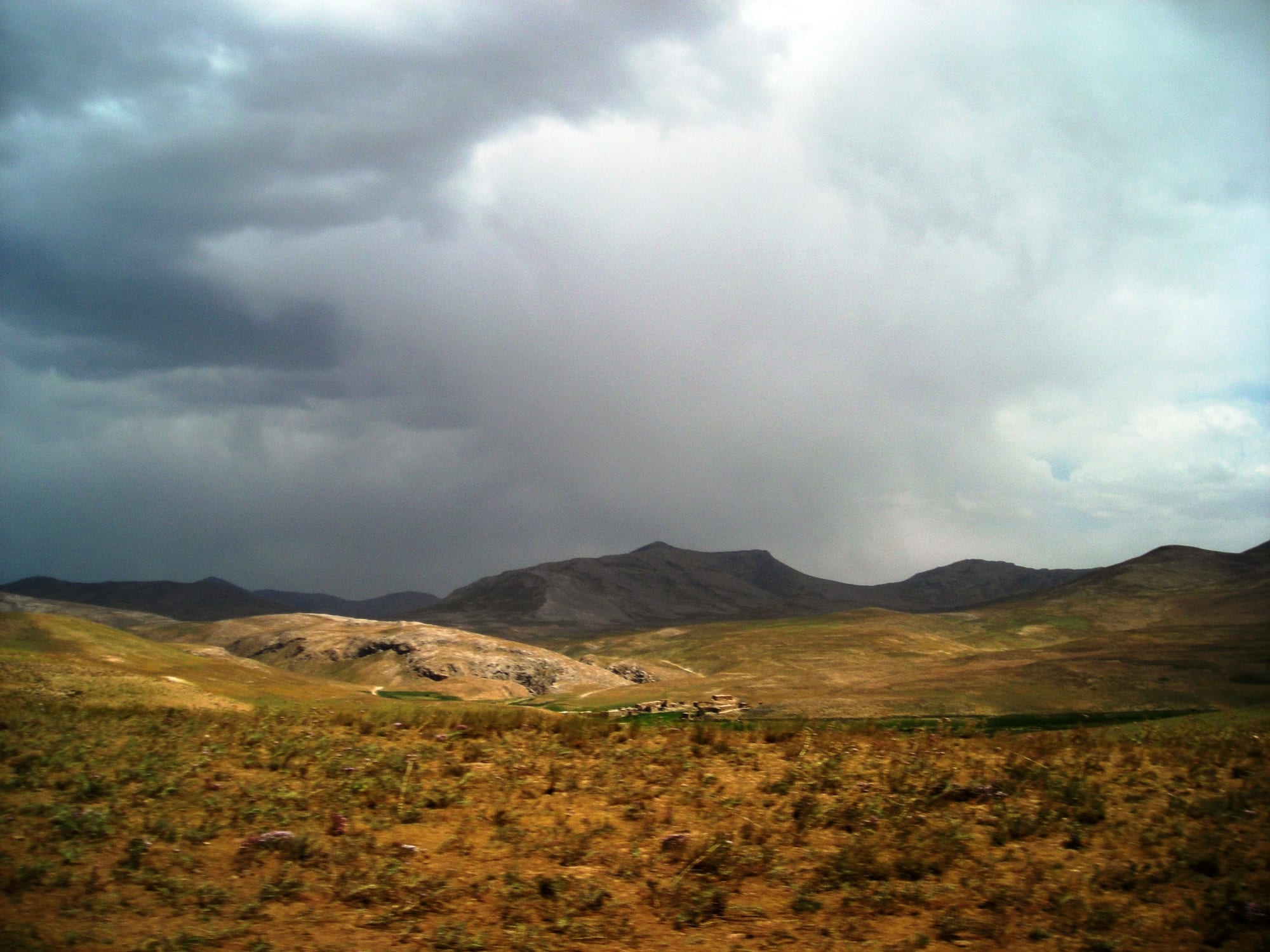
Rolling highland grassland turning gold, with a small cluster of mud-brick buildings below bare rounded mountains under a dark rain cloud

Herat & the West, Afghanistan

Chaghcharan

Highland country in Ghor Province, on the road west of Chaghcharan. (Afghanistan Matters from Brunssum, Netherlands / Wikimedia Commons · CC BY 2.0)

The capital of Ghor province, a small town on the upper Hari river in the central Afghan highlands at about 2,200 metres, also known as Firuzkoh. It is a road junction and market for a vast, thinly settled mountain region, and the nearest town to the Minaret of Jam. This page is written to explain the town, not to encourage travel.

Neighbourhoods

  • The bazaar street
    • First-time visitors
    • Markets
    • Local life

    Chaghcharan is essentially one long trading street: single-storey shops, workshops, tea houses and transport agents lining the main road through town. Goods brought up from Herat or Kabul are sold here, and this is where drivers and onward transport are found.

    Open in Maps
  • The government and airstrip side
    • Quiet and residential

    Provincial offices, the hospital, schools and the compounds built for aid organisations stand in a more open district towards the airstrip. It holds much of the town's salaried work and its few larger buildings.

    Open in Maps
  • The riverside and the edges
    • Quiet and residential
    • Views

    Away from the main street, walled mud-brick compounds, poplar windbreaks and small irrigated plots run down towards the Hari river, giving way to open pasture and bare hills within a few minutes' walk.

    Open in Maps

Things to do

The town and the river

  • Hari Riverattraction

    The river that rises in the mountains of Ghor and flows past the town on its way west to the Herat valley and the Turkmen desert.

    Open in Maps
  • Chaghcharan Airporttransit hub

    The town's airport, in its eastern part and now named after the Ghurid sultan Ghiyath al-Din Muhammad, historically the alternative to a long and difficult drive across the mountains. Scheduled flights have always been limited and intermittent.

    Open in Maps

The Ghurid monuments

  • Minaret of Jamlandmark

    A brick minaret about 65 metres high, covered in geometric brickwork and Kufic inscriptions, standing where the Jam river meets the Hari — the first place in Afghanistan listed as a UNESCO World Heritage Site.

    Open in Maps

Along the central highlands road

  • Band-e Amir National Parkpark

    A chain of deep blue lakes held back by natural travertine dams in the highlands east of Ghor, Afghanistan's first national park.

    Open in Maps

Seasonal events

  • NowruzMarch

    The Persian New Year on 21 March, marking the end of the highland winter, though it is no longer an official holiday.

  • Ramadanvaries with the lunar calendar

    A month of daylight fasting, when the bazaar street empties by day and fills after sunset.

  • Eid al-Fitrvaries with the lunar calendar

    The festival that ends Ramadan, kept with new clothes, visiting between households and shared meals.

  • Eid al-Adhavaries with the lunar calendar

    The feast of sacrifice, when a sheep or goat is slaughtered and the meat divided among family, neighbours and the poor.

Eat and drink

Long-standing places and food districts in Chaghcharan. Hours, ratings and directions come from your maps app, always current.

Mountain kitchens

  • Bazaar tea housesneighborhood

    The chaikhanas along the main street serve shorwa, a lamb and potato soup eaten with bread, rice palaw on good days, and skewers of kebab, with green tea poured all afternoon.

    Open in Maps
  • Bread and dairy stallsmarket

    Naan from tandoor ovens, yoghurt and curd from the flocks, and the hard dried qurut balls that highland households rely on through the winter.

    Open in Maps

Experience Chaghcharan

History

The mountains around Chaghcharan gave Afghanistan one of its great dynasties. In the 12th century the Ghurids, local rulers from these valleys, built an empire that reached from eastern Iran into northern India, and their summer capital, Firuzkoh, is widely thought to have stood in the Hari valley near the Minaret of Jam, some distance west of the modern town. The minaret, raised in the 1190s and covered in carved inscriptions, is what survives of that centre; the Mongols destroyed the Ghurid capital in the 1220s, and its exact location has been argued over ever since. The modern town took the name Firuzkoh officially in 2014, though Chaghcharan remains in common use.

For most of the centuries that followed, Ghor was mountain country outside the main routes of empire, held by local chiefs and by the semi-nomadic Aimaq peoples. Afghan rulers in Kabul brought it under central administration in the 19th century, and it became a province in its own right in the 20th, with Chaghcharan as the seat of the governor: a bazaar, an administration and an airstrip in a place with almost no industry.

The town was fought over during the Soviet-Afghan war and the civil wars that followed. After 2001 a provincial reconstruction team was based here and aid organisations built roads, schools and a hospital, giving the settlement its first real growth; work also began on conserving the Minaret of Jam, which is threatened by erosion from the rivers at its foot. The province passed to the Taliban with the rest of the country in 2021 and most international aid ended.

Culture & Customs

Ghor is Persian-speaking country with a strongly rural culture. Dari is the language of the bazaar and the household, and much of the rural population belongs to the Aimaq peoples — Persian-speaking, traditionally semi-nomadic groups who move flocks between valley and high pasture and have long been known for weaving. Hazara communities live in the east of the province towards the central highlands, and Tajiks and Pashtuns are also present, so the town's market brings several traditions together.

Life is governed by the extended family, the village and its elders, who settle disputes and organise shared labour. Hospitality is emphatic: a visitor is fed before being questioned, and refusing tea is difficult. Weddings are the great social occasions, with music on the long-necked lute and the frame drum, days of feasting and the exchange of obligations between families. Dress is conservative throughout, and men and women's spaces in a household are separate.

Because Ghor has never had many towns, its culture is carried in portable things: felt and carpet weaving, embroidery, songs, and a deep stock of Persian poetry and proverbs used in everyday speech. Nowruz, the Persian New Year, has traditionally marked the end of a winter of isolation and the return of the herds to the high pastures, although it is no longer an official holiday. Literacy rates are among the lowest in the country, and much knowledge is still passed on by speech rather than writing.

Daily Life

Chaghcharan is small for a provincial capital — its municipality is credited with about 130,000 people, and it feels like a large village with an administration attached — but it is the only real town in a province of some three-quarters of a million. Almost everything happens on one street: shops, transport agents, a few guesthouses and the tea houses where deals are made. Around it, walled compounds of mud brick spread towards the river and the pastures.

The economy is livestock, rain-fed farming and trade. Sheep and goats are the main wealth of the province, with wool and dairy sold through the town; wheat and barley grow on the valley floors, and potatoes have become an important cash crop in parts of the highlands. Government salaries, the hospital and the schools support a significant share of households in the town itself, and remittances from relatives working in Iran matter throughout the province.

Winter dominates the calendar. Families lay in flour, fuel and dried food before the snow, roads close for weeks, and prices rise sharply; heavy snowfalls and spring floods regularly cut the province off and damage villages. Ghor is among Afghanistan's poorest provinces: electricity is limited and often from generators or small solar panels, drought has hit harvests repeatedly, and the end of most international aid after 2021 removed both jobs and services. Restrictions on girls' secondary education and on women's work apply here as elsewhere.

Food

Highland cooking is plain and built on bread, dairy and meat. Naan baked in a tandoor comes with everything, and shorwa — lamb or mutton simmered long with potato and onion, the broth poured over torn bread and the meat eaten afterwards — is the standard meal. Kebabs of lamb are grilled over charcoal in the bazaar, and palaw, rice steamed with meat, carrot and raisins, marks a wedding or an honoured guest rather than an ordinary day.

Dairy is the store that gets households through winter. Milk from sheep and goats becomes yoghurt, butter and curd, and above all qurut, hard balls of salted dried yoghurt that keep for months and are soaked and beaten into a sharp white sauce for rice, dumplings and kichri qurut, a dish of rice and mung beans. Mantu and ashak, steamed dumplings filled with minced meat or leek, are festive food here as across the country.

Fruit is limited by the altitude but mulberries, apricots, apples and walnuts grow in sheltered valleys and are dried in quantity; dried mulberries ground with walnuts make a dense sweet paste eaten in winter. Potatoes have become a staple of the highland diet. Tea is drunk all day, mostly green and unsweetened, with sheer chai, a milk tea, for cold mornings, and it is offered to every visitor within minutes of arrival. Alcohol is prohibited.

Planning tools

Budget

Costs are low but so is choice: a few very basic guesthouses and rooms above shops, bazaar food and shared transport. Everything is cash, in afghanis, and goods carried up from Herat or Kabul cost more here than on the plains. Hiring a vehicle and driver is the dominant expense, and a trip to the Minaret of Jam means several days of it.

Daily Budget Midrange
USD 40–80 (the best available room, hired car with driver)
Daily Budget Shoestring
USD 15–30 (basic room, bazaar food, shared transport)

Change money in Herat and carry enough cash for the whole journey; there is no reliable way to get more in Ghor.

Best Time to Visit

Late spring to early autumn. The mountain tracks through Ghor are open roughly from May to October, and the Minaret of Jam is realistically reachable only in those months. Snow blocks the passes for much of the winter, and the spring melt leaves rivers high and tracks broken.

Suggested Number of Days

The town itself takes a few hours. Its value is as a staging post, and journeys out across Ghor are counted in days rather than hours, with spare time built in for weather and road conditions.

First Visit
1 day
With Surroundings
3–5 days

Transportation

Chaghcharan sits on the central highlands route between Herat and Kabul, much of it rough track rather than paved road, and has an airstrip that has at times carried flights. Shared taxis, pickups and minibuses work the valley roads to surrounding districts. The Minaret of Jam lies to the west, reached by mountain track. Within the town, everything is walked.

Treat any journey here as an expedition, with a sturdy 4x4, an experienced local driver, fuel and food carried, and spare days for weather.

Airport & Station Connections

Almost everyone arrives by road: from Herat up the Hari valley, or from Kabul through the central highlands, in both cases a journey of one to two long days depending on the state of the track and the season. Chaghcharan Airport, in the eastern part of the town, has historically been served by occasional flights. There is no railway anywhere near.

Walkability

The town is small enough to cross on foot in twenty minutes, and the bazaar street is the centre of everything. Surfaces are dirt or broken asphalt, dusty in summer and muddy in spring, there is little lighting after dark, and the altitude of about 2,200 metres makes uphill walking harder than expected.

Safety

Most governments advise against all travel to Afghanistan, and that applies here. Ghor is remote, poor and far from medical care, kidnapping and detention risks apply as elsewhere in the country, and there is no consular help. Landmines and unexploded ordnance remain a hazard off used ground, and the mountain tracks themselves — landslides, snow, river crossings — are the everyday danger.

Most governments advise against all travel to Afghanistan, and that applies here. Anyone still considering a visit should read their government's full advisory, move only with trusted local help, and avoid border areas and the desert roads of the south-west. Check current official travel advice before travelling.

Climate

A high mountain climate. Summers are short, dry and pleasantly warm by day with cold nights; winters are long, severe and snowy, cutting the town off from the rest of the province for weeks at a time. Most precipitation falls as winter and spring snow.

Summer
warm and dry by day — often in the mid to high 20s °C, with nights that can approach freezing
Winter
long and severe — daytime temperatures often below 0°C, with night frosts far colder and heavy snow

Local Customs

Ghor is rural and conservative, and hospitality towards a guest is close to an obligation. Modest dress is expected: women cover their hair and wear loose clothing, men wear long trousers and sleeves. Shoes come off indoors, the right hand is used for eating and giving, and tea, bread and dried mulberries or walnuts arrive before anything is discussed. Elders lead conversation.

Ask before photographing anyone, especially women, and never photograph officials, checkpoints or military sites. Alcohol is prohibited, and the restrictions on women's dress, movement and work apply to visitors as well as residents.

Common Payment Methods

The currency is the Afghan afghani and the town is entirely cash-based. International cards do not work and there is no ATM to rely on. US dollars can sometimes be changed with bazaar traders at poor rates, so afghanis should be brought in from Herat or Kabul, in small notes for transport, bread and tea.