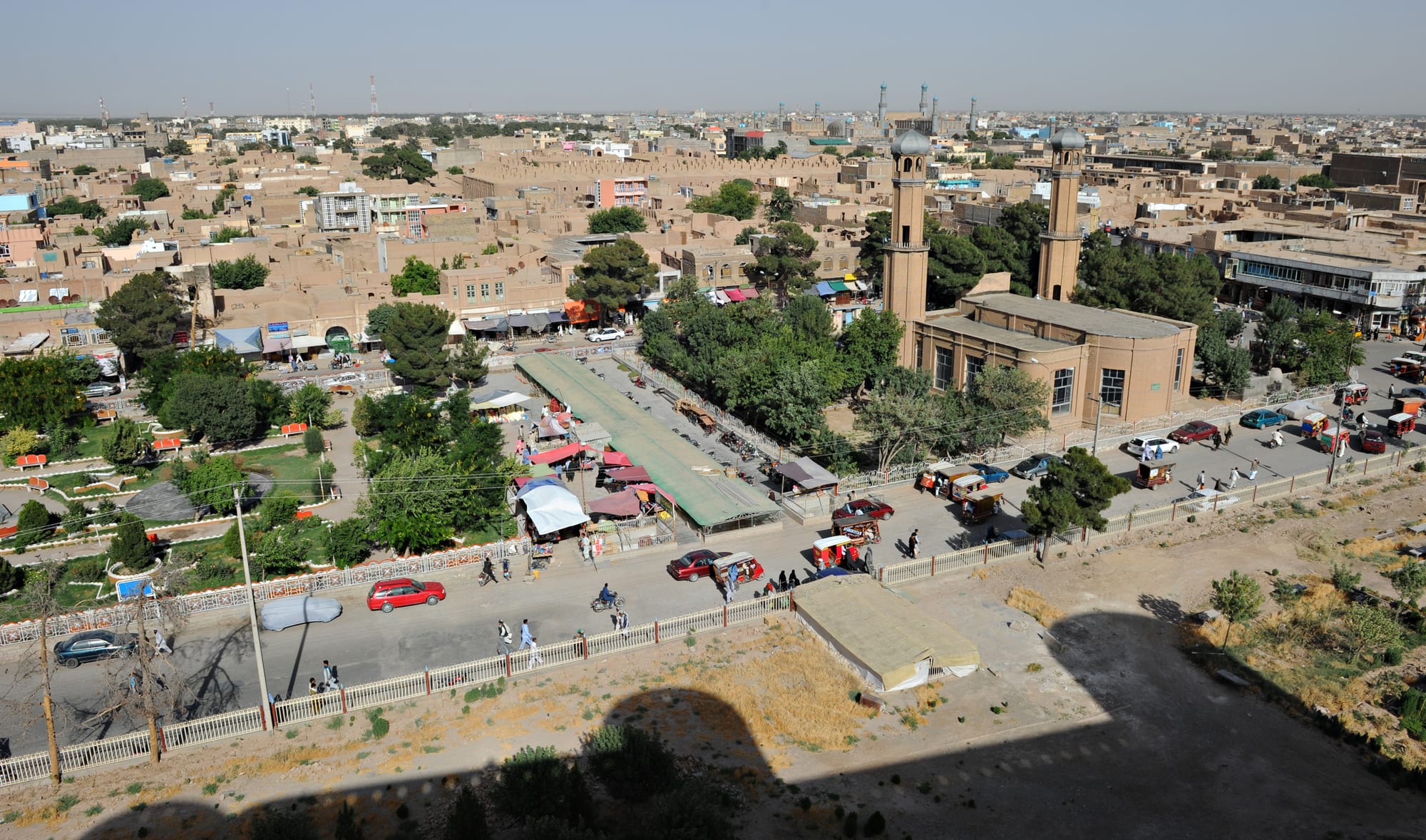
A low-rise city of flat-roofed brown buildings seen from above, with a mosque's twin minarets and a tree-lined avenue in the middle distance

Herat & the West, Afghanistan

Herat

The old city of Herat seen from the citadel. (S.K. Vemmer (U.S. Department of State) / Wikimedia Commons · Public domain)

Afghanistan's western city, in the irrigated Hari river valley near the Iranian border, and one of the oldest cities of the Persian world. Timurid rulers made it a capital of poetry, painting and tilework in the 15th century, and its citadel, blue-tiled Friday Mosque and leaning minarets still stand above a trading city. This page is written to explain the city, not to encourage travel.

Neighbourhoods

  • The old city
    • First-time visitors
    • Historic district
    • Markets

    The walled quarter south of the citadel, a dense grid of lanes, courtyard houses, cisterns and covered bazaars that still follows its medieval plan. The Friday Mosque stands at its northern edge, and the trades — cloth, glass, metalwork, spices — are grouped street by street.

    Open in Maps
  • The citadel quarter
    • Landmarks
    • Views

    The ground around Qala Ikhtiyaruddin, the great mud-brick fortress on its mound, with parks, offices and the main road running below the walls. The ramparts give the best overview of the old city's rooftops and the valley beyond.

    Open in Maps
  • The Musalla district
    • Landmarks
    • Quiet and residential

    North of the centre, an open area of parkland and roads where the surviving Timurid minarets lean over the traffic beside a domed mausoleum. Residential streets and newer institutional buildings spread around it.

    Open in Maps
  • Gazar Gah and the northern edge
    • Quiet and residential
    • Gardens

    On rising ground a few kilometres north-east, a village-like district around a walled shrine complex with pine trees and old gravestones. The air is cooler here, and the slope looks back over the whole city.

    Open in Maps
  • The new city
    • Close to public transport
    • Local life

    West and south of the old walls, a spread of wide avenues, concrete shopfronts, hotels and apartment blocks built through the late 20th century and after. Most offices, transport yards and modern shopping are here rather than in the old lanes.

    Open in Maps

Things to do

The old city

  • Citadel of Heratlandmark

    Qala Ikhtiyaruddin, a mud-brick fortress of towers and ramparts on a mound at the northern edge of the old city, rebuilt many times and restored between 2006 and 2011.

    Open in Maps
  • Friday Mosque of Heratlandmark

    The city's congregational mosque, founded by the Ghurids around 1200, with a vast courtyard framed by iwans covered in blue, turquoise and white tilework.

    Open in Maps
  • Herat National Museummuseum

    The provincial museum housed inside the restored citadel, showing finds from western Afghanistan alongside the fortress itself.

    Open in Maps

Shrines and minarets

  • Musalla Complexlandmark

    The remains of a 15th-century religious complex built by Queen Gawhar Shad — a group of leaning brick minarets, still patterned with tilework, and her ribbed-domed mausoleum.

    Open in Maps
  • Gazar Gahlandmark

    The walled shrine of the 11th-century Sufi poet Khwaja Abdullah Ansari on the hills north-east of the city, rebuilt in the Timurid period and set among pines and carved tombstones.

    Open in Maps

Getting in and out

  • Herat International Airporttransit hub

    The city's airport, about 10 kilometres south-east of town and now named after Khwaja Abdullah Ansari, the main air link for western Afghanistan.

    Open in Maps
  • Islam Qalaattraction

    The crossing point on the Iranian border west of the city, one of the country's busiest frontier posts for goods and for people returning from Iran.

    Open in Maps
  • Torghundiattraction

    The town on the Turkmen border north of Herat, where a short railway line crosses into Afghanistan.

    Open in Maps

Further afield

  • Minaret of Jamlandmark

    A brick minaret about 65 metres high, covered in carved Kufic inscriptions, standing in a remote gorge of Ghor — the first place in Afghanistan listed as a UNESCO World Heritage Site.

    Open in Maps
  • Chisht-e Shariflandmark

    A town on the northern bank of the Hari river in the east of Herat Province, which gave its name to the Chishti Sufi order, begun there by Abu Ishaq Shami.

    Open in Maps

Seasonal events

  • NowruzMarch

    The Persian New Year on 21 March, long the great spring celebration in this Persian-speaking city, though it is no longer an official holiday.

  • Saffron harvestlate October to November

    The fields around Herat are picked at dawn for a few weeks in autumn, and the crop is one of the province's best-known products.

  • Ramadanvaries with the lunar calendar

    A month of daylight fasting, when the bazaars are quiet by day and busy long after sunset.

  • Eid al-Fitrvaries with the lunar calendar

    The festival closing Ramadan, marked with new clothes, family visits and crowded shrines.

  • Eid al-Adhavaries with the lunar calendar

    The feast of sacrifice, when meat is shared among relatives, neighbours and the poor.

Eat and drink

Long-standing places and food districts in Herat. Hours, ratings and directions come from your maps app, always current.

Herati classics

  • Kebab houses of the old cityneighborhood

    Skewers of lamb and minced kofta grilled over charcoal and served with naan straight from the tandoor, in small rooms and street-front grills through the bazaar lanes.

    Open in Maps
  • Palaw and qorma restaurantsneighborhood

    The larger eating houses of the new city serve rice dishes — Kabuli palaw with lamb, carrot and raisins, or plain chalaw with a meat and fruit qorma — and aush, a herb and bean noodle soup.

    Open in Maps

Markets

  • The covered bazaarsmarket

    Trade grouped by craft through the old city: dried fruit, nuts and saffron, spices, cloth, glass and metalwork, with tea houses among the stalls.

    Open in Maps
  • Fruit and saffron sellersmarket

    Herat's raisins, figs, melons and pomegranates come from the Hari valley orchards, and saffron grown in the province is sold by the gram in small tins and jars.

    Open in Maps

Experience Herat

History

Herat is one of the oldest cities of the Iranian world: the Aria of the Achaemenid Persians, refounded by Alexander the Great as Alexandria in Aria, whose fortress tradition places under the present citadel. Water from the Hari river made the valley rich, and the city passed through Parthian, Kushan, Sasanian and early Islamic hands, growing as a staging point on the roads between Persia, India and Central Asia. In the 12th century the Ghurids, a dynasty from the mountains of Ghor to the east, founded the Friday Mosque here. Genghis Khan's armies sacked the city in the 1220s.

Its golden age followed under the Timurids. Shah Rukh, son of Timur, made Herat his capital early in the 15th century, and his wife Gawhar Shad built the Musalla complex of mosque and madrasa north of the walls. Under Sultan Husayn Bayqara, late in the century, the court drew the poet Jami, the Turkic poet Ali-Shir Nava'i and the painter Behzad, whose work defined the Herat school of miniature painting; tilework, calligraphy and bookmaking flourished alongside them.

Safavid Persia and then the Durrani kingdom fought over the city, and Persia besieged it repeatedly in the 19th century before the border with Afghanistan was settled. In 1885, fearing a Russian advance, British and Afghan engineers demolished most of the Musalla to clear a field of fire, leaving the minarets standing alone. The March 1979 uprising against the communist government was crushed with heavy loss of life, the deadliest episode before the Soviet invasion that December. The Taliban took Herat in 1995, lost it in 2001, and took it again in 2021. The citadel was restored between 2006 and 2011.

Culture & Customs

Herat thinks of itself as the cultural capital of Afghanistan, and the claim rests on a long line of poets, calligraphers, miniature painters and tile-makers running back to the Timurid court. Dari is spoken in a Herati accent close to the Persian of eastern Iran, classical poetry is quoted in ordinary speech, and family, trade and religious ties across the border are close enough that the city has always looked as much west as east.

Sufism is part of the city's identity. The shrine of Khwaja Abdullah Ansari at Gazar Gah, an 11th-century poet and mystic, remains a place of pilgrimage and of weekend family visits, and the Chishti order, later hugely influential in India, takes its name from Chisht-e Sharif in the east of the province. Most Heratis are Tajiks, with Pashtun, Hazara and other communities, and the Aimaq peoples of the eastern hills bring another Persian-speaking tradition into the city's markets.

Craft is the visible side of that culture: glass blown in the old city, metalwork, embroidery and carpets, and the blue and turquoise tile that has been remade for the Friday Mosque in workshops attached to it. Hospitality is formal — tea, dried fruit and nuts appear before any conversation of substance — and manners are more reserved than in Kabul. The city was also known for women's education and professional work before 2021, a history residents mention often.

Daily Life

About 670,000 people live in Herat, making it the country's third city and the commercial capital of the west. The shape is clear: the walled old city with its bazaars and courtyard houses, the citadel above it, the minarets standing in open ground to the north, and wide modern avenues spreading west and south across the valley floor, where most newer housing and offices are.

Trade drives the economy. Goods cross from Iran at Islam Qala and from Turkmenistan at Torghundi, and Herat distributes them across the west; the bazaars handle everything from cloth and machinery to dried fruit. The valley grows wheat, grapes, pomegranates and saffron, the last a signature crop picked in autumn, and marble and cement works, food processing and carpet weaving employ many. Large numbers of Afghans deported or returning from Iran pass through the city, which has long absorbed displaced families.

The day runs on bread from the neighbourhood oven and green tea, with bazaars busiest in the morning and again after the afternoon heat, when families walk in the parks and around Gazar Gah. Electricity has often depended on imports from Iran and Turkmenistan, and supply is uneven. Drought has pressed hard on the valley's farming, the suspension of development aid after 2021 removed many jobs, and restrictions on girls' secondary education and on women's work weigh on a city once known for its schools.

Food

Western Afghan cooking shares much with eastern Iran, and rice leads it. Kabuli palaw — long-grain rice steamed with lamb, carrot julienne and raisins — is the dish of weddings and guests, while chalaw, plain white rice, is eaten with qorma, a slow stew of meat and onions often sweetened with fruit. Aush, a noodle soup with herbs, beans and yoghurt, and shorwa, a meat and vegetable broth poured over torn bread, are everyday food.

The grill is the city's street food. Lamb kebab and minced kofta are cooked over charcoal and wrapped in naan from the tandoor, and bolani, flatbread stuffed with potato or leek and fried, is sold through the bazaar. Dumplings appear at celebrations: mantu, steamed and filled with minced meat and onion, served under yoghurt and a tomato sauce, and ashak, filled with leek.

Herat is orchard and garden country. Its grapes are famous and many are dried into raisins; pomegranates, figs, melons and apricots come from the valley, and pistachios from the uplands of Badghis to the north. Saffron grown in the province's fields colours rice and sweets and is sold in the bazaar by the gram. Sweets run to firni, a milk pudding scented with cardamom and rosewater, and sugared almonds. Drinks are green tea above all, doogh — salted yoghurt thinned with water and mint — and fruit sharbat in summer. Alcohol is prohibited.

Planning tools

Budget

Herat has long been one of the cheaper and better-supplied cities in Afghanistan, with guesthouses, deep bazaars and goods arriving from Iran. Everything is paid in cash, in afghanis changed from US dollars. Rooms and food cost little; the real expense for an outsider is a hired car with a driver, and any journey into the mountains of Ghor costs far more again.

Daily Budget Midrange
USD 40–80 (better hotel in Herat, hired car with driver)
Daily Budget Shoestring
USD 15–30 (basic guesthouse, bazaar food, shared taxis)

Bring newer US dollar bills to change in the bazaar; Iranian rials circulate near the border but are no substitute for afghanis.

Best Time to Visit

March to May and October to November, when the city is mild and the gardens and orchards are green or turning. Summer is hot, dry and windy — the so-called wind of 120 days blows from the north-west from late May to late September — and winter nights fall close to freezing, with light snow.

Suggested Number of Days

The monuments and bazaars are concentrated in and around the old city, so two days covers the city itself. Add a day or two for the valley and the shrines on its edge; journeys into Ghor need far longer and depend on the season.

First Visit
2 days
With Surroundings
3–4 days

Transportation

Herat has an airport with domestic flights to Kabul and is linked by paved road to Islam Qala on the Iranian border and north to Torghundi on the Turkmen border, where a short railway crosses. The ring road runs south towards Farah and Kandahar. Within the city, shared taxis and small three-wheelers cover the avenues, and the old city is walked.

Roads out of the province are long and exposed; travel by day, and treat any trip towards the Minaret of Jam as an expedition with a sturdy 4x4 and spare days.

Airport & Station Connections

Herat International Airport lies about 10 kilometres south-east of the city and handles domestic flights and a limited number of regional services. Many arrivals come overland from Iran through Islam Qala, a little over 100 kilometres west, or from Turkmenistan at Torghundi to the north. The drive from Kandahar along the ring road takes a long day.

Walkability

The old city is flat and best seen on foot: the bazaar lanes, the Friday Mosque and the citadel are within a short walk of one another. Distances open up quickly beyond the walls — the Musalla minarets and Gazar Gah need transport — and summer heat, dust and traffic on the wide new avenues make longer walks unpleasant in the middle of the day.

Safety

Most governments advise against all travel to Afghanistan, and that applies here. Herat has been attacked by bombers, including at mosques, and kidnapping and detention risks apply as elsewhere, with no consular help. Landmines and unexploded ordnance remain a hazard off used ground, and the October 2023 earthquakes left damage in parts of Herat Province.

Most governments advise against all travel to Afghanistan, and that applies here. Anyone still considering a visit should read their government's full advisory, move only with trusted local help, and avoid border areas and the desert roads of the south-west. Check current official travel advice before travelling.

Climate

Hot, dry summers and cool winters in the valley of the Hari river. Rain falls mostly between December and April; the rest of the year is dry. The wind of 120 days blows hard from the north-west through the summer, lifting dust across the city.

Summer
hot, dry and windy — daytime temperatures around 35°C, with cool nights
Winter
cool — daytime highs often around 8–12°C, with nights near or below 0°C and occasional light snow

Local Customs

Herat is conservative, Persian in manner and proud of its literary past. Modest dress is expected: women cover their hair and wear loose clothing, men wear long trousers and sleeves, and shoes come off in mosques, shrines and homes. Guests are received with green tea, dried fruit and nuts, and hospitality is insistent. Greetings are unhurried and the right hand is used for eating and giving.

Ask before photographing people, especially women, and never photograph officials, checkpoints or military sites. Alcohol is prohibited, and the restrictions on women's dress, movement and work apply to visitors as well as residents.

Common Payment Methods

The currency is the Afghan afghani and the city runs on cash. International cards do not work and ATMs cannot be relied upon. Clean, recent US dollar notes are changed by dealers in the bazaar; Iranian rials circulate in border trade but are not a substitute. Keep small afghani notes for taxis, bread and tea.