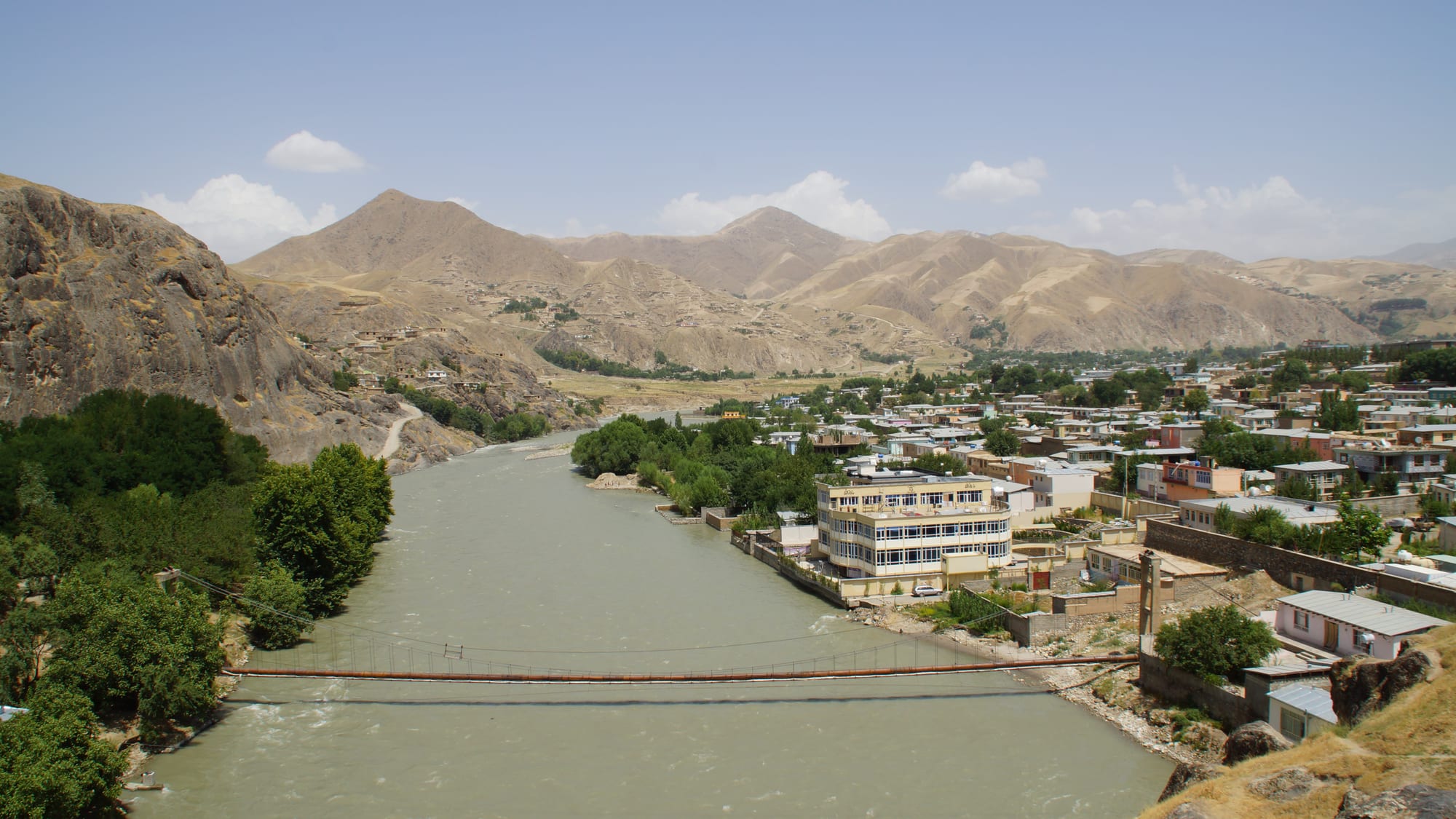
A wide pale-green river curving past a hillside town of flat-roofed houses, crossed by a red suspension footbridge, with bare brown mountains behind

Mazar-i-Sharif & the North, Afghanistan

Fayzabad

Fayzabad along the Kokcha river in Badakhshan Province. (Julian-G. Albert / Wikimedia Commons · CC BY 2.0)

The capital of Badakhshan province in Afghanistan's mountainous north-east, built along the fast green Kokcha river where the valley widens between bare ridges. A long, rough road from the northern plains ends here, and the tracks east towards Ishkashim, the Wakhan corridor and the Pamirs begin. This page is written to explain the city, not to encourage travel.

Neighbourhoods

  • The bazaar and the riverbank
    • First-time visitors
    • Markets
    • Local life

    The town's working centre is a long line of shops, tea houses and workshops strung along the road above the Kokcha, with footbridges crossing to the far bank. Almost everything sold in Badakhshan passes through here, and this is where transport onwards is arranged.

    Open in Maps
  • The government quarter
    • Quiet and residential

    Provincial offices, the hospital, schools and aid agency compounds stand in a more spacious district set back from the bazaar, with walled gardens and poplar trees. It is the quieter half of the town and holds much of its salaried employment.

    Open in Maps
  • The hillside terraces
    • Views
    • Quiet and residential

    Housing climbs the slopes above the river in stepped terraces of flat-roofed mud-brick and concrete compounds, reached by steep lanes. The higher streets give long views over the river bend and the ridges beyond, though water and services are thinner up there.

    Open in Maps
  • The Baharak road, east
    • Transport links

    East of the centre the valley opens out towards the road up to Baharak and Jurm. Fuel stations, transport yards and newer compounds line the route that carries traffic heading deeper into the mountains.

    Open in Maps

Things to do

The river and the town

  • Kokcha Riverattraction

    The pale green river that runs past the town on its way down from the Hindu Kush to the Panj, crossed in the centre by suspension footbridges.

    Open in Maps
  • Fayzabad Airporttransit hub

    The small airport about six kilometres north-west of the town, built during the Soviet-Afghan war and given an asphalt runway in 2012, with limited domestic flights and the alternative to a very long drive from the northern plains.

    Open in Maps

Up the Kokcha valley

  • Sar-e-Sangattraction

    The lapis lazuli mines of the Kuran wa Munjan district, worked since the third millennium BC and the source of the blue stone traded to Mesopotamia, Egypt and the Indus valley.

    Open in Maps

Towards the Wakhan

  • Ishkashimattraction

    The border town on the Panj river, facing Tajikistan, where the Wakhan corridor begins its run east towards the Pamirs.

    Open in Maps
  • Wakhan Corridorattraction

    The narrow high valley running east between Tajikistan and Pakistan, with Wakhi villages, Kyrgyz herders and the Pamir grasslands at its head.

    Open in Maps

Seasonal events

  • NowruzMarch

    The Persian New Year on 21 March, marking the end of a long mountain winter, though it is no longer an official holiday.

  • Ramadanvaries with the lunar calendar

    A month of daylight fasting, when the bazaar is subdued by day and busy after sunset.

  • Eid al-Fitrvaries with the lunar calendar

    The festival ending Ramadan, kept with new clothes, visits between households and shared meals.

  • Eid al-Adhavaries with the lunar calendar

    The feast of sacrifice, when livestock is slaughtered and the meat divided among family, neighbours and the poor.

Eat and drink

Long-standing places and food districts in Fayzabad. Hours, ratings and directions come from your maps app, always current.

Badakhshan cooking

  • Bazaar tea housesneighborhood

    The chaikhanas along the main street serve the mountain staples — rice palaw, shorwa soup with bread, and skewers of lamb kebab — on carpeted platforms, with endless pots of green tea.

    Open in Maps
  • Bread and dairy stallsmarket

    Naan from tandoor ovens, yoghurt, curd and the hard dried qurut balls that mountain households live on through the winter, sold in the lanes off the bazaar.

    Open in Maps
  • Fruit and nut sellersmarket

    Mulberries, apricots and walnuts from the valley orchards, fresh in season and dried for the rest of the year, alongside almonds and raisins brought up from the plains.

    Open in Maps

Experience Fayzabad

History

Badakhshan has been known far beyond its mountains for one commodity: the lapis lazuli mined at Sar-e-Sang in the Kokcha valley, traded to Mesopotamia and Egypt thousands of years ago and used for the blue in the jewellery of ancient courts. The routes that carried it ran through the valleys around the site of Fayzabad long before any town stood there, and the region's rubies and gold added to its reputation among medieval geographers.

The town itself is comparatively recent. Local Uzbek and Tajik rulers governed Badakhshan as a distinct principality into the 19th century, often loosely tied to Kabul, Bukhara or Kunduz, and Fayzabad emerged as its seat on the Kokcha, replacing Munjan as the capital of Badakhshan. Emir Abdur Rahman Khan annexed the region in 1888, after which the town recovered its importance as a place of trade, and the boundary settlements agreed with Britain and Russia at the end of that century fixed the Panj river as the northern border and left Afghanistan the narrow Wakhan corridor reaching east towards China.

Remoteness shaped the modern story. The Soviet-Afghan war and the civil wars that followed reached Badakhshan, but during the civil war of the 1990s the province was one of the main power bases of the Northern Alliance, whose political head, Burhanuddin Rabbani, was a native of Badakhshan, and Fayzabad remained its administrative centre. After 2001 aid organisations and a provincial reconstruction effort brought roads, an airstrip, schools and a hospital, and the town grew quickly. The province passed to the Taliban with the rest of the country in 2021, and aid has since fallen sharply.

Culture & Customs

Badakhshan's people are mostly Tajik and Persian-speaking, and the Dari heard in Fayzabad has its own mountain accent, distinct from Kabul's. East of the town, in the upper valleys and the Wakhan, live Pamiri peoples — the Wakhi above all — who speak Eastern Iranian languages unrelated to Dari, and many of them are Ismaili Shia rather than Sunni, which gives the far east of the province a religious life of its own, centred on community prayer houses rather than mosques.

Music and poetry hold a strong place. Badakhshan has folk styles of its own, drawing on Pamiri, Tajik and Uzbek traditions and played at weddings and gatherings, and poetry and storytelling are largely oral, kept in Dari and the Pamiri languages. Hospitality is close to obligatory: a guest is fed before anything else is discussed, and refusing tea is hard to do politely.

Life is organised around the extended family and the village, with elders settling disputes and labour shared at harvest and at house-building. Men and women's spaces are separate in most households, and dress is conservative throughout. Nowruz, the Persian New Year, has long been the great spring celebration in the mountains, marking the end of the winter isolation, although it is no longer recognised as an official holiday. Opium poppy was grown as a cash crop on small, remote plots in the province's isolated valleys until a ban in 2022, and the drug trade and addiction have left their mark.

Daily Life

Fayzabad is small — its population is estimated at about 85,000 — but it is the largest settlement for a very long way and the administrative, medical and trading centre of a province of about 1.2 million people. The town runs along the Kokcha, with a bazaar street at its core, government compounds set back from it, and houses climbing the terraces above.

Work is farming, trade, transport and government. The valleys grow wheat, maize, mulberries, apricots and walnuts on narrow irrigated terraces, and livestock is taken up to summer pasture; the town handles the goods that come up from Kunduz and the plains, and the movement of people and supplies further east. Public salaries, teaching and the hospital support many households, and remittances from relatives working abroad matter a great deal. Mining, above all lapis, has long been a source of both income and conflict.

The day starts early, with the bazaar busiest in the morning and quiet during the afternoon. Winter shapes everything: households lay in flour, fuel and dried food before the snow, roads close, and prices rise. Poverty is deep, electricity supply is intermittent, drought has hit harvests in recent years, and the ending of much international aid after 2021 removed a large part of the local economy. As elsewhere in the country, restrictions on girls' secondary education and on women's work apply here.

Food

Mountain cooking is plain, filling and built on bread, dairy and rice. Naan baked in a tandoor accompanies every meal, and shorwa — a long-simmered soup of lamb, potato and whatever vegetables are to hand — is poured over torn bread in a shared bowl. Palaw, rice steamed with meat, carrots and raisins, appears at any gathering worth the name, and chalaw, plain rice, is eaten with qorma, a stew of meat and onions.

Dairy is the winter store. Milk from sheep, goats and cattle becomes yoghurt, curd and qurut, hard balls of salted dried yoghurt that keep for months and are soaked and beaten into a tart white sauce for dumplings and rice dishes. Mantu, steamed dumplings of minced meat and onion, and ashak, filled with leek, are festive food here as across the north. Bolani, a flatbread stuffed with potato or leek and fried, is sold in the bazaar.

The valleys are orchard country. Mulberries are the signature fruit, eaten fresh in early summer and dried in quantity for the winter, sometimes ground with walnuts into a dense sweet paste; apricots, apples and walnuts are dried the same way. Tea is drunk all day, usually green and unsweetened, poured from a pot kept refilled, with sheer chai, a salted or sweetened milk tea, for cold mornings. Alcohol is prohibited.

Planning tools

Budget

Costs are low but choice is very limited: a handful of simple guesthouses, bazaar food and shared transport. Everything is paid in cash, in afghanis changed from US dollars, and prices for goods carried up from the plains are noticeably higher than in Mazar-i-Sharif. Any travel beyond the town means hiring a vehicle and driver, which is the single largest expense.

Daily Budget Midrange
USD 50–100 (the better hotels in town, hired car with driver; a journey into the Wakhan costs considerably more)
Daily Budget Shoestring
USD 15–30 (simple guesthouse, bazaar food, shared taxis)

Change money in Mazar-i-Sharif or in Fayzabad's bazaar and carry enough cash for the whole trip — there is nothing to change further east.

Best Time to Visit

Late spring to early autumn. The valley is green and mild from May, and roads are at their most reliable from about July to September, which is also the only realistic window for the Wakhan and the Pamirs. Snow closes the high passes for months, and the approach roads are worst during the spring melt.

Suggested Number of Days

The town itself takes a day. It matters more as a base and a staging post, and journeys deeper into Badakhshan should be counted in days rather than hours, with spare time built in for weather and road conditions.

First Visit
1 day
With Surroundings
3–5 days

Transportation

Fayzabad is a long, rough drive east from Kunduz and Taloqan, and the town has an airport with limited domestic flights. Shared taxis and minibuses work the valley roads to Baharak, Jurm and Argo, and from Ishkashim a gravel road runs up the Wakhan. Within the town, shared taxis and walking cover everything.

Distances in Badakhshan are measured in days, not hours; arrange transport through experienced local drivers and allow a margin for delays.

Airport & Station Connections

Most people arrive overland from the north-west, on the road from Kunduz and Taloqan, a journey of many hours along river valleys that can lengthen sharply in bad weather or after landslides. Fayzabad Airport lies about six kilometres north-west of the town and provides limited domestic flight services. There is no passenger rail anywhere in Afghanistan.

Walkability

The centre strings out along the river and is walkable end to end, with footbridges linking the two banks, but the town is steep away from the water and the hillside lanes climb hard. Surfaces are rough, there is little lighting after dark, and dust in summer and mud in spring make the walk harder than the distances suggest.

Safety

Most governments advise against all travel to Afghanistan, and that applies here. Badakhshan is remote, poor and a very long way from any medical care that could handle a serious injury, and risks of kidnapping and detention apply as elsewhere in the country, with no consular help available. Mountain roads are the everyday danger: landslides, snow and river crossings.

Most governments advise against all travel to Afghanistan, and that applies here. Anyone still considering a visit should read their government's full advisory, follow local guidance on dress and conduct, and never stray off used tracks. Check current official travel advice before travelling.

Climate

A mountain climate, milder in the valley bottom than on the ridges above. Summers are warm and dry with cool nights; winters are long, cold and snowy, and snow closes the passes around the town for months. Spring brings melt water and unstable slopes.

Summer
warm and dry in the valley — typically in the high 20s to low 30s °C by day, with much cooler nights
Winter
long and cold — daytime temperatures often near 0–5°C, with nights well below freezing and heavy snow on the passes

Local Customs

Badakhshan is conservative and hospitable in equal measure. Modest dress is expected: women cover their hair and wear loose clothing, men wear long trousers and sleeves. Shoes come off indoors, the right hand is used for eating and giving, and a visitor will be offered tea, bread, dried fruit and nuts almost immediately. Many people in the eastern valleys are Ismaili Shia, a minority elsewhere in the country.

Ask before photographing anyone, especially women, and never photograph officials, checkpoints or military sites. Alcohol is prohibited, and the restrictions on women's dress, movement and work apply to visitors as well as residents.

Common Payment Methods

The currency is the Afghan afghani, and the town runs entirely on cash. International cards are not usable and ATMs cannot be relied upon. Clean, recent US dollar notes can be changed with dealers in the bazaar, but rates are poorer than in the larger cities and there is no way to change money in the valleys further east.