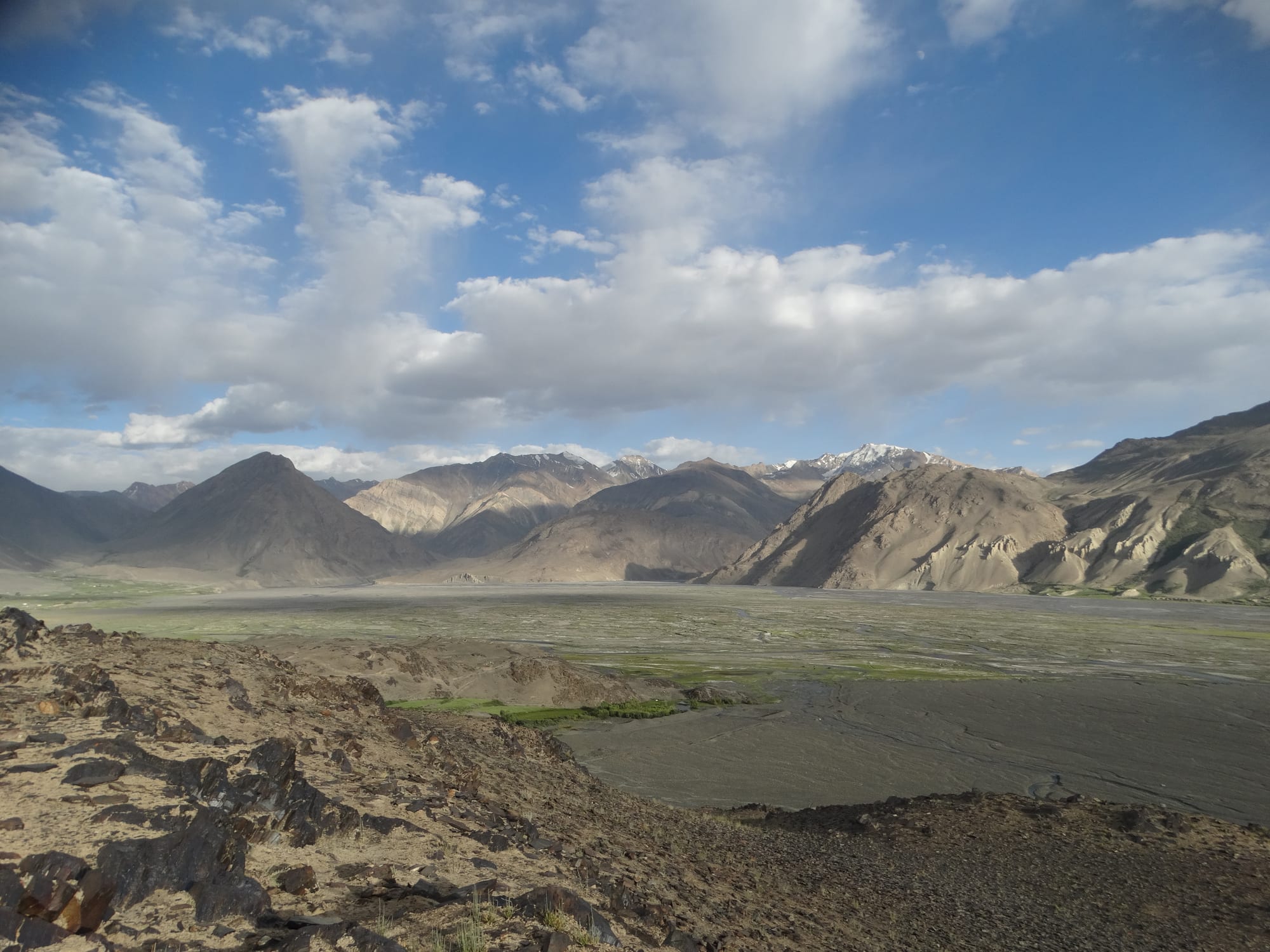
A wide, braided river valley ringed by bare brown mountains and a snow-capped peak under a cloudy blue sky

Afghanistan

Mazar-i-Sharif & the North

The upper Wakhan valley near Sarhad-e Broghil, in the far east of Badakhshan Province. (Benoît Vicart / Wikimedia Commons · CC0)

Afghanistan's north, the plains of ancient Bactria between the Hindu Kush and the Amu Darya, running from Mazar-i-Sharif and Balkh east through Kunduz to the Pamir valleys of Badakhshan and the Wakhan corridor — Uzbek, Turkmen and Tajik country with Central Asian roots. This page is written to explain the region, not to encourage travel.

Explore Mazar-i-Sharif & the North

History

The northern plain was ancient Bactria, and its capital, Bactra — the Balkh of later centuries — was among the great cities of Asia. Zoroastrian tradition links the prophet Zoroaster with it, and Alexander the Great passed through in the 320s BC. His successors founded a Greco-Bactrian kingdom whose city at Ai-Khanoum, on the Amu Darya in today's Takhar, had a theatre and a gymnasium. The Kushans followed and made the region Buddhist: the Nava Vihara monastery at Balkh and the rock-cut stupa of Takht-e Rostam date from those centuries, and the Tillya Tepe hoard of Bactrian gold was excavated near Sheberghan in 1978.

Arab armies arrived in the 7th and 8th centuries, and Balkh became a Muslim centre of learning — the Barmakid family of viziers came from here, as did the family of the poet Rumi, born in 1207. Genghis Khan's Mongols destroyed it in 1220. In the 15th century the Timurid ruler Sultan Husayn Bayqara rebuilt the shrine at a nearby village where tradition placed the tomb of the caliph Ali, and the town that grew around it, Mazar-i-Sharif, "the noble shrine", gradually replaced Balkh as the north's main city.

Uzbek khanates ruled much of the region until Afghan rulers in Kabul absorbed it in the mid-19th century, and late-19th-century agreements with Britain and Russia made the Amu Darya and Panj the border with the Russian empire, leaving Afghanistan the narrow Wakhan. In 1979 Soviet troops crossed into Afghanistan from Termez, across the river from Hairatan, and in 1989 the last of them left over the Friendship Bridge there. The civil wars of the 1990s were fought hard here: the Taliban took Mazar-i-Sharif in 1998 at great cost to its people, while Badakhshan remained a stronghold of their opponents. Mazar-i-Sharif was the first major city to fall to the anti-Taliban coalition in 2001, and the Taliban took the whole north again in August 2021.

Culture & Customs

The north is where Afghanistan meets Central Asia. Tajiks form a large share of the population, especially in Badakhshan and Takhar, and Uzbeks and Turkmen are strong across Jowzjan, Faryab and Balkh, alongside Pashtuns settled in the north since the late 19th century and Hazaras in the southern hills. Dari is the common language, with Uzbek and Turkmen spoken at home in many districts. Badakhshan and the Wakhan add another layer: the Wakhi and other Pamiri peoples speak their own Eastern Iranian languages and many are Ismaili Shia, while a small community of Kyrgyz herders lives in the high Pamirs.

Mazar-i-Sharif's shrine is the region's spiritual centre. Nowruz, the Persian New Year, was traditionally marked there with the raising of the Janda Bala, a great banner, and forty days of the Mela-i Gul-i Surkh, the red-tulip festival, though the Taliban authorities cancelled Nowruz as an official holiday after 2021, while saying they would not prevent private celebration.

Buzkashi, the mounted game fought over a goat or calf carcass, is Afghanistan's national sport, played by Uzbek, Tajik and Turkmen horsemen among others. Turkmen and Uzbek families weave many of the carpets sold as "Afghan", with Andkhoy and Aqcha long known for the craft, and the karakul cap of curly lambskin became popular in Mazar-i-Sharif.

Daily Life

Mazar-i-Sharif, with several hundred thousand people, is Afghanistan's main northern city and one of its largest: a trading hub of wide avenues and bazaars laid out around the shrine. Kunduz, Sheberghan, Pul-e Khumri, Taloqan, Maimana and Faizabad are the other provincial centres, while Balkh itself is now a modest town. Most people live in villages, farming irrigated land along the rivers that run down from the Hindu Kush and fade out on the plain before reaching the Amu Darya.

The economy is agricultural — wheat, cotton, rice around Kunduz and Takhar, melons, almonds and livestock — with trade across the Uzbek and Tajik borders adding a great deal. Hairatan, on the Amu Darya, is one of the country's main ports of entry for goods, and Jowzjan has natural gas fields around Sheberghan. Badakhshan's mountains hold the lapis lazuli mines of Sar-e Sang, worked for thousands of years.

Days start early to beat the heat, with bread from the tandoor and green tea; the bazaars do most of their business by midday. Poverty, drought and the suspension of development aid after 2021 weigh heavily on the region, and the restrictions on girls' secondary education and women's work apply here as everywhere in the country. In the Wakhan life follows the herds, with families moving animals up to summer pastures.

Food

Northern cooking leans toward Central Asia. Palaw is the centre of any feast, above all the national Kabuli palaw, cooked with carrots, raisins and lamb. Mantu, steamed dumplings of minced meat and onion under yoghurt and a tomato sauce, and ashak, leek-filled dumplings, are standard celebration food, and shorwa, a meat soup eaten with bread, is everyday fare.

The plains are famous for fruit. Balkh's melons and grapes are especially well regarded, and pomegranates, almonds and pistachios are grown around Balkh, Samangan and Kunduz. Qurut, balls of dried salted yoghurt, are reconstituted into a sauce for ashak, mantu and kichri qurut.

In Badakhshan and the Wakhan food is mountain fare: bread, dairy from yak, sheep and goat. Tea is drunk in large quantities everywhere, mostly green and unsweetened, with sheer chai, milk tea, kept for mornings and special occasions. Alcohol is prohibited.

Attractions & Natural Wonders

Mazar-i-Sharif's Blue Mosque, the Shrine of Hazrat Ali, is the region's great monument: a 15th-century core rebuilt and retiled many times, its courtyard of blue and turquoise faience filled with pilgrims. About 24 kilometres north-west, Balkh keeps the eroded mud-brick walls of the ancient city and its citadel, the Bala Hisar; the Noh Gonbad, or Haji Piyada, mosque, one of the oldest Islamic buildings in the country, with carved stucco columns; the Green Mosque shrine of Khwaja Abu Nasr Parsa; and the tomb of the poet Rabia Balkhi.

South of Mazar-i-Sharif, near Aybak in Samangan, Takht-e Rostam is a Buddhist stupa cut down into the living rock with monastery caves beside it, and further south in Baghlan lies the Kushan temple site of Surkh Kotal. To the east, Kunduz is the market town of an irrigated plain, and the ruins of Ai-Khanoum stand on the Amu Darya in Takhar, badly damaged by looting during the wars. Sheberghan, capital of Jowzjan, lies near the site of the Tillya Tepe gold hoard.

Badakhshan is mountain country, with Faizabad on the Kokcha river as its capital. From Ishkashim the Wakhan corridor runs east along the Panj river, with the Hindu Kush on one side and Tajikistan across the water, through Wakhi villages to Qala-e Panja and Sarhad-e Broghil. Beyond them, the Pamir valleys of Badakhshan — the Big Pamir, with Lake Zorkul on the Tajik border, and the Little Pamir — are high grasslands grazed by the herds of Kyrgyz nomads, rising to peaks above 6,000 metres.

Cities in Mazar-i-Sharif & the North

Planning basics

Budget

Costs follow the national picture: very low, cash-only and paid in afghanis changed from US dollars. Mazar-i-Sharif has the widest choice of guesthouses and hotels in the north. Badakhshan and the Wakhan are a different matter — a 4x4 with driver, permits, porters or pack animals and supplies carried in make any trip there far more expensive than time in the cities.

Daily Budget Midrange
USD 50–100 (better hotel, hired car with driver; a Wakhan trip costs considerably more)
Daily Budget Shoestring
USD 15–30 (basic guesthouse in Mazar-i-Sharif, local food, shared taxis)

Bring clean, newer US dollar bills and change them in Mazar-i-Sharif or Faizabad; there is nothing to change money in the Wakhan.

Safety

Most governments advise against all travel to Afghanistan, and that applies here. The north has seen heavy fighting within living memory, including in Kunduz and around Mazar-i-Sharif, and bombings have struck the region's mosques and cities. Risks of terrorism, kidnapping and detention apply, there is no consular help, and landmines and unexploded ordnance remain off paved ground. The Wakhan is often described as calmer, but it is extremely remote, far from medical care and high enough for altitude sickness.

Anyone still considering a visit should read their government's full advisory, follow local guidance on dress and conduct, and never stray off used tracks. Check current official travel advice before travelling.

Climate

The northern plains are the hottest part of Afghanistan outside the south: Mazar-i-Sharif and Kunduz pass 40°C in high summer, with dust storms, while winters are cold and grey. Badakhshan is mountain climate — snow closes the passes for months — and the Wakhan and the Pamirs are high, dry and cold, with frost possible even in summer.

Summer
very hot on the plains, often 38–45°C in Mazar-i-Sharif; mild days and cold nights in the Wakhan
Winter
cold on the plains, around or below freezing at night; severe cold and deep snow in Badakhshan and the Pamirs

Transportation

Mazar-i-Sharif has an airport with domestic flights to Kabul and lies on the main road north from Kabul through the Salang tunnel, a long day's drive when the pass is open. Shared taxis link it with Balkh, Sheberghan, Kunduz and Pul-e Khumri, and a freight railway runs from the Uzbek border at Hairatan to Mazar-i-Sharif. Faizabad is a long, rough drive east, and a gravel road runs up the Wakhan through Qala-e Panja and Sarhad-e Broghil.

Distances in Badakhshan are measured in days, not hours; plan the Wakhan with an experienced local organiser and a margin for delays.

Best Time to Visit

March to May, when the plains are green and Nowruz, the Persian New Year on 21 March, has traditionally been marked at Mazar-i-Sharif's shrine, and again in October. The Wakhan and the Pamirs are only realistically reached from about July to September, before snow returns.