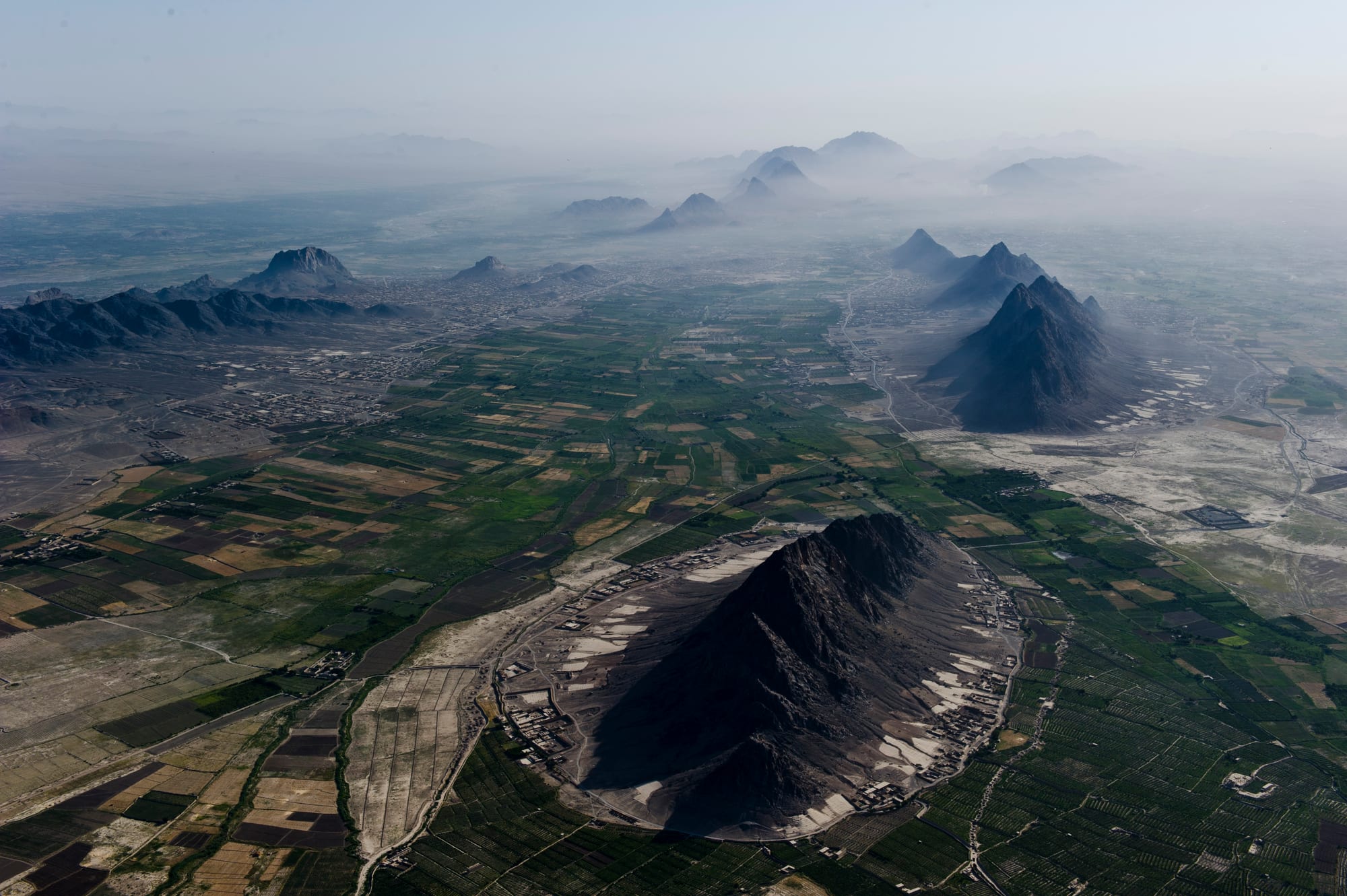
Aerial view of green irrigated fields and villages around dark, steep rocky hills fading into a hazy plain

Afghanistan

Kandahar & the South

Irrigated farmland and rocky ridges south-west of Kandahar, with the city under the haze beyond. (Mark Ray / Wikimedia Commons · Public domain)

Afghanistan's Pashtun south and south-east, from the old royal city of Kandahar and the irrigated Helmand valley to the Registan desert, up to Ghazni's minarets and east to the tribal borderlands of Paktia and Khost — the birthplace of the Afghan state and of the Taliban movement. This page is written to explain the region, not to encourage travel.

Explore Kandahar & the South

History

The south was Arachosia to the Persian empire, and Alexander the Great founded a city here in about 330 BC; in the next century the Mauryan emperor Ashoka had an edict carved in Greek and Aramaic at Old Kandahar. In the 10th century Ghazni became the capital of the Ghaznavids, whose sultan Mahmud, ruling from 998 to 1030, raided deep into India and gathered poets and scholars, among them Firdausi, who presented him with the Shahnameh. The Ghurid ruler Ala al-Din, remembered as the "World Burner", sacked Ghazni around 1150, and the Mongols ravaged the region in the following century. The palaces of Lashkari Bazar, where the Arghandab meets the Helmand, were the winter retreat of the Ghaznavid sultans.

Kandahar was fought over for centuries by the Mughals and the Safavids, and the Persian ruler Nader Shah destroyed the old city in 1738. After his death in 1747, a council of Pashtun chiefs near Kandahar chose Ahmad Shah Durrani as king, and he built a new city beside the ruins as his capital. The capital moved to Kabul in 1776, but Kandahar remained the heartland of the Durrani tribes. The British stormed Ghazni in 1839 and fought at Maiwand, west of Kandahar, in 1880, where an Afghan army defeated a British brigade.

In the 1950s American engineers built dams and canals in the Helmand valley, and Lashkar Gah was rebuilt as a planned town. After the Soviet war and the civil war, the Taliban movement emerged around Kandahar in 1994 under Mullah Omar, who ruled from the city. The south was the main battleground of the 2001–2021 war, with British and American forces in Helmand and Kandahar for years, and since 2021 the Taliban's supreme leader has been based in Kandahar.

Culture & Customs

The south is overwhelmingly Pashtun, and Pashto, in its southern Kandahari form, is the everyday language. Kandahar is the home of the Durrani confederation, the tribes that produced Afghanistan's kings, while the Ghilzai tribes dominate Ghazni, Zabul and Paktika. In Paktia, Khost and Paktika the tribes of Loya Paktia — Zadran, Mangal, Jaji and others — have a strong tradition of self-government through the jirga and have often resisted central authority. Baloch herders live in the Registan and southern Helmand, and Daykundi and parts of Ghazni and Uruzgan are Hazara country.

Social life is conservative and shaped by Pashtunwali, with public space largely male and women's lives lived within the family compound. The attan, the circle dance of the Pashtuns performed to drums, has distinctive fast styles in Khost and Paktia. Pashto poetry, especially the verse of the 17th-century warrior-poet Khushal Khan Khattak and of the Sufi Rahman Baba, is widely recited, as are landay, folk poems of a single couplet.

Kandahar holds one of the most revered relics in the country, a cloak said to have been worn by the Prophet Muhammad, kept in a shrine beside Ahmad Shah's mausoleum. Kandahari men's shirts, collarless and embroidered on the front, are recognised across Pashtun country.

Daily Life

Kandahar, with some 730,000 people, is one of Afghanistan's largest cities and the commercial centre of the south, with bazaars, fruit markets and trucks bound for Pakistan. Lashkar Gah, Ghazni, Gardez, Khost, Qalat, Tarinkot, Sharana and Nili are much smaller provincial capitals, and most people live in villages along irrigation canals or herd on the dry uplands; Kuchi nomads move their flocks between highland and lowland pastures.

Farming depends on water from the Helmand, Arghandab and Tarnak rivers and the underground karez channels. Kandahar grows pomegranates and grapes; Helmand wheat, cotton and melons; Daykundi almonds. Helmand was long one of the world's largest sources of opium poppy, until the Taliban banned its cultivation in 2022, which removed a major income for many farming families. Cross-border trade through Spin Boldak and Khost matters greatly.

Days begin early to beat the heat, with the bazaars busy by dawn and quiet at midday. Drought, poverty and the return of refugees deported from Pakistan weigh on the region, and a strong earthquake in 2022 killed more than a thousand people, mostly in Paktika, Paktia and Khost.

Food

Southern food is the plain, generous cooking of Pashtun country. Lamb is the meat of choice — grilled as kebabs or slow-cooked with rice in a palaw for guests. Landi, mutton salted and dried in the sun, is cooked with rice as landi palaw. In the Baloch south, sajji is lamb roasted whole on skewers around a fire.

Breakfast is naan with tea. Shorwa, mutton broth with bread torn into it, is everyday food, and dried yoghurt, qurut, thickens winter dishes.

Kandahar's grapes and pomegranates are among the finest fruit in the country, and the city has plants for drying and packing them; Helmand adds melons and apricots, and Daykundi's almonds are sold throughout Afghanistan. Tea, green or black, is drunk constantly, and alcohol is prohibited.

Attractions & Natural Wonders

Kandahar's centre is dominated by the Mausoleum of Ahmad Shah Durrani, under a blue-tiled dome, beside the Shrine of the Cloak. West of the modern city, the Old Kandahar ruins lie below the ridge where Chilzina's forty steps climb to inscriptions recording Babur's conquests. The Arghandab valley, just north-west, is a green belt of orchards and vineyards.

Helmand runs west along its river. Near Lashkar Gah, Qala-e Bost keeps a massive fortress and a tall pointed arch from the Ghaznavid and Ghurid periods, with the ruins of the palaces of Lashkari Bazar along the river. Further upstream is the Kajaki Dam. Between Helmand and Kandahar, the Registan desert is an arid plateau of red sand hills and sand-covered plains.

To the north-east, Ghazni's minarets — the towers of Mas'ud III and Bahram Shah — stand on the plain outside the city, star-shaped in plan and covered in patterned brickwork, with the great citadel above the town and the tomb of Sultan Mahmud nearby. East of Ghazni, Gardez in Paktia is the gateway to the Pashtun borderlands of Khost and Paktia, a region of forested mountains, fortified family compounds and valleys running down to the Pakistani frontier.

Cities in Kandahar & the South

Planning basics

Budget

Prices follow the national picture — low, cash-only, in afghanis changed from US dollars — but there is almost no accommodation for foreign visitors outside Kandahar city, and moving around the south means hiring a car and a driver with local connections, which is the main expense.

Daily Budget Midrange
USD 40–80 (better hotel in Kandahar, hired car with driver)
Daily Budget Shoestring
USD 15–30 (basic guesthouse in Kandahar, bazaar food, shared taxis)

Afghanis, changed from US dollars, are the currency to carry; change only what is needed.

Safety

Most governments advise against all travel to Afghanistan, and this region saw the heaviest fighting of the 2001–2021 war, in Helmand, Kandahar and along the border. Terrorism, kidnapping and detention risks apply, with no consular help, and the south is dangerous with landmines, unexploded ordnance and old improvised explosives. Heat and dust are serious hazards in summer, and the Pakistani border areas are tense.

Anyone still considering a visit should read their government's full advisory, stay off unpaved ground, and avoid the border areas and the desert. Check current official travel advice before travelling.

Climate

The south is the hottest and driest part of Afghanistan. Kandahar, Helmand and the Registan have fierce summers, often above 40°C, with dust storms, and mild winters with little rain. Ghazni and Paktika, high on the plateau, have cold, snowy winters, while Khost, lower and open to the monsoon's edge, is warmer and catches some summer rain.

Summer
very hot, 40–45°C in Kandahar and Helmand; warm in Ghazni and the Paktia highlands
Winter
mild in Kandahar and Helmand, occasional frost; cold with snow in Ghazni, Paktia and Paktika

Transportation

Kandahar has an airport with domestic flights to Kabul and lies on the ring road between Kabul, through Ghazni and Zabul, and Herat, through Helmand. The Spin Boldak crossing south-east of Kandahar links it with Quetta in Pakistan, and Khost has its own border crossing at Ghulam Khan. The Registan and Daykundi are reached only by rough tracks.

The Kabul–Kandahar highway is long and has a violent history; travel only by day and with a trusted driver.

Best Time to Visit

November to March for Kandahar and Helmand, when temperatures are bearable, and spring and autumn for Ghazni and the highlands. From June to August the southern plains are dangerously hot, and Kandahar's pomegranate harvest comes in the autumn.