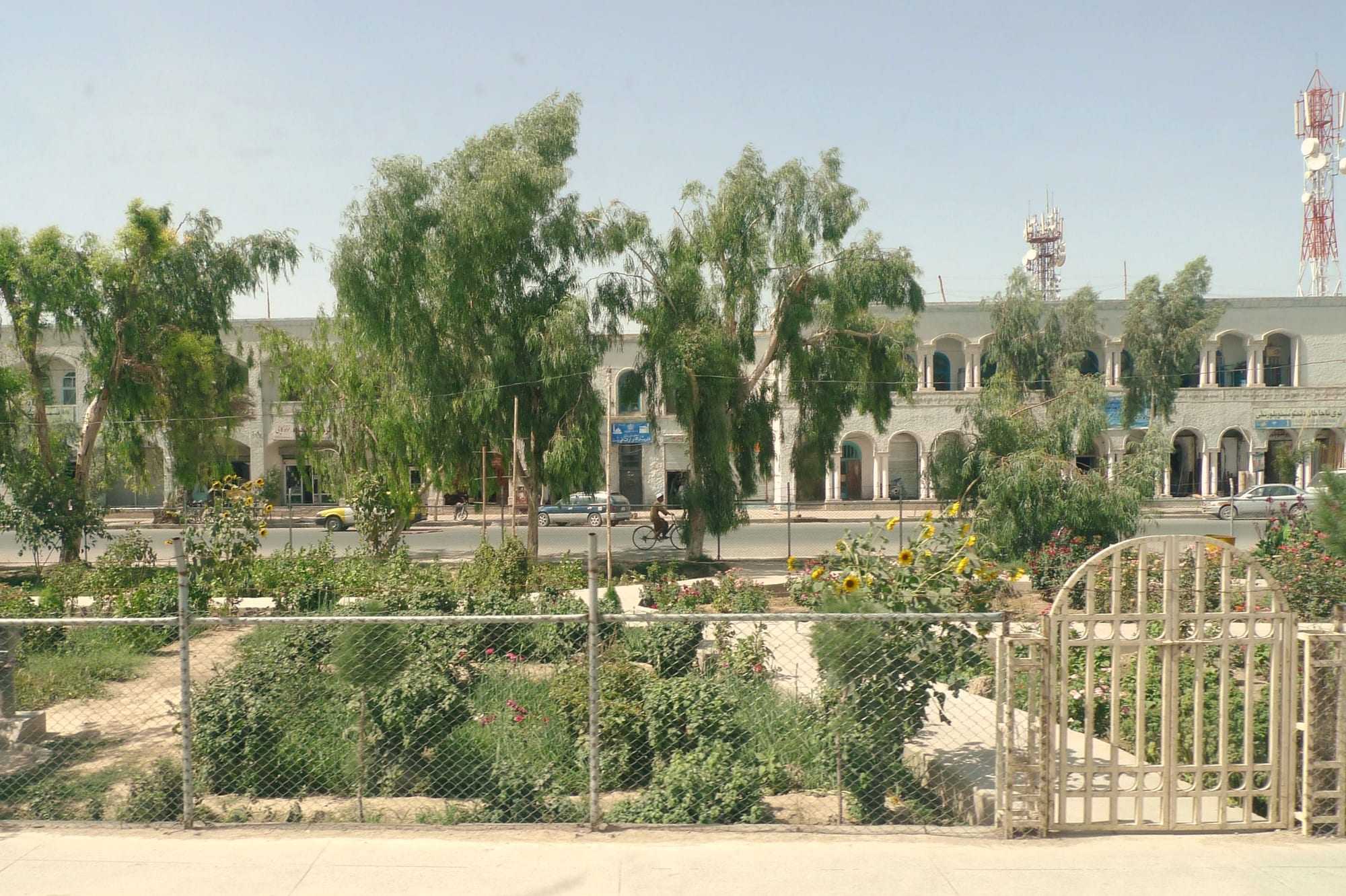
A wide Kandahar street with a long white arcaded building behind tamarisk trees and a planted garden strip in front

Kandahar & the South, Afghanistan

Kandahar

A main street in Kandahar, with arcaded shopfronts behind a planted central strip. (Matthew Chlosta / Wikimedia Commons · Public domain)

Afghanistan's southern city, laid out in the 18th century on a plain of orchards and irrigation canals below bare ridges. It was the first capital of the Afghan state, founded by Ahmad Shah Durrani, and remains the commercial centre of the Pashtun south, known for pomegranates, grapes and long bazaars. This page is written to explain the city, not to encourage travel.

Neighbourhoods

  • The city centre and the four bazaars
    • First-time visitors
    • Bazaars
    • Central

    The heart of Ahmad Shah Durrani's planned city, where two long covered bazaar streets cross at a central square. The mausoleum, the Shrine of the Cloak, money changers, cloth merchants and fruit sellers are all within a few minutes of the crossing, and it is the busiest part of Kandahar by day.

    Open in Maps
  • Old Kandahar
    • Historic district
    • Ruins

    The walled city west of the modern centre, destroyed in 1738 and never rebuilt, whose earth ramparts and mounds still stand below the ridge. Villages and fields have grown up around the ruins, and the rock-cut steps of Chil Zena climb the hillside above.

    Open in Maps
  • Aino Mina
    • Quiet and residential
    • Modern housing

    A large planned township on the north-eastern edge of the city, begun in 2003 with straight streets, walled villas and its own shops and schools. It was built as a self-contained alternative to the crowded centre and is where much of Kandahar's wealth has moved.

    Open in Maps
  • The Arghandab edge
    • Countryside
    • Orchards

    North-west of the city the ground turns green where the Arghandab river feeds orchards, vineyards and pomegranate groves through canals and underground channels. Villages here supply the city's fruit markets and are the source of the produce Kandahar is known for.

    Open in Maps

Things to do

Landmarks and shrines

  • Mausoleum of Ahmad Shah Durranilandmark

    The blue-domed octagonal tomb of the ruler chosen king near Kandahar in 1747, who founded the Durrani state and laid out the modern city; it stands in the centre beside the main bazaar.

    Open in Maps
  • Shrine of the Cloaklandmark

    A small domed shrine next to the mausoleum that holds a cloak said to have been worn by the Prophet Muhammad, given to Ahmad Shah Durrani by the amir of Bukhara around 1768 and among the most revered relics in Afghanistan.

    Open in Maps
  • Chil Zenaviewpoint

    Forty steps cut into the rock of the ridge west of the city, climbing to a niche inscribed with a record of Babur's conquests, with a long view over the old city and the plain.

    Open in Maps
  • Old Kandaharlandmark

    The earth walls, citadel mound and street lines of the pre-18th-century city, razed by the Persian ruler Nader Shah in 1738 and left as a large archaeological site.

    Open in Maps
  • Kandahar Bilingual Rock Inscriptionlandmark

    An edict of the Mauryan emperor Ashoka carved in Greek and Aramaic in the 3rd century BC and found on the Chil Zena outcrop above Old Kandahar, evidence of how far Hellenistic and Indian worlds overlapped here.

    Open in Maps

Gardens, water and the plain

  • Arghandab Riverattraction

    The river that waters Kandahar's orchards and vineyards, running past the city to join the Helmand; its canals and underground karez channels make the plain farmable.

    Open in Maps
  • Dahla Damattraction

    The large irrigation dam on the Arghandab about 40 kilometres north-east of the city, completed in 1952 and the main store of water for the Kandahar plain.

    Open in Maps

Arriving and moving on

  • Kandahar International Airporttransit hub

    The airport about 17 kilometres south-east of the city, built by American engineers in the early 1960s and handling domestic flights and a small number of international routes.

    Open in Maps
  • Spin Boldakattraction

    The border town about 100 kilometres south-east on the crossing to Chaman in Pakistan, the busiest trade route out of southern Afghanistan.

    Open in Maps

Seasonal events

  • Nowruzaround 21 March

    The Persian new year and the start of spring, when the orchards of the Arghandab are in blossom and families go out to the gardens.

  • Ramadanvaries by the lunar calendar

    The month of fasting, when the bazaars are quiet in the heat of the day and busy from sunset until late.

  • Eid al-Fitrat the end of Ramadan

    Days of visiting and feasting at the end of the fast, with very large prayer gatherings in the city.

  • Pomegranate harvestautumn

    From about September to November the Arghandab orchards are picked and the city's markets and packing sheds fill with the fruit Kandahar is best known for.

Eat and drink

Long-standing places and food districts in Kandahar. Hours, ratings and directions come from your maps app, always current.

Kandahar classics

  • Kandahar kebab housesrestaurant

    Charcoal grills in and around the bazaar serve lamb and minced kebabs on naan, along with landi, mutton dried in the sun and cooked with rice in winter.

    Open in Maps
  • Palaw and shorwa housesrestaurant

    Plain dining rooms serving rice palaw with lamb and shorwa, a mutton broth with bread torn into it, which is the everyday meal of the south.

    Open in Maps

Bazaars and fruit markets

  • The central bazaarsmarket

    The long bazaar streets crossing at the centre sell dried fruit, nuts, spices, tea, cloth and household goods, and are where most of the city shops.

    Open in Maps
  • Kandahar fruit marketsmarket

    Wholesale yards and stalls heaped with pomegranates, grapes, melons and figs in season; Kandahar's fruit is sold across Afghanistan and exported to Pakistan and India.

    Open in Maps

Experience Kandahar

History

Kandahar sits on the corridor between the Iranian plateau and the Indus, and there has been a city here since antiquity. The Persians governed the region as Arachosia, Alexander the Great founded a city here around 330 BC, and in the 3rd century BC the Mauryan emperor Ashoka had an edict carved in Greek and Aramaic in the rock — a reminder that Hellenistic and Indian worlds met on this plain. The walled town below the ridge, now called Old Kandahar, was fortified again and again under later rulers.

From the 16th century it became a prize fought over by the Mughal emperors of India and the Safavid shahs of Persia, changing hands repeatedly. In 1709 Mirwais Hotak led a revolt that made Kandahar the seat of an independent Afghan power, and Hotaki armies went on to overrun Persia. Retribution came in 1738, when Nader Shah besieged and destroyed the old city. After his death in 1747 a council of Pashtun chiefs near Kandahar chose Ahmad Shah Durrani as king, and he built a new walled city on the plain east of the ruins, laid out on a grid around two crossing bazaar streets, with his own tomb at its centre.

The capital moved to Kabul in 1776, but Kandahar remained the Durrani heartland. British forces occupied it in both Anglo-Afghan wars, and in 1880 an Afghan army defeated a British brigade at Maiwand, west of the city. American aid built the airport and irrigation works in the 1950s and 1960s. The city was fought over during the Soviet war and the civil war, the Taliban movement emerged here in 1994, and the surrounding districts saw heavy fighting in the 2001–2021 war.

Culture & Customs

Kandahar is a Pashtun city and the home ground of the Durrani tribal confederation that produced Afghanistan's kings. Pashto in its southern Kandahari form is the everyday language, and social life runs on Pashtunwali, the tribal code whose obligations of hospitality, sanctuary, honour and revenge shape how disputes are settled and how guests are treated. Decisions that matter are often made by a jirga, a council of elders, rather than by an office.

The city has an old reputation for craft and dress. Kandahari men's shirts, collarless with dense embroidery down the front, are recognised across Pashtun country, and the city's embroidery, sandal-making and silk work were long traded from its bazaars. Pashto poetry is recited in ordinary company: the verse of the 17th-century warrior-poet Khushal Khan Khattak, the Sufi poems of Rahman Baba, and above all landay, anonymous folk couplets, many composed by women, that turn on love, war and exile. The attan, a circle dance to drums, is performed at weddings.

Religion is worn seriously here. The Shrine of the Cloak in the city centre holds a garment believed to have been the Prophet Muhammad's, shown in public only very rarely, and Kandahar's shrines draw pilgrims from across the south. Public life is male and formal; women's lives are lived largely within family compounds, and restrictions on schooling, work and travel since 2021 have been felt sharply. Guests are welcomed with unhurried courtesy and endless green tea, and refusing it outright would be read as an insult.

Daily Life

Kandahar has roughly 730,000 people and is one of Afghanistan's largest cities, the market and transport hub of the whole south. The old grid at the centre is dense and crowded; newer districts run out along wide avenues towards the airport road, and the planned township on the north-eastern edge holds walled villas built during the boom years after 2001. Beyond them the plain is dust and bare ridges, broken by the green strip of the Arghandab.

The economy rests on fruit, trade and transport. Orchards along the river produce pomegranates, grapes, apricots and figs, with drying and packing plants in the city and trucks running to Pakistan through Spin Boldak; wheat and vegetables come from the canal-fed villages. Bazaar trading, workshops, construction and haulage employ most of the rest, and remittances from relatives in Pakistan and the Gulf support many households.

Days begin before dawn to beat the heat, with bread from the tandoor and tea. The bazaars are busiest early and again in the evening, and the middle of a summer day empties the streets. Water is the city's central problem: the water table under the plain has fallen as wells have multiplied, drought has repeated through recent years, and orchards that took decades to establish have been lost. Electricity is intermittent, much of it imported, and generators and solar panels fill the gaps.

Food

Southern Afghan cooking is plain, meat-heavy and generous, and Kandahar is its centre. Lamb and mutton are grilled over charcoal as sikh kebab or pressed onto skewers as minced kebab, and served on naan with raw onion. Palaw, rice steamed over lamb stock, is the dish for guests and celebrations; landi, mutton salted and dried in the autumn sun, is cooked with rice through the winter as landi palaw. Shorwa, a mutton broth into which bread is torn, is the everyday meal, and bread from a clay tandoor accompanies everything, beginning with breakfast.

Fruit is what Kandahar is famous for. Its pomegranates, especially the sweet thin-skinned kind grown in the Arghandab valley, are considered the best in the country, and its grapes — dried into raisins of several types — its apricots, figs and melons fill the markets from midsummer into late autumn. Dried fruit and nuts are kept for the winter and set out for visitors, and dried grape powder, ghora, is dusted on kebabs and stirred into stews for sourness.

Dairy carries the rest. Qurut, yoghurt dried into hard balls and soaked again, sharpens winter dishes; fresh yoghurt is eaten with bread and rice. Sweets run to halwa, sugared almonds and, in summer, sheer yakh, the hand-churned Afghan ice cream. Green tea, drunk scalding with cardamom and sugar held in the mouth, is offered at every shop and meeting; alcohol is prohibited.

Planning tools

Budget

Costs in Kandahar are low, but there is very little accommodation aimed at foreign visitors, and the main expense is a hired car with a driver who has local connections. Bazaar food, fruit and short taxi rides cost very little. Everything is paid in cash, in afghanis changed from US dollars.

Daily Budget Midrange
USD 40–80 (better hotel in Kandahar, hired car with driver)
Daily Budget Shoestring
USD 15–30 (basic guesthouse in Kandahar, bazaar food, shared taxis)

Afghanis, changed from US dollars, are the currency to carry; change only what is needed.

Best Time to Visit

November to March, when the southern plain is mild and dry and the days are clear. Autumn adds the pomegranate and grape harvest, and spring brings blossom in the Arghandab orchards. From June to August the heat is extreme, often above 40°C, with dust storms, and the middle of the day comes to a stop.

Suggested Number of Days

The central monuments and the bazaars can be seen in a day or two. Two or three allow the old city, the ridge above it and the orchard country along the river. Heat, checkpoints and the need to arrange transport slow everything down.

First Visit
1–2 days
With Surroundings
2–3 days

Transportation

There is no rail or formal public transport system; people move by shared taxi, minibus, motorbike and rickshaw along the main avenues, and goods move by truck to Pakistan and along the ring road. Traffic is dense near the bazaars, and checkpoints are frequent. Foreign visitors travel by hired car with a local driver.

The Kabul–Kandahar highway is long and has a violent history; travel only by day and with a trusted driver.

Airport & Station Connections

Kandahar International Airport lies about 17 kilometres south-east of the city and has domestic flights and a limited number of international services. By road, the ring road runs north-east to Ghazni and Kabul, a long day's drive, and west through Helmand towards Herat; the Spin Boldak crossing to Chaman in Pakistan is about 100 kilometres south-east. Visas must be arranged in advance.

Walkability

The bazaar streets at the centre are walkable and best seen on foot, and the main monuments stand close together there. Beyond the centre the city is spread out along wide avenues with broken or missing pavements, heavy traffic and little shade, and the summer heat makes walking any distance unwise between late morning and late afternoon.

Safety

Most governments advise against all travel to Afghanistan, and the south saw the heaviest fighting of the 2001–2021 war. Kandahar has a long history of bombings and targeted attacks, kidnapping and the wrongful detention of foreigners are real risks, and there is no consular help. Landmines, unexploded ordnance and old improvised explosives remain a danger on unused ground around the city, and summer heat and dust are serious hazards in themselves.

Most governments advise against all travel to Afghanistan, and this region saw the heaviest fighting of the 2001–2021 war. Anyone still considering a visit should read their government's full advisory, stay off unpaved ground, and avoid the border areas and the desert. Check current official travel advice before travelling.

Climate

A hot desert climate on a plain at about 1,000 metres, with very little rain, what falls coming mostly in winter and early spring. Summers are long and fierce with dust storms; winters are mild by Afghan standards, with cold nights and occasional frost.

Summer
very hot and dry — daytime highs commonly 40–45°C, with dust in the air
Winter
mild by day, around 12–18°C, with cold nights and occasional frost

Local Customs

Kandahar is the most conservative of Afghanistan's big cities, and public space is essentially male. Women are required to cover their hair and body in public, and rules on dress and on women travelling without a male relative have tightened since 2021. Pashto is the language of the street, greetings are long, the right hand is used for eating and giving, and Pashtunwali's code of hospitality means guests are pressed with tea and food.

Alcohol is prohibited. Never photograph people, especially women, without clear permission, and avoid photographing shrines, checkpoints, the airport and official buildings. Non-Muslims are generally not admitted to the shrines around the mausoleum.

Common Payment Methods

The currency is the afghani, and the city runs on cash. Foreign cards, ATMs and online payment cannot be relied on; visitors bring US dollars and change them with licensed money changers in the bazaar. Pakistani rupees circulate in the border trade but are not generally used in the city. Keep small notes for taxis and markets.