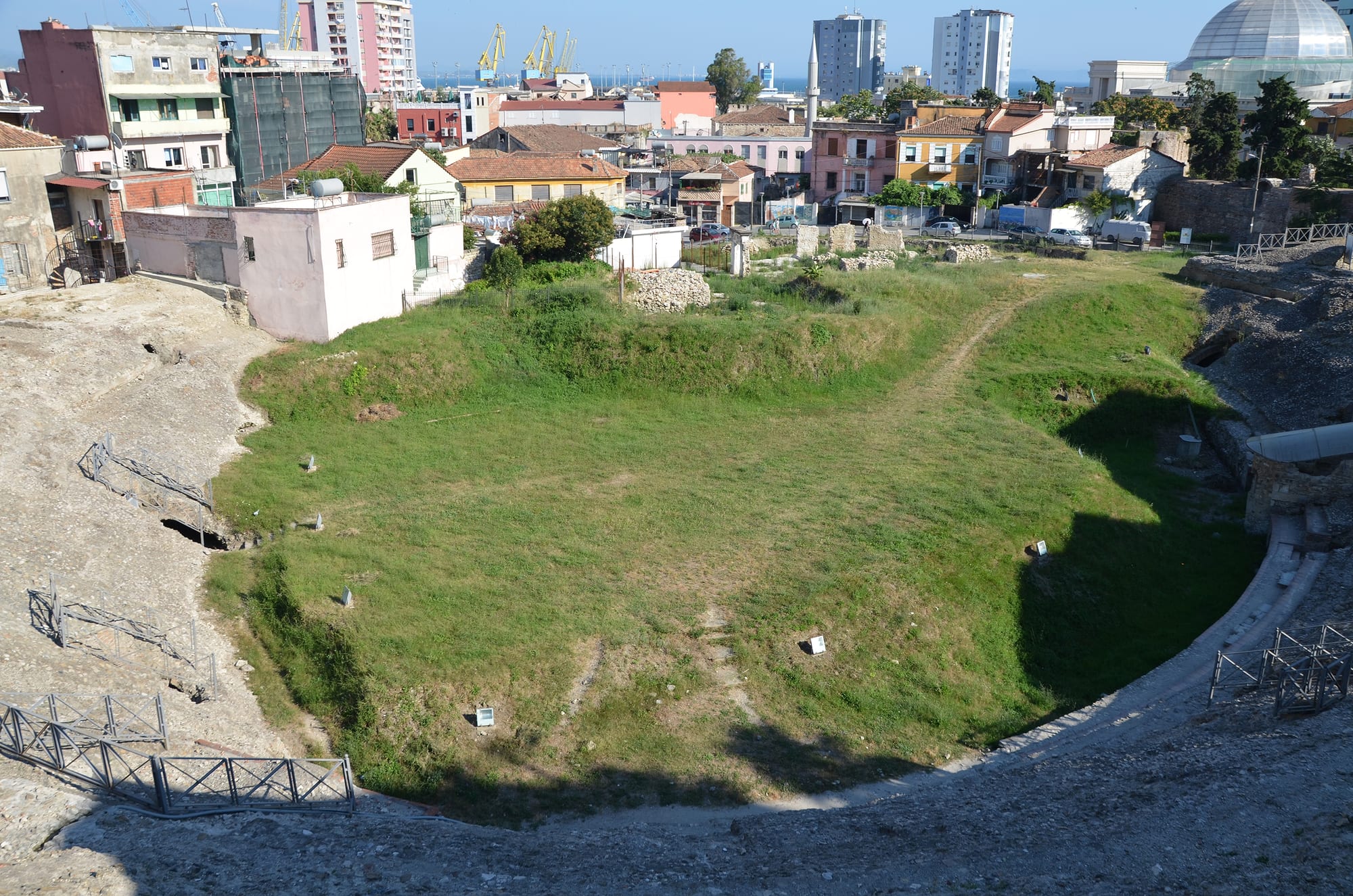
Grassy arena of the Roman amphitheatre ringed by stone seating, with houses, apartment towers and port cranes behind

Tirana & Central Albania, Albania

Durrës

The Roman amphitheatre in the centre of Durrës, with the port cranes beyond. (Carole Raddato from FRANKFURT, Germany / Wikimedia Commons · CC BY-SA 2.0)

Albania's main port and one of its oldest cities, on the Adriatic west of Tirana. Founded by Greek colonists as Epidamnos and grown rich as Roman Dyrrachium at the head of the Via Egnatia, it keeps a huge Roman amphitheatre and Byzantine walls in its centre, while ferries leave for Italy and a long sandy beach runs south.

Neighbourhoods

  • The old town inside the walls
    • First-time visitors
    • Historic district

    The fortified old city, enclosed by walls of the late 5th century, holds the Roman amphitheatre, the Venetian Tower and the Fatih Mosque among ordinary houses and lanes. It sits beside the port and a short walk from the seafront and the main bus terminal.

    Open in Maps
  • The seafront promenade
    • Cafés
    • Evening walks
    • Close to public transport

    The broad promenade along the bay south of the old walls, lined with cafés and restaurants and close to the archaeological museum, is where the city takes its evening walk. It joins a walking and cycling path that continues along the beach.

    Open in Maps
  • Plepa and the city beaches
    • Beaches
    • Families

    The beach strip south-east of the centre, along Rruga Pavarësia, is lined with apartment blocks, hotels and beach bars. Local buses run along the boulevard behind the sand, and the southern bus station at Plepa serves coaches to Tirana and the south.

    Open in Maps
  • Golem
    • Beaches
    • Summer holidays

    The southern coastal stretch beyond the city, known for mass beach tourism and dense, largely unplanned development. It fills with families in July and August.

    Open in Maps

Things to do

Famous landmarks

  • Amphitheatre of Durrëslandmark

    Begun under the emperor Trajan in the 2nd century AD and once able to hold 20,000 people, the largest Roman amphitheatre in the Balkans was rediscovered only in 1966 and is on Albania's tentative list for UNESCO.

    Open in Maps
  • Durrës Castlelandmark

    The walls of the fortified old city, built in the late 5th century and repaired through the Middle Ages; under Anastasius I they were among the strongest fortifications in the western Balkans.

    Open in Maps
  • Venetian Towerlandmark

    A circular defensive tower of the 16th century near the old city walls and the central promenade, associated with the Venetian fortifications.

    Open in Maps
  • Royal Villa of Durrëslandmark

    King Zog's summer residence, completed in 1937 in the Italian Rationalist style on a hill nearly 98 metres above the bay, still a dominant presence on the skyline.

    Open in Maps
  • Fatih Mosquelandmark

    The Small or Old Mosque, completed in 1502, the year after the Ottoman conquest of the city.

    Open in Maps
  • Great Mosque of Durrëslandmark

    Also called the New Mosque, built in the era of the Albanian Kingdom and designated a Cultural Monument of Albania.

    Open in Maps

Museums and culture

  • Archaeological Museum of Durrësmuseum

    Founded in 1951, the largest archaeological museum in the country, near the beach with the 6th-century Byzantine walls just to the north.

    Open in Maps
  • Aleksandër Moisiu Theatreattraction

    The city theatre in the centre, named after the Austrian actor Alexander Moissi, who was of Albanian descent.

    Open in Maps
  • Niko Dovana Stadiumattraction

    The home ground of the football club Teuta, with room for about 12,000 spectators.

    Open in Maps

Beaches and the coast

  • Seafront promenadetrail

    The wide walk along the bay, with a walking and cycling path that continues south along the beach and links back to the city along the docks.

    Open in Maps
  • Port of Durrëstransit hub

    Albania's largest seaport and one of the busiest passenger ports on the Adriatic, with ferries to Bari and Ancona in Italy.

    Open in Maps
  • Shkëmbi i Kavajësviewpoint

    An outsized rock on the coast about 8 km from Durrës, said to be where Caesar fought Pompey in 48 BC.

    Open in Maps

Short trips from the city

  • Kepi i Rodonitviewpoint

    A rocky cape on the Adriatic north of the city, with the castle Skanderbeg built in 1463 and the ruined St Anthony Church.

    Open in Maps
  • Lalzi Baybeach

    The large bay north of Durrës, a mostly unspoiled stretch of coast where beach resorts have been built since 2009.

    Open in Maps

Eat and drink

Long-standing places and food districts in Durrës. Hours, ratings and directions come from your maps app, always current.

Durrës classics

  • Seafront promenade restaurantsneighborhood

    Restaurants and cafés along the bay serving the seafood of the Albanian coast — grilled sea bass and bream, and fish fried whole.

    Open in Maps
  • Beach bars of Rruga Pavarësianeighborhood

    The boulevard behind the city beaches is lined with restaurants, bars and cafés that are busiest on summer evenings.

    Open in Maps

Cafés

  • Old town caféscafe

    Cafés around the amphitheatre, the Venetian Tower and the old walls, where coffee comes with views of the ruins.

    Open in Maps

Experience Durrës

History

Greek colonists from Corinth and Corcyra founded Epidamnos in 627 BC on the coast of the Illyrian Taulantii, who helped them settle. After the Illyrian Wars of 229 BC the city passed to Rome, which called it Dyrrachium and made it a major military and naval base. Under Rome the city prospered as the western end of the Via Egnatia, the road to Thessalonica and Constantinople; Augustus settled his veterans here, and in the 4th century it became the capital of the province of Epirus Nova. After an earthquake, Anastasius I rebuilt its walls as the strongest fortifications in the western Balkans.

Under Byzantium Dyrrachium was a key port linking the empire with western Europe. The Normans of Robert Guiscard took it in 1082 and returned in 1107–08 and 1185; Bulgarians, local Albanian families and Venice all contested it. The city held out against Mehmed II in 1466 but fell to the Ottomans in 1501, and for two centuries it declined into a den of piracy before trade with Venice and later Austria revived the port.

Durrës became the capital of the new Albanian state on 7 March 1914 under Prince Wilhelm and remained so until 1920. Under King Zog Italian investment built a modern harbour in 1927, and Zog's royal villa rose on the hill. Italian troops landed here on 7 April 1939, and the port was bombed and blown up during the war. Under communism the city grew strongly in population and economic activity, and it became the terminus of Albania's first railway, begun in 1947. In the crises of the 1990s it was the centre of the European food-aid programme and an Italian-led peacekeeping force.

Culture & Customs

Durrës is defined by the sea and by layers of the past visible in its streets: the amphitheatre, built in the 2nd century and discovered only in 1966, the late Roman and Byzantine walls, the Venetian Tower and the Fatih Mosque of 1502. The city's many names — Epidamnos, Dyrrachium, Durazzo in Italian and Drač in the Slavic languages — reflect the peoples who have ruled or traded here.

Its cultural life centres on the Aleksandër Moisiu Theatre, named after the Austrian actor Alexander Moissi, who was of Albanian descent, and on the Aleksandër Moisiu University, the country's newest public university, founded in 2005. Football means Teuta, which plays at the Niko Dovana Stadium. The archaeological museum, the largest in Albania, holds finds from the ancient city.

The city has long been the centre of Albanian mass beach tourism, and summer reshapes its character: hotels and apartments fill, the promenade is crowded until late, and the beaches to the south are lined with umbrellas. Religious life is mixed and relaxed, with mosques of the Ottoman and royal periods and a history that includes Orthodox, Catholic and Jewish communities.

Daily Life

About 113,000 people lived in the city's municipal unit at the 2011 census, making Durrës one of the largest cities in Albania. Its transport links, economic institutions and industrial tradition give it a leading place in the country's economy, and it is the starting point of the main national roads and of the railway.

The port, the largest in Albania and one of the busiest for passengers on the Adriatic, with about 1.5 million passengers a year in the mid-2010s, is central to the city's life, alongside a shipyard and factories producing leather, plastic and tobacco goods. Tourism is the other pillar: the southern coast at Golem has seen intensive, largely unplanned development, while beach resorts have been built at Lalzi Bay to the north since 2009.

The earthquake of November 2019 struck the city hard, and the Niko Dovana Stadium served as a shelter in its aftermath. The government plans to move the port north to Porto Romano and build a luxury marina and housing on the present port grounds, a project that would reshape the waterfront. Daily rhythms follow the season: quiet in winter, crowded and late in July and August.

Food

Durrës eats from the sea. The restaurants of the promenade and the beach boulevard serve the seafood of the Albanian coast: grilled sea bass and bream, and fish fried whole. Fish restaurants are busiest on summer evenings, when the promenade fills with people.

Inland dishes are also on every menu. Tavë kosi, mutton and rice baked under a mixture of yoghurt, eggs, butter and flour, is regarded as one of the national dishes, and fërgesë, a casserole of peppers, tomatoes, onions and gjizë, a salted curd cheese, is another familiar dish. Byrek, flaky filo layered with cheese, spinach or minced meat, is the standard cheap meal, sold from bakeries all over the city.

Meals often start with homemade cheese, yoghurt, dhallë, a yoghurt drink, and pickles, and end with strong Turkish-style coffee or a glass of raki, the clear spirit made from grapes, plums or blackberries. In the old town, cafés around the amphitheatre and the Venetian Tower serve coffee with views of the ruins.

Planning tools

Budget

Durrës is cheaper than Tirana for most of the year, but beach hotels and apartments become expensive in July and August, when holidaymakers fill the coast. Seafood dinners on the promenade cost more than inland restaurants, while city buses, byrek and coffee cost very little. Cards work in hotels and larger restaurants; buses and small cafés want cash.

Daily Budget Midrange
USD 80–150 (sea-view hotel, seafood dinners, museum tickets, taxis)
Daily Budget Shoestring
USD 40–65 (hostel or budget guesthouse, bakery lunches, city buses and furgons)

Book summer rooms early, and agree taxi fares at the port before setting off.

Best Time to Visit

May, June and September are the best months, warm enough for the sea without the July and August crowds. High summer is the beach season, when the city is busiest and hottest. Winters are mild and wet, and the amphitheatre, museum and walls are quiet.

Suggested Number of Days

The historic centre needs a day or two. A beach holiday or trips along the coast and inland stretch a stay to three or four days or more; many visitors also see Durrës as a day trip from Tirana or on arrival by ferry from Italy.

First Visit
1–2 days
With Surroundings
3–4 days

Transportation

Orange city buses connect the centre with the beaches, with tickets sold by the driver or a conductor on board, and the Plepa line runs along the boulevard behind the sand. Taxis are plentiful. A walking and cycling path follows the beach south of the city, and bicycles and e-bikes can be hired.

Coaches from Tirana and the south often stop at Plepa rather than the central terminal; check where a bus ends before boarding.

Airport & Station Connections

Buses and furgons run from Tirana's North Bus Terminal about every half hour, and a direct bus links the city with Tirana International Airport Nënë Tereza, the country's only airport with scheduled flights. Ferries sail from the port to Bari and Ancona in Italy, with daily services to Bari. A new railway linking Durrës, the airport and Tirana is under construction.

Walkability

The old town, the amphitheatre, the port, the museum and the seafront are all within a short walk of one another, and the promenade and beach path make long walks easy along the bay. The beaches to the south-east are further out, though the walk along the sand is flat; Golem and the capes need a bus or taxi.

Safety

Albania is a safe country for visitors, and violent crime against tourists is rare. In Durrës the main concerns are traffic, taxi overcharging at the port, petty theft on crowded beaches, and summer heat. The city was among the worst hit by the earthquake of November 2019.

Keep valuables out of sight on the beach, agree taxi fares in advance, and swim where others are swimming. Check current official travel advice before travelling.

Climate

A hot-summer Mediterranean climate, with an average annual temperature of about 16°C. Summers are hot and dry; winters are mild and wet.

Summer
hot — the warmest months average about 24°C, with much hotter afternoons
Winter
mild — the coldest months average about 7.5°C, with frequent rain

Local Customs

Durrës is a relaxed beach and port city, used to visitors from Italy, Kosovo and beyond. The evening walk along the promenade is the social high point of the day, and coffee is the centre of social life. Beachwear belongs on the beach, not in the old town or the mosques.

Remove shoes and dress modestly to visit a mosque, avoid the busy Friday midday prayer, and ask before photographing people.

Common Payment Methods

The currency is the Albanian lek. Cards are accepted in hotels, larger restaurants and supermarkets, but cash is needed for buses, furgons, beach loungers and small cafés. ATMs are easy to find; all charge a withdrawal fee, and some charge more than others.