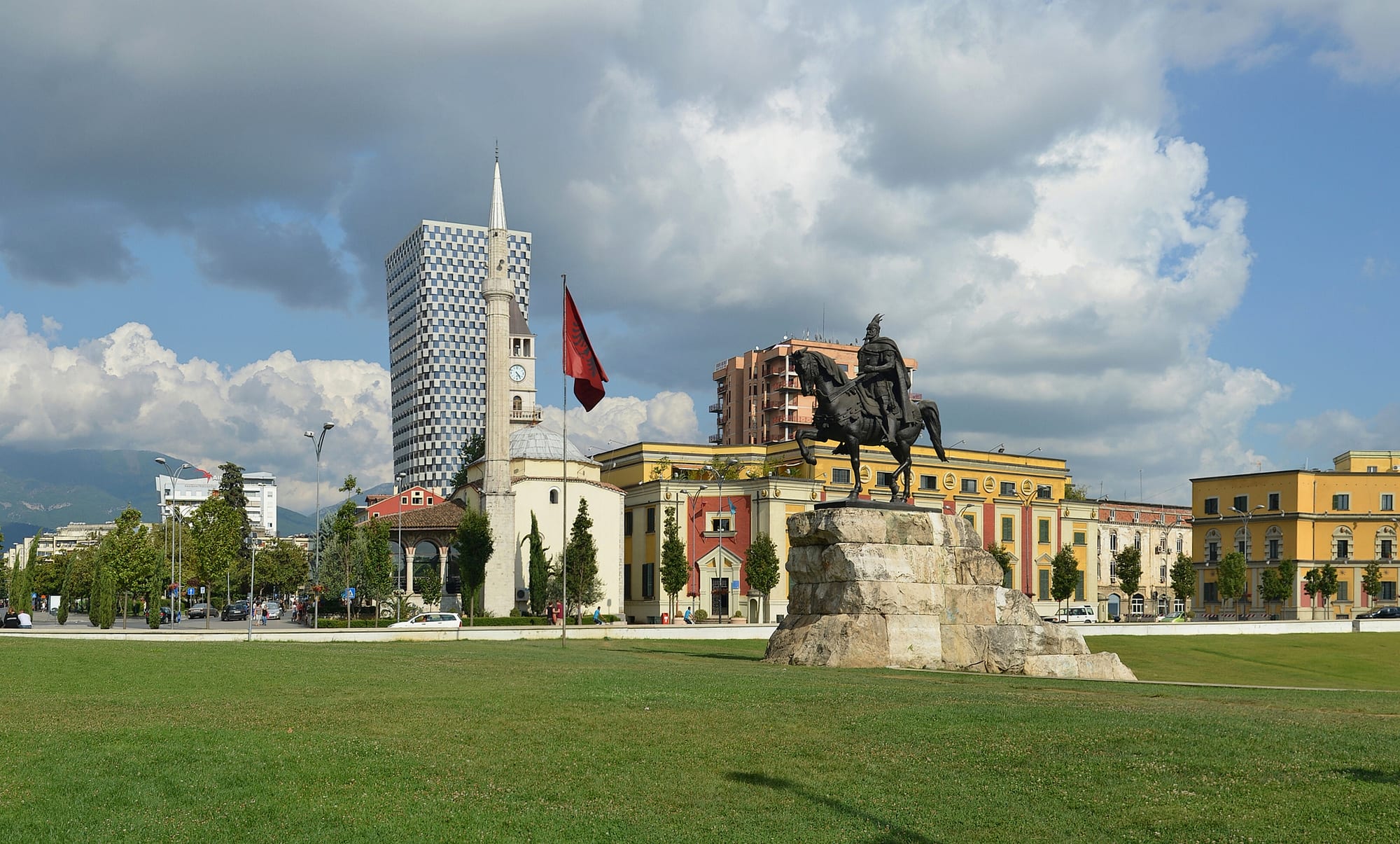
Equestrian statue of Skanderbeg on a stone plinth, with a minaret, clock tower and ochre government buildings behind

Tirana & Central Albania, Albania

Tirana

The Skanderbeg Monument, the Et'hem Bey Mosque and the Clock Tower on Skanderbeg Square in 2014. (Pudelek / Wikimedia Commons · CC BY-SA 4.0)

Albania's capital and largest city, on a plain in the centre of the country with Mount Dajti rising to the east. Founded as an Ottoman bazaar town in 1614 and made capital in 1920, it was remade by Italian planners, then by the communist regime, and since the 1990s by painted façades, towers, cafés and fast growth.

Neighbourhoods

  • Skanderbeg Square and the centre
    • First-time visitors
    • Museums
    • Close to public transport

    The vast main square and the streets around it hold the Et'hem Bey Mosque, the Clock Tower, the Palace of Culture with the opera and national library, government ministries and many of the city's hotels. The Dëshmorët e Kombit Boulevard runs south from here to the university.

    Open in Maps
  • Blloku
    • Nightlife
    • Best for food
    • Cafés

    The former closed residential quarter of the communist Politburo, where ordinary Albanians were not allowed, is now the city's upmarket entertainment district of boutiques, restaurants, bars and cafés. Enver Hoxha's residence still stands here, 10–15 minutes' walk from the centre.

    Open in Maps
  • The New Bazaar
    • Markets
    • Best for food
    • Historic district

    Part of the old town east of the central boulevard, built around the market of 1931 on the site of the Old Bazaar. The market hall and the restaurants around it are lively from early morning, and the Ottoman Kokonozi Mosque stands nearby.

    Open in Maps
  • Murat Toptani Street and the castle
    • Historic district
    • Walking

    The pedestrian street at the city's historic core runs beside the vine-covered Ottoman wall of Tirana Castle, whose recently uncovered foundations are set into the paving. It links the centre with the Lana river and Rinia Park.

    Open in Maps
  • The Grand Park and the south
    • Parks
    • Quiet and residential
    • Students

    South of Mother Teresa Square and the University of Tirana, the large park around the artificial lake is where many residents run or walk early in the morning, with the zoo and botanical garden at its southern end and residential streets on either side.

    Open in Maps

Things to do

Famous landmarks

  • Skanderbeg Squarelandmark

    The main plaza of about 40,000 square metres, named after the national hero and dominated by his equestrian monument, with the Palace of Culture, the Bank of Albania and the National History Museum on its edges.

    Open in Maps
  • Et'hem Bey Mosquelandmark

    A mosque known for the frescoes of trees, waterfalls and bridges in and around its portico; closed under communism, it was reopened for prayer in 1991 when 10,000 people attended without permission.

    Open in Maps
  • Tirana Clock Towerlandmark

    The Ottoman-era tower beside the Et'hem Bey Mosque, part of the same complex and a recognised monument of cultural heritage since 1948.

    Open in Maps
  • Pyramid of Tiranalandmark

    Opened in 1988 as a museum to Enver Hoxha, later a conference centre and a NATO base, and reopened to the public in 2023 after a conversion by MVRDV into a youth technology centre.

    Open in Maps
  • Tanners' Bridgelandmark

    An 18th-century Ottoman stone footbridge that once carried the road from the eastern highlands, along which livestock and produce entered the city, over the Lana stream.

    Open in Maps
  • Resurrection Cathedrallandmark

    The Albanian Orthodox cathedral opened in 2012, among the largest Eastern Orthodox churches in the Balkans.

    Open in Maps
  • Namazgah Mosquelandmark

    Also called the Great Mosque of Tirana, with room for 10,000 worshippers.

    Open in Maps
  • World Headquarters of the Bektashilandmark

    The international centre of the Bektashi Sufi order, on the eastern edge of the city.

    Open in Maps

Museums and memorials

  • Bunk'Art 1museum

    A huge Cold War bunker on the outskirts, built for the political elite in the 1970s and kept secret for much of its existence, now a museum of history and contemporary art spread over several underground floors.

    Open in Maps
  • Bunk'Art 2museum

    A communist-era bunker and tunnel system below the Interior Ministry in the centre, telling the story of the police and security services in the 20th century.

    Open in Maps
  • House of Leavesmuseum

    The Museum of Secret Surveillance, opened in 2017 in the building that served as headquarters of the Sigurimi, the communist secret police, and dedicated to those it spied on, imprisoned and executed.

    Open in Maps
  • National Archaeological Museummuseum

    Opened in 1948 on Mother Teresa Square, the first museum founded in Albania after the Second World War, with finds from prehistory to the Middle Ages and later.

    Open in Maps
  • Postbllokattraction

    A memorial to the victims of the communist regime on Dëshmorët e Kombit Boulevard, created by the writer Fatos Lubonja and the artist Ardian Isufi and opened in 2013.

    Open in Maps

Parks and squares

  • Grand Park of Tiranapark

    A 289-hectare park laid out in 1955–56 around an artificial lake, with the St Procopius Church, memorials, a zoo and a botanical garden.

    Open in Maps
  • Rinia Parkpark

    The central Youth Park, created in 1950, a small green space in the middle of the city.

    Open in Maps
  • Mother Teresa Squarelandmark

    The second-largest square in the city, laid out in a Rationalist style by Gherardo Bosio in 1939–41, now a pedestrian space in front of the university buildings and the archaeological museum.

    Open in Maps

Sport and nights out

  • Arena Kombëtareattraction

    The national football stadium, known as the Air Albania Stadium, opened in 2019 with 22,500 seats and a 112-metre tower at one corner.

    Open in Maps
  • Blloku barsneighborhood

    The densest cluster of bars, pubs and cafés in the city, in the former Politburo quarter.

    Open in Maps

Short trips from the city

  • Dajti Mountain National Parkpark

    The mountain park on the city's eastern side, reached by the Dajti Ekspres cable car, a 15-minute, 4.7-kilometre ride from the edge of Tirana to the Llarka plateau, with forest walks and traditional restaurants.

    Open in Maps
  • Petrelë Castlelandmark

    A hilltop castle of Byzantine origin above the village of Petrelë, once part of the signalling system of Krujë Castle, with views over the Erzen valley and a restaurant inside.

    Open in Maps
  • Cave of Pëllumbasattraction

    A 360-metre karst cave in the Skorana Gorge on the slopes of Dajti, regarded as one of the most beautiful in the country.

    Open in Maps

Eat and drink

Long-standing places and food districts in Tirana. Hours, ratings and directions come from your maps app, always current.

Tirana classics

  • Restaurants around the New Bazaarneighborhood

    Traditional eating houses near the market serve the everyday Albanian repertoire — fërgesë, tavë dheu, soups, salads and grilled meatballs.

    Open in Maps
  • Byrek bakeriesrestaurant

    Small bakeries all over the city sell byrek, flaky pastry with cheese, spinach or meat, the cheapest breakfast and lunch in town.

    Open in Maps

Markets

  • Pazari i Rimarket

    The central market on Sheshi Avni Rustemi, busiest early in the morning.

    Open in Maps

Cafés and bars

  • Blloku cafés and barsneighborhood

    Coffee by day and cocktails by night in the city's main entertainment district, in a country with more coffee houses per head than any other.

    Open in Maps
  • Mount Dajti restaurantsneighborhood

    Long-established restaurants in the national park above the city serve local dishes in the slow food tradition.

    Open in Maps

Experience Tirana

History

The plain beneath Dajti has been inhabited since the Iron Age and was probably the heart of the Illyrian kingdom of the Taulantii. A castle was built here in Byzantine times, and Ottoman land registers of 1431–32 already record dozens of settlements and some 7,300 inhabitants. The town itself dates its founding to 1614, when Sylejman Pasha Bargjini built the Old Mosque, a small bazaar and a hammam; the Et'hem Bey Mosque followed, and after 1816 the Toptani family of Krujë controlled the town.

On 8 February 1920 the Congress of Lushnjë made Tirana the capital of independent Albania. Refugees from Dibër and Muslim emigrants from lands lost to neighbouring states swelled its population, and Italian architects — Armando Brasini, Florestano Di Fausto and later Gherardo Bosio — laid out its ministries, its main square and the boulevard under King Zog and, after 1939, the Italian occupation. The Communist Party of Albania was founded in the city in 1941.

From 1944 to 1991 the regime built apartment complexes and factories, razed the Old Bazaar and the Orthodox cathedral for the Palace of Culture, sealed off the Blloku for its leaders and built the Pyramid as Hoxha's memorial. Student demonstrations and the toppling of Hoxha's statue in Skanderbeg Square marked the end of communism; the 1997 unrest and a failed coup in 1998 followed. As mayor from 2000 to 2011, Edi Rama demolished illegal buildings along the Lana and had façades painted in bright colours, and the city has since been reshaped by towers, a new master plan and fast growth. An earthquake in September 2019 struck the city hard, while the stronger one that November, centred near Durrës, caused comparatively little damage here.

Culture & Customs

Tirana is the country's cultural capital as well as its political one. The Palace of Culture on Skanderbeg Square houses the National Theatre of Opera and Ballet and the National Library, the city publishes the country's largest newspapers, and foreign cultural institutes from Italy, France, Greece and China are based here. The Tirana International Film Festival, founded in 2003, was the first international cinema festival in Albania, and it is held each year at the end of November and the beginning of December. On 14 March the city celebrates Dita e Verës, Summer Day, a spring festival that is officially celebrated in Albania.

Religion is visible and relaxed. The skyline mixes the Et'hem Bey Mosque, the Orthodox Resurrection Cathedral of 2012, the Catholic St Paul's Cathedral and the Namazgah Mosque, one of the largest in the Balkans, and the city is home to the world headquarters of the Bektashi order; in 2024 the prime minister was reported to be planning a sovereign Bektashi microstate within the city. At the 2011 census 55.7 per cent of the municipality's people were counted as Muslim, 3.4 per cent as Bektashi and 11.8 per cent as Christian, with most of the rest reporting no religion or giving no answer.

Daily culture revolves around coffee: in 2016 Albania overtook Spain as the country with the most coffee houses per head. Football is followed passionately, with KF Tirana, Partizani and Dinamo all based in the city, and basketball is popular too. The memory of the dictatorship is a living subject, kept in Bunk'Art, the House of Leaves and the Postbllok memorial.

Daily Life

About 598,000 people lived in the municipality of Tirana at the 2023 census, making it by far the largest and most densely populated in the country; the wider area that takes in Durrës holds about a million, nearly a third of all Albanians. The population has grown steadily since the fall of communism, as people moved in from the mountains and the south, and new apartment towers now rise across the city.

As the seat of government, parliament and the presidency, and the country's main financial and trade centre, Tirana runs on public administration, banking, universities, construction and services, with rapidly growing tourism through the airport. The University of Tirana alone has more than 28,000 students, beside the Polytechnic University and the universities of arts, agriculture, medicine and sport.

Mornings start early with coffee, and the evening walk fills the boulevard, the Blloku and the Grand Park. Traffic is the most common complaint: buses are the only public transport and are often stuck in congestion, though cycle lanes have spread. Since late May 2026 the city has been the centre of the large protests known as the Flamingo Revolution, which began over coastal resort projects and broadened into opposition to the government, with daily demonstrations around Skanderbeg Square.

Food

Tirana's own dish is fërgesë, baked vegetables with cheese, served in an earthenware dish; tavë dheu is the same dish with liver added. Byrek, flaky pastry filled with cheese, spinach or minced meat, is sold cheaply from bakeries all over the city for breakfast and lunch, and traditional eating houses around the New Bazaar serve the everyday Albanian repertoire of soups, village salads, grilled meatballs and stews.

Tavë kosi, one of the national dishes — mutton and rice baked under a mixture of yoghurt, eggs, butter and flour — is a familiar traditional dish, and homemade cheese, yoghurt, dhallë, a yoghurt drink, and pickles start a meal. The central market at the New Bazaar is busiest early in the morning.

Coffee shapes the city's rhythm more than any meal, from strong Turkish-style coffee to espresso in the cafés of the Blloku and the boulevard, and raki, the clear spirit most often made from grapes or plums, ends many dinners. On Mount Dajti, long-established restaurants in the national park serve local dishes in the slow food tradition, and the castle at Petrelë has a restaurant within its walls.

Planning tools

Budget

Tirana is the most expensive place in Albania — hotel rooms, Blloku cocktails and rents have climbed steeply in recent years — but by European standards it is still cheap. Byrek, city buses and coffee cost very little, and many sights, from the squares and parks to the Postbllok memorial, are free. Cards work in most hotels, restaurants and shops; markets, buses and small cafés want cash.

Daily Budget Midrange
USD 85–150 (central hotel, restaurant dinners, museum tickets, taxis)
Daily Budget Shoestring
USD 40–65 (hostel bed, byrek and bakery lunches, city buses)

Use metered official taxis, which display their fares inside, or a ride app, and agree the airport fare before setting off.

Best Time to Visit

April to June and September to October, when the city is warm rather than oppressive and the hills of Dajti are green. July and August are hot and the city partly empties to the coast. Winters are mild but wet, with snow on the mountains rather than in the streets; it is a good season for museums and cafés.

Suggested Number of Days

Two or three days cover the centre, the communist-era museums and an evening or two in the Blloku. Four or five allow time for the mountain park and the castles and towns within reach. Tirana is also the hub for travel around the country, so many visitors return between trips.

First Visit
2–3 days
With Surroundings
4–5 days

Transportation

Buses are the only public transport, and they often get stuck in traffic; there is no metro or tram. Tickets are bought from a conductor on board, and routes appear on online maps. Taxis are plentiful and ride apps work. Cycle lanes have spread in recent years, and there are combined bus and bike lanes on some main streets. Intercity buses and furgons use the North and East terminals on the edge of the city.

Allow extra time at rush hour; walking is often as quick as the bus within the centre.

Airport & Station Connections

Tirana International Airport Nënë Tereza, at Rinas, about 11 km north-west of the city, is the only airport in Albania with scheduled passenger flights and passed 10 million passengers in 2024. Buses and taxis link it with the centre. Buses arrive from across Albania and from Kosovo, North Macedonia, Montenegro and Greece. A new railway to the airport and Durrës is under construction.

Walkability

The centre is compact and flat: Skanderbeg Square, the Blloku, the New Bazaar, the Pyramid and the Grand Park are all within a half-hour walk of one another, and the main square and Murat Toptani Street are pedestrianised. Traffic is heavy and drivers do not always stop at crossings, so crossing the big roads takes care.

Safety

Albania is a safe country for visitors, and violent crime against tourists is rare. In Tirana the main hazards are traffic, pickpocketing on crowded buses and around the bus terminals, and taxi overcharging. Since late May 2026 large anti-government protests have been held in the city, centred on Skanderbeg Square, with occasional clashes.

Keep bags closed on buses, cross roads with care, and keep away from demonstrations. Check current official travel advice before travelling.

Climate

Humid subtropical, with hot summers and mild, wet winters; the city ranks among the wettest in Europe, yet is also one of the sunniest, and most of the rain falls between autumn and spring. The surrounding mountains are often snow-covered in winter, while the city itself rarely sees snow.

Summer
hot — July averages about 24°C, with temperatures above 20°C from May to September and much hotter afternoons
Winter
mild and wet — January averages about 6.7°C, and snow is rare in the city

Local Customs

Coffee is the centre of social and business life, and the evening walk fills the boulevard and the Blloku. The city is religiously diverse — Muslim, Bektashi, Orthodox and Catholic — and relaxed about it, and religious and other festivals from Christmas to Eid and Nowruz are celebrated. Dress is casual and fashionable.

Remove shoes and dress modestly to visit a mosque, avoid visiting during prayers, and ask before photographing people.

Common Payment Methods

The currency is the Albanian lek. Cards are accepted widely in the centre — hotels, restaurants, supermarkets and most shops — but cash is needed for buses, markets, byrek shops and furgons. ATMs are everywhere; all charge a withdrawal fee, and some charge more than others.