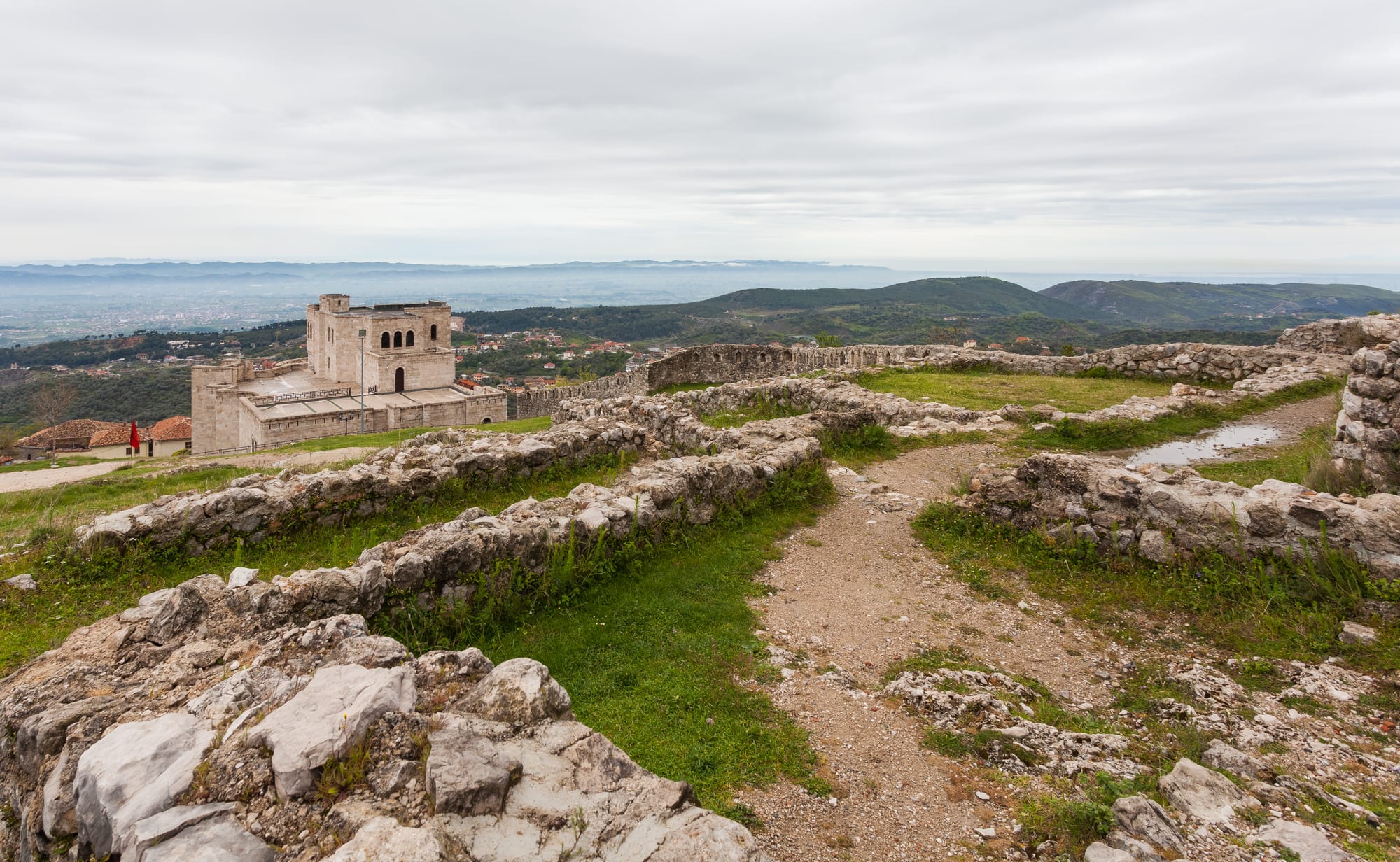
Ruined stone walls of Kruja Castle and the Skanderbeg Museum on their hilltop above the coastal plain

Albania

Tirana & Central Albania

Kruja Castle, Skanderbeg's stronghold against the Ottomans. (Diego Delso / Wikimedia Commons · CC BY-SA 3.0)

Albania's centre of gravity — the capital, Tirana, in its bowl of hills beneath Mount Dajti; Durrës, the ancient port and beach city on the Adriatic; Skanderbeg's castle town of Kruja on the mountainside above the plain; and Elbasan in the Shkumbin valley on the old Via Egnatia — the crowded, fast-changing heart of the country, where most of its money and people now are.

Explore Tirana & Central Albania

History

Durrës is the oldest place in the region. Greek colonists from Corinth and Corcyra founded it as Epidamnos in 627 BC, and as Roman Dyrrachium it became the western gate of the Via Egnatia, the paved road that ran east through Scampa — today's Elbasan — to Thessaloniki and Byzantium. Caesar and Pompey fought outside its walls in 48 BC, and the 2nd-century amphitheatre, the largest in the Balkans, was rediscovered only in 1966. Byzantines, Normans, Angevins, Serbs and Venetians held the port in turn before the Ottomans took it in 1501.

Kruja is the other pole. Gjergj Kastrioti Skanderbeg raised his banner over its castle in 1443 and held it through Ottoman sieges in 1450, 1466 and 1467; Mehmed II built the fortress at Elbasan in 1466 as his base against him, and Kruja fell only in 1478, a decade after Skanderbeg's death. Tirana was founded in 1614, when Sulejman Pasha Bargjini built a mosque, a small bazaar and a bath there, and it stayed a small bazaar town for three centuries.

The Congress of Lushnjë made Tirana the capital in 1920, as neutral ground between north and south, and Italian architects laid out King Zog's ministries and boulevard in the 1920s and 30s; Italy invaded through Durrës on 7 April 1939. Under Enver Hoxha the capital gained Skanderbeg Square's museum and Palace of Culture, the sealed Blloku quarter of the Politburo and, in 1988, the Pyramid built as his memorial, while Elbasan got the Chinese-built "Steel of the Party" plant. Hoxha's statue was pulled down in the square in 1991, and that year tens of thousands crammed on to ships at Durrës bound for Italy. Since 2000 Tirana has been repainted and filled with towers; an earthquake on 26 November 2019 killed 51 people, most of them in and around Durrës.

Culture & Customs

Tirana is the youngest and fastest place in Albania, a city where business, friendship and politics are conducted over a macchiato and where the evening xhiro fills the boulevard from Skanderbeg Square to the university and spills into the Blloku, the quarter once fenced off for the Politburo and now the densest cluster of bars in the country. The Grand Park's lake, the New Bazaar and the apartment blocks painted in the 2000s belong to the same outdoor life. The city sits on the Gheg side of the Shkumbin, the river that divides Albania's two dialects, and Elbasan, on the river itself, speaks the in-between variety that the Congress of Elbasan chose in 1909 as the basis for a common written language, before today's Tosk-based standard replaced it.

Religion here is visible and relaxed. Tirana holds the world headquarters of the Bektashi order, Kruja keeps a tekke of the Bektashi saint Sari Salltik, and the skyline mixes the Et'hem Bey Mosque — reopened for prayer on 18 January 1991 by a crowd of 10,000 in defiance of the atheist ban — with the Orthodox cathedral of 2012, the Catholic cathedral of St Paul and the huge Turkish-funded Namazgah mosque beside parliament.

The region's own festival is Dita e Verës, Summer Day, on 14 March: a pre-Christian spring rite centred on Elbasan and now an official holiday across Albania, marked by picnics and the cornmeal biscuits called ballokume. Kruja's bazaar keeps the crafts — white felt qeleshe caps, woollen qilim rugs, copper and filigree — and football divides the capital between Tirana and Partizani, whose derby is the capital's great rivalry.

Daily Life

Tirana's municipality holds well over half a million people, and the county — with Kamëz, Vorë and the villages towards Durrës grown into one sprawl — close to 800,000, about a third of all Albanians. Durrës is the country's second municipality by population, Elbasan has over 100,000, and Kruja is a town of some 9,000 that lives on day-trippers to the castle. All of them have grown or held steady on migration from the mountains and the south while the rest of the country has emptied.

The capital runs on government, banks, universities, construction and a service economy that includes Italian-speaking call centres and a growing technology sector. Durrës has one of the largest ports on the Adriatic, the ferries to Italy and a summer industry along the sand; Elbasan lives with the legacy of the communist steel combine and farms olives and grain on the Shkumbin plain.

The day starts with coffee before eight, offices work through a short lunch, and the evening belongs to the walk, the cafés and, in Tirana, to bars that run past midnight. In July and August the capital empties to Durrës and Golem, whose beaches fill with families from Kosovo. The issues of the moment are traffic, air quality, rents pushed up by tourism and short-term lets, the slow rebuilding after the 2019 earthquake, and the graduates who still leave for Germany and Italy — though the Pyramid's reopening in 2023 as a technology school for teenagers is the symbol the city prefers.

Food

Tirana's own dish is fërgesë, peppers, tomatoes and gjizë curd baked in an earthenware pan, with a Tirana version made with liver; the city also claims the best byrek, sold by the slice from hole-in-the-wall bakeries at breakfast, and the qofte and grilled lamb of the restaurants around the New Bazaar. Elbasan answers with tavë Elbasani, the lamb-in-yoghurt bake the rest of the country calls tavë kosi, and with ballokume, the large buttery cornmeal biscuits baked for Summer Day, while boza, a thick fermented drink made from maize and millet, is sold from stalls in both cities.

Durrës eats from the sea: grilled sea bass and bream, fried small fish by the plate, octopus salad and fish soup along the waterfront. The hills around Tirana grow Shesh i Bardhë and Shesh i Zi, two of the country's best-known native grapes, named after the village of Shesh, and Birra Tirana has been brewed in the capital since 1960.

Sweets are shared with the Ottoman world — baklava, kadaif, and sheqerpare — with one modern addition: trilece, a milk-soaked sponge modelled on the Latin American tres leches cake and now in every Tirana café. Cheese is white brined djathë, and the stalls of the New Bazaar sell mountain honey, olives from the Elbasan groves and fresh gjizë.

Attractions & Natural Wonders

Tirana's centre is compact. Skanderbeg Square, repaved as a vast pedestrian plain in 2017, holds the Et'hem Bey Mosque, completed around 1820, the 19th-century clock tower and the National History Museum beneath its socialist-realist mosaic; BUNK'ART 2, in a communist-era bunker, and the House of Leaves, the former secret-police headquarters, tell the dictatorship's story a few streets away, and the Pyramid, the Blloku, the Grand Park and the Ottoman Tanners' Bridge are all within a half-hour walk. On the eastern edge the Dajti Ekspres cable car climbs in fifteen minutes to the ridge of Mount Dajti, whose summit reaches 1,613 metres, with walks in the national park and views to the sea. Petrelë Castle on its crag outside the city and the Pëllumbas cave, with its Palaeolithic finds, are the day trips.

Durrës has the Roman amphitheatre, the Byzantine walls, an archaeological museum and King Zog's villa on the hill; its beaches run south in a continuous strip through Golem to the Kavajë Rock, and to the north lie the quieter Lalzi Bay and Cape Rodon, with the ruins of the castle Skanderbeg built and the small church of St Anthony on the point. Kruja, half an hour inland, stacks its Ottoman bazaar street below the castle, where the Skanderbeg Museum of 1982, the ethnographic museum in the Toptani house and the Sari Salltik tekke make a full day.

Elbasan's fortress of 1466 encloses an old town with the King Mosque of 1492, the Orthodox church of St Mary and an Ottoman bath, and the county's mountains hold Shebenik-Jabllanicë National Park near Librazhd — beech forest and one of the last refuges of the Balkan lynx. Much of the park's beech woodland is part of the Ancient and Primeval Beech Forests, a UNESCO World Heritage Site.

Cities in Tirana & Central Albania

Planning basics

Budget

Tirana has the highest prices in Albania — hotel rooms, Blloku cocktails and rents have climbed steeply since 2022 — and Durrës's beach hotels are dear in July and August, when families from Kosovo fill them. By European standards the region is still cheap, and Elbasan and Kruja cheaper again. Cards work almost everywhere in the capital and Durrës; markets, furgons and small guesthouses want cash.

Daily Budget Midrange
USD 80–150 (mid-range hotel in Tirana or Durrës, restaurant dinners, museum tickets, taxis or a hire car)
Daily Budget Shoestring
USD 40–65 (hostel or budget guesthouse, byrek and bakery lunches, city buses and furgons)

Agree the taxi fare from Rinas airport before getting in, or take the airport bus; Tirana's museums charge a few hundred lek each.

Safety

The region is safe for visitors. Tirana's hazards are traffic — pedestrian crossings are advisory at best — pickpocketing on packed buses and around the bus terminals, and taxi overcharging at the airport and at Durrës port. Durrës and the towns around it were the worst hit by the earthquake of November 2019, and some damaged buildings still stand. Stray dogs are common but rarely aggressive, and summer heat in Elbasan is real.

Cross roads with the locals, keep bags closed on buses, and pick a beach south of Durrës at Golem or north at Lalzi Bay rather than the city strip. Check current official travel advice before travelling.

Climate

Tirana and Durrës are Mediterranean, with long hot summers — July highs of 31–35°C, humid in the capital's basin — and mild, very wet winters of 3–12°C; Tirana receives well over a metre of rain a year, most of it between October and March, and snow settles only on Dajti. Elbasan's inland valley runs a few degrees hotter in summer and colder in winter than the coast.

Summer
hot, 30–35°C, humid in Tirana and up to 38°C in Elbasan; sea breezes at Durrës
Winter
mild and rainy, 3–12°C; snow on Mount Dajti and the Elbasan hills, rarely in the cities

Transportation

Everything runs through Tirana. Rinas airport is 11 kilometres north-west of the centre, linked by an airport bus and taxis; the city has cheap but crowded buses and no metro, so most journeys are on foot or by taxi. Durrës is 35 kilometres west by motorway, Kruja about 30 kilometres north via Fushë-Krujë, and Elbasan some 50 kilometres south-east over the Krrabë hills. Regional buses and furgons leave from terminals on the edge of the capital, Durrës port has ferries to Bari and other Italian ports, and the Tirana–Durrës railway has been under reconstruction for years.

Take the Dajti Ekspres cable car rather than the winding road up the mountain; furgons to Kruja and Elbasan leave when full, mostly before noon.

Best Time to Visit

April to June and September to October, when the capital is warm rather than oppressive, the hills above Kruja and Dajti are green and the sea at Durrës is swimmable without August's crowds. July and August are for the beach only: Tirana empties and swelters, while Durrës and Golem fill with holidaymakers from Kosovo. Elbasan's Summer Day on 14 March is the region's own festival, and winter, though wet, suits Tirana's museums and cafés.