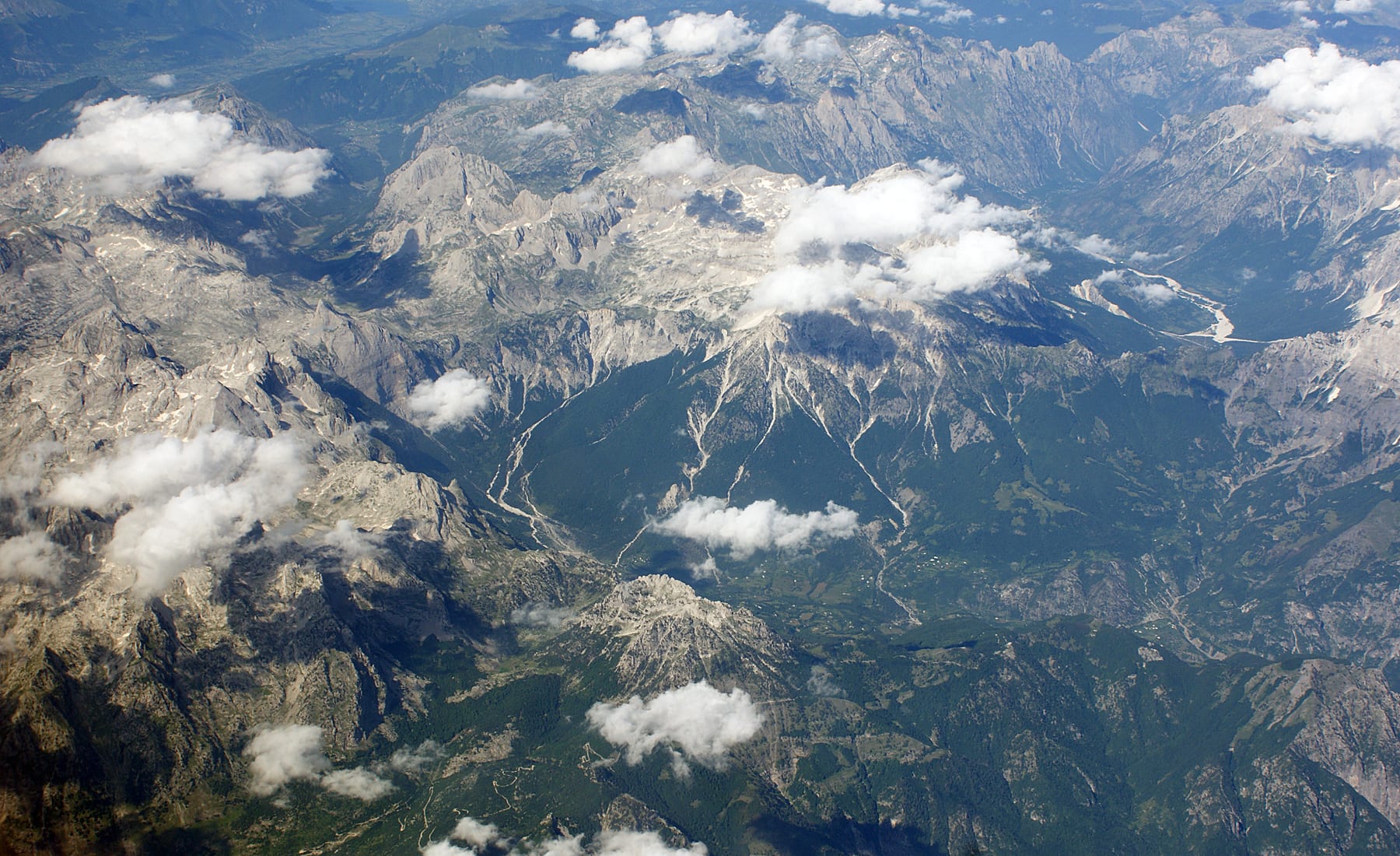
Aerial view of the jagged grey peaks of the Albanian Alps, with the green valley and village of Theth in the centre

Albania

Northern Albania & the Alps

The Accursed Mountains from the air, with the Theth valley in the centre and Valbona beyond the ridge. (Albinfo / Wikimedia Commons · CC BY-SA 3.0)

Albania's mountainous north, from the old lakeside city of Shkodër up into the Accursed Mountains of Theth and Valbona and east to the remote highlands of Dibër — a region of clan traditions, stone tower-houses, a spectacular lake ferry and some of the Balkans' best walking.

Explore Northern Albania & the Alps

History

The north has always stood slightly apart. Shkodër, on the lake, was the capital of the Illyrian kingdom whose last ruler, Gentius, surrendered to Rome in 168 BC; Rozafa Castle, rebuilt many times and with walls that are mostly Venetian, carries a founding legend in which a young mother is walled into the fortress so that it will stand. Venice held the city until 1479, when the Ottomans took it after a long siege, and Shkodër went on to become a prosperous Ottoman trading town and, from the 19th century, the centre of Albanian Catholicism, printing and schooling.

The highlands were never fully governed by anyone. The clans of the Malësia and Dukagjin lived by the Kanun of Lekë Dukagjini, a code of oral law regulating honour, hospitality and blood revenge, and their stone tower-houses, the kulla, were built with slit windows for that reason. They rose against Ottoman conscription and tax throughout the 1800s, and the region's Catholic clergy and its Muslim and Orthodox clansmen were all part of the national awakening that led to independence in 1912.

Communism after 1944 hit the north hard: Enver Hoxha's regime crushed the clans and the Catholic church, executed priests in Shkodër's prisons, collectivised the valleys and cut them off from Kosovo. The 1990s brought emigration, a short resurgence of blood feuds and the collapse of state order in 1997. Since the 2000s the Alps have been reborn as a walking destination, with paved roads to Theth and Valbona and guesthouses in villages that were half-abandoned a generation ago.

Culture & Customs

Northern Albania is the home of the Gheg dialect and of a culture shaped by the Kanun, whose rule of hospitality — the guest is sacred, and the host answers for the guest's safety — still explains the welcome in mountain guesthouses. Shkodër is the country's Catholic heartland, with a cathedral that was used as a sports hall under communism, but Muslim and Orthodox families live alongside, and the region is proud of that mix. The city also has a long artistic streak: the Marubi photographers documented highland life from the 1850s onwards, and their archive is one of the Balkans' great collections.

Mountain villages keep older habits. Polyphonic and epic singing with the one-stringed lahuta survives in the Alps, weddings run for days, and the dress of the Malësia — white felt caps, black-and-white striped woollens — appears at festivals. Coffee is offered to every visitor and raki to most, and a refusal needs a reason. The Kanun's darker side, the blood feud, has not vanished, and a small number of families still live under its threat, but it is a private matter and invisible to travellers.

Names, too, reflect the region: Shkodër is Scutari in older books, and the Accursed Mountains are Bjeshkët e Nemuna to Albanians and Prokletije across the Montenegrin border.

Daily Life

Shkodër, with around 130,000 people in its municipality, is the region's only real city: a low-rise, bicycle-riding town with a pedestrian core of Italianate houses, a big daily market and a university. Lezhë, Pukë, Kukës and the Dibër county town of Peshkopi are small; the mountain villages number a few hundred souls in summer and far fewer in winter, when many families move down to the lowlands.

Work is farming on the plain, fishing and tourism on the lake, small trade, and increasingly guesthouses, guiding and horse-hire in the Alps. Kukës and Dibër were mining and hydro-power districts under communism and have lost much of their population to Tirana and abroad since; remittances from Italy, Greece and beyond matter everywhere. The road links to Kosovo, cut for decades, now run through the Kalimash tunnel and have made Kukës a transit town.

Days are early and slow: coffee at the bar, the market before the heat, a long lunch, and evenings on Shkodër's pedestrian street. In the mountains the rhythm follows the animals and the trekking season, and electricity, once intermittent, is now reliable in most villages even if mobile coverage is not.

Food

The north eats from its lake, its mountains and its Ottoman past. Around Shkodër the specialities are carp and eel from the lake, grilled or baked with onions and peppers, and krap i pjekur, whole carp roasted in the oven, alongside the small lake fish fried by the plateful at Shiroka. Ottoman-era dishes survive too: tavë kosi, lamb baked in a yoghurt custard, is eaten here as across Albania, and Shkodër's bakeries make baklava and the flaky, cheese-filled byrek that is Albania's everyday breakfast.

In the Alps the food is mountain fare: fli, a many-layered pancake baked over coals, cornbread, pickled peppers and cabbage, lamb roasted on the spit for guests, sheep's cheese, and trout from the Valbona and Shala rivers. Guesthouses serve whatever the family grows — beans, potatoes, wild greens — and the dinner is usually generous rather than varied.

Drink is raki, the grape or plum spirit offered at any hour; Shkodër is also the home of Kallmet, a red wine grape grown around Lezhë, and of strong Turkish-style coffee. Blueberries and wild strawberries appear on the trails in July, and chestnuts in the autumn markets.

Attractions & Natural Wonders

The Accursed Mountains are the reason most people come. Theth, at the end of a now-paved road from Shkodër, is a scatter of stone houses in a valley beneath grey limestone walls, with the Grunas waterfall and a restored lock-in tower once used by men under blood feud. The day's walk over the Valbona Pass — about 1,800 metres, six to eight hours with a horse for the bags — drops into the beech forests of the Valbona Valley, part of the Alps of Albania National Park, and harder routes continue to the peak of Jezerca or along the Peaks of the Balkans circuit into Kosovo and Montenegro.

The Koman ferry is the other set piece: a slow boat up the flooded canyon of the Drin between Koman and Fierza, cliffs rising straight from green water, that most visitors combine with Valbona. Lake Shkodër, the largest in southern Europe, has pelicans and cormorants in its reed beds, the waterfront villages of Shiroka and Zogaj, and a border with Montenegro running down its middle.

Shkodër itself deserves a day for Rozafa Castle above the meeting of the Drin, Buna and Kir rivers, the Marubi photography museum, and the mosques and the cathedral within a few streets of each other. Further east, the Dibër highlands around Peshkopi offer thermal baths, the Lura lakes and the little-known peaks of Korab, Albania's highest mountain on the North Macedonian border.

Cities in Northern Albania & the Alps

Planning basics

Budget

The north is the cheapest part of an already cheap country. Guesthouses in Theth and Valbona charge modest half-board rates that include dinner and breakfast, Shkodër has good-value hotels and hostels, and the mountain minibuses, the Koman ferry and the guided horse for luggage are all inexpensive. Cash is essential beyond Shkodër.

Daily Budget Midrange
USD 55–110 (better guesthouses or Shkodër hotels, private transfers, a guide)
Daily Budget Shoestring
USD 30–45 (guesthouse half-board, minibuses, self-organised trek)

Carry enough lek for the whole mountain stretch — there are no cash machines in Theth or Valbona.

Safety

The region is safe and hospitality is taken seriously; the old blood-feud tradition does not touch visitors. The real hazards are mountain ones: sudden storms, exposed sections and loose scree on the Valbona Pass, the absence of mobile signal, and the risk of walking alone or late. Roads are narrow and driven fast.

Start the pass walk early, carry water and a map, tell the guesthouse the plan, and do not attempt it in snow. Check current official travel advice before travelling.

Climate

Shkodër and the lowlands are Mediterranean, with hot summers around 30–35°C and mild, very wet winters — the city is one of the rainiest places in Europe. The Alps are a different world: snow blocks the Valbona Pass and the Theth road from roughly November to May, and summer days in the valleys are warm while nights stay cool.

Summer
hot in Shkodër, 30–35°C; pleasant in the mountain valleys, 20–28°C, with afternoon storms
Winter
mild and wet in the lowlands; deep snow and closed passes in the Alps

Transportation

Shkodër is two hours by bus from Tirana and the gateway to everything. Minibuses run the now-paved road to Theth in the morning, and the classic loop is Shkodër to Koman by minibus, the ferry to Fierza, a minibus up to Valbona, the day's walk over the pass to Theth, and a minibus back down. Peshkopi and the Dibër highlands are reached by a separate road east from Tirana. There is no railway of any use.

Book the Koman ferry and the Theth minibus a day ahead in summer; guesthouses will arrange onward transport and luggage horses.

Best Time to Visit

June to September for the mountains, when the Valbona Pass is snow-free, the guesthouses are open and the Koman ferry runs daily; July and August are the busiest on the Theth–Valbona trail. May and October suit Shkodër and the lake, and the autumn colours in the beech forests are at their best in October, though some guesthouses close.