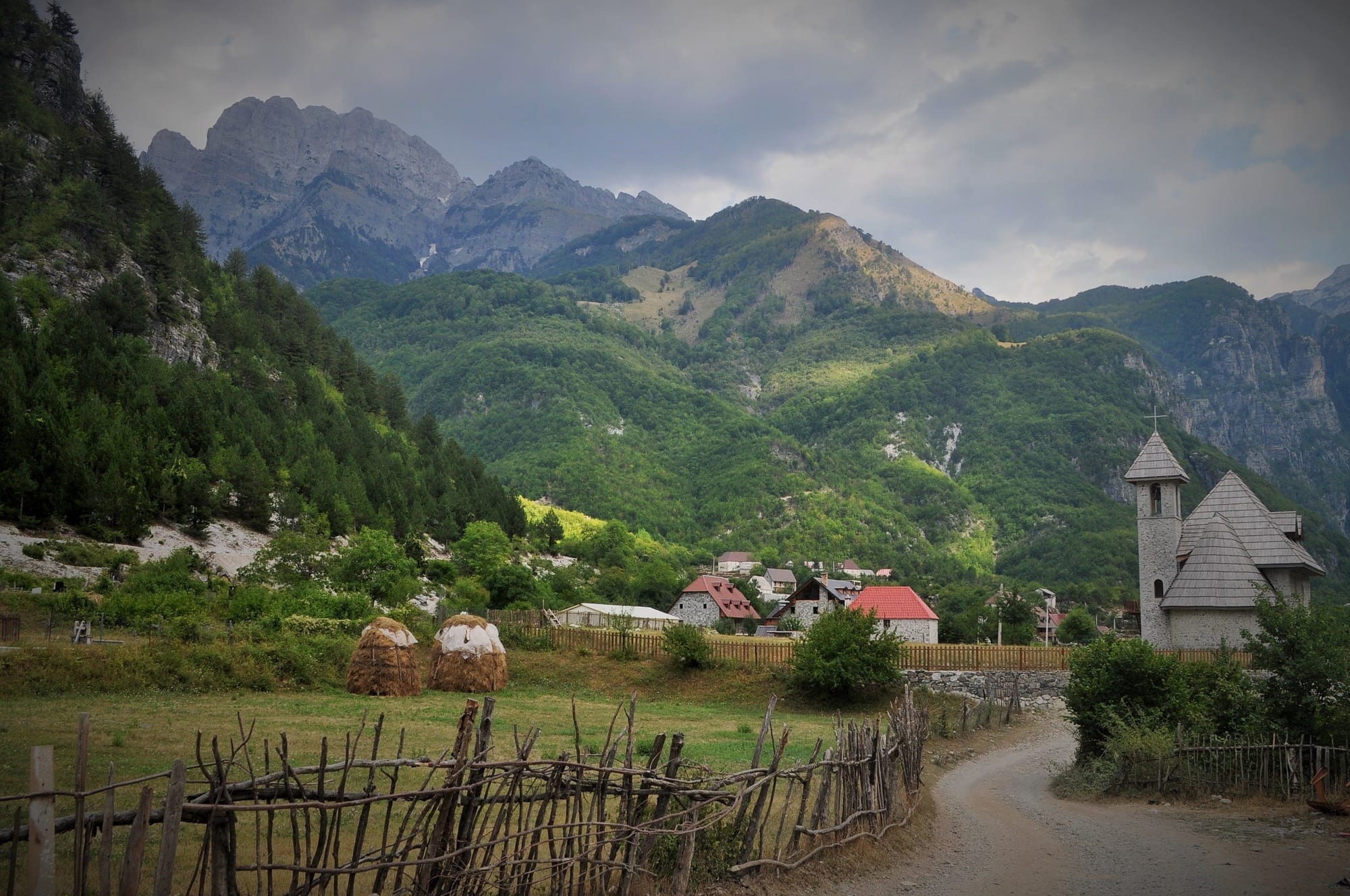
Stone church with a shingled bell tower beside a dirt road, haystacks and red-roofed houses below grey peaks

Northern Albania & the Alps, Albania

Theth

The church and houses of Theth beneath the Accursed Mountains. (young shanahan from Bratislava, Slovakia / Wikimedia Commons · CC BY 2.0)

A small village of scattered stone houses in the upper Shala valley, ringed by the limestone peaks of the Accursed Mountains. Settled by Catholic highlanders who kept the old customary law, it has lost much of its population in recent decades and now lives on summer walkers, with family guesthouses, a lock-in tower, waterfalls and the trail over the Valbona Pass.

Neighbourhoods

  • The village centre
    • First-time visitors
    • Historic district

    The cluster of houses, fields and guesthouses around the church on the valley floor, where the road from Shkodër arrives and a small tourist information point stands at the village entrance. The lock-in tower and the trail towards the Valbona Pass are close by.

    Open in Maps
  • Nderlysaj and the lower valley
    • Walking
    • Quiet and residential

    The hamlet further down the Shala valley where the path to the Blue Eye begins, following the river upstream. It has parking for drivers and a few places to eat beside the water.

    Open in Maps

Things to do

In the village

  • Lock-in Towerlandmark

    One of very few surviving lock-in towers, the stone refuges where men of a family 'in blood' sheltered during a feud under the Kanun.

    Open in Maps
  • Theth Catholic Churchlandmark

    The small stone church on the valley floor, a reminder of the Catholic faith that the village's founders came to these mountains to keep.

    Open in Maps
  • Watermill and ethnographic museummuseum

    A working watermill still used to grind the villagers' corn, and a modest ethnographic museum of highland life.

    Open in Maps

Waterfalls and walks

  • Grunas Waterfall and Canyonattraction

    A waterfall and narrow canyon close to the village, reached over a newer bridge across the Nanrreth river.

    Open in Maps
  • Blue Eyetrail

    A clear blue pool below a waterfall in the mountains above Nderlysaj, about an hour's walk on a relatively easy trail along the river.

    Open in Maps
  • Valbona Passtrail

    The 1,795-metre pass on the mountain path between Theth and the Valbona valley, the favourite of the walks from Theth.

    Open in Maps
  • Alps of Albania National Parkpark

    Albania's largest national park, created in 2022 by joining the Theth and Valbona parks, with most of the country's peaks above 2,000 metres.

    Open in Maps

Short trips from the village

  • Valbona Valleypark

    The forested valley on the far side of the pass, beneath Maja Jezercë, the highest peak of the Dinaric Alps, reached on foot from Theth in a long day.

    Open in Maps

Eat and drink

Long-standing places and food districts in Theth. Hours, ratings and directions come from your maps app, always current.

Theth classics

  • Guesthouse kitchensrestaurant

    Family guesthouses provide board as well as lodging, cooking with their own produce and preparing packed lunches for walkers heading over the pass.

    Open in Maps
  • Riverside restaurants in Nderlysajneighborhood

    A few simple places to eat at the start of the Blue Eye trail, beside the river.

    Open in Maps

Experience Theth

History

Theth's people hold that they descend from a single ancestor, Ded Nika, and that the community moved up from the lower Shala valley some 300 to 350 years ago to keep its Catholic faith rather than convert to Islam. The village grew as a scatter of stone houses and fields on the valley floor, governed, like the rest of the northern highlands, by the Kanun, the customary law of honour, hospitality and revenge. Its lock-in tower, one of very few that survive, was built as a refuge for men of a family caught in a blood feud.

The English traveller Edith Durham described Theth as a bariak, a highland unit, of about 180 houses, and noted that it was almost free of the blood feud that blighted other parts of the Albanian highlands; it was also spared the feuds that returned to the north after communism. Theth National Park was created around the Shala valley in 1966. The population has been greatly reduced over recent decades, and most of those who remain live here only in summer.

Tourism has given the valley a new purpose. Families began offering board and lodging to walkers, a cross-border peace park project helped mark the footpaths, and a new bridge was built to the Grunas waterfall. Theth was declared a Protected Historic Centre in 2017, the last stretch of the road from the Thore pass was paved in 2021, and in 2022 the Theth and Valbona parks were joined to form the Alps of Albania National Park, the largest in the country.

Culture & Customs

Theth is a Catholic highland community, and its church stands on the open valley floor. The founding story of migration to keep the faith is still told, and the idea of descent from one ancestor gives the village a strong sense of kinship.

The Kanun remains influential in the valley, above all in its rules of hospitality: the guest is honoured and protected, and visitors arriving at a family guesthouse are welcomed with coffee or raki. The harsher side of the code, the blood feud, has not troubled Theth in the post-communist years, and the lock-in tower is now visited as a monument to a past way of life rather than a working refuge. The north of Albania has a tradition of sung epic poetry accompanied by the one-stringed lahuta, and the village has a modest ethnographic museum.

Manners are those of a small farming village. People greet each other on the lanes, fields and haystacks are private property even where paths cross them, and the working watermill, still used to grind corn, is a reminder that this is a place where people live as well as a hiking destination. The village has kept a nine-grade school, a sign of a community determined to continue.

Daily Life

Theth is small, and its population has fallen sharply over recent decades; most of those who remain occupy the village only in the summer months, when the road is open. Since the 2015 local government reform the village has been part of the municipality of Shkodër.

The economy is guesthouses, guiding and transport. Families let rooms, cook for walkers, prepare packed lunches, hire out horses for luggage and arrange rides back to Shkodër or onward to Valbona, while still keeping fields, animals and kitchen gardens. A small tourist information point at the village entrance helps visitors find guides and rentals, and the protected areas agency has an official information centre beside the Theth bridge.

The rhythm of the day follows the season. In summer, walkers leave early for the pass or the waterfalls and return in the afternoon, and dinner is taken at the guesthouse table. From November to April snow closes the road, and the valley falls quiet. Depopulation remains the community's most serious long-term challenge.

Food

Theth eats what its families grow and raise. Guesthouse meals are built around the produce of the household and the valley — vegetables from the garden, cheese and yoghurt, and meat from the family's animals — and the dinner served to walkers is usually generous. Packed lunches are prepared for those heading over the pass.

Albanian mountain food draws on cornbread, pies such as lakror, meat and trout, and the Shala and Kapresa rivers around Theth are rich in speckled trout. Homemade cheese, yoghurt, dhallë, a yoghurt drink, and pickles start a meal, as across Albania. Byrek, flaky filo layered with cheese, spinach or minced meat, is the familiar quick food of the whole country.

Families also preserve the summer for the winter months, making jams, pickles and dried fruit from seasonal mountain produce, which are sold to visitors as well. Strong Turkish-style coffee begins the day, and raki, the clear spirit most often made from grapes or plums, is offered to guests as a sign of welcome.

Planning tools

Budget

Staying in Theth costs little. Most visitors sleep in family guesthouses that include dinner and breakfast, and packed lunches for the trail cost little more. The main extra costs are the minibus or private transfer from Shkodër, a guide, and a horse to carry bags over the pass. Cash is needed for almost everything.

Daily Budget Midrange
USD 55–100 (private room with board, private transfer, a local guide or luggage horse)
Daily Budget Shoestring
USD 30–45 (guesthouse half-board, a packed lunch, shared minibus)

Bring enough cash from Shkodër for the whole stay.

Best Time to Visit

June to September, when the road is open, the guesthouses are working and the Valbona Pass is free of snow. July and August are the busiest months on the trail. The road is closed from November to April, and most families spend the winter away from the valley.

Suggested Number of Days

One night allows a short look at the valley, but most visitors stay two nights to walk without hurrying. Combining Theth with the walk to Valbona and the return by lake ferry or road usually takes three or four days, depending on the weather.

First Visit
1–2 days
With Surroundings
3–4 days

Transportation

There is no transport within the village, whose own lanes are unpaved; everything is reached on foot. Guesthouses can arrange onward transfers, guides and horses for luggage, and the tourist information point at the village entrance helps with guides and rentals.

Walkers crossing to Valbona should arrange luggage transport and the onward ride with their guesthouse the day before.

Airport & Station Connections

The only road climbs from Shkodër by way of Boga and the Thore pass; its last section was paved in 2021, but it is closed from November to April and can be dangerous in bad weather, with snow, ice and landslides. Minibuses run from Shkodër in the summer season, with morning departures and some afternoon services. The other way in is on foot over the Valbona Pass from the Valbona valley.

Walkability

The village is spread out along the valley floor, and walking is the only way to get around. Lanes are rough and unpaved, and the walks to the Grunas waterfall and the Blue Eye are on mountain paths, so good shoes are needed. The pass to Valbona is a full mountain day with a long climb.

Safety

Albania is a safe country for visitors, and violent crime against tourists is rare. In Theth the hazards are those of the mountains: sudden storms, exposed ground and loose scree on the pass, patchy mobile signal and the risk of walking alone or late in the day. The road in can be dangerous in bad weather.

Start the pass walk early, carry water and a map, tell the guesthouse the plan, and do not attempt the pass in snow. Check current official travel advice before travelling.

Climate

An alpine climate in a deep valley. Summer days in the mountain valleys are warm and nights stay cool; winters bring deep snow that closes the road and the passes for months.

Summer
warm in the valleys and fresh at altitude — in the neighbouring Valbona valley summer maximum temperatures range from about 36°C to 40°C
Winter
deep snow and closed passes — in the neighbouring Valbona valley winter lows fall to between about −16°C and −23°C

Local Customs

The highland code of hospitality still shapes the welcome: a guest is looked after, and coffee or raki is offered readily. The village is Catholic, and its people trace their descent from a single ancestor. Guesthouse meals are eaten with the family or other guests, and the food served is what the household grows.

Dress modestly in the church, ask before photographing people, close farm gates and keep to marked paths across private fields.

Common Payment Methods

The currency is the Albanian lek. Guesthouses, transfers and guides are generally paid in cash, so enough money for the whole stay should be drawn in Shkodër.