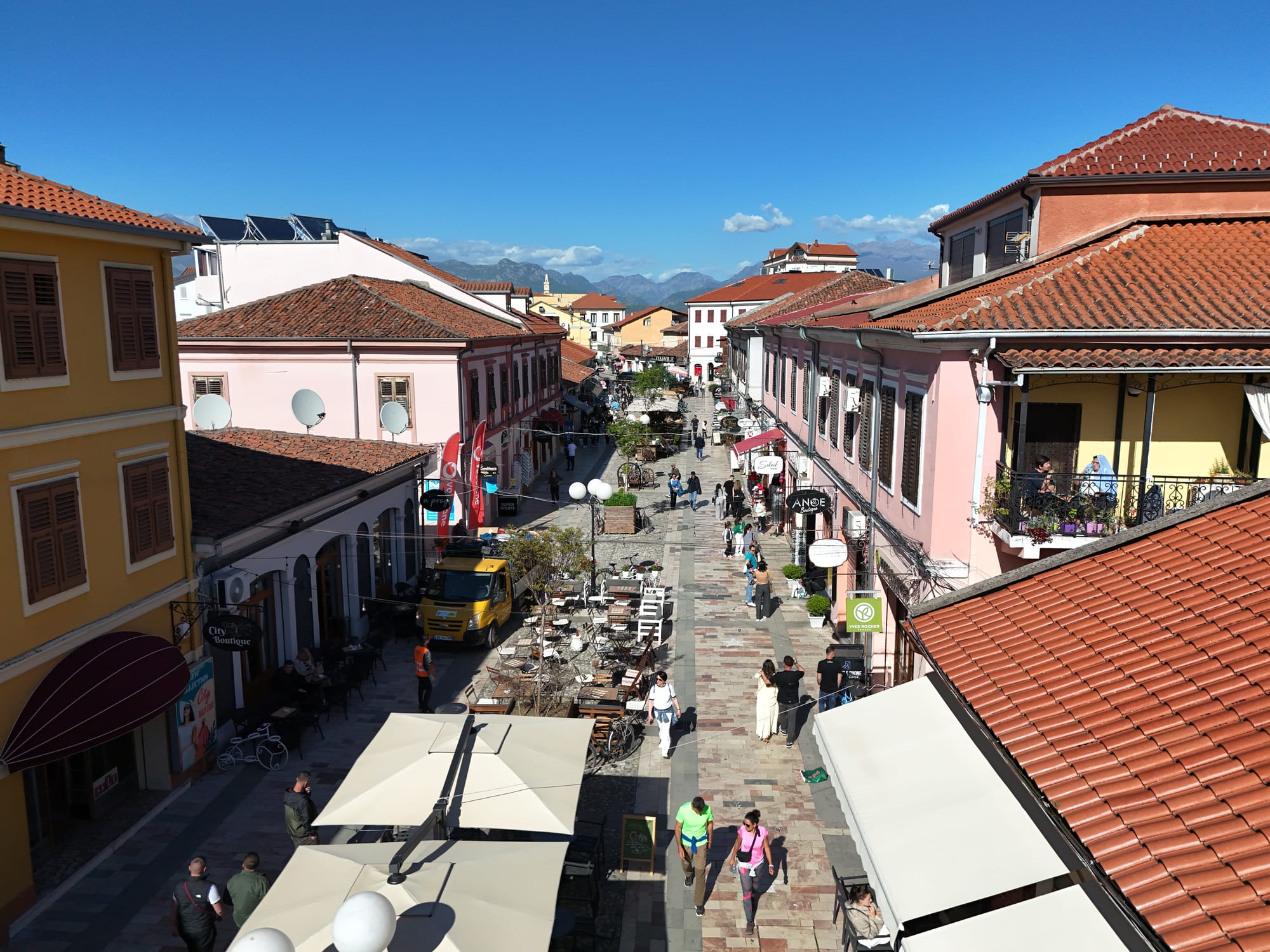
Pedestrian Kolë Idromeno Street lined with pastel houses, tiled roofs and café umbrellas, mountains on the horizon

Northern Albania & the Alps, Albania

Shkodër

Kolë Idromeno Street, the pedestrian heart of Shkodër. (Arianit Dobroshi / Wikimedia Commons · CC BY-SA 4.0)

Northern Albania's traditional capital, spread across a plain between Lake Shkodër and the foothills of the Albanian Alps where the Buna, Drin and Kir rivers meet. An Illyrian royal seat, then a Venetian and Ottoman stronghold beneath Rozafa Castle, it is now a flat, bicycle-riding city of churches and mosques and the usual base for the Accursed Mountains.

Neighbourhoods

  • Kolë Idromeno Street and the centre
    • First-time visitors
    • Cafés
    • Close to public transport

    The main pedestrian street, lined with cafés and restaurants, runs into the centre around Democracy Square and its fountain, where most buses and minibuses arrive. The Marubi photography museum is halfway along, and the street fills with people walking in the evening.

    Open in Maps
  • Rozafa hill and the rivers
    • Historic district
    • Views

    The south-western edge of the city, where the castle hill rises above the meeting of the Buna and Drin. The plain beneath it was the site of the ancient city, and the bridges over the Buna lead out towards the lake shore.

    Open in Maps
  • Shiroka and the lake shore
    • Lakeside
    • Best for food
    • Quiet and residential

    A former lakeside village, now part of the city, reached by a cycle path and walkway along the water from the Buna bridge. Its waterfront restaurants are known for carp from the lake, and the road continues to the fishing village of Zogaj near the Montenegrin border.

    Open in Maps

Things to do

Famous landmarks

  • Rozafa Castlelandmark

    The fortress on a 130-metre rocky hill above the Buna and Drin rivers, first walled as the citadel of Illyrian Skodra; the walls visible today are mostly Venetian, and a museum inside tells its history.

    Open in Maps
  • Mesi Bridgelandmark

    An Ottoman stone bridge of 13 arches over the Kir river in the village of Mes, about 5 km north-east of the city, built around 1770 by the local pasha Kara Mahmud Bushati.

    Open in Maps
  • St Stephen's Cathedrallandmark

    The Catholic cathedral, known locally as the Kisha e Madhe or Grand Church, damaged in the siege of 1912–13, closed by the communist regime in 1967 and reopened in 1990.

    Open in Maps
  • Lead Mosquelandmark

    The Mosque of Mehmet Bushati, named after the lead that covered its domes, designated a Cultural Monument of Albania in 1948.

    Open in Maps
  • Ebu Bekër Mosquelandmark

    A Sunni mosque in the city centre, sometimes simply called the Great Mosque, one of the most prominent of the city's religious buildings.

    Open in Maps
  • St Francis Churchlandmark

    A Franciscan church built in 1905, one of the landmarks of the city's long Catholic tradition.

    Open in Maps

Museums

  • Marubi National Museum of Photographymuseum

    The archive of the photo studio founded in Shkodër in 1856 by Pietro Marubbi and run by three generations, showing Albanian life, politics and dress from the 1850s onwards in a restored building on Kolë Idromeno Street.

    Open in Maps
  • Site of Witness and Memorymuseum

    A museum on the crimes of the communist regime, with photographs, film and the first-hand accounts of political prisoners from Shkodër.

    Open in Maps
  • Shkodër Historical Museummuseum

    Housed in a traditional Shkodran house, with objects from every part of the region's social life and history.

    Open in Maps

The lake and the streets

  • Kolë Idromeno Streetneighborhood

    The main pedestrian street, named after the painter and architect who studied under Pietro Marubbi, where cafés spread across the paving and the city takes its evening walk.

    Open in Maps
  • Lake Shkodërpark

    The large lake on the city's western edge, shared with Montenegro, whose waters drain to the Adriatic through the Buna; a cycle path follows its shore to Shiroka.

    Open in Maps
  • Loro Boriçi Stadiumattraction

    The home ground of Vllaznia, the oldest sports club in Albania, with about 16,000 seats.

    Open in Maps

Short trips from the city

  • Drisht Castlelandmark

    The ruined hilltop castle of medieval Drivastum, above the village of Drisht beyond the Mesi Bridge, reached on foot from the village.

    Open in Maps
  • Velipojëbeach

    The nearest beach to the city, a village on the Adriatic near the mouth of the Buna, reached by minibus from the centre.

    Open in Maps
  • Lake Komanattraction

    A reservoir in the narrow, steep-sided gorge of the Drin, crossed by a daily ferry from Koman to Fierza that takes about two and a half hours; minibuses leave Shkodër early in the morning for the boat.

    Open in Maps

Eat and drink

Long-standing places and food districts in Shkodër. Hours, ratings and directions come from your maps app, always current.

Shkodër classics

  • Lakeside fish restaurants in Shiroka and Zogajneighborhood

    Restaurants along the lake shore serving carp from Lake Shkodër, the city's best-known fish, including tavë krapi, one of its most familiar specialities.

    Open in Maps
  • Kolë Idromeno Streetneighborhood

    The pedestrian street holds the greatest concentration of the city's restaurants and cafés, from traditional Albanian kitchens to quick lunch places.

    Open in Maps

Markets

  • Tregu i Madhmarket

    The Big Market, one of the best known in the city, selling food, household goods and handmade textiles.

    Open in Maps
  • Pazari i Vjetërmarket

    The second-hand and vintage market at Qafë Hardhi, where sellers call out prices for clothes, hats and bric-a-brac.

    Open in Maps

Experience Shkodër

History

People have lived around Shkodër since the Early Bronze Age. In the 4th century BC the Illyrian Labeatae founded an urban settlement, Skodra, on the 130-metre hill where the lake drains into the Buna, and it became the capital of an Illyrian kingdom. Rome annexed and sacked it after defeating King Gentius in 168 BC, and in the 3rd century AD it became the capital of the Roman province of Praevalitana; an archdiocese followed with the spread of Christianity.

After the break-up of the Serbian Empire the Balšić family handed the city to Venice in 1396, and the castle withstood two Ottoman sieges before an agreement in January 1479 let its defenders leave and the Ottomans take a deserted town. It revived in the 17th century as the seat of the Sanjak of Scutari, with stone houses, a great bazaar and a river port on the Buna, and from 1757 to 1831 the local Bushati family ruled a near-independent pashalik from here, building the Mesi Bridge and the Lead Mosque. In the later 19th century the Marubi studio began photographing the city and the national movement.

In the Balkan Wars Montenegrin and Serbian forces besieged Shkodër for seven months; it surrendered in April 1913 but was handed to the new Albanian state a month later by the London Conference of Ambassadors. Under communism the regime repressed many religious people, mostly Catholics but also some Muslims, and intellectuals, and demolished the old bazaar and the river port. The city was a centre of the democratic movement that ended the regime in the early 1990s. Severe floods struck in December 2010, and a new bridge over the Buna opened in 2011.

Culture & Customs

Shkodër is regarded as the traditional capital of the Gheg north and as one of the country's main centres of art and learning. Its skyline mixes the domes and minarets of the Lead Mosque and the Ebu Bekër Mosque with the bell towers of St Stephen's Cathedral and the Franciscan church, and the city is the seat of a Catholic archbishopric. Under the atheist regime the cathedral was closed for more than twenty years; its reopening in 1990 is part of the city's memory of the end of communism, along with the prisons and interrogation rooms now recorded in the Site of Witness and Memory.

The city has a long visual tradition. The Marubi studio left an archive of hundreds of thousands of negatives covering Albanian life from the 1850s to the mid-20th century, and the painter and architect Kolë Idromeno, who studied under the studio's founder, gave his name to the main street. Music is part of the identity too: the folktronica duo Shkodra Elektronike, formed in the city in 2019, represented Albania at the Eurovision Song Contest in 2025 and finished eighth.

Sport means football and Vllaznia, Albania's oldest sports club, followed passionately at the Loro Boriçi Stadium. The calendar includes a carnival, a children's festival, an animated film festival named after Rozafa, a jazz festival and a lake day, and at the end of March a festival of north Albanian folklore is staged at the castle. Everyday manners are those of the north: guests are welcomed with coffee, and the bicycle is used by people of every age.

Daily Life

About 77,000 people lived in the city's municipal unit at the 2011 census, and about 135,600 in the wider municipality, which includes villages on the plain and around the lake. Shkodër is the largest city in the north and the main road link between Tirana and Podgorica, and it lives on trade, services, the markets that supply the surrounding countryside and, increasingly, on travellers heading for the lake and the Alps.

Life is lived at street level. The city is flat, and its cycling tradition, dating back to the communist years, means bicycles are everywhere, with cycle lanes along many roads and a newer cycle path and walkway along the river to the lake. Mornings start with coffee in the bars of the centre and a visit to one of the markets, such as Tregu i Madh or the newer Tregu i Ri, and in the evening Kolë Idromeno Street fills with people walking and talking.

Water shapes daily concerns. The rivers and the lake that give the city its setting also flood the plain in wet winters, and work on a bypass began after the 2010 floods. Local politics is closely watched; the municipal council was last elected in 2023. The city remains the main centre of the north, with a strong sense of itself.

Food

The lake is the source of Shkodër's best-known food. Carp from Lake Shkodër is the city's signature fish, and tavë krapi, a carp dish, is one of its familiar specialities; the restaurants along the shore at Shiroka and in the fishing village of Zogaj near the Montenegrin border are where people go to eat it, beside the water.

In the centre the everyday food is the same as across Albania: byrek, flaky filo layered with cheese, spinach or minced meat, sold from bakeries for breakfast and a cheap lunch; tavë kosi, mutton and rice baked under a mixture of yoghurt, eggs, butter and flour, one of the national dishes; and fërgesë, a casserole of peppers, tomatoes, onions and gjizë, a salted curd cheese. Homemade cheese, yoghurt and pickles start a meal, and the restaurants of Kolë Idromeno Street serve both traditional Albanian cooking and quicker meals for students and visitors.

Coffee is the city's social glue, drunk strong in the Turkish style or as an espresso in the bars of the pedestrian centre, and raki, the clear spirit made from grapes or plums, is offered to guests at almost any hour. The markets supply what the plain and the mountains produce in season, from fruit and vegetables to cheese and honey.

Planning tools

Budget

Shkodër is among the cheapest cities in one of Europe's cheapest countries. Hostels and family-run hotels are good value, coffee and byrek cost very little, and bicycle hire and city minibuses are inexpensive. Costs rise once private transfers to the mountains or guided treks are added. Cash is needed for minibuses, markets and anything beyond the city.

Daily Budget Midrange
USD 55–100 (family-run hotel, lakeside fish dinners, museum tickets, taxis or a private transfer)
Daily Budget Shoestring
USD 30–45 (hostel bed, bakery breakfasts and market lunches, a hired bicycle, minibuses)

Draw enough lek in Shkodër before heading into the mountains, where cash machines are few.

Best Time to Visit

May, June, September and October are the most comfortable months, warm enough for the lake shore and cycling without the full heat of high summer. July and August are hot and busiest, as trekkers pass through on the way to Theth and Valbona. Winters are mild but very wet.

Suggested Number of Days

The city itself needs one or two days. Most visitors stay longer because Shkodër is the starting point for the mountains and the lake ferry; a trip that includes the Alps usually takes four to six days, depending on the weather and how much walking is planned.

First Visit
1–2 days
With Surroundings
4–6 days

Transportation

The city is flat, and cycling is the local way to get around: Shkodër is known as the bicycle capital of Albania, with cycle paths and lanes on many roads and bikes for hire near the centre. Local buses run to places such as Shirokë, and taxis are available. Minibuses (furgons) to Theth, Koman, Velipojë and the Montenegrin border leave from separate gathering points rather than a single bus station.

Ask at the accommodation which gathering point serves a given minibus; mountain departures are early in the morning.

Airport & Station Connections

Tirana International Airport Nënë Tereza is the only airport in Albania with scheduled passenger flights, and there are direct bus connections from it as well as from central Tirana; the 116 km bus journey from the capital takes about two hours. Direct buses also run from Durrës, and buses link the city with Ulcinj and Podgorica in Montenegro, crossing at Han i Hotit, and with Gjakova in Kosovo.

Walkability

The centre is compact and easy on foot, with the pedestrian Kolë Idromeno Street at its heart. Rozafa Castle, the lake shore and the Mesi Bridge lie a little further out and are best reached by bicycle; the climb to the castle is short but steep. Traffic at the central roundabout can be chaotic.

Safety

Albania is a safe country for visitors, and violent crime against tourists is rare. In Shkodër the everyday risks are traffic, especially for cyclists and pedestrians at busy junctions, and occasional petty theft. Floods have struck the city and its plain in wet winters, most severely in 2010.

Use a light on a hired bicycle after dark, watch for cars at roundabouts, and plan mountain trips around the weather. Check current official travel advice before travelling.

Climate

A Mediterranean climate with continental influences, set between the lake and the mountains. Summers are hot and dry; winters are mild in the daytime, chilly at night and very wet, with most of the year's rain between autumn and spring.

Summer
hot — August days average about 33°C, with nights around 20°C
Winter
mild by day and cold at night — January ranges from about 2°C to 10°C, with frequent heavy rain

Local Customs

Shkodër is the seat of a Catholic archbishopric and also home to a large Muslim community, and the city is noted for its religious diversity. Coffee is the main social ritual, and an offer of coffee or raki is a gesture of hospitality. The evening walk along the pedestrian street is a fixture.

Dress modestly and remove shoes where asked when entering mosques, keep voices low in churches, and ask before photographing people.

Common Payment Methods

The currency is the Albanian lek. Cards work in many hotels, larger restaurants and supermarkets, but cash is needed for minibuses, markets, bicycle hire and small cafés. ATMs are easy to find in the centre; some charge high fees. Prices are sometimes quoted in old lek, ten times the current figure, so it is worth checking which is meant.