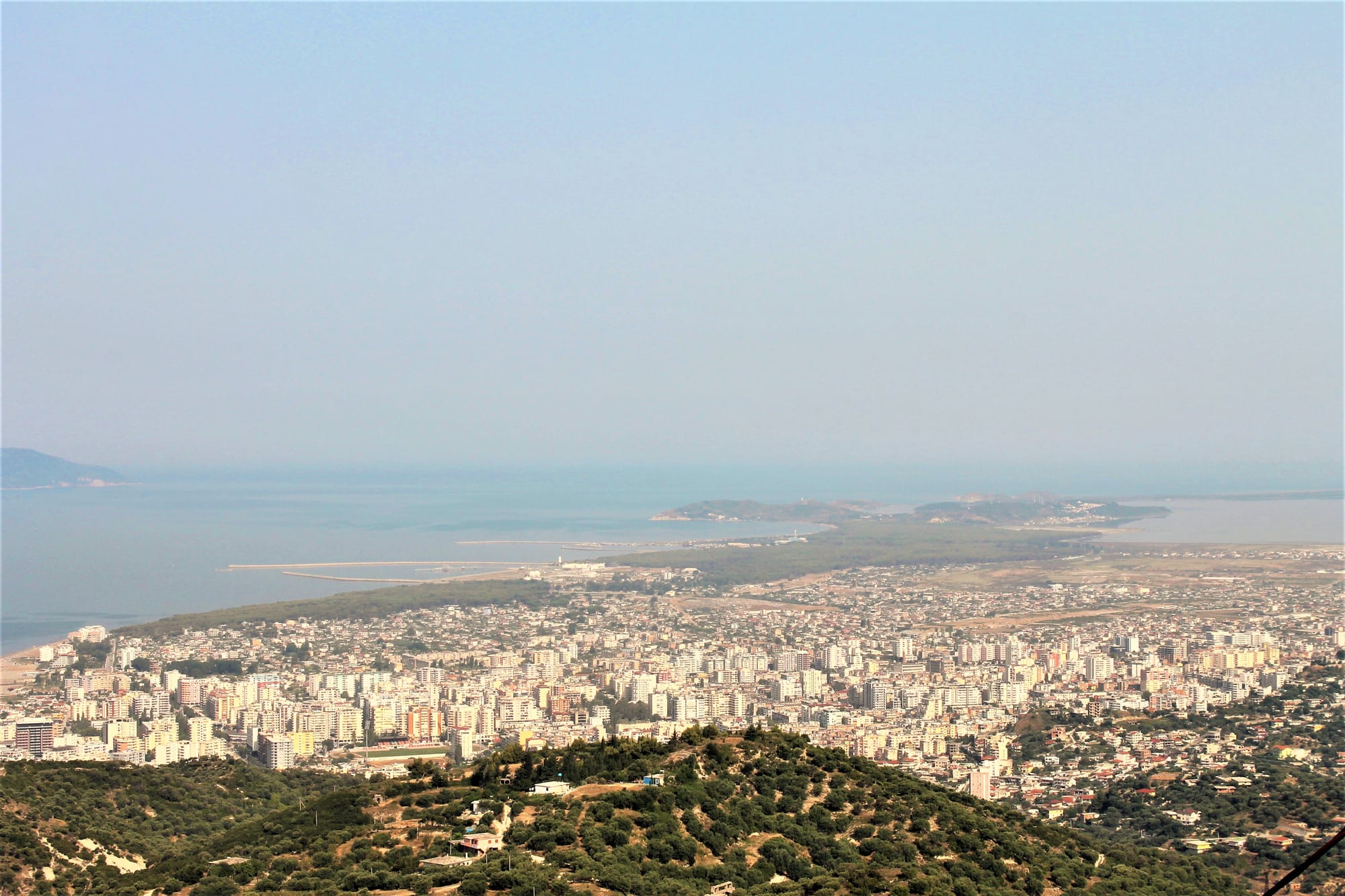
A city of pale apartment blocks spread across a plain beside a wide bay, seen from a wooded hill, with a lagoon and low hills beyond

Southern Albania & the Riviera, Albania

Vlorë

Vlorë and its bay seen from the hill of Kaninë Castle. (A1 / Wikimedia Commons · CC BY-SA 4.0)

Albania's third city and second port, on the Bay of Vlorë where the Adriatic meets the Ionian Sea, below the foothills of the Ceraunian Mountains. Ancient Aulon, it was where Albania declared independence in 1912 and became the country's first capital; today it is a working port, university town and summer resort with a long seafront and the Riviera road south.

Neighbourhoods

  • The old centre and Flag's Square
    • First-time visitors
    • Historic district
    • Close to public transport

    The inland town centre around Flag's Square and the Independence Monument, with the Muradie Mosque, the Ethnographic and History museums, cafés and the buses and furgons that serve the surrounding towns. A long palm-lined boulevard runs down to the port.

    Open in Maps
  • Skelë and the port
    • Nightlife
    • Ferries
    • Best for food

    The waterfront district around the port at the bottom of the boulevard, where the ferries from Italy dock, with hotels, restaurants and the start of the Lungomare promenade.

    Open in Maps
  • The Lungomare and Uji i Ftohtë
    • Beaches
    • Nightlife
    • Families

    The seafront promenade running south from the port past beaches, cafés and new apartment towers to the tunnel at Uji i Ftohtë, the city's summer heart, with bars and restaurants along the bay.

    Open in Maps

Things to do

Independence and the city centre

  • Independence Monumentlandmark

    The large socialist-realist monument on Flag's Square, with Ismail Qemali at its centre, commemorating the declaration of independence of 1912.

    Open in Maps
  • Museum of Independencemuseum

    The 19th-century building where the founders of modern Albania signed the declaration, now a museum of documents and artefacts from 1912.

    Open in Maps
  • Muradie Mosquelandmark

    A mosque of 1537–1542 on a central square, attributed to the Ottoman architect Mimar Sinan and also known as the Lead Mosque.

    Open in Maps
  • Ethnographic Museummuseum

    A 19th-century mansion near the Museum of Independence displaying the folk heritage of Vlorë and its region.

    Open in Maps
  • History Museummuseum

    A museum on Perlat Rexhepi Street with finds from the Illyrian and ancient Greek sites around the bay.

    Open in Maps

The seafront

  • Lungomaretrail

    The long seaside promenade from the port to Uji i Ftohtë, lined with cafés and restaurants, with cycle paths.

    Open in Maps
  • Kaninë Castleviewpoint

    A castle on the hill above the city, on the site of ancient Kionina, with views over the city and the bay; paragliders take off from here.

    Open in Maps

Lagoons and islands

  • Narta Lagoonpark

    A lagoon north of the bay inside the Vjosa Wild River National Park, an internationally important bird area that was home to some 3,000 flamingos in 2020.

    Open in Maps
  • St. Mary's Monastery, Zvërneclandmark

    A monastery on Zvërnec Island in the Narta Lagoon, founded most likely between the 11th and 14th centuries.

    Open in Maps
  • Karaburun-Sazan Marine Parkpark

    A national marine park around the Karaburun peninsula and the waters of Sazan island, closing the bay on the west, with sea caves such as Haxhi Ali on the peninsula.

    Open in Maps

Short trips from the city

  • Oricumlandmark

    The ruins of an ancient Greek harbour town at the south end of the bay, with a monumental fountain once taken for a theatre, beside the lagoon of Pashaliman.

    Open in Maps
  • Marmiroi Churchlandmark

    A small church near Oricum, first recorded in 1307, at the edge of the bay.

    Open in Maps
  • Amantialandmark

    An ancient hill city above the Vjosa valley, with walls from the 4th century BC, a theatre and a temple of Aphrodite.

    Open in Maps
  • Llogara National Parkpark

    Pine forest on the Ceraunian Mountains where the coast road climbs to the Llogara Pass at 1,027 metres before dropping to the Riviera.

    Open in Maps

Seasonal events

  • Independence Day28 November

    The anniversary of the 1912 declaration, signed in this city, recalled at Flag's Square and the Independence Monument.

Eat and drink

Long-standing places and food districts in Vlorë. Hours, ratings and directions come from your maps app, always current.

Vlorë classics

  • Seafood at the marina and the portneighborhood

    Restaurants around the port and marina serve grilled fish, calamari, prawns, mussels and lobster, busiest on summer evenings.

    Open in Maps
  • Lungomare cafés and restaurantsneighborhood

    The promenade's cafés, bars and restaurants are where the city spends its summer evenings.

    Open in Maps
  • Roast lamb on the Llogara roadneighborhood

    Restaurants along the road through Llogara National Park serve roasted lamb.

    Open in Maps

Experience Vlorë

History

The coast of the bay saw Illyrian pre-urban settlement from the 11th–10th centuries BC, and Greek colonists are traditionally said to have founded Orikos, Thronion and Aulon on these shores. A large walled port town at Triport, north-west of the modern city and now partly under the sea, was inhabited from the 6th century BC to the 2nd century AD, and the city may later have moved to its present site. Aulon, from which Vlorë takes its name, is first recorded by Ptolemy in the 2nd century AD; it was an important Roman port and from the 5th century a bishopric.

Byzantines and Normans fought over it in the 11th and 12th centuries, and from 1346 to 1417 it was the capital of the Principality of Valona. The Ottomans took it in 1417, and it became an international port trading between western Europe and the Ottoman state. From 1426 the Ottomans encouraged Jewish merchants to settle, and after 1492 exiles from Spain arrived; Ottoman records of the early 16th century count some 2,600 Jews in the city. Venice held it briefly in 1690–91, and an earthquake struck it in 1851.

On 28 November 1912 Ismail Qemali led the Albanian Declaration of Independence here, and the city became the first capital of independent Albania. Italy occupied it from 1914 until an Albanian revolt drove its forces out in 1920, and again from 1939 to 1943; Germany held it until 1944. After the war the base at Pashaliman was leased to the Soviet Union until the split of 1961, when Moscow threatened to occupy the city. In 1997 Vlorë was the centre of the unrest that followed the collapse of the pyramid schemes.

Culture & Customs

Vlorë belongs to Labëria, the region stretching from the coast into the mountains of the south-east that is known as the birthplace of Albanian iso-polyphony, recognised by UNESCO. Most Albanians in the city speak the Lab dialect of southern Tosk, slower than speech elsewhere in the country, and the habit of calling strangers sister and brother is part of local identity. Labs are known for their pride in their region and its food.

The city's public culture is built around 1912. Flag's Square and the Independence Monument, with Ismail Qemali at its centre, commemorate the declaration of 28 November, and the building where the declaration was signed is the Museum of Independence. The city also has an Ethnographic Museum in a 19th-century mansion and a History Museum of finds from the ancient sites around the bay.

Vlorë has long been religiously mixed. In the 19th and early 20th centuries Albanian-speaking Muslims were the majority, alongside Greek-speaking families, Albanian Orthodox, Jews and a few Catholics; the Muradie Mosque and the 19th-century Saint Aloysius Gonzaga and Mary Church still stand in the centre. Football is followed through KS Flamurtari Vlorë, the city's oldest and most popular top-flight club, whose stadium stands near Independence Square.

Daily Life

About 80,000 people lived in the city of Vlorë at the 2011 census, and about 105,000 in the municipality, which stretches from the mouth of the Vjosa past the Narta Lagoon to the Llogara Pass and takes in the Karaburun peninsula and Sazan island. The city grew between 1989 and 2011 while the wider municipality lost people.

Vlorë is a major seaport and commercial centre with fishing and industry, and it hosts important installations of the Albanian Navy. The surrounding region produces petroleum, natural gas, bitumen and salt, and olive and fruit orchards have spread widely. Tourism has become a major industry, filling the seafront with hotels and apartment towers. The University of Vlora, founded in 1994, is the second-largest university in Albania, with two private universities alongside.

Current issues include the new airport in the protected Vjosa–Narta landscape and repeated fires at the city landfill between 2020 and 2024; it had been due to close in 2021, when a new landfill was expected to open. The day follows the heat: early coffee, a quiet afternoon, and the evening xhiro along the Lungomare.

Food

The bay's seafood is the city's pride: grilled fish, calamari and prawns, usually seasoned simply with olive oil, lemon and herbs, along with mussels and lobster. Vlorë has long been known for its olives and olive oil, and fish dishes in southern Albania are often flavoured with white vinegar and olive oil.

Lab cooking from the hills and the Karaburun peninsula is the other half of the table. Grilled meat is on every menu, and lamb roasted over an open fire, mish në hell, is a local speciality, and roast lamb is served at restaurants in Llogara National Park. Byrek in Vlorë is often filled with field greens or made as a milky pie, and harapash is a porridge of corn flour cooked with lamb's intestines, cheese and butter. Yoghurt is made in the traditional way, and dhallë, a yoghurt drink, is common.

Raki, made most often from grapes, plums or blackberries, is offered as a welcome drink, and in the south a version flavoured with oregano, raki rigoni, is popular. Boza, a slightly sweet fermented drink of corn or wheat, local wines and spring water from the mountains complete the list, and coffee in the seafront cafés fills the evenings.

Planning tools

Budget

Vlorë is cheaper than the Riviera resorts to its south and stays a working city out of season. Seafront rooms rise sharply in July and August, but food, coffee, city buses and furgons stay inexpensive all year.

Daily Budget Midrange
USD 80–150 (seafront hotel, fish dinners, museum tickets, taxis or a hire car for the Riviera)
Daily Budget Shoestring
USD 35–55 (guesthouse or hostel, byrek and grill-house meals, buses and furgons)

Book seafront rooms early for August, or come in June or September, when prices are far lower and the sea is warm.

Best Time to Visit

May, June and September are best for the beaches, with a warm sea and room on the Lungomare. July and August are hot, sunny and crowded, and the coast road south is slow. Winters are mild, rainy and quiet.

Suggested Number of Days

One or two days cover the city's monuments and seafront. Allow three to five to add the lagoon, the ancient sites around the bay, a boat trip on the peninsula or the mountain road south. Beach holidays naturally run longer.

First Visit
1–2 days
With Surroundings
3–5 days

Transportation

Passenger trains no longer run south of Fier. Buses and furgons line up along the road near the History Museum, with services to Tirana and to Gjirokastër and Sarandë, both inland and along the Riviera. The A2 motorway runs north from the city towards Fier. City buses and cheap taxis cover the distance between the centre and the Lungomare, and bicycles can be rented for the promenade.

Only a few buses a day run the length of the Riviera, so check times the day before; a hire car is the practical way to reach the smaller beaches.

Airport & Station Connections

Most visitors come by road from Tirana and its international airport; minibuses run from the airport to the city. Overnight ferries cross from Brindisi in Italy to the port. A new international airport has been built north of the city in the protected landscape of the Vjosa–Narta area, a project that drew wide criticism; it has had no scheduled commercial flights.

Walkability

The centre around Flag's Square is compact and walkable, and the palm-lined boulevard runs about 2 kilometres down to the port. The Lungomare is flat and pleasant for walking and cycling along the bay; beyond it the city spreads out along busy roads, and buses or taxis are more practical.

Safety

Albania is a safe country for visitors, and violent crime against tourists is rare. In Vlorë the practical risks are traffic on the busy seafront and on the Llogara road's bends in summer, heat, and wildfires on dry hillsides; smoke from fires at the city's landfill has been a recurring problem in recent years.

Drive the coast road in daylight, swim at guarded beaches, and carry water in summer. Check current official travel advice before travelling.

Climate

A hot-summer Mediterranean climate with an average yearly temperature of about 17°C and around 2,750 hours of sunshine, the sunniest conditions in Albania. Snow falls on about one day a year.

Summer
dry and hot — August averages about 27°C, and July has around 12 hours of sunshine a day
Winter
mild and rainy — January averages about 8°C

Local Customs

Vlorë is part of Labëria, and most people speak the Lab dialect of Tosk; locals often call each other motra and vlla, sister and brother, even on first meeting. The city is proud of its role in 1912, and the events of 1997, which began here, are a sensitive subject best not raised. Dress modestly in mosques and churches, and keep beachwear for the beach.

Tipping is not an established custom in Albania and is not expected. Shake hands on meeting, and avoid arguing about religion or politics.

Common Payment Methods

The currency is the Albanian lek (ALL). Cards work in hotels, larger restaurants and supermarkets, but cash is needed for buses, furgons, beach bars and small cafés. ATMs are common in the centre and along the seafront; some charge high withdrawal fees. Prices are sometimes quoted in old lek, ten times higher, so confirm which is meant.