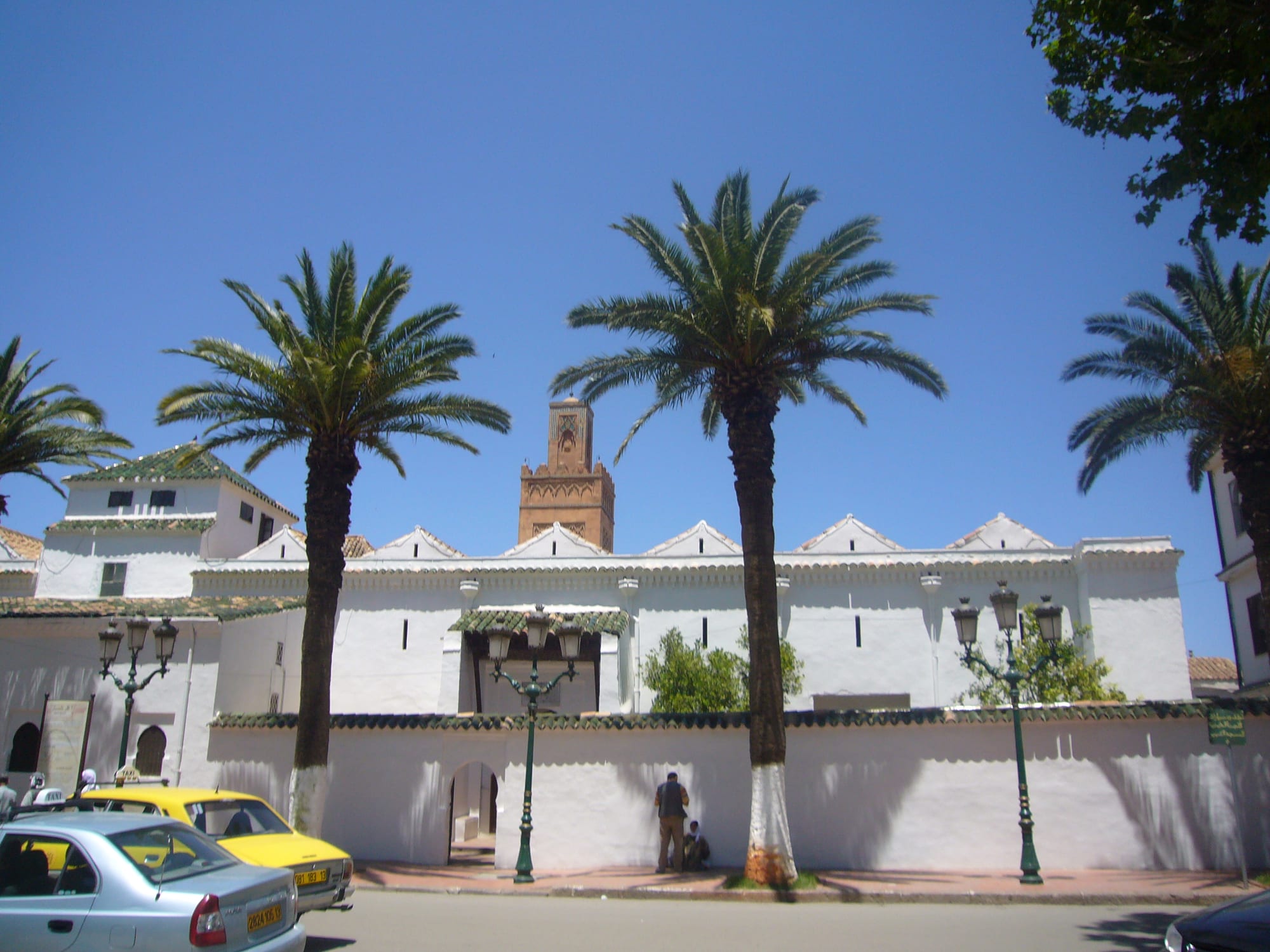
The whitewashed outer walls and brick minaret of the Great Mosque of Tlemcen behind palm trees, with taxis parked on the square

Oran & the West, Algeria

Tlemcen

The Great Mosque of Tlemcen seen across the square in the city centre. (Noureddine Gori / Wikimedia Commons · CC BY-SA 2.5)

An inland city in western Algeria, set on a terrace below wooded mountains near the Moroccan border. Capital of the Zayyanid kingdom from the 13th century, it kept close ties with Muslim Spain and keeps some of the finest Islamic architecture in Algeria — the Almoravid Great Mosque of 1082, the shrine of Sidi Boumediene, the Mechouar palace and the ruins of Mansourah.

Neighbourhoods

  • The old medina and the Mechouar
    • Historic district
    • First-time visitors

    The walled heart of the city, where the Great Mosque, the covered markets, craft workshops and the Mechouar palace stand within a few streets of each other. Lanes are narrow, shaded and busiest in the morning.

    Open in Maps
  • The French-era centre
    • First-time visitors
    • Close to public transport
    • Shopping

    Colonial boulevards and squares immediately outside the old walls, with hotels, banks, cafés, the theatre and the bus and taxi stands. It joins the medina without a break.

    Open in Maps
  • El Eubbad
    • Historic district
    • Quiet and residential

    A hillside village absorbed into the city east of the centre, built around the shrine and mosque of Sidi Boumediene, with steep streets, a cemetery and long views back over Tlemcen.

    Open in Maps
  • Mansourah
    • Historic district
    • Quiet and residential

    A western district named after the ruined camp-city beside it, mixing modern housing and olive groves around the surviving walls and minaret.

    Open in Maps
  • Lalla Setti and the upper terrace
    • Views
    • Families
    • Quiet and residential

    The plateau above the city, reached by a cable car and a winding road, with parks, walks, a small amusement area and the widest view over Tlemcen and the plain.

    Open in Maps

Things to do

Mosques and monuments

  • Great Mosque of Tlemcenlandmark

    The Almoravid mosque founded in 1082 at the centre of the medina, with a carved plaster mihrab, a dome completed in 1136 and a minaret added by the Zayyanids.

    Open in Maps
  • Mansourah Mosquelandmark

    The ruins of the mosque of the Marinid camp-city, completed in 1302 during the siege of Tlemcen, with a 38-metre minaret of which three sides still stand inside long stretches of wall.

    Open in Maps
  • Sidi Boumediene Mosquelandmark

    The mosque, madrasa and tomb complex at El Eubbad founded by the Marinids in 1339, honouring the Sufi master Abu Madyan of Seville, with a richly decorated portal and tiled interior.

    Open in Maps
  • El Mechouar Palacelandmark

    The walled citadel of the Zayyanid sultans in the middle of the city, where one of the courtyard palaces was rebuilt over its ruins in 2010–11 and the minaret of the old Mechouar mosque still stands.

    Open in Maps
  • Sidi El Haloui Mosquelandmark

    A Marinid mosque built in 1353 on the edge of the old city, over the tomb of a qadi from Seville, with arches carried on onyx columns and a minaret of interlacing sebka patterns.

    Open in Maps
  • Great Mosque of Agadirlandmark

    The ruined mosque of Agadir, the settlement that preceded Almoravid Tlemcen on the site of Roman Pomaria; a Zayyanid brick minaret some 27 metres high is all that stands.

    Open in Maps

Museums and crafts

  • Sidi Belahcen Mosque and calligraphy museummuseum

    A former mosque beside the Great Mosque, now the National Public Museum of Islamic Calligraphy, holding Almoravid and Zayyanid art, Roman and Almohad coins and finds from Siga, Honaïne and the Agadir mosque.

    Open in Maps
  • The medina's craft workshopsattraction

    Weavers, embroiderers and metalworkers still work in the old streets, producing the carpets and gold-thread embroidery for which the city is known.

    Open in Maps

Parks, water and viewpoints

  • Lalla Setti plateauviewpoint

    A wooded plateau above the city with gardens, walks and a viewpoint over the whole plain, reached by cable car from the centre.

    Open in Maps
  • El Ourit Fallsattraction

    Waterfalls in a mountainous, pine-covered gorge about seven kilometres from the city, inside the national park.

    Open in Maps
  • Tlemcen National Parkpark

    Protected mountain country around the city, taking in the Ifri, Zariffet and Aïn Fezza forests, the El Ourit falls and cliffs, caves and the ruins of Mansourah.

    Open in Maps

Short trips

  • Beni Add Caveattraction

    Underground chambers of stalactites and stalagmites at Aïn Fezza, east of the city within the national park.

    Open in Maps
  • Nedromaattraction

    A hill town about 75 km to the north-west, founded by the Almohad caliph Abd al-Mu'min, with a great mosque, an old centre settled by refugees from Spain and a living gharnati music tradition.

    Open in Maps
  • Honaineattraction

    A small port on the coast about 60 km to the north-west, one of the two ports of Zayyanid Tlemcen, with medieval remains above the sea.

    Open in Maps

Seasonal events

  • Wedding seasonsummer

    Tlemcen weddings are elaborate and much studied, with the gold-embroidered chedda costume, Andalusian orchestras and celebrations lasting several days.

  • Ramadan eveningsthe month of Ramadan, which moves through the year

    The medina is quiet by day and busy long after sunset, when pastry shops and cafés fill and families visit one another.

  • The olive harvestlate autumn and winter

    The groves around Mansourah and the surrounding hills are picked and pressed, and new oil appears in the markets.

Eat and drink

Long-standing places and food districts in Tlemcen. Hours, ratings and directions come from your maps app, always current.

Markets and food streets

  • The medina marketsmarket

    Covered and street markets near the Great Mosque selling olives, olive oil, spices, honey, dried fruit and the day's vegetables.

    Open in Maps
  • Tlemcen pastry shopscafe

    Almond sweets, griwech and semolina cakes, a speciality of a city known across Algeria for its pastry and its mint tea.

    Open in Maps
  • Centre cafés and grillsneighborhood

    Cafés, soup counters and grill houses on the boulevards outside the old walls, serving harira, brochettes and tajines.

    Open in Maps

Experience Tlemcen

History

Tlemcen began as the Roman garrison town of Pomaria, on the road along the edge of the mountains, and grew again in the Islamic period as Agadir, beside which the Almoravids founded Tagrart in the 11th century. The two settlements merged into one city, and the Almoravid ruler Yusuf ibn Tashfin's Great Mosque, later enlarged by his successors, dates from that time. Under the Almohads the city remained a regional centre on the route between Morocco and the central Maghreb.

Its great age began in 1236, when the Abd al-Wadid or Zayyanid dynasty made Tlemcen the capital of an independent kingdom. For nearly three centuries it controlled the western plains and the northern end of the trans-Saharan trade routes, trading gold, wool and grain with Genoa, Venice and Aragon, and it attracted scholars, Sufi masters and refugees from Muslim Spain, who shaped its architecture, music and crafts. The rival Marinids of Fez besieged the city several times and built the walled camp-town of Mansourah outside it around 1300, holding Tlemcen for periods in the 14th century.

The Ottomans absorbed the kingdom in the 16th century and the city became a provincial town of the Regency, whose western beylik was governed from Mascara and later from Oran. French forces entered the city in 1836, during the long campaign against Emir Abdelkader, who had used it as a base. Under colonial rule it kept its craft industries and gained a European quarter outside the walls. Since independence it has grown as a university and administrative city and has been promoted as a centre of Islamic heritage, including a year as capital of Islamic culture in 2011.

Culture & Customs

Tlemcen thinks of itself as the most Andalusian city in Algeria, and the claim is not empty. Families trace descent from refugees of Muslim Spain, and the city is a stronghold of Andalusian classical music in the gharnati style, played by amateur associations at concerts and weddings on the oud, the rebab and percussion. Sufi brotherhoods remain important, and the shrine of Sidi Boumediene draws visitors and pilgrims from across the region.

Its crafts are equally distinctive: carpets, brocade, leatherwork, and above all the gold-thread embroidery used on the chedda of Tlemcen, the heavy bridal costume whose wedding rites and craftsmanship UNESCO has listed as intangible cultural heritage since 2012. A Tlemcen wedding runs for days, with several changes of costume, henna evenings and a strict order of ceremonies that families take very seriously.

The city's manner is formal and reserved by Algerian standards, conscious of lineage and learning, and its dialect and cooking are closer to those of north-eastern Morocco than to the coast. Religious observance is visible, and the mosques and madrasas remain in daily use rather than being monuments only. Football, as everywhere in Algeria, is followed closely, and the university gives the old city a large student population.

Daily Life

The city itself had about 140,000 people at the 2008 census, with more in the surrounding communes that run up the slopes and along the plain. The provincial administration, the university, hospitals, textiles, leather and food processing provide most of the steady work, alongside construction, trade and the olive groves and orchards that surround the city.

Housing spreads outwards in low apartment blocks and villas, while the medina remains densely lived in, with restoration work on its older houses a constant subject of discussion. Many families have relatives in France, and money and visitors come back in summer. The closed border with Morocco, a short drive away, shapes the economy of the whole area: cross-border trade that was once ordinary is now smuggling, and the frontier is heavily policed.

Daily life is unhurried. Mornings are the busiest time in the markets, the middle of the day is quiet, and the cafés and pastry shops fill in the late afternoon. Evenings are family occasions rather than public ones, which makes the city seem to close early compared with Oran. Water supply, unemployment among graduates and the cost of housing are the recurring local concerns.

Food

Tlemcen's cooking is the most refined in western Algeria, slow and lightly spiced, with clear Andalusian and Moroccan echoes. Lamb tajines cooked with prunes, quince or pears are the signature dishes, alongside chicken with olives and preserved lemon. Couscous appears in many forms, including a fine-grained version served with buttermilk and one made with barley in winter. Harira, a thick soup of lentils, chickpeas and tomato, is more common here than in eastern Algeria and breaks the fast in Ramadan.

Bread and pasta dishes matter: rechta, hand-cut semolina noodles served with chicken, chickpeas and turnips in a pale, lightly spiced sauce, is a dish for feasts and family occasions, and trida, small squares of pasta, is cooked in a similar way. Olive oil from the hills around Mansourah goes into everything, and local honey and figs appear on most tables.

The city's pastry is famous well beyond the region. Shops sell griwech soaked in honey, makroud of semolina and dates, ktaif, and a great range of almond sweets prepared for weddings, where trays of them are part of the ceremony. Mint tea is taken seriously and poured from a height, and strong coffee is drunk in the cafés of the boulevards outside the old walls.

Planning tools

Budget

Tlemcen is cheaper and quieter than Oran, with modest hotels in the centre and a few larger ones on the plateau above the city. Meals, cafés, buses and shared taxis all cost little, and most of the monuments charge small entrance fees or none. Everything is paid for in dinar cash.

Daily Budget Midrange
USD 90–190 (mid-range hotel, restaurant meals, a taxi or hired driver for the sites around the city)
Daily Budget Shoestring
USD 30–55 (simple hotel, café meals, buses and shared taxis)

The city makes a calmer and cheaper base than the coast for exploring the far west; bring euros to change, as foreign cards are almost never accepted.

Best Time to Visit

March to June and September to November are the best months, with warm days, green hills and comfortable walking weather in the medina. Summer is hot and dry inland, though less humid than the coast, and winter nights are cold, with occasional snow on the surrounding mountains.

Suggested Number of Days

Two days are enough for the monuments in and around the city. Three or four suit anyone adding the mountains, the caves and the coast to the north, where roads are slow and transport needs arranging.

First Visit
2 days
With Surroundings
3–4 days

Transportation

The centre and the medina are covered on foot, and buses and shared taxis run to El Eubbad, Mansourah and the surrounding communes. A cable car climbs to the Lalla Setti plateau. Trains and coaches connect the city with Oran and Sidi Bel Abbès, and the East–West Highway passes nearby. A hired car or driver is the practical way to reach the caves, the falls and the coast.

The land border with Morocco is closed, so no overland crossing should be planned; checkpoints are frequent on roads towards the frontier.

Airport & Station Connections

Zenata – Messali El Hadj Airport lies about 17 km north-west of the city, with domestic flights and services to France. Oran is roughly two hours away by road, with coaches, shared taxis and trains, and the railway also links Tlemcen with Sidi Bel Abbès and onward to Algiers.

Walkability

The old city is compact and walkable, with the Great Mosque, the markets and the Mechouar close together and shaded lanes for hot afternoons. The ground rises steadily, and El Eubbad and Mansourah are long uphill walks from the centre, so most people take a taxi to them and walk once there.

Safety

Tlemcen is a quiet, conservative provincial city with little crime beyond occasional petty theft in crowded markets. The security presence is heavy near the closed Moroccan border to the west and south-west, where smuggling is common, and checkpoints on those roads are routine.

Identification should be carried for checkpoints, and military sites and the frontier zone must not be photographed. Most governments advise against all travel to the border regions with Mali, Niger, Libya, and Mauritania, and to parts of the Saharan interior, citing terrorism and kidnapping risk. Check current official travel advice before travelling.

Climate

A Mediterranean climate modified by altitude, the city standing several hundred metres above sea level below higher mountains. Summers are hot and dry with cool nights; winters are mild by day and cold after dark, with rain between autumn and spring and snow on the heights.

Summer
hot and dry, generally around 28–34°C by day, with noticeably cooler nights
Winter
cool and damp, generally 6–16°C, with rain and cold nights, and snow on the mountains above the city

Local Customs

Tlemcen is proud of its scholarly and Andalusian past and is more conservative than Oran. Modest dress is expected, particularly around the mosques and shrines, and shoes are removed where visitors are admitted; non-Muslims are not generally admitted to prayer halls. Greetings are formal and unhurried, hospitality is insistent, and Friday midday is quiet while people are at prayer.

Permission should be asked before photographing people or inside religious buildings, and the shrines are places of prayer rather than sightseeing, so quiet behaviour matters.

Common Payment Methods

The currency is the Algerian dinar and cash is used for everything, including hotels. Foreign cards are accepted almost nowhere and cash machines that take them are unreliable, so euros or US dollars are brought to change. The official bank rate is much weaker than the widely used parallel rate, and changing money outside the banking system is technically illegal.