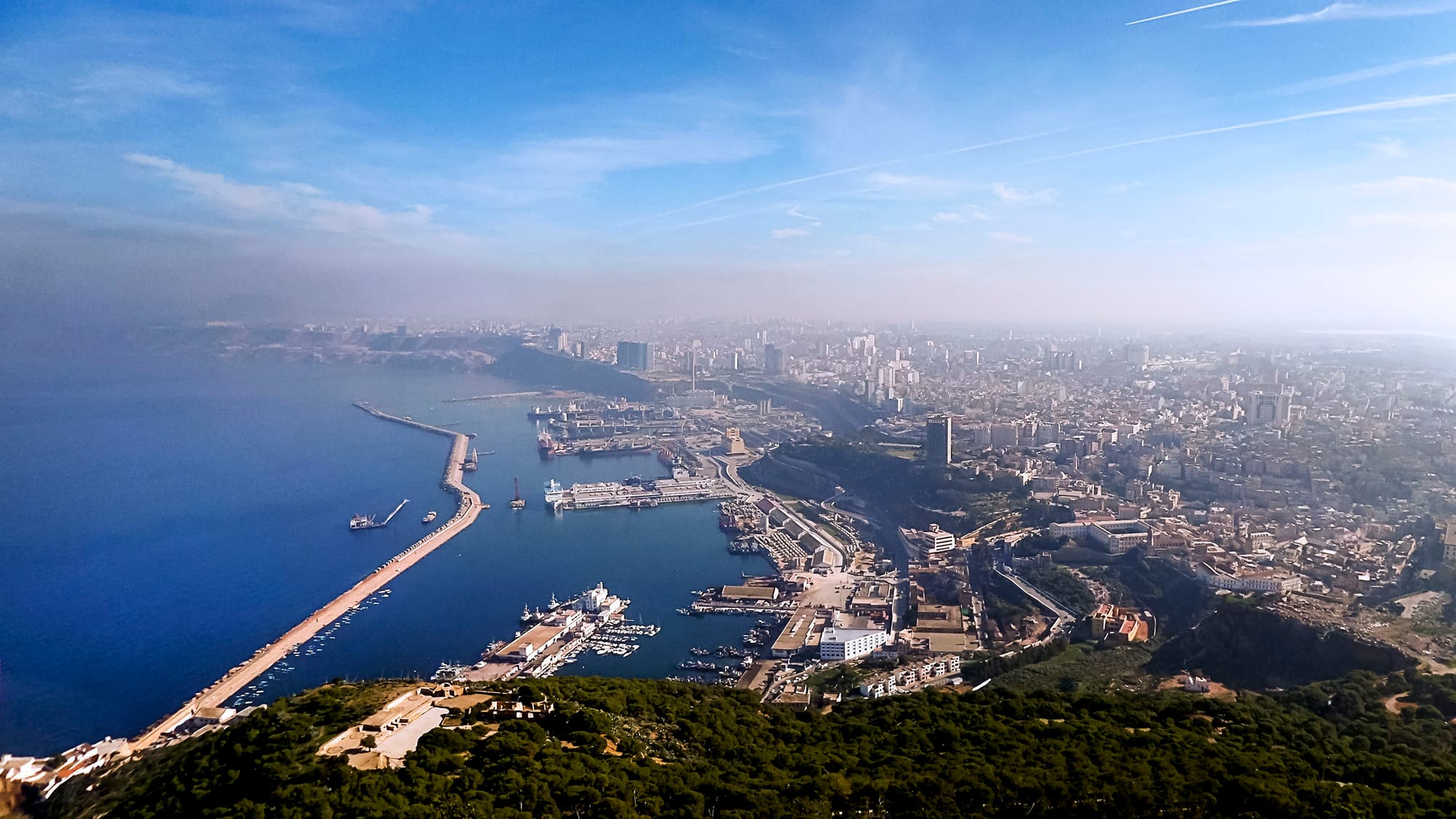
Aerial view over pine trees to the port of Oran, its long breakwater and the city spreading along the bay under light haze

Algeria

Oran & the West

The port and city of Oran seen from the wooded slopes of Mount Murdjajo. (habib kaki / Wikimedia Commons · CC BY 3.0)

Western Algeria from the Moroccan border to the Chélif valley, centred on the port city of Oran and the old royal capital of Tlemcen, with the coast of Mostaganem and Aïn Témouchent, the wine and grain country of Mascara and Sidi Bel Abbès, and the high Tiaret plateau inland — the home of raï music.

Explore Oran & the West

History

The west has Roman traces, but its great age began with Islam. Tiaret, as Tahert, was the capital of the Ibadi Rustamid state from the 8th century until the Fatimids took it in 909, and around it stand the Djeddars, stepped Berber funerary monuments of late antiquity. Tlemcen grew from Roman Pomaria and the Almoravid town of Tagrart; from 1236 it was the capital of the Zayyanid (Abd al-Wadid) kingdom, a centre of learning and trans-Saharan trade. The rival Marinids of Fez besieged it around 1300 and built a whole town, Mansourah, beside it. Ibn Khaldun began his Muqaddimah in the 1370s at Qal'at Ibn Salama, near Frenda in Tiaret province.

Oran was founded in 903 by Andalusian merchants. Spain took it in 1509 and held it, with an interruption, until 1792, after an earthquake had wrecked the city; it then became the seat of the Regency's western beylik, whose beys had earlier ruled from Mascara.

After the French landed in 1830, the west became the base of Emir Abdelkader, proclaimed near Mascara in 1832, who fought French forces for fifteen years before surrendering in 1847. Colonial Oranie then became a region of heavy European settlement — many settlers were Spanish — with vineyards, and Sidi Bel Abbès was the headquarters of the French Foreign Legion until 1962. In 1940 the British attacked the French fleet at Mers el-Kébir. Oran was the scene of violence and a mass departure of Europeans at independence in 1962, and Chlef, then Orléansville and later El Asnam, was devastated by earthquakes in 1954 and 1980.

Culture & Customs

The Oranie has its own accent of Algerian Arabic, full of Spanish and French words, and a reputation for a relaxed, outgoing temperament compared with the more reserved east. Its signature is raï, which grew from the rural sung poetry of the plateaus and the cabarets of Oran and Sidi Bel Abbès into a global popular music; Cheikha Rimitti, Cheb Khaled and Cheb Hasni are its best-known names, and raï was added to UNESCO's intangible heritage lists in 2022.

Tlemcen is the region's conservative, cultured counterweight. It is a stronghold of Andalusian classical music in the gharnati style, of Sufi brotherhoods and of fine crafts such as embroidery and carpet weaving, and its wedding traditions, including the gold-embroidered chedda costume, are listed by UNESCO as intangible heritage. The city is proud of its scholarly past and its family names that trace back to Muslim Spain.

Across the countryside, the zaouïas of Sufi saints hold annual gatherings called waadas, with horsemen, music and shared meals, and the plateaus around Tiaret, Mascara and Saïda are horse country, with the national stud at Chaouchaoua, and fantasia displays of charging riders firing powder rifles are staged at festivals. Mostaganem hosts a festival of amateur theatre.

Daily Life

Oran is Algeria's second city, with a population of well over half a million and more in the surrounding towns, spread from the old Spanish quarter of Sidi El Houari to French boulevards and new districts to the east. Its port, the nearby petrochemical complex at Arzew, universities and a busy service sector make it the west's economic centre. Tlemcen, Sidi Bel Abbès, Chlef, Mostaganem, Mascara, Relizane and Tiaret are all substantial provincial towns.

Away from the coast, life follows agriculture: cereals and sheep on the Tiaret, Tissemsilt and Saïda plateaus, citrus and vegetables in the Chélif valley and on the Mostaganem plateau, and olives and fruit around Tlemcen and Mascara. Much of the colonial vineyard was uprooted after independence, but some wine is still made here.

Oran's evenings run late, with families on the seafront Front de Mer and packed beaches in summer, and weddings are loud, long and full of raï. The closure of the border with Morocco since 1994 has shaped the far west, cutting families apart and fuelling smuggling around Maghnia. Unemployment and emigration towards Spain are persistent concerns for the young.

Food

The west's cooking mixes Algerian staples with Andalusian, Spanish and Jewish influences. Oran's great street food is karantika, a baked chickpea-flour flan cut in squares, dusted with cumin and often eaten in a baguette, a dish tied by tradition to the Spanish period. Sardines, grilled or stuffed and fried, are everyday coastal food, and Oran's restaurants serve paella-like rice with seafood and grilled fish from Arzew and Béni Saf.

Tlemcen has a refined kitchen of slow-cooked stews and pastries. Its tables include lamb tajines with prunes or quince, couscous of many kinds, and harira, a lentil and chickpea soup that is more common here than in eastern Algeria. The city's pastry shops make almond sweets and griwech, and mint tea is taken seriously.

On the plateaus, sheep farming gives mutton for méchoui, and wheat for bread and couscous. Mascara's hills have long been known for wine, and the Coteaux de Mascara and Coteaux de Tlemcen are among Algeria's best-known wine names, though most local people do not drink it.

Attractions & Natural Wonders

Oran is the region's hub. The Santa Cruz fort and chapel on Mount Murdjajo give the classic view over the bay, and below them lie the old Sidi El Houari quarter with its Spanish-era walls and the Pasha's mosque, the cathedral of the Sacred Heart now used as a library, the French-era centre around the Place du 1er Novembre and the seafront promenade. Beyond the city, the naval base of Mers el-Kébir sits on the western bay and resort beaches stretch towards Aïn el Turk.

Tlemcen has the richest monuments of the west: the Almoravid Great Mosque, the Mechouar palace of the Zayyanid sultans, the shrine complex of Sidi Boumediene at El Eubbad and, just outside town, the ruined walls and minaret of Mansourah. The El Ourit waterfalls and the Tlemcen national park lie in the hills nearby.

Along the western coast, Mostaganem has its old Tigditt quarter and long beaches, and Aïn Témouchent's coast offers cliffs, the fishing port of Béni Saf and Rachgoun island. Inland, Mascara keeps the memory of Emir Abdelkader in its mosques and monuments, and Sidi Bel Abbès has its colonial grid. The Tiaret plateau holds the Chaouchaoua horse stud, the ruins of old Tahert and, near Frenda, the Djeddars and the old caves of Taoughazout.

Cities in Oran & the West

Planning basics

Budget

The west costs slightly less than Algiers. Oran has the widest choice of hotels, busiest in summer and during events, while Tlemcen, Mostaganem, Mascara and Tiaret are cheaper and quieter. Street food, trams, trains and shared taxis are all inexpensive, and cash rules everywhere.

Daily Budget Midrange
USD 90–190 (mid-range hotel in Oran or Tlemcen, seafood dinners, taxis or a driver for day trips)
Daily Budget Shoestring
USD 35–60 (simple hotel, karantika and café meals, trains, trams and shared taxis)

Oran's seafront hotels fill in July and August; Tlemcen makes a calmer and cheaper base for the far west.

Safety

The west is one of the calmer parts of Algeria. Oran has normal big-city petty crime, especially around the seafront and markets at night. The border zone with Morocco is closed and watched, with smuggling and a heavy security presence, and police checkpoints are common on inland roads.

Keep away from the closed Moroccan frontier, carry identification at checkpoints, and avoid photographing military sites around Mers el-Kébir. Check current official travel advice before travelling.

Climate

The coast is Mediterranean but drier than central Algeria, with hot summers and mild winters; Oran gets much less rain than Algiers. Inland the land climbs to the Tlemcen mountains and the Tiaret and Saïda plateaus, which are cold in winter, occasionally snowy, and hot and dry in summer.

Summer
hot and dry, around 28–33°C on the coast; hotter on the Chélif plain and the plateaus
Winter
mild on the coast, 8–17°C; cold nights and some snow around Tlemcen and Tiaret

Transportation

Oran has an international airport, a tram and the terminus of the main line from Algiers. Trams also run in Sidi Bel Abbès and Mostaganem, and the East–West Highway links Oran, Sidi Bel Abbès, Tlemcen and Chlef. Coaches and shared taxis reach Mascara, Tiaret and Saïda. The land border with Morocco is closed.

Oran to Tlemcen takes about two hours by road; do not plan an overland crossing into Morocco.

Best Time to Visit

March to June and September to November suit Oran, Tlemcen and the countryside, with green hills in spring and pleasant sea temperatures in early autumn. July and August are the beach season, busy and hot, and Tiaret and the plateaus are best avoided in the depths of winter.