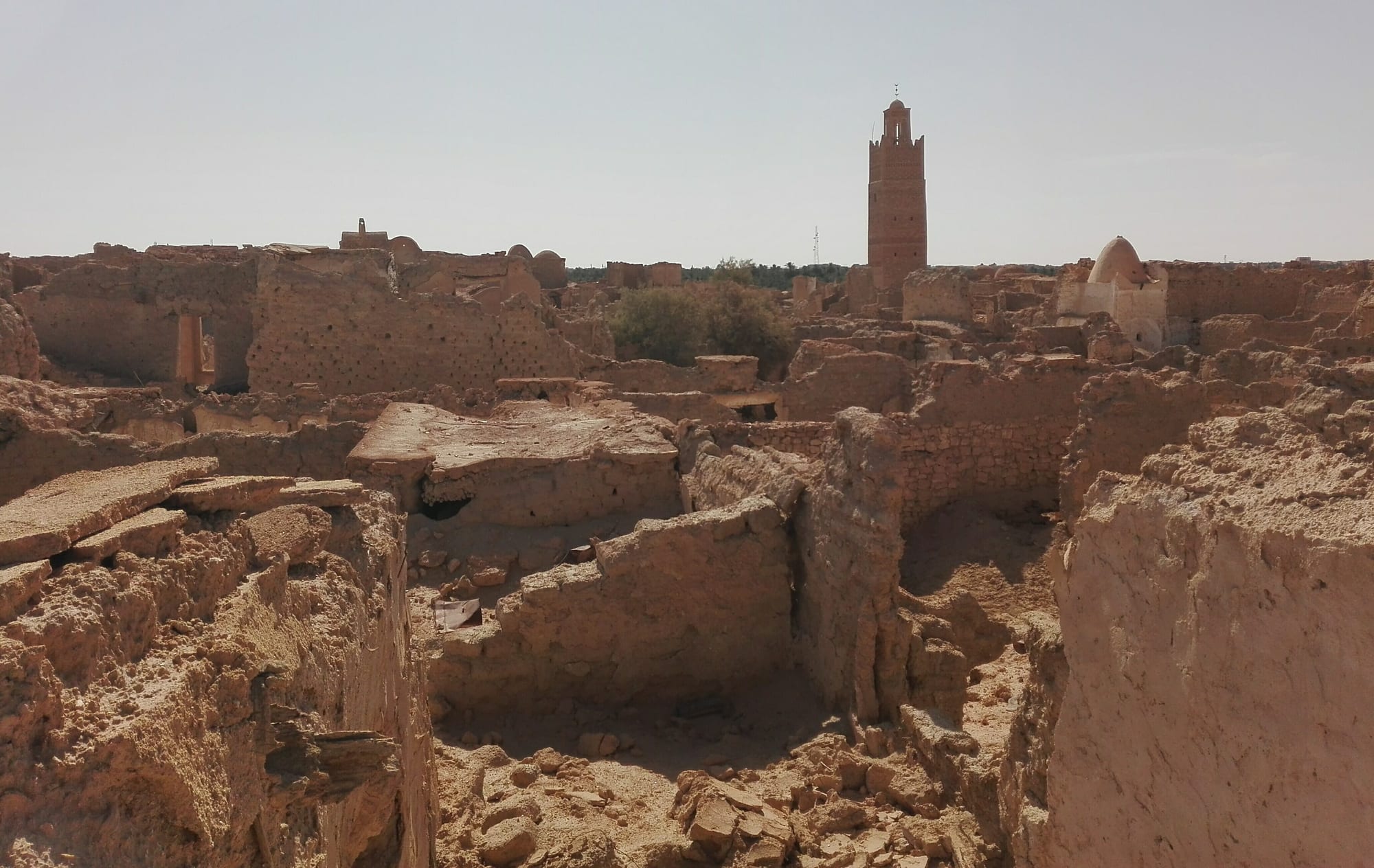
Crumbling mud-brick walls and roofless houses of an old desert village, with a tall brick minaret and a white dome rising behind under a hazy sky

Algeria

The M'zab, the Grand Erg & the Southeast Sahara

The ruins of the old ksar of Temacine, near Touggourt, with its minaret rising above the mud-brick houses. (Riad Hadjsadok / Wikimedia Commons · CC BY-SA 4.0)

The eastern half of the Algerian Sahara, from the Ibadi towns of the M'zab valley and the domed oases of the Souf beside the Grand Erg Oriental to the oil fields of Ouargla and, far to the south, the Tuareg country of the Tassili n'Ajjer and the Hoggar mountains around Djanet and Tamanrasset, up to the borders with Libya and Niger.

Explore The M'zab, the Grand Erg & the Southeast Sahara

History

The Sahara here was once green. The paintings and engravings of the Tassili n'Ajjer record thousands of years of changing life, from wild animals and hunters to cattle herders and, later, horses and camels, as the land dried. The Tuareg of the Ahaggar trace their descent to Tin Hinan, a founding queen whose tomb, probably of the 4th century, lies at Abalessa, west of Tamanrasset.

Islam and trade came along the caravan routes. After the fall of the Rustamid capital Tahert in 909, Ibadi refugees settled at Sedrata near Ouargla and later in the M'zab, where five fortified towns were founded between the 11th and 14th centuries, from El Atteuf to Beni Isguen. Ouargla and Touggourt became oasis capitals trading gold, slaves, salt and dates, and the Tuareg confederations of the Kel Ahaggar and Kel Ajjer controlled the desert beyond.

French forces reached the M'zab in the 1850s and annexed it in 1882, and the Tuareg of the Hoggar resisted French rule. The priest Charles de Foucauld lived among them at Tamanrasset and Assekrem until he was killed in 1916. In 1956 oil was found at Hassi Messaoud, near Ouargla, and the Sahara's wealth became a question in the independence negotiations; since 1962 oil and gas have been the backbone of the Algerian state. In 2013 an armed group attacked the In Amenas gas plant, and dozens of hostages died.

Culture & Customs

The M'zab is home to the Mozabites, Ibadi Muslims who speak their own Berber language, Tumzabt, and run their towns through councils of religious scholars. Their towns are famously strict and orderly: houses of equal height set in rings around the mosque, and councils that rule even on dress and celebrations. Relations with the Arabic-speaking Chaamba, who live alongside them, have been tense at times, most recently in 2015.

In the Souf, around El Oued, the people are Arabic-speaking and known for trade and poetry, and the white domes of their houses reflect the heat. The Oued Righ oases around Touggourt are home to Sufi zaouïas, notably the Tijani centre at Temacine.

The deep south is Tuareg country. Tuareg men wear the indigo or white veil, the tagelmust, and Tamahaq is written in the Tifinagh script. Women hold high status and are the traditional players of the imzad, a one-stringed fiddle whose music is recognised by UNESCO as intangible heritage. In Djanet, the Sebeïba ceremony at Ashura, in which two quarters of the oasis compete in dance and song, is also on UNESCO's list. Tea, brewed three times at length, is the essential ritual of hospitality.

Daily Life

Ghardaïa, Ouargla, El Oued and Touggourt are the main cities, while Tamanrasset, with around 100,000 people, is the capital of the far south. Djanet, Illizi, In Salah and In Guezzam are small, isolated towns.

Oil and gas define the economy: Hassi Messaoud, in Ouargla province, is Algeria's leading oil town and a company town of workers on rotation, and gas fields lie around In Amenas and In Salah, where Algeria's first shale-gas drilling was launched at the end of 2014. The oases grow dates, and the Souf has turned sand into farmland. Ghardaïa is a busy trading town known for its merchants and carpets.

Tamanrasset is a crossroads on the trans-Saharan road, where Algerians, Tuareg and migrants from West Africa meet, and cross-border trade with Niger and Mali is part of life. In the heat, life begins early and pauses through the afternoon. Water supply, youth unemployment and a sense of distance from Algiers are recurring issues, and southern towns have held protests over jobs in the oil industry.

Food

Dates are the region's staple and pride: Deglet Nour from the Souf and the Oued Righ are among the best in the world, and dozens of other varieties are eaten fresh, dried or pressed into paste. In the M'zab, family cooking centres on couscous, often made with barley or with dates, and on hearty stews and flatbreads baked at home.

The Souf around El Oued has its own dishes based on semolina, dates and lamb, and its bakeries turn out large rounds of flatbread. Across the northern oases, chorba and mutton stews are everyday food, and camel meat is sold in the markets.

The Tuareg cook simply in the desert. Taguella is a thick flatbread baked directly in hot sand under the embers of a fire, then broken into pieces and served with a tomato and meat sauce. Dried meat, goat's cheese, milk and millet porridges belong to the nomadic diet. Green tea brewed with sugar and mint is poured three times from a height, the first glass said to be bitter like life, the second strong like love and the third soothing like death.

Attractions & Natural Wonders

The M'zab valley towns of Ghardaïa are the heart of the north: Ghardaïa's market square and hilltop mosque, Beni Isguen's walled town and auction market, El Atteuf, Bounoura and Melika, with palm groves along the wadi. El Meniaa, to the south, has a large palm grove and the parish church beside which Charles de Foucauld is buried.

The Souf oases of El Oued lie among the dunes of the Grand Erg Oriental, with domed houses and palm trees planted in hollows dug into the sand, the ghout. Ouargla has its old ksar and palm groves, Touggourt the zaouïa and lake at Temacine, and the region around Hassi Messaoud is closed oil country.

In the far south, the Tassili n'Ajjer rock art near Djanet — the painted figures of Sefar among sandstone forests — is reached on foot or by 4x4 with a guide, along with the red dunes of the Tadrart. The Hoggar mountains above Tamanrasset rise in basalt peaks around Assekrem, where de Foucauld's hermitage looks out over a volcanic landscape; Mount Tahat, Algeria's highest peak, stands nearby. The tomb of Tin Hinan at Abalessa and the Arak gorge lie on the routes around Tamanrasset.

Cities in The M'zab, the Grand Erg & the Southeast Sahara

Planning basics

Budget

The northern oases — Ghardaïa, El Oued, Ouargla, Touggourt — are priced like provincial Algeria, but hotels are few. The deep south is a different matter: visits to the Tassili and the Hoggar are made through licensed agencies with 4x4s, guides, cooks and permits, and flights to Djanet and Tamanrasset add a large cost.

Daily Budget Midrange
USD 150–300 in the deep south, mostly the daily rate of a licensed agency tour with camping and 4x4
Daily Budget Shoestring
USD 35–60 in the northern oases (basic hotel, café food, coaches)

In Ghardaïa, consider hiring a local guide for Beni Isguen; in the deep south, compare agencies well before the winter season.

Safety

The northern oases are generally calm, though Ghardaïa saw serious communal clashes in 2015. The deep south is more sensitive: most governments advise against travel near the borders with Libya, Niger and Mali, citing terrorism, kidnapping and smuggling, and the 2013 attack on the In Amenas gas plant took place here. Djanet and Tamanrasset are visited on licensed agency tours, sometimes with police escorts.

Travel only with a licensed agency in the deep south, carry permits and the passport at all times, and never approach the border areas or oil installations. Check current official travel advice before travelling.

Climate

This is full Sahara. The northern oases have scorching summers and mild winters with cold nights; the Grand Erg Oriental is extremely hot from May to September. In the south, the Tassili and Hoggar are high enough to be cooler, with cold nights and occasional frost at Assekrem in winter, though the lowlands around them are still very hot in summer.

Summer
extreme heat, often 40–45°C or more in the oases and ergs; slightly cooler in the Hoggar
Winter
mild days of 18–25°C, cold nights near freezing, and frost on the high plateaus

Transportation

Ghardaïa, El Oued, Ouargla, Touggourt, Djanet, Illizi, In Salah and Tamanrasset have airports, and flying is the practical way to reach the deep south. National Road 1, the trans-Saharan highway, runs from Ghardaïa through In Salah to Tamanrasset and on to In Guezzam, and coaches serve the northern oases. Travel beyond the towns is by agency 4x4 with permits.

Algiers to Ghardaïa takes about an hour by air or eight hours by road; arrange deep-south permits through the agency before arriving.

Best Time to Visit

November to February is the season for the Tassili, the Hoggar and the desert crossings, with clear skies and comfortable days; October and March are also possible. Ghardaïa and El Oued suit the same months. Summer is dangerously hot, and most agencies do not run desert trips. The Sebeïba festival in Djanet falls at Ashura in the Islamic calendar.