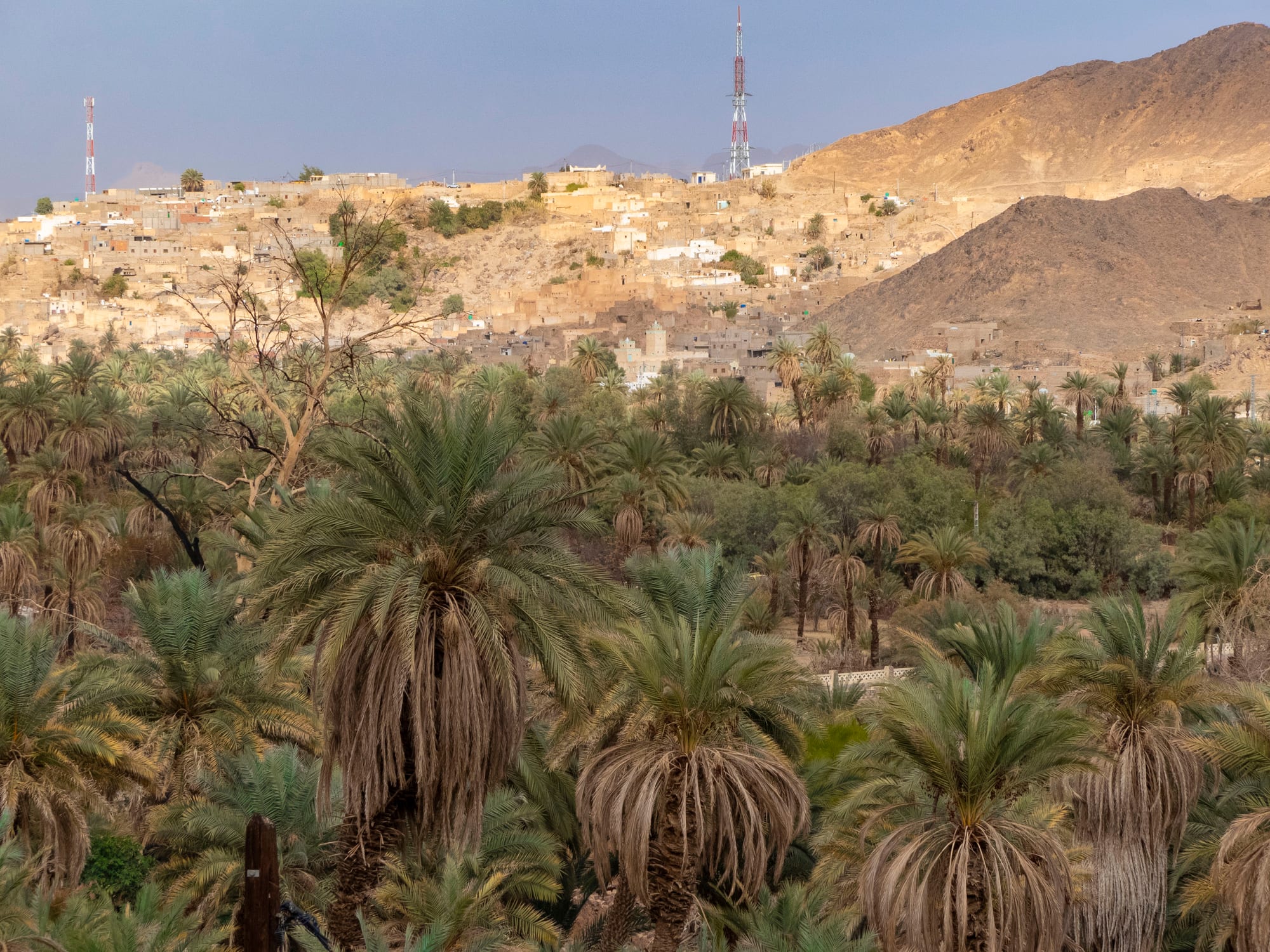
A dense palm grove filling the foreground with a hillside village of sand-coloured houses rising behind it below bare rocky slopes

The M'zab, the Grand Erg & the Southeast Sahara, Algeria

Djanet

The ksar of El Mihan above the palm grove at Djanet, seen from the neighbouring ksar of Adjahil. (Camille Gillet / Wikimedia Commons · CC BY-SA 4.0)

An oasis town in Algeria's far south-east, close to the Libyan border, built as a group of old ksour on the slopes above a long palm grove. It is the gateway to the Tassili n'Ajjer, the sandstone plateau whose prehistoric paintings and engravings made the Sahara's green past visible, and the home of the Sebiba, a Tuareg ceremony recognised by UNESCO.

Neighbourhoods

  • The old ksour on the slopes
    • Historic district
    • Viewpoints

    Djanet's old quarters — El Mihan, Adjahil and Azelouaz among them — stand on rock spurs above the palm grove, their stone and mud houses stacked in terraces. Parts are ruined and parts restored, and the lanes give long views over the oasis.

    Open in Maps
  • The town centre
    • First-time visitors
    • Shops and agencies

    The low modern streets along the main road, with the market, shops, small hotels, guesthouses and the travel agencies that organise trips into the Tassili. Almost every practical arrangement in Djanet is made here.

    Open in Maps
  • The palm grove
    • Gardens
    • Quiet and residential

    A long ribbon of date palms, fruit trees and small gardens fed by springs and wells along the valley floor, walled into family plots and cool in the middle of the day.

    Open in Maps
  • The airport road and the desert edge
    • Quiet and residential
    • Desert scenery

    Newer houses, workshops and camps spread out along the airport road, where the town ends abruptly in stone desert and dunes. This is where most 4x4 convoys assemble before heading out.

    Open in Maps

Things to do

The old town and the oasis

  • Ksar El Mihanlandmark

    The best-known of Djanet's three old quarters, a terraced village of stone and mud houses on a spur above the palm grove, partly restored and partly in ruins.

    Open in Maps
  • Ksar Adjahillandmark

    An old quarter facing El Mihan across the valley, with a viewpoint over the oasis and the surrounding rock walls.

    Open in Maps
  • The palm grove and gardenspark

    Walled plots of dates, figs and vegetables watered from springs along the valley, still worked by Djanet families and the coolest place in the town.

    Open in Maps

The Tassili n'Ajjer

  • Tassili n'Ajjerlandmark

    A sandstone plateau of eroded rock forests and canyons holding thousands of prehistoric paintings and engravings, a UNESCO World Heritage Site since 1982.

    Open in Maps
  • Sefarlandmark

    A rock-art site in a maze of sandstone towers on the plateau, its shelters holding painted human and animal figures, among them the very large figure that made the site famous.

    Open in Maps
  • Jabbarenlandmark

    Another painted site on the Tassili plateau, among those recorded by Henri Lhote's expedition, known for the scale of some of its human figures.

    Open in Maps
  • Tadrart Rougeattraction

    A landscape of red dunes, rock arches and sandstone towers south of Djanet towards the Libyan border, with its own engravings and painted shelters.

    Open in Maps

Practicalities

  • Djanet Inedbirene Airporttransit hub

    The airport about 30 km south of the town, the way nearly all visitors arrive, with flights from Algiers.

    Open in Maps

Seasonal events

  • SebibaAshura, which moves through the year with the Islamic calendar

    A Tuareg ceremony in which two quarters of the oasis, Azelouaz and El Mihan, meet in a day of drumming, singing and measured dancing in costume; UNESCO recognised it as intangible cultural heritage in 2014.

Eat and drink

Long-standing places and food districts in Djanet. Hours, ratings and directions come from your maps app, always current.

Djanet classics

  • Taguella in the campsrestaurant

    The Tuareg flatbread baked in hot sand under the embers of a fire, broken up and eaten with a sauce of meat, tomato and onion, is the standard meal on desert trips from the town.

    Open in Maps
  • Small restaurants in the centrerestaurant

    Plain kitchens along the main street serving couscous, chorba, grilled meat and rice dishes, and the guesthouses that cook for their guests.

    Open in Maps

Market and tea

  • The Djanet marketmarket

    A small market for dates from the oasis, goat and camel meat, and the vegetables, flour, tea and sugar brought in by lorry from the north.

    Open in Maps
  • Tea stalls and terracescafe

    Green tea brewed over charcoal and poured three times is the social ritual of the town, taken at shopfronts and in guesthouse courtyards after dark.

    Open in Maps

Experience Djanet

History

The record of human life around Djanet is far older than the town. On the Tassili n'Ajjer plateau above it, thousands of paintings and engravings show wild animals and hunters, then herds of cattle, then horses and chariots and finally camels — a sequence that tracks the drying of a Sahara that was once grassland with lakes and rivers. Later the oasis lay in the country of the Kel Ajjer, one of the Tuareg confederations, who grazed the plateau, held the wells and taxed the caravan traffic crossing between the Niger, the Fezzan and the north.

The oasis itself grew as separate ksour on defensible spurs above the palm grove — El Mihan, Adjahil and Azelouaz among them — each with its own community, gardens and water rights. Ottoman and then Italian authority in Libya and French expansion from the west made the Ajjer a contested frontier. French troops under Captain Charlet occupied Djanet in November 1911 and built Fort Charlet, which was besieged in 1916 by a force gathered at Ghat during the First World War.

Modern attention to the rock art began in the 20th century, above all with the expeditions of Henri Lhote in the 1950s, whose copies and books made the Tassili famous internationally; the plateau was inscribed by UNESCO in 1982. Since independence Djanet has become the capital of Djanet Province, with an airport and a tourism season built on the plateau and the dunes, interrupted by long periods when travel to the region was restricted.

Culture & Customs

Djanet is a Tuareg town, and the Kel Ajjer traditions are visible in daily life: the tagelmust worn by men, the Tamahaq language, the Tifinagh script used for inscriptions and short messages, and a social order in which descent and inheritance run in important respects through the mother's line. Women are the traditional players of the imzad, the single-stringed fiddle that accompanies sung poetry at evening gatherings.

The town's own ceremony is the Sebiba, held at Ashura. The two old quarters of the oasis meet on open ground: men in the costume made for the occasion perform a slow, measured dance while women drum and sing in answering lines, in a ritual generally explained as the replacement of an old rivalry between the quarters by a contest in music and bearing. UNESCO recognised it in 2014, and it draws families back to Djanet from across the country.

Hospitality is formal and unhurried, and tea is its instrument, brewed three times over charcoal and poured from a height. Craft here means leatherwork, silver, and mats and baskets of palm fibre. Guiding is itself now part of the local culture: many families have someone who works the plateau and knows the shelters, the routes and the water, and there is a strong local insistence that the paintings are left untouched.

Daily Life

Djanet is a small place — about 15,000 people were counted at the 2008 census, up from some 9,700 in 1998 — set far from any large city and not far from the Libyan border. That distance governs everything. Flour, vegetables, fuel and building materials arrive by lorry or by air, prices are high, and shortages are part of ordinary planning.

The oasis gardens still produce dates, figs and vegetables under family ownership worked out over generations, and goats and camels are kept in the valleys around. Beyond that, work is with the province's administration, schools and clinic, with the army and border security, or in tourism: agencies, drivers, cooks, guides and guesthouses, which between them support a large share of the town in the winter months and very little for the rest of the year.

The day divides around the heat, with business early and late and a long quiet middle, and evening life takes place outside on terraces and around tea stalls. A strong seasonal rhythm runs through the town: preparations and arrivals from autumn, the busy season through winter, then a hot and near-empty summer. Water, electricity, work for young people and the town's dependence on a single airport are the recurring concerns, and the Sebiba is the fixed point of the year that brings the community together.

Food

Cooking in Djanet combines the Algerian everyday — couscous with mutton or goat, chorba, stews with tomato and chickpeas, bread with everything — and the Tuareg food of the desert journey. Goat and camel meat are the usual meats, vegetables come in by lorry, and dates from the oasis gardens are eaten at every hour and offered to guests as a matter of course.

Taguella is the dish visitors remember. A stiff dough of wheat or millet flour is shaped into a disc and buried in hot sand beneath the embers of a fire; when it is cooked the bread is dug out, beaten clean, torn into pieces and soaked in a sauce of meat, onion and tomato, then eaten from a shared dish. Around it sit the other foods of the nomadic Sahara: dried salted meat, goat's cheese, milk, and eghajira, a pounded drink of millet, dates and cheese made for celebrations.

Tea is not a drink here so much as a sequence. Green tea is boiled with a lot of sugar, sometimes with mint, and poured three times from a height into small glasses, each round different in strength, a process that can take an hour and is the frame for most conversation in the town. Alcohol has no place in public life, and water — carried, rationed and shared on desert trips — is treated with a seriousness that visitors quickly learn.

Planning tools

Budget

Djanet is a small town with few hotels and guesthouses, and staying in it costs little. The real expense is the desert: trips into the Tassili and the Tadrart are organised by licensed agencies with guides, cooks, 4x4s, camels and permits, charged by the day, and the flight from Algiers adds a further large sum.

Daily Budget Midrange
USD 150–300 in the deep south, mostly the daily rate of a licensed agency tour with camping and 4x4
Daily Budget Shoestring
USD 35–60 (guesthouse room in town, market and café food)

Book with an agency well before the winter season, check exactly what the daily rate covers, and bring cash in clean euro notes.

Best Time to Visit

November to February, the season for the plateau and the dunes, with clear skies, warm days and cold nights; October and March are also possible. The Sebiba falls at Ashura and moves through the year with the Islamic calendar. Summer is dangerously hot and most agencies do not run trips.

Suggested Number of Days

The town and its ksour take a day or two. Trips onto the Tassili plateau or into the Tadrart run for several days at a time and set the length of a visit; the agency's route and the walking involved decide the rest.

First Visit
1–2 days
With Surroundings
6–10 days

Transportation

Djanet is small enough to walk or cross by taxi, and the palm grove and the ksour are close together. Everything beyond the town is done by agency 4x4 with a driver and guide, with the climb onto the Tassili plateau made on foot with donkeys or camels carrying the camp.

Arrange permits and vehicles through the agency before arriving, carry a passport for the checkpoints, and expect convoys and sometimes an escort on desert routes.

Airport & Station Connections

Djanet Inedbirene Airport, about 30 km south of the town, has flights from Algiers, and that is how almost everyone arrives; the overland routes across the Sahara are enormous and controlled. Travellers on a tour with an approved Algerian agency can obtain a visa on arrival for itineraries in the southern provinces, which include Djanet.

Walkability

The centre is flat and everything in it is within a few minutes' walk, and the palm grove paths are easy going. The old ksour are steep, with rough steps and uneven stone lanes. Out in the Tassili the walking is serious: loose sand, rock scrambles and long days at altitude on the plateau.

Safety

Djanet itself is a quiet town with a strong security presence, and visitors are received with courtesy. The setting is sensitive: the Libyan and Niger borders are close, desert travel is controlled through licensed agencies, permits and sometimes police escorts, and routes can change at short notice. Heat, dehydration, cold nights and vehicle breakdowns far from help are the practical dangers.

Travel outside the town only with a licensed agency, carry permits and a passport, keep away from the border areas entirely, and touch nothing at the rock-art sites. Most governments advise against all travel to the border regions with Mali, Niger, Libya, and Mauritania, and to parts of the Saharan interior, citing terrorism and kidnapping risk. Check current official travel advice before travelling.

Climate

Saharan and very dry, with strong sun, a wide daily temperature range and rain that may not fall for years at a time. The plateau above the town is higher and noticeably colder at night than the oasis, and winter nights out there can drop below freezing.

Summer
extreme heat, often above 40°C from May to September, with hot nights
Winter
warm days of 20–25°C and cold nights, near or below freezing on the plateau

Local Customs

Djanet is a Tuareg oasis and custom here is Tuareg: men wear the tagelmust wound round head and face, Tamahaq is spoken alongside Arabic, and women hold a strong social position and play the imzad fiddle. Tea is offered at every meeting and poured three times; refusing it, or drinking it quickly, is discourteous. Modest dress is expected of visitors.

Ask before photographing people, especially during the Sebiba; never touch or wet rock paintings and engravings, or take stones, fossils or artefacts; follow the guide on where it is permitted to camp and walk.

Common Payment Methods

The currency is the Algerian dinar and everything is paid in cash. Foreign cards are effectively unusable and ATMs that accept them are scarce, so money is changed before arriving in the south. Agency trips are commonly paid in cash or settled in advance.