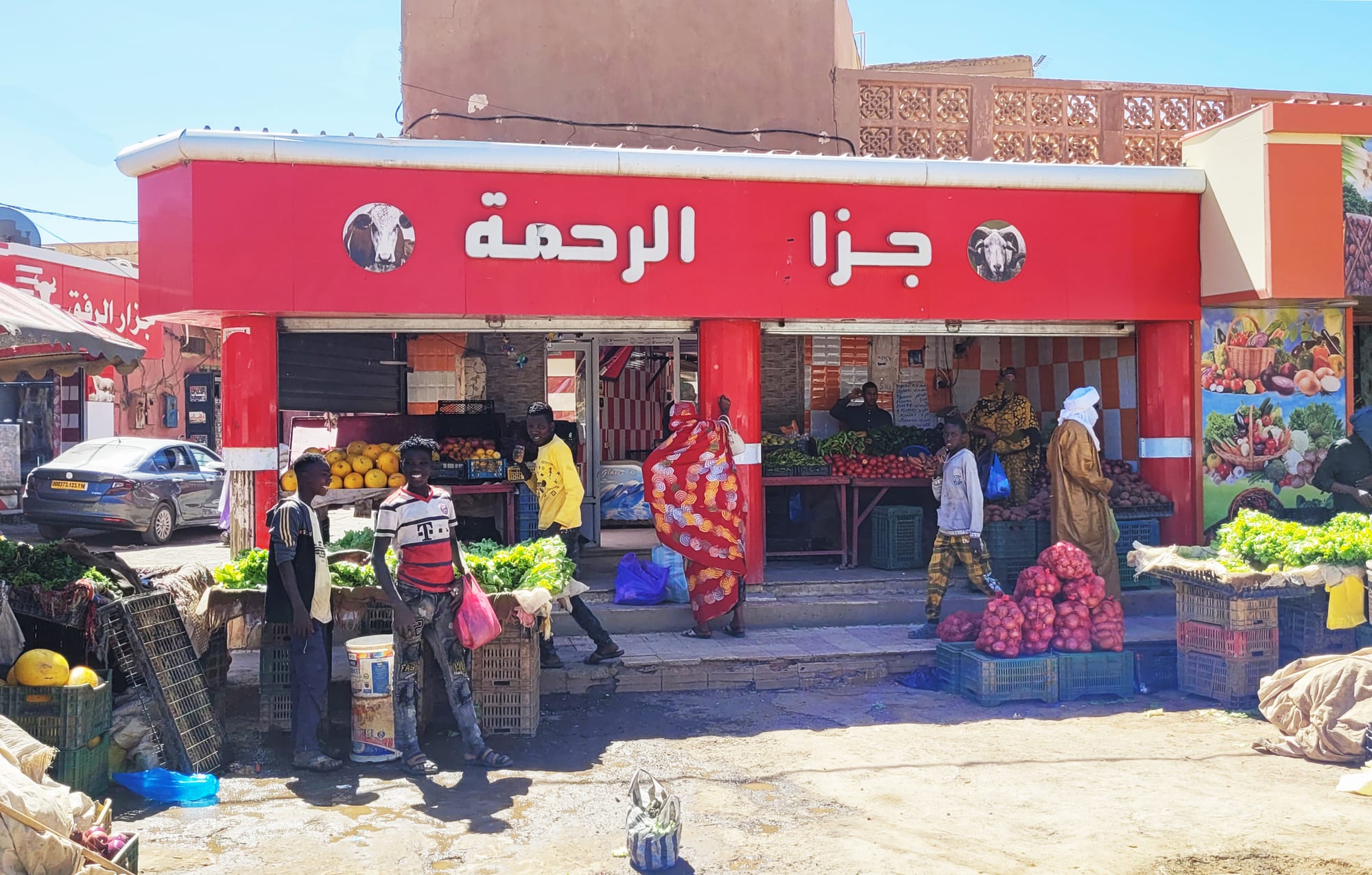
A red-painted butcher's shopfront with Arabic lettering on a sunlit street, crates of onions and greens stacked on the ground in front

The M'zab, the Grand Erg & the Southeast Sahara, Algeria

Tamanrasset

Shops and produce stalls at the market in Tamanrasset. (Bernard Gagnon / Wikimedia Commons · CC BY 4.0)

The chief town of the Algerian Tuareg, set at about 1,320 metres on the southern edge of the Hoggar mountains. It began as a small oasis and a French military post on the trans-Saharan routes, grew around the memory of Charles de Foucauld, who lived and died here, and is now a provincial capital, a market for the deep south and the base for journeys into the volcanic peaks around Assekrem.

Neighbourhoods

  • The centre and the main avenue
    • First-time visitors
    • Shops and cafés

    A few straight streets of low red-earth and concrete buildings holding the banks, travel agencies, hotels and cafés. Most arrangements for desert travel are made here, and the pavements are busiest in the early morning and after dark.

    Open in Maps
  • The market quarter
    • Markets
    • Best for food
    • Local life

    Covered halls and open stalls selling vegetables trucked from the north, dates, spices, meat and Tuareg silver and leather work. It is the meeting point of the town's Algerian, Tuareg and West African communities.

    Open in Maps
  • The old quarter and the bordj
    • Historic district
    • Quiet and residential

    Older blocks of mud-brick building near the French-built fort, with the small chapel and house associated with Charles de Foucauld nearby. The scale is low and the lanes are quiet away from the main road.

    Open in Maps
  • The oasis gardens and the outskirts
    • Gardens
    • Quiet and residential

    Walled plots of dates, figs, almonds, cereals and vegetables fed by wells along the wadi, with houses and small farms among them. Beyond them the town gives way at once to stone desert and the road north into the mountains.

    Open in Maps

Things to do

In the town

  • Museum of the Hoggarmuseum

    The town's museum of Tuareg life and of the Hoggar, with exhibits on dress, jewellery, tools, the imzad fiddle and the region's prehistory.

    Open in Maps
  • The marketmarket

    The commercial heart of the deep south, where produce brought a thousand kilometres by lorry is sold beside dates, camel meat, silver and leather work.

    Open in Maps
  • The bordj and the Foucauld siteslandmark

    The bordj, the fort Charles de Foucauld had established by 1915 on the edge of the town, and the simple house and chapel linked to the priest, who settled here in 1905 and was killed in December 1916.

    Open in Maps

The Hoggar mountains

  • Assekremviewpoint

    A high plateau in the Atakor volcanic field reached by a rough track, with Charles de Foucauld's stone hermitage on the ridge and a much-photographed view of basalt spires at sunrise.

    Open in Maps
  • Hoggar Mountainsattraction

    A highland region of eroded volcanic plugs, lava plateaus and deep valleys rising north of the town, protected within the Ahaggar Cultural Park.

    Open in Maps
  • Mount Tahatviewpoint

    The highest mountain in Algeria, in the Atakor massif north of Tamanrasset, climbed on foot from a camp in the surrounding valleys.

    Open in Maps

Short trips from the town

  • Abalessalandmark

    A village about 80 km west of the town beside the stone monument long identified as the tomb of Tin Hinan, the ancestral queen of the Tuareg of the Ahaggar, opened in 1925 and more thoroughly investigated in 1933.

    Open in Maps
  • Tamanrasset Airporttransit hub

    The airport about 7 km north-west of the town, the practical link to Algiers and the arrival point for almost all visitors to the Hoggar.

    Open in Maps

Eat and drink

Long-standing places and food districts in Tamanrasset. Hours, ratings and directions come from your maps app, always current.

Tamanrasset classics

  • Taguella in the desert campsrestaurant

    Taguella, the Tuareg flatbread baked in hot sand beneath a fire, then broken up and served with a meat and tomato sauce, is the standard meal on journeys into the Hoggar.

    Open in Maps
  • Grill-houses on the main streetrestaurant

    Small kitchens serving couscous, chorba, grilled mutton and goat, and the rice and sauce dishes brought north by West African residents.

    Open in Maps

Market and cafés

  • Tamanrasset marketmarket

    Dates, camel meat, spices, imported vegetables and the tea and sugar that go into the three rounds of Tuareg tea.

    Open in Maps
  • Tea houses and café terracescafe

    Places to sit over strong green tea or coffee in the cool of the evening, when the town's street life resumes after the heat of the day.

    Open in Maps

Experience Tamanrasset

History

Tamanrasset is young by the standards of Saharan towns. The Kel Ahaggar, the Tuareg confederation of the Hoggar, used the valley as grazing and garden land, and a small settlement grew at the oasis where the wadi allowed date palms and cereals to be raised. Trans-Saharan caravans passed through the massif carrying salt, dates, cloth and, historically, enslaved people between the Niger bend and the Mediterranean, and the Tuareg controlled the routes and the wells.

French columns reached the Hoggar at the beginning of the 20th century and the Tuareg resistance was broken after the fighting of 1902. A military post was established in the valley to watch the caravan roads, and in 1905 the French priest and former officer Charles de Foucauld settled here, learning Tamahaq, compiling a dictionary of the language and building a hermitage on the Assekrem plateau in 1911. He was killed at Tamanrasset on 1 December 1916. The bordj he had established by 1915 stands on the edge of town.

After independence in 1962 Tamanrasset became the capital of a province larger than most European countries, and grew from a village of a few thousand into a town of tens of thousands. The trans-Saharan highway reached it, an airport opened, and administration, the army and trade with Niger and Mali drew people from across Algeria and West Africa. Tourism to the Hoggar grew in the later twentieth century, fell away during the insecurity of later decades and returns in the winter months.

Culture & Customs

Tamanrasset is the cultural capital of the Algerian Tuareg. Tamahaq, the northern Tuareg language, is spoken here and written in the Tifinagh script, an alphabet still used for short messages and inscriptions on rock. Men wear the tagelmust, the long veil wound around head and face, more often indigo or white than any other colour, while women go unveiled, a reversal that has struck outsiders for centuries. Descent and inheritance in Tuareg society pass in important respects through the mother's line, and women hold high standing in the community.

Music belongs above all to the imzad, a single-stringed fiddle with a gourd body and horsehair string, played by women to accompany sung poetry at evening gatherings; the tende drum and the guitar-led desert blues of the wider Sahara are heard alongside it. Silverwork is the best-known craft, made in small family workshops, together with tooled leather and woven mats.

Hospitality follows a strict form. Tea is brewed three times over a small charcoal stove and poured from a height into small glasses, and the ceremony is unhurried by design. Beside the Tuareg majority the town holds Chaamba and northern Algerian families, and a large community from Niger, Mali and further south, so Hausa, Songhai and French are heard in the market as well.

Daily Life

About 93,000 people were counted in Tamanrasset at the 2008 census, up from some 73,000 in 1998, and it has kept growing, which makes it the largest town of the Algerian deep south. It sits at about 1,320 metres, high enough for the nights to be cool, and its distance from the coast — some 2,000 kilometres by road — shapes everything: fresh produce arrives by lorry from the north, and prices are higher than anywhere in the Tell.

The provincial administration, the army and the security services are major employers, along with trade, transport and building. The oasis gardens still grow dates, figs, almonds, cereals and vegetables, and herding continues in the valleys of the massif. Cross-border commerce with Niger and Mali is part of ordinary life, and the town is also a stage on the migration routes north, with a large and shifting population from West Africa living and working in it.

The day is split by the sun: business early, a long pause, and a second life from late afternoon until well into the night, when the market streets and tea stalls are busiest. Water, electricity supply, and jobs for young people are the recurring public complaints, as in other southern towns, and the winter season brings a modest flow of Algerian and foreign visitors heading for the mountains.

Food

Everyday eating in Tamanrasset is Algerian — couscous with mutton, chorba, stews with chickpeas and tomato, grilled meat and bread — with the difference that most of the ingredients have travelled a long way to get here. The market sets the town's rhythm of supply, and camel meat, sold from its own stalls, is common on the table.

The Tuareg contribution is the food of the desert journey. Taguella is a thick unleavened bread of wheat or millet flour cooked directly in hot sand under the embers of a fire, lifted out, dusted off and broken into pieces that are soaked in a sauce of meat, tomato and onion; it is the classic meal in camp and the one most visitors remember. Dried and salted meat, goat's cheese, dates and milk belong to the same tradition, as does eghajira, a pounded drink of millet, dates and goat's cheese made for celebrations.

Dates from the town's own gardens and from the oases to the north are eaten through the day, and figs and almonds ripen in the small walled plots. The drink that matters most is green tea, boiled with a great deal of sugar and sometimes mint and poured three times, each round stronger and sweeter than the last, the three glasses described in Tuareg and Saharan tradition as bitter like life, strong like love and gentle like death. Alcohol has no place in public life here.

Planning tools

Budget

Tamanrasset itself is inexpensive — a simple hotel, market food and taxis cost little. The expense is everything beyond it: travel into the Hoggar is made through licensed agencies with 4x4s, guides, cooks and permits, and the flight from the north is a substantial extra. Algeria runs largely on cash, and the gap between official and unofficial exchange rates changes the total.

Daily Budget Midrange
USD 150–300 in the deep south, mostly the daily rate of a licensed agency tour with camping and 4x4
Daily Budget Shoestring
USD 35–60 (basic hotel in town, market and café food, shared taxis)

Compare agencies well before the winter season, confirm what the daily rate covers, and bring clean euro notes to change.

Best Time to Visit

November to February, when days in the mountains are clear and comfortable and nights are cold, with frost possible at Assekrem. October and March also work. Summer is dangerously hot in the lowlands around the town and most agencies do not run desert trips then.

Suggested Number of Days

The town can be seen in a day or two. Journeys into the Hoggar are the point of coming, and they run to several days at a time; the length depends on the agency's route and on how far into the massif the trip goes.

First Visit
2 days
With Surroundings
5–7 days

Transportation

The town is small enough to cross on foot or by shared taxi, and pick-ups and lorries serve the surrounding villages. Everything beyond the town is done by agency 4x4 with a driver and guide, which is both the practical and the required way to travel, and permits are arranged in advance.

Confirm permits and the vehicle arrangements with the agency before arriving, carry a passport for the frequent checkpoints, and expect a police escort on some routes.

Airport & Station Connections

Tamanrasset has an airport with flights from Algiers, which is how nearly everyone arrives; the overland alternative is the trans-Saharan highway, National Road 1, which runs south from Ghardaïa through In Salah, a journey of days by coach. Travellers on a tour with an approved Algerian agency can obtain a visa on arrival for itineraries in the southern provinces, which include Tamanrasset.

Walkability

The centre is flat and compact, and the main street, the market and the agencies are all within a short walk of one another. The altitude of about 1,320 metres takes the edge off the heat, but the sun is strong, shade is limited and the outskirts are spread out, so a taxi is useful in the middle of the day.

Safety

Tamanrasset is a garrison and administrative town with a heavy security presence, and the town itself is generally calm. The surrounding region is sensitive: it lies within reach of the borders with Niger, Mali and Libya, and desert travel is controlled through licensed agencies, permits and sometimes police escorts. The natural hazards are heat, dehydration, cold nights in the mountains and breakdowns far from help.

Travel only with a licensed agency outside the town, carry permits and a passport at all times, and never approach the border areas or military installations. Most governments advise against all travel to the border regions with Mali, Niger, Libya, and Mauritania, and to parts of the Saharan interior, citing terrorism and kidnapping risk. Check current official travel advice before travelling.

Climate

Saharan, but tempered by altitude: hot days, cool to cold nights and almost no rain, with the mountains several degrees cooler than the town. Occasional storms bring brief, heavy downpours. The daily temperature swing is wide all year.

Summer
very hot, commonly around 35–40°C by day, with warm nights
Winter
mild days of 20–25°C, cold nights near freezing, and frost on the high plateaus such as Assekrem

Local Customs

This is the main town of the Algerian Tuareg, and Tuareg custom is visible in the street: men wear the tagelmust, the indigo or white veil wound round head and face, and Tamahaq is spoken alongside Arabic. Tuareg women hold a high social position and are the traditional players of the imzad fiddle. Tea is the ritual of hospitality, poured three times from a height, and it is impolite to refuse or to hurry it.

Ask before photographing people, especially veiled men and women; dress modestly; do not photograph checkpoints, soldiers or the airport; and follow the guide's instructions about where it is permitted to walk or camp.

Common Payment Methods

The currency is the Algerian dinar and payment here is in cash almost without exception. Foreign cards are rarely accepted and ATMs that take them are scarce, so travellers change euros or US dollars, usually before arriving in the south. Agency tours are commonly settled in cash or arranged in advance.