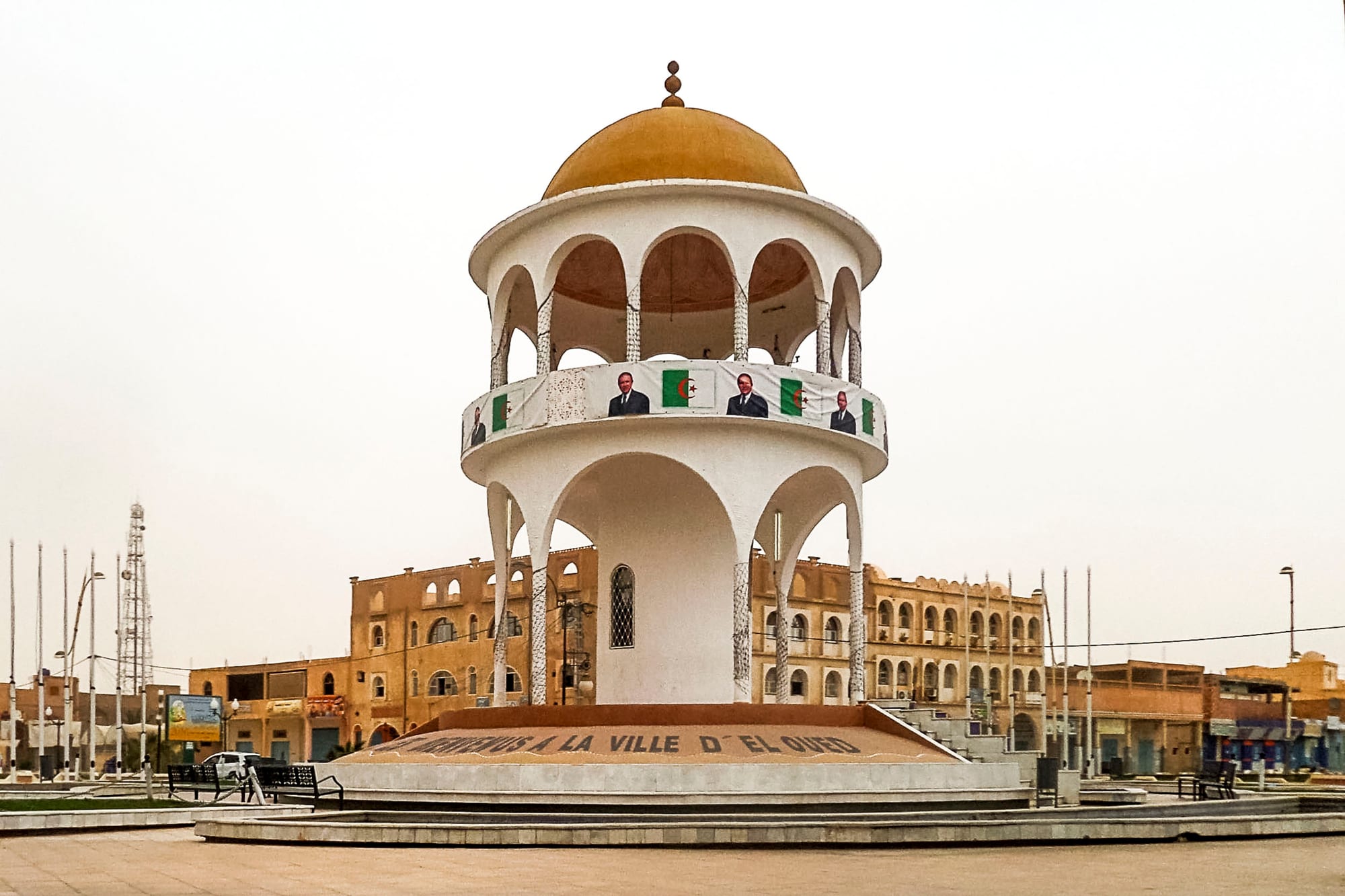
A white monument with a gold dome and arched colonnade standing on a paved square, with low arcaded sandy-coloured buildings behind it

The M'zab, the Grand Erg & the Southeast Sahara, Algeria

El Oued

The domed monument on a central square in El Oued, with the town's arcaded buildings behind. (Habib kaki / Wikimedia Commons · CC BY-SA 4.0)

The capital of the Souf, on the western edge of the Grand Erg Oriental in south-eastern Algeria. Timber is scarce here, so roofs were built as low domes of gypsum and plaster, giving the place its name of the town of a thousand domes. Its palm gardens grow in hollows dug down towards the water table.

Neighbourhoods

  • The centre and the souk
    • First-time visitors
    • Markets
    • Cafés

    The administrative and commercial heart of the town, where the arcaded streets, the covered market, the banks, the hotels and the cafés are grouped within a few blocks. Traders from across the Souf come in for the market days, and the arcades give shade through the middle of the day.

    Open in Maps
  • The old domed quarters
    • Architecture
    • Walks and photography

    The older residential streets away from the centre, where houses are still roofed with the low plastered domes and barrel vaults built from local gypsum. The lanes are narrow, sandy and quiet, and rooftops of pale domes run away in every direction.

    Open in Maps
  • The edge of the dunes
    • Palm groves
    • Sunset views

    Where the built-up area gives out into sand, the palm gardens of the Souf begin — each group of trees planted in a funnel-shaped hollow scooped out of the dunes so that the roots reach the groundwater. The ground rises and falls between the hollows and the open erg beyond.

    Open in Maps
  • Bayadha and Kouinine
    • Quiet and residential
    • Local life

    Two adjoining communes that have grown into El Oued's outskirts, built mostly since the late 20th century in concrete rather than gypsum. They hold much of the area's housing, along with schools, workshops and the roads out towards Guemar and the north.

    Open in Maps

Things to do

Dunes and palm gardens

  • Grand Erg Orientallandmark

    The vast sand sea that begins at the edge of the town and covers some 185,000 square kilometres, spilling north-east into Tunisia.

    Open in Maps
  • Debilaneighborhood

    A small town north-east of El Oued set among the sunken ghout palm gardens that define farming in the Souf.

    Open in Maps

Short trips from the town

  • Guemarneighborhood

    An old Souf settlement a short drive north, long known for its religious schooling and its date gardens.

    Open in Maps
  • Touggourtneighborhood

    An oasis town west of El Oued in the Oued Righ, with an old quarter, large palm groves and a market.

    Open in Maps
  • Temacinelandmark

    An oasis near Touggourt with a ruined mud-brick ksar and a Tijaniyya zaouia that draws pilgrims.

    Open in Maps
  • Djamaaneighborhood

    A date-growing town on the road west from El Oued, in the chain of oases of the Oued Righ.

    Open in Maps

Eat and drink

Long-standing places and food districts in El Oued. Hours, ratings and directions come from your maps app, always current.

Markets and food streets

  • The central marketmarket

    The covered market and the stalls around it sell dates by the crate, semolina, dried vegetables, spices, mutton and camel meat, and they are the best place to see what the Souf actually eats.

    Open in Maps
  • Date sellers of the Soufmarket

    Shops and roadside stalls handling the Deglet Nour harvest, sold loose, on the branch or pressed into paste for cooking.

    Open in Maps

Cafés and grills

  • Cafés around the centrecafe

    Small male-dominated cafés serving strong coffee and glasses of sweet mint tea, busy from late afternoon until well after dark.

    Open in Maps
  • Grills and rotisseries in the centrerestaurant

    Plain eating houses near the market doing grilled mutton, chicken, chorba soup and couscous, with bread baked on the premises.

    Open in Maps

Experience El Oued

History

The Souf was settled long before the town existed, but El Oued as it is known today grew from the arrival of Arab tribes, among them the Troud, who moved into this corner of the Grand Erg Oriental and learned to farm sand. The name means "the river" or "the valley", though no surface stream runs here. Without timber to span a roof, builders worked with what the ground gave them: gypsum quarried nearby, burnt and mixed into plaster, raised over rooms as low domes and barrel vaults. Whole quarters were built this way, and the skyline of pale cupolas gave the place its name, the city of a thousand domes.

Algeria's Saharan south came under French military control from the mid-nineteenth century, and the Souf was administered from a garrison post in El Oued. The most famous outsider to live here was the Swiss-born writer Isabelle Eberhardt, who settled in the town in 1900, dressed as a man, took the name Si Mahmoud Saadi and wrote about the desert and its Sufi brotherhoods before drowning in a flash flood at Aïn Séfra in 1904.

After independence in 1962 El Oued became the administrative centre of its own province, and the town expanded quickly on government money. Concrete replaced gypsum in the new quarters, deep wells replaced some of the labour of the old gardens, and the population multiplied several times over in a few decades. The domed houses survive in the older streets, and newer public buildings borrow the dome as a deliberate local signature.

Culture & Customs

El Oued's identity is built on two things: the architecture and the date. The domes are more than decoration — they shed the fierce sun, hold cool air and can be built without a single beam — and local pride in them is strong enough that banks, mosques and civic buildings copy the form in concrete. The second signature is agricultural. The ghout, the funnel-shaped hollow dug out of a dune so that palm roots can reach the water table, is a technique particular to the Souf and is maintained by hand, generation after generation.

The Souf is Arabic-speaking, tribal in its older social structure and religiously observant, with Sufi brotherhoods long established in the surrounding oases and Quranic schooling a traditional strength of nearby Guemar. Weddings are large and loud, henna and drumming carry the ceremony, and hospitality towards a guest is close to an obligation. Poetry recited in the local Arabic dialect is a respected local art, and the calendar follows the Islamic one, with Ramadan reshaping the day and the two Eids bringing families back from the northern cities.

Visitors are still unusual enough to be greeted with curiosity rather than indifference, and the norms are those of a conservative desert town: modest dress, restraint between men and women in public, and care with the camera. Friday is the quiet day, with the middle of it given over to prayers and the family meal.

Daily Life

About 135,000 people lived in the commune of El Oued at the 2008 census, with several hundred thousand more across the province and the neighbouring communes of Bayadha, Kouinine, Robbah and Debila, which have effectively become suburbs. Almost all of that growth is recent, and the built-up area now spreads far beyond the old domed core.

Agriculture is the backbone. Farming goes on in a sand sea: the ghout gardens produce Deglet Nour dates, and since the arrival of deep boreholes and pivot irrigation thousands of wells have allowed new farms of vegetables and cereals beyond the old hollows. Trade, transport, government employment and the construction that follows public money take up much of the rest of the workforce, and the Tunisian border a short distance east has always given the region a commercial edge.

Water is the local anxiety in both directions. The old gardens depend on a water table close to the surface, while decades of pumping, irrigation and waste water have raised it in places, waterlogging hollows and undermining buildings; deeper aquifers, meanwhile, are drawn down by the new farms. Daily life runs around the heat: an early start, a long pause through the middle of the day, and streets and cafés that fill again in the cool of the evening.

Food

Dates run through everything. The Deglet Nour of the Souf is the variety with a name abroad — translucent, honey-flavoured and sold on the branch — but dozens of other kinds are eaten fresh, dried, stuffed with butter or almonds, pressed into paste for pastries, or simply taken with a bowl of buttermilk, which is the standard desert breakfast and the standard offering to a guest.

Everyday cooking is Algerian Saharan: couscous steamed over a stew of mutton and whatever vegetables the gardens have given, chorba soup thick with vermicelli or crushed wheat, and stews eaten with plenty of bread. Semolina does most of the work in the kitchen — as couscous, as thick flatbreads, and as the doughs used for filled pastries. Bread is often baked as a large round in a clay oven, and the oldest Saharan method, burying dough in hot sand and embers, is still known here. Camel meat appears in the market butchers alongside mutton, and grilled meat with bread and harissa is the standard cheap meal out.

Sweets lean on dates and honey, and the fried and syrup-soaked pastries made for Ramadan and for weddings are made in quantity. To drink there is sweet mint tea poured from a height, strong black coffee in the cafés, and cold buttermilk in the heat; alcohol is effectively absent from public life in the Souf.

Planning tools

Budget

El Oued is priced like provincial Algeria rather than like a desert expedition: hotels are few and simple, food is cheap, and the main extra cost is hiring a car with a driver to reach the dunes and the outlying oases. Algeria runs largely on cash, and foreign cards are rarely accepted, so the budget has to be brought in and changed. Longer guided trips further south cost far more, at roughly USD 150–300 a day for a licensed agency tour with a 4x4 and camping.

Daily Budget Midrange
USD 90–160 (the better hotels in town, restaurant meals, a car with a driver for the palm gardens and dunes)
Daily Budget Shoestring
USD 35–60 (basic hotel, café food, coaches and shared taxis)

Rooms are limited, so a booking matters more here than the price does; carry enough cash for the whole stay.

Best Time to Visit

November to February, when days are mild and the dunes can be walked without danger. October and March are also workable, though sandstorms blow in spring. Summer, from May to September, is extremely hot and unsuitable for walking outside. During Ramadan most cafés and restaurants close in daylight hours and the town wakes up after sunset.

Suggested Number of Days

The town itself is small and a day or two covers it. Add a couple more to take in the surrounding Souf oases, the palm gardens and the edge of the dunes, or to continue along the chain of oases westward. Transport arrangements, not distance, usually decide the length of a stay.

First Visit
1–2 days
With Surroundings
3–4 days

Transportation

Shared taxis and minibuses link El Oued with the surrounding communes and with the other oasis towns, and long-distance coaches run north towards Biskra, Constantine and Algiers. Within the town, taxis are the usual way to move between the centre, the outer quarters and the airport road. There is no local rail or tram service.

Hiring a car with a driver for a half or full day is the practical way to see the ghout gardens and the dunes outside town.

Airport & Station Connections

Guemar Airport, about 20 kilometres north of the town, handles domestic flights, and flying is the quickest way in from the north of the country. Otherwise El Oued is reached by road: long, straight desert highways run north towards Biskra and west towards Touggourt and Ouargla, served by intercity coaches and shared taxis. Journeys from Algiers take the best part of a day by road.

Walkability

The centre is compact and easily walked, and the older domed streets reward wandering on foot. Distances to the outer communes and to the palm gardens are longer, sand drifts across the roads, and pavements give out at the edge of the built-up area. Heat governs everything from late spring to early autumn, when walking is only sensible early in the morning and after sunset.

Safety

El Oued and the Souf oases are quiet, conservative and used to Algerian visitors, and police checkpoints are frequent on the roads between towns. The practical risks are the desert rather than crime: heat, dehydration, getting lost in the dunes and driving on sand-covered roads. Photographing police, military sites and infrastructure is not allowed anywhere in Algeria.

Do not walk into the erg alone or without water, and keep the passport at hand for checkpoints. Most governments advise against all travel to the border regions with Mali, Niger, Libya, and Mauritania, and to parts of the Saharan interior, citing terrorism and kidnapping risk. Check current official travel advice before travelling.

Climate

Full Saharan desert: almost no rain, very large differences between day and night, and dust and sand in the air when the wind gets up. The pleasant season is short, running from late autumn to early spring.

Summer
extreme heat, often 40–45°C or more by day, with warm nights and dust storms
Winter
mild days of about 18–25°C with cold nights that can fall close to freezing

Local Customs

The Souf is religious and socially conservative, more so than the Algerian coast. Modest dress covering the shoulders and knees is expected of both men and women, and cafés are largely male spaces. Arabic is the everyday language, with French widely understood. Greetings are unhurried, hospitality is taken seriously, and an offer of tea or dates is meant to be accepted.

Ask before photographing people, especially women; avoid photographing official buildings; alcohol is not sold openly and is best left alone here.

Common Payment Methods

The currency is the Algerian dinar. This is a cash economy: foreign cards are rarely accepted and ATMs that take them are scarce, so travellers bring euros or US dollars to change. The dinar is difficult to obtain outside Algeria, and there is a wide gap between the official and unofficial exchange rates.