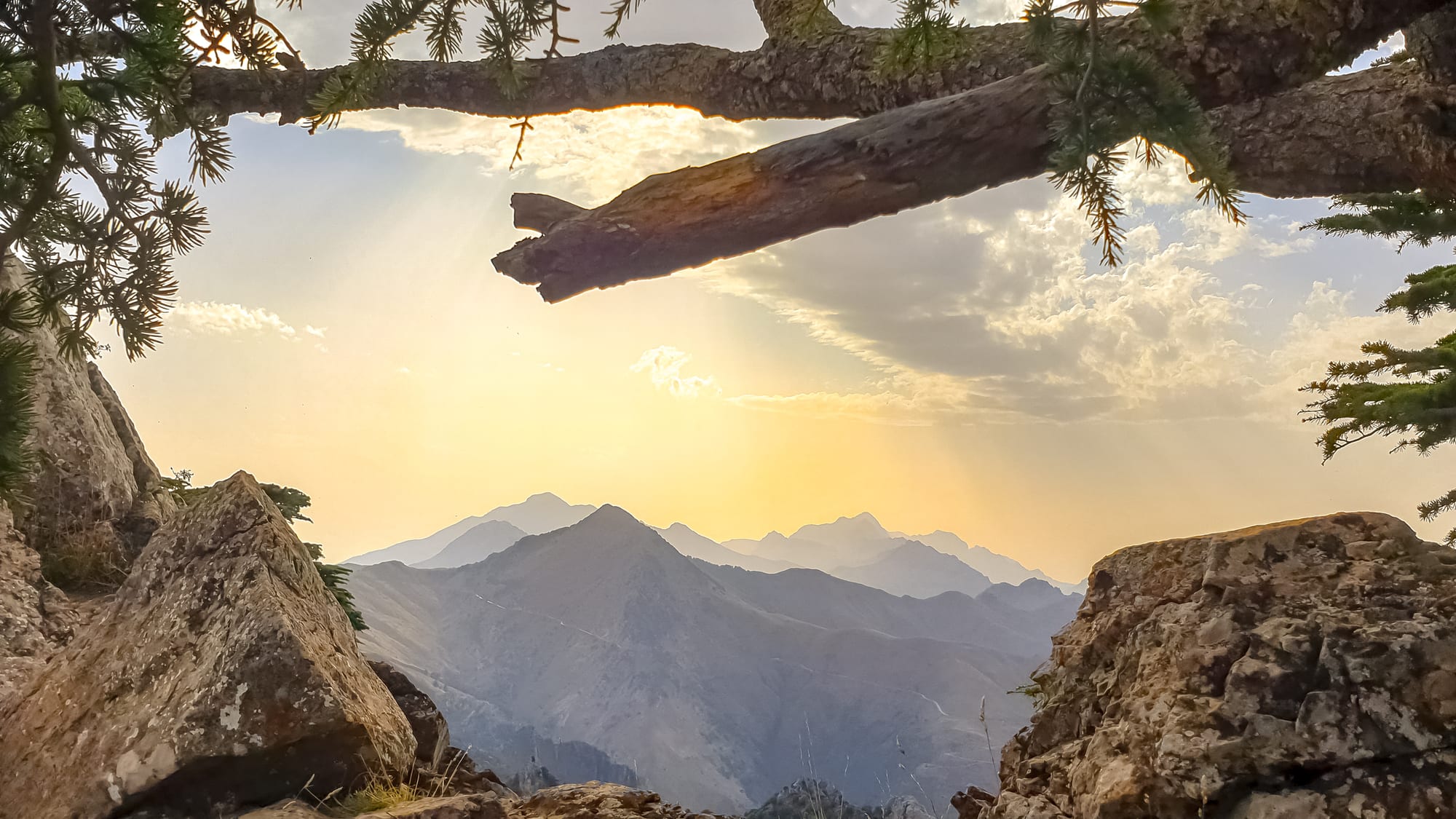
Hazy ridges of the Djurdjura mountains at sunset, framed by rocks and the branches of a cedar tree

Algeria

Algiers & Kabylie

The Djurdjura range seen from the peak of Azrou-n-T'hor, in Tizi Ouzou province in Kabylie. (Rabah Boualia / Wikimedia Commons · CC BY-SA 4.0)

The central Mediterranean coast of Algeria, from the capital and its Ottoman Casbah west to the Roman ruins of Tipaza and east into the Djurdjura mountains and the Berber heartland of Kabylie around Tizi Ouzou and Béjaïa, with the cedar-covered Blida Atlas rising behind the Mitidja plain.

Explore Algiers & Kabylie

History

The coast was settled by Phoenician and Carthaginian traders long before Rome. Tipasa began as a Punic trading post, and Iol, at modern Cherchell, became Caesarea, the capital of the client kings Juba II and Ptolemy of Mauretania before Rome annexed the kingdom. The Royal Mausoleum of Mauretania, a great stone drum on a hill near Tipaza, dates from this era. Algiers itself was the small Roman port of Icosium; the Zirid prince Bologhine ibn Ziri refounded it in the 10th century as El Djazaïr, "the islands", after the islets off its harbour.

To the east, Béjaïa became the capital of the Hammadid dynasty in the 11th century and a major Mediterranean port; Leonardo Fibonacci was educated there and learned the Hindu–Arabic numerals, and the town's wax trade gave French its word for a candle, bougie. In 1516 the corsair brothers Aruj and Hayreddin Barbarossa took Algiers, which became the seat of the Ottoman Regency and a base for corsairs for three centuries, while the Kabyle mountains largely governed themselves.

France landed at Sidi Fredj, west of Algiers, in 1830 and took the city; Kabylie was conquered only in 1857 and rose again in the great revolt of 1871. During the War of Independence the Casbah was the scene of the Battle of Algiers in 1956–57, and Kabylie was a centre of the fighting. After 1962 the region carried Berber cultural demands: the Berber Spring of 1980 in Tizi Ouzou and the deadly unrest of 2001 preceded the recognition of Tamazight. The 1990s conflict hit the Mitidja plain and the mountains south of Algiers especially hard.

Culture & Customs

This region holds two distinct identities. Algiers is Arabic-speaking and cosmopolitan, with its own urban dialect, a strong French-language life and a city culture shaped by the old Casbah families. Its music is chaâbi, a mandole-led popular style associated with El Hadj M'Hamed El Anka and Dahmane El Harrachi, played at weddings and in cafés. Andalusian classical music also has devoted associations here.

Kabylie, stretching from Boumerdès and Bouira through Tizi Ouzou to Béjaïa, is the largest Berber-speaking area of Algeria. Kabyle (Taqbaylit) is the language of home and village, and the region's politics and songs have long centred on identity and language; the singers Idir, Lounis Aït Menguellet and Lounès Matoub, killed in 1998, are revered. Villages were traditionally run by an assembly, the tajmaât, and hilltop settlements still keep strong collective customs, including shared work and the timechret, a communal meat-sharing ritual.

Kabyle crafts are distinctive: jewellery from the Ath Yenni villages, hand-made pottery painted with geometric designs, and brightly embroidered Kabyle dresses worn at weddings and festivals. Yennayer, the Berber new year in January, is celebrated with family meals and has been a national holiday since 2018. Islam is the majority faith, observed in Kabylie with a more relaxed public style than in much of the country, and hospitality in the mountain villages is generous.

Daily Life

Algiers is Algeria's capital and largest city, with more than four million people in its urban area, spread from the old centre around the bay onto hills of French-era apartment blocks and new suburbs towards the airport. Government, banks, oil company offices, the main universities and the port make it the country's economic centre, and the daily commute across the Mitidja is long and congested. Blida, Boumerdès, Tizi Ouzou, Béjaïa and Médéa are the main provincial towns, while Bouira and Aïn Defla are farming and transit centres on the inland road.

Béjaïa is an industrial port with oil and food processing, and Kabylie's hills live from olives, figs, small workshops and money sent by relatives in France, where the Kabyle diaspora is large. The Mitidja plain grows citrus, vegetables and vines. Many young Kabyles leave for Algiers or abroad, and villages fill up again in summer and for weddings.

The day follows the usual Algerian rhythm: an early coffee, work until lunch, a slower afternoon and busy streets after dark, especially along the Algiers seafront and in Ramadan evenings. Housing shortages, traffic, unemployment and the high cost of imported goods are everyday concerns, and in Kabylie the question of language and regional recognition remains politically alive.

Food

Algiers cooking is city food with Ottoman and Andalusian roots. Chorba beida, a white soup of chicken and vermicelli, is an Algiers classic, alongside mhadjeb, thin semolina crêpes folded around a spiced tomato and onion filling and sold hot on the street. Dolma of stuffed vegetables, tajine zitoune (chicken with olives) and fried sardines along the port are everyday dishes, and for Ramadan the city's pastry shops pile up qalb el louz, a syrup-soaked semolina and almond cake.

Kabyle food is mountain food built on olive oil, figs and grain. Couscous is steamed with vegetables; berkoukes is a large-grained hand-rolled pasta cooked in a vegetable and meat broth, and aghrum is flatbread baked on a clay griddle. Kabylie's olive oil is pressed each winter in village mills and prized across Algeria, and dried figs from the hills are sold in every market.

The Mitidja supplies oranges and clementines, and the town of Boufarik, in Blida province, is famous for zlabia, fried spirals of batter soaked in syrup and eaten especially during Ramadan. Mint tea and strong coffee accompany everything, and Kabylie also bottles mineral water.

Attractions & Natural Wonders

In Algiers the Casbah is the essential sight: a steep maze of whitewashed houses, stairways and Ottoman palaces such as Dar Mustapha Pacha, with the Ketchaoua Mosque at its foot. The French-built city below has arcaded boulevards and the Grande Poste; above it stand the basilica of Notre-Dame d'Afrique and the Martyrs' Memorial, Maqam Echahid, and at Mohammadia the new Great Mosque of Algiers with its very tall minaret. The Jardin d'Essai du Hamma is a 19th-century botanical garden near the bay.

West of the capital, Tipaza's Roman ruins run along the sea — the amphitheatre, basilicas, villas and the cemeteries on the headlands — and, with the Royal Mausoleum of Mauretania and Cherchell's museum of mosaics and statues, form the most rewarding day trip from Algiers. The Blida Atlas rises straight from the plain, and Chréa National Park above Blida protects Atlas cedar forests, walking trails and a small ski station.

East lies Kabylie. The Kabylie mountains around Tizi Ouzou lead up to Djurdjura National Park, with the Lalla Khedidja summit, cedar and oak forests, the Tikjda resort on the Bouira side and hill villages such as those of Ath Yenni. Béjaïa sits on a bay beneath Mount Gouraya, with the Gouraya National Park, the headland and lighthouse at Cap Carbon and the old Casbah; the coast road to the east passes cliffs, coves and beaches that fill in August.

Cities in Algiers & Kabylie

Planning basics

Budget

Algiers is the most expensive place in Algeria, with business-class hotels priced for oil and government visitors and few budget options that accept foreigners. Tizi Ouzou, Béjaïa, Blida and the smaller towns are noticeably cheaper, and café food, shared taxis and trains cost little everywhere. Cash in dinars is needed for almost everything.

Daily Budget Midrange
USD 110–220 (mid-range hotel in Algiers or Béjaïa, restaurant meals, taxis or a hired driver)
Daily Budget Shoestring
USD 35–65 (simple hotel, café and street food, trains and shared taxis)

Stay outside central Algiers or book well ahead; bring euros to change, as foreign cards work in few places.

Safety

The capital and the coast are generally calm, with ordinary city risks: pickpockets on crowded streets and in the lower Casbah, and bag snatching. Walking in remote mountain areas is best done with local guides. Police checkpoints are frequent and roads are driven fast.

Go into the Casbah with a local guide, carry a copy of the passport for checkpoints, and avoid photographing police or official buildings. Check current official travel advice before travelling.

Climate

The coast from Tipaza to Béjaïa is Mediterranean, with hot, humid summers and mild, rainy winters; Kabylie receives relatively abundant rain. Inland the Djurdjura, the Blida Atlas and the Médéa uplands are markedly cooler, and snow falls in winter at Tikjda and Chréa.

Summer
hot and humid on the coast, around 28–34°C; hotter inland at Bouira and Aïn Defla
Winter
mild and wet on the coast, 8–17°C; cold in the mountains, with snow on the Djurdjura

Transportation

Algiers has a metro, trams, cable cars up the hillsides and suburban trains across the Mitidja to Blida and Thénia. Mainline trains run east to Tizi Ouzou and Béjaïa, and the East–West Highway crosses Bouira; shared taxis and buses fill the gaps. Mountain villages in Kabylie are reached by winding roads, and ferries link Algiers and Béjaïa with Marseille.

Algiers to Tizi Ouzou takes about two hours by road; the Algiers traffic is heavy at rush hour, so travel early.

Best Time to Visit

April to June and late September to November: green hills, spring flowers in Kabylie, comfortable days for walking the Casbah and Tipaza. July and August are hot and busy on the beaches of Tipaza and Béjaïa, when Algerians take their holidays; winter brings rain and, in the mountains, snow for a few ski days at Chréa and Tikjda.