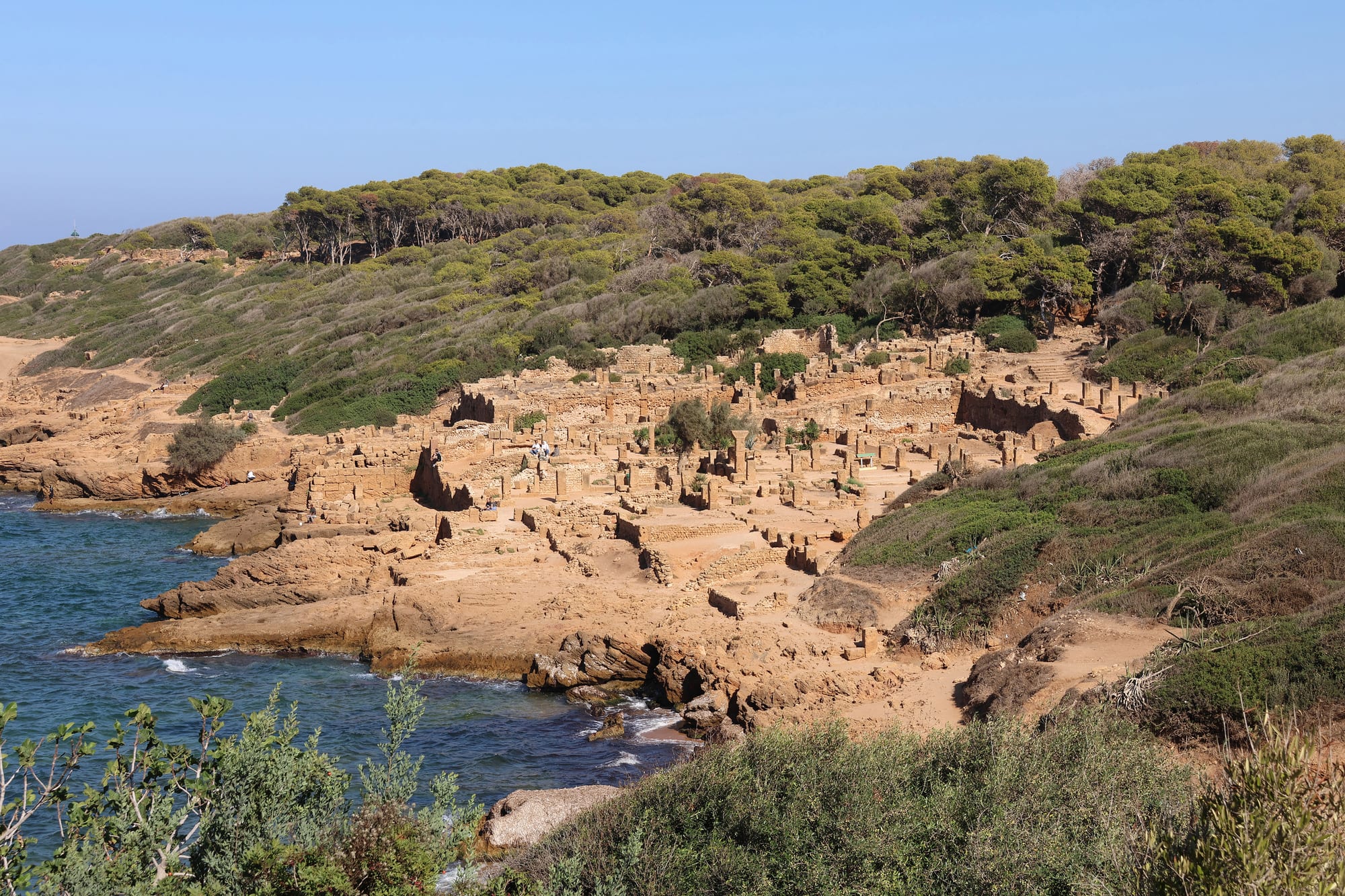
Low stone ruins of a Roman town spread over a rocky headland above a blue sea, with pine woods on the slope behind

Algiers & Kabylie, Algeria

Tipaza

The Roman ruins of Tipasa on their headland above the Mediterranean. (Bernard Gagnon / Wikimedia Commons · CC BY 4.0)

A small coastal town west of Algiers, built beside the ruins of the Punic trading post and Roman city of Tipasa, whose walls, streets and Christian basilicas run along the sea on a UNESCO World Heritage site. Mount Chenoua rises to the west, the royal mausoleum of Mauretania stands on the hills inland, and the town lives from fishing, farming and weekend visitors.

Neighbourhoods

  • The town centre and the harbour
    • First-time visitors
    • Best for food
    • Close to public transport

    A compact grid of streets between the main road and the fishing port, with the market, cafés, hotels and the entrances to the archaeological park. Boats land their catch beside the restaurants on the quay.

    Open in Maps
  • The archaeological park and the shore
    • Historic district
    • Walks by the sea

    The fenced ruins occupy two headlands either side of the modern town, with paths through pine trees between foundations, cisterns and basilicas, and rocky coves at the water's edge.

    Open in Maps
  • Chenoua Plage and the coast west
    • Beaches
    • Families
    • Quiet and residential

    Sand beaches, holiday flats and small hotels under the slopes of Mount Chenoua, a few kilometres west of town. It fills with Algerian families in July and August and is very quiet out of season.

    Open in Maps
  • The hills inland
    • Quiet and residential
    • Countryside

    Villages and farmland on the slopes behind the coast road, growing vines, citrus and vegetables, with the road climbing towards the royal mausoleum and the Mitidja plain beyond.

    Open in Maps

Things to do

The ancient city

  • The Roman ruins of Tipasalandmark

    A large seaside archaeological park inscribed by UNESCO in 1982, taking in the theatre, the amphitheatre, the baths, the nymphaeum, houses and the line of the Roman ramparts above the sea.

    Open in Maps
  • The Great Christian Basilicalandmark

    The largest of the early Christian churches on the western hill, divided into seven aisles and surrounded by a cemetery of stone coffins.

    Open in Maps
  • Tipasa Archaeological Museummuseum

    A small museum in the town holding mosaics, sarcophagi, glass and inscriptions found on the site.

    Open in Maps

Landmarks nearby

  • Royal Mausoleum of Mauretanialandmark

    A great circular stone tomb on a hill about 10 km inland, built for the Mauretanian royal family around the end of the first century BC and visible from far across the plain.

    Open in Maps
  • Mount Chenouaviewpoint

    The wooded massif west of the town, home to a Berber-speaking community, with tracks up the slopes and views along the coast.

    Open in Maps
  • The fishing harbourattraction

    A working port below the town where the day's sardines, bream and prawns are landed and sold beside the quay restaurants.

    Open in Maps

Short trips along the coast

  • Cherchellattraction

    The ancient Caesarea, about 25 km west, with a museum of Roman mosaics and statues and ruins scattered through a small port town.

    Open in Maps
  • Koléaattraction

    An Ottoman-era hill town about 30 km east, known for its shrines, old houses and views over the Mitidja plain.

    Open in Maps
  • Sidi Fredjattraction

    A headland and marina resort on the way towards Algiers, where French forces landed in 1830, now a weekend destination for city families.

    Open in Maps

Seasonal events

  • Summer beach seasonJuly and August

    The coast west of the town fills with Algerian holidaymakers, hotel prices rise and the beaches and restaurants are busy well into the night.

  • YennayerJanuary

    The Amazigh new year, a public holiday marked with family meals, particularly in the Berber-speaking villages of the Chenoua.

Eat and drink

Long-standing places and food districts in Tipaza. Hours, ratings and directions come from your maps app, always current.

Seafood and markets

  • Harbour fish restaurantsneighborhood

    Simple places along the quay grilling sardines and bream, frying small fish and serving prawns with bread and salad.

    Open in Maps
  • Tipaza marketmarket

    Fruit, vegetables and citrus from the plain, olives, spices and fish, with bakeries and pastry shops on the streets around it.

    Open in Maps
  • Town centre caféscafe

    Coffee, mint tea and pastries on the main street, busiest at the end of the afternoon and through summer evenings.

    Open in Maps

Experience Tipaza

History

Phoenician and Punic traders used the headlands here as a stop on the coastal route west. Under Roman rule Tipasa became a military and commercial town of the province of Mauretania Caesariensis, made a colony under the emperor Claudius and defended by a wall about 2.3 km long. It had a theatre, an amphitheatre, baths, a nymphaeum, a harbour and villas looking over the sea, and its quarries supplied stone along the coast.

From the third century it became an important Christian centre, and the large basilicas, the basilica of Bishop Alexander and the great cemeteries of stone sarcophagi on the western headland date from that time. The town declined after the Vandal conquest in the fifth century and was largely abandoned by the Arab period, leaving the ruins to be quarried and grazed.

The modern town was founded by French settlers in 1857 beside the ancient site, which was excavated from the late 19th century onwards. Albert Camus wrote an essay, Noces à Tipasa, about the ruins among wild flowers above the sea, and the place has been associated with him ever since. UNESCO inscribed Tipasa as a World Heritage Site in 1982; it was placed on the List of World Heritage in Danger in 2002 and removed from it in 2006 after conservation work. Tipaza is the capital of the province that bears its name.

Culture & Customs

Tipaza's identity is bound up with the ruins and the sea. It is a provincial Algerian town for most of the year, with life turning on the mosque, the market, the harbour and the cafés, and then a holiday town for two months each summer when families arrive from Algiers and the interior. That double rhythm shapes everything from opening times to the price of a room.

The area has a Berber as well as an Arabic-speaking identity. The Chenoua massif immediately west is home to speakers of Chenoua, an Amazigh language, and the mountain gave its name to Assia Djebar's film La Nouba des femmes du Mont Chenoua, which drew on the women of these villages. Kabyle and Arabic music are both heard at weddings, and Yennayer, the Amazigh new year, is marked in January.

The literary association with Albert Camus, who grew up in Algiers and wrote about the site's stones, absinthe and sea light, brings a steady trickle of visitors making a pilgrimage of sorts. Custom otherwise follows the Algerian pattern: hospitality offered before anything else, Friday as the day of rest, modest dress in town, and a strong preference for eating at home with family rather than in restaurants.

Daily Life

The town itself is small, and far more people live in the surrounding communes of Tipaza province, of which it is the administrative capital; the province counted about 706,000 inhabitants in 2019. Fishing from the small port, farming on the coastal plain — vines, citrus, tomatoes and early vegetables — and provincial administration provide most of the steady work, supplemented by construction and by the summer visitors who fill the hotels and beach flats.

Housing spreads inland from the old grid in low blocks and villas, and holiday developments run along the shore towards Chenoua. Young people travel to Algiers or Blida for university and often for work, a commute of well over an hour each way on a road that is congested at both ends of the day. Water supply, building too close to the protected site and the seasonal swing in the local economy are recurring local issues.

The daily rhythm is that of a small Mediterranean town: fishing boats in early, the market busy in the morning, a long quiet afternoon, and the promenade and cafés filling as the heat drops. In winter the seafront is nearly empty and the town turns inward; in August the same streets are full until well after midnight.

Food

The harbour sets the menu. Sardines grilled over charcoal, fried anchovies, sea bream and prawns come to the quay restaurants straight from the boats, usually served plain with bread, lemon, salad and harissa. Fish soup and rice with seafood, echoes of Spanish and Italian cooking along this coast, appear on the same tables.

Away from the sea the food is that of the Mitidja and the Algiers region. Chorba, a soup of tomato and cracked wheat or vermicelli, opens most evening meals in Ramadan; couscous with lamb and seasonal vegetables is the Friday dish; and dolma of stuffed courgettes and peppers, tajine zitoune of chicken with olives and bourek pastries are everyday cooking. Mhadjeb, folded semolina crêpes with a tomato and onion filling, are sold hot from street griddles.

The plain behind the town supplies oranges, clementines, tomatoes and early vegetables, and its olives are pressed for oil. Vines have been grown here since the colonial period, though most local people do not drink wine. Pastries lean on semolina, honey and almonds — makroud, baklawa, griwech — and mint tea or a small strong coffee ends any meal or visit.

Planning tools

Budget

Tipaza is inexpensive outside high summer, when hotel prices on the coast rise steeply and rooms are scarce. Many visitors come for the day from Algiers, which costs little beyond transport and the site ticket. Meals at the harbour are the main expense, and everything is paid for in dinar cash.

Daily Budget Midrange
USD 110–220 (mid-range coastal hotel, seafood dinners, a taxi or hired driver from Algiers)
Daily Budget Shoestring
USD 30–55 (simple hotel or guesthouse, café meals and fried fish, buses and shared taxis)

Rooms should be booked well ahead for July and August; outside those months the same hotels are much cheaper and half empty.

Best Time to Visit

April to June and September to early November are the best months, with warm days, green hills and the ruins largely to oneself. July and August are hot, humid and crowded on the beaches. Winter is mild but wet, and the exposed headlands are windy when storms come in off the sea.

Suggested Number of Days

The town's sights are few and close together, so one unhurried day covers them. Two or three days suit anyone adding more of the coast, the hills inland and time on a beach, or using the town as a quieter base than the capital.

First Visit
1 day
With Surroundings
2–3 days

Transportation

The town is small enough to cross on foot. Buses and shared taxis run along the coast road east to Algiers and west to Cherchell, and inland to Koléa and Blida, leaving from near the centre. A hired car or driver makes the mausoleum and the hill villages much easier to reach.

The coast road is slow and winding, and traffic is heavy on summer weekends, so journeys take longer than the map suggests.

Airport & Station Connections

Tipaza lies about 60 km west of Algiers, roughly one and a half to two hours by road depending on traffic, and is usually reached by bus, shared taxi or hired car from the capital. The nearest airport is Houari Boumediene in Algiers. There is no passenger railway to the town.

Walkability

Very walkable: the centre, the market, the harbour and both entrances to the archaeological park are within a few minutes of each other. The site itself involves a few kilometres of walking on uneven stone and sandy paths with little shade, and the beaches west of town are far enough to need a taxi.

Safety

A quiet town with little crime beyond occasional petty theft on crowded summer beaches. The practical risks are the coast road, the unfenced cliff edges and slippery rock within the ruins, and swimming where there are no lifeguards. Police checkpoints are common on the road to and from Algiers.

Sturdy shoes, water and sun cover make the archaeological park much easier in warm weather. Most governments advise against all travel to the border regions with Mali, Niger, Libya, and Mauritania, and to parts of the Saharan interior, citing terrorism and kidnapping risk. Check current official travel advice before travelling.

Climate

Mediterranean, moderated by the sea and slightly cooler than inland Algiers. Rain falls between late autumn and early spring, sometimes heavily, while summer is dry for weeks at a time. Sea breezes make the headlands pleasant even in hot weather.

Summer
hot and humid, generally around 29°C by day, with warm sea and almost no rain
Winter
mild and wet, generally 9–17°C, with rain, cloud and windy spells

Local Customs

A small, fairly conservative coastal town, more relaxed in summer when holidaymakers arrive. Modest dress away from the beach avoids attention, and swimwear is for the sand rather than the streets. Greetings are unhurried, hospitality is pressed on guests, and Friday midday is quiet while people are at prayer.

Tipping is a matter of rounding up; ask before photographing people, especially women, and avoid photographing the port or any military installation.

Common Payment Methods

The currency is the Algerian dinar and payment is in cash almost everywhere, including hotels and restaurants. Foreign cards are very rarely accepted and cash machines that take them are unreliable, so money is normally changed in Algiers before coming. The official rate is much weaker than the parallel rate, and changing outside the banks is technically illegal.