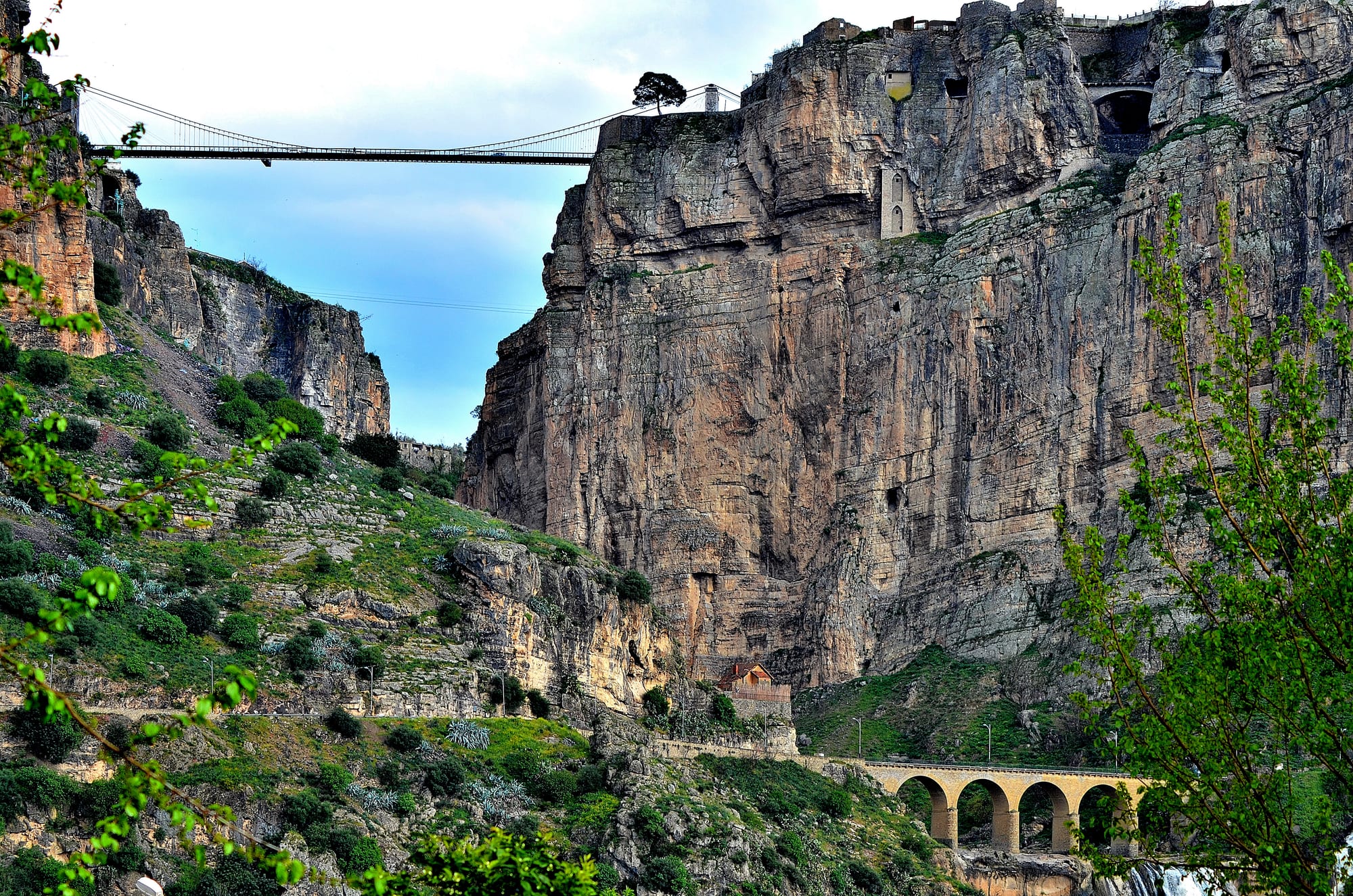
Sheer limestone cliffs of a deep gorge crossed high above by a suspension bridge, with a stone arched bridge below

Algeria

Constantine & the East

The Rhumel gorge at Constantine, spanned by the Sidi M'Cid suspension bridge. (Louadfel / Wikimedia Commons · CC BY-SA 4.0)

Eastern Algeria from the Sétif highlands to the Tunisian border — the old Numidian heartland around the gorge city of Constantine, with the Roman cities of Djémila and Timgad, the ports of Annaba and Skikda, the wooded Jijel coast and the Chaoui Berber country of the Aurès mountains.

Explore Constantine & the East

History

The east was the core of Numidia. Cirta, on its rock above the Rhumel gorge, was the capital of the Numidian kings: Masinissa allied with Rome against Carthage, and his grandson Jugurtha fought Rome in the war that bears his name. Under Roman rule the region became a rich grain land, and colonies such as Timgad, founded around 100 AD for army veterans, and Djémila, Roman Cuicul, spread across the plateaus. Cirta was rebuilt and renamed after the emperor Constantine in the early 4th century. Augustine was born at Thagaste, modern Souk Ahras, in 354 and was bishop of Hippo Regius until his death in 430, while the Vandals besieged the city. The Byzantines later rebuilt Theveste, modern Tébessa, as a fortress.

The Aurès mountains held out under Berber leaders, including the queen known as the Kahina, who resisted the Arab conquest in the late 7th century. Constantine later passed between Berber dynasties before becoming the seat of the Ottoman beylik of the east, whose last bey, Ahmed, built his palace there and resisted France until the city fell in 1837.

The east saw two defining moments of the colonial era. On 8 May 1945, police fire on a nationalist demonstration in Sétif set off riots in which about a hundred European settlers were killed, followed by a mass repression around Sétif, Guelma and Kherrata in which thousands of Algerians were killed; the death toll is still disputed. On 1 November 1954 the War of Independence began with coordinated attacks, many of them in the Aurès, and the mountains remained a guerrilla stronghold until 1962.

Culture & Customs

Constantine regards itself as the country's scholarly and religious capital, the city of Abdelhamid Ben Badis, founder of the reformist Association of Algerian Muslim Ulama in 1931. It is conservative and proud, with an old bourgeoisie, a tradition of malouf — the Andalusian classical music played with oud, violin and darbouka — and craftsmen who still hammer copper trays in the old town. Women's traditional dress is the gandoura of Constantine, a dress of embroidered velvet, and a black veil, the mlaya, was once worn by older women in the city.

The Aurès, around Batna and Khenchela, is the land of the Chaoui, Berber speakers with their own dialect, music of reed flute and bendir drum, and songs popularised by singers such as Aïssa Djermouni. Mountain villages are built of stone and earth on cliff edges, and the memory of 1954 is central to local pride. Annaba, by contrast, is a busy port city with a looser, Mediterranean manner, and Sétif is known for trade and for its football club.

Religious life is Sunni Islam of the Maliki school, and Friday prayer, Ramadan evenings and family weddings with musicians and henna nights shape the calendar across the region.

Daily Life

Constantine is the east's main city, with several hundred thousand people in the city and a new town, Ali Mendjeli, built on the plateau to the south. Sétif, Annaba, Batna, Bordj Bou Arréridj, Skikda, Tébessa and Jijel are all large towns, and the east as a whole is one of Algeria's most populous regions.

The economy is broad. Annaba has the El Hadjar steelworks and a phosphate and mining port; Skikda has a large petrochemical and gas terminal; Sétif and Bordj Bou Arréridj are centres of commerce and light industry, and Bordj Bou Arréridj has grown into a hub for electronics assembly. The high plains grow wheat and barley and raise sheep, while Jijel and El Tarf live from fishing, cork oak forests and summer tourism.

Days start early, markets are crowded in the mornings, and the cafés fill after work. Constantine's centre, hemmed in by its gorge, suffers from crumbling old buildings and congestion, and many families have moved to new housing on the edge of the city. Youth unemployment and emigration are concerns here as across Algeria.

Food

Constantine has one of Algeria's most elaborate kitchens. Its signature dish is chakhchoukha, pieces of thin torn flatbread soaked in a spiced sauce of lamb, chickpeas and tomato, also claimed by Biskra. Other favourites include djari frik, the green-wheat soup of Ramadan, trida, a hand-made pasta of the north-east, and chbah essafra, a sweet tagine of lamb and fried almond-paste fritters in a cinnamon-scented sauce, served at weddings and in Ramadan.

Sweets are a point of civic pride: baklawa, makroud stuffed with dates, and many almond pastries fill trays at weddings and Eid, and rfiss, a crumbled semolina flatbread moistened with butter, milk and honey, is eaten across the east. Couscous is eaten on Fridays, often with a mutton and vegetable stew.

In the Aurès, the food is plainer and heartier — couscous with dried meat, flatbreads, butter, apricots and dates brought up from the desert fringe. On the coast, Annaba and Jijel serve grilled sardines, fried fish and shellfish.

Attractions & Natural Wonders

Constantine's bridges are the region's signature: the Sidi M'Cid suspension bridge high above the Rhumel gorge, the stone arches of the Sidi Rached viaduct, the El Kantara bridge and the cable-stayed Salah Bey bridge. The Palace of Ahmed Bey, the old medina, the Emir Abdelkader Mosque and the Monument aux Morts on the far cliff complete a visit, and the Numidian tomb of the Soumaa and the Roman ruins at Tiddis lie nearby.

The Roman cities are among the best in North Africa. Djémila, in Sétif province, has forums, temples, an arch and a mosaic museum on a sloping ridge; Timgad, near Batna, has its grid of streets, Trajan's Arch and a theatre. Tébessa has a Byzantine wall, the Arch of Caracalla and a large early Christian basilica, and Madauros, near Souk Ahras, was the town of Apuleius.

Annaba holds the ruins of Hippo Regius and the Basilica of Saint Augustine on the hill above them. Around Batna, the Aurès mountains offer the canyon and abandoned cliff villages of Ghoufi, the Numidian royal tomb of Medracen and the cedars of Belezma National Park. The Jijel coast has a corniche of headlands and beaches, Taza National Park and the Grottes Merveilleuses cave, while El Kala National Park in the far east protects lakes and wetlands.

Cities in Constantine & the East

Planning basics

Budget

The east is priced like the rest of northern Algeria outside Algiers. Constantine and Annaba have the most hotels; Sétif, Batna and Jijel are cheaper, and small towns near the ruins have few rooms, so day trips from a city base are common. Jijel and the Annaba coast fill and rise in price in summer.

Daily Budget Midrange
USD 90–190 (mid-range hotel in Constantine or Annaba, restaurant meals, a driver for Timgad or Djémila)
Daily Budget Shoestring
USD 35–60 (simple hotel, café meals, trains, coaches and shared taxis)

Hiring a car with a driver for a day is the easiest way to combine Djémila with Sétif, or Timgad with Batna.

Safety

The cities are generally calm, with normal petty crime. Armed groups have operated in remote mountain and forest areas of the east in the past, and some governments advise against travel close to the Tunisian border in the El Tarf, Souk Ahras and Tébessa areas. Police checkpoints are frequent, and visitors may occasionally be given a police escort.

Keep to main roads in the border provinces, cooperate with checkpoints and escorts, and avoid lonely mountain walks without a local guide. Check current official travel advice before travelling.

Climate

The coast from Jijel to El Tarf is one of the wettest parts of Algeria, green and forested, with warm, humid summers. Inland, Constantine, Sétif and Batna sit on high plateaus with hot, dry summers and cold winters in which snow is not unusual; the Aurès peaks carry snow into spring.

Summer
warm and humid on the coast, 28–32°C; hot and dry inland, often above 33°C
Winter
mild and wet on the coast; cold on the plateaus, near freezing at night in Sétif and Batna

Transportation

Constantine and Annaba have airports with flights to Algiers and to France, and a railway links Algiers with Sétif, Constantine and Annaba. Constantine has a tramway and a cable car across the gorge. The East–West Highway runs through Bordj Bou Arréridj, Sétif and Constantine towards the Tunisian border, and coaches and shared taxis reach Batna, Jijel, Guelma and Tébessa.

Constantine to Batna and Timgad is roughly two hours by road; Sétif to Djémila is under an hour.

Best Time to Visit

April to June and September to October are best for the Roman sites and Constantine, when the plateaus are neither baking nor frozen. July and August suit the Jijel and Annaba beaches but are hot inland; winter on the high plateaus is raw, although Constantine's gorge is at its most dramatic after rain.