💰 Budget
Constantine has the widest choice of hotels in eastern Algeria, from plain places in the centre to a few larger business hotels, and prices sit below those in Algiers. The main extra cost is transport to the Roman sites, which usually means hiring a car with a driver for the day. Cash is used for almost everything.
- Daily Budget Midrange
- USD 90–190 (mid-range hotel, restaurant meals, a driver for Djémila or Timgad)
- Daily Budget Shoestring
- USD 35–60 (simple hotel, café meals, tram and shared taxis)
Bring euros or US dollars to change, as foreign cards are rarely accepted and few ATMs take them.
📅 Best Time to Visit
April to June and September to October are the most comfortable, warm by day and cool at night on the plateau. Summer is hot and dry, with temperatures often above 33°C. Winter is cold, wet and sometimes snowy, although the gorge is at its most dramatic when the Rhumel is running after rain.
⏳ Suggested Number of Days
Two days are enough for the city itself, which is compact but steep. Four or five allow for the Roman sites and smaller towns of the region, most of which need a full day each because of the driving involved.
- First Visit
- 2 days
- With Surroundings
- 4–5 days
🚆 Transportation
A tramway opened in 2013 runs from the centre south through Zouaghi to the new town of Ali Mendjeli, and a cable car crosses the gorge, saving a long climb. Buses and shared taxis cover the rest of the city, and coaches and trains leave for Algiers, Sétif, Annaba and Batna. Traffic in the centre is heavy and parking is difficult.
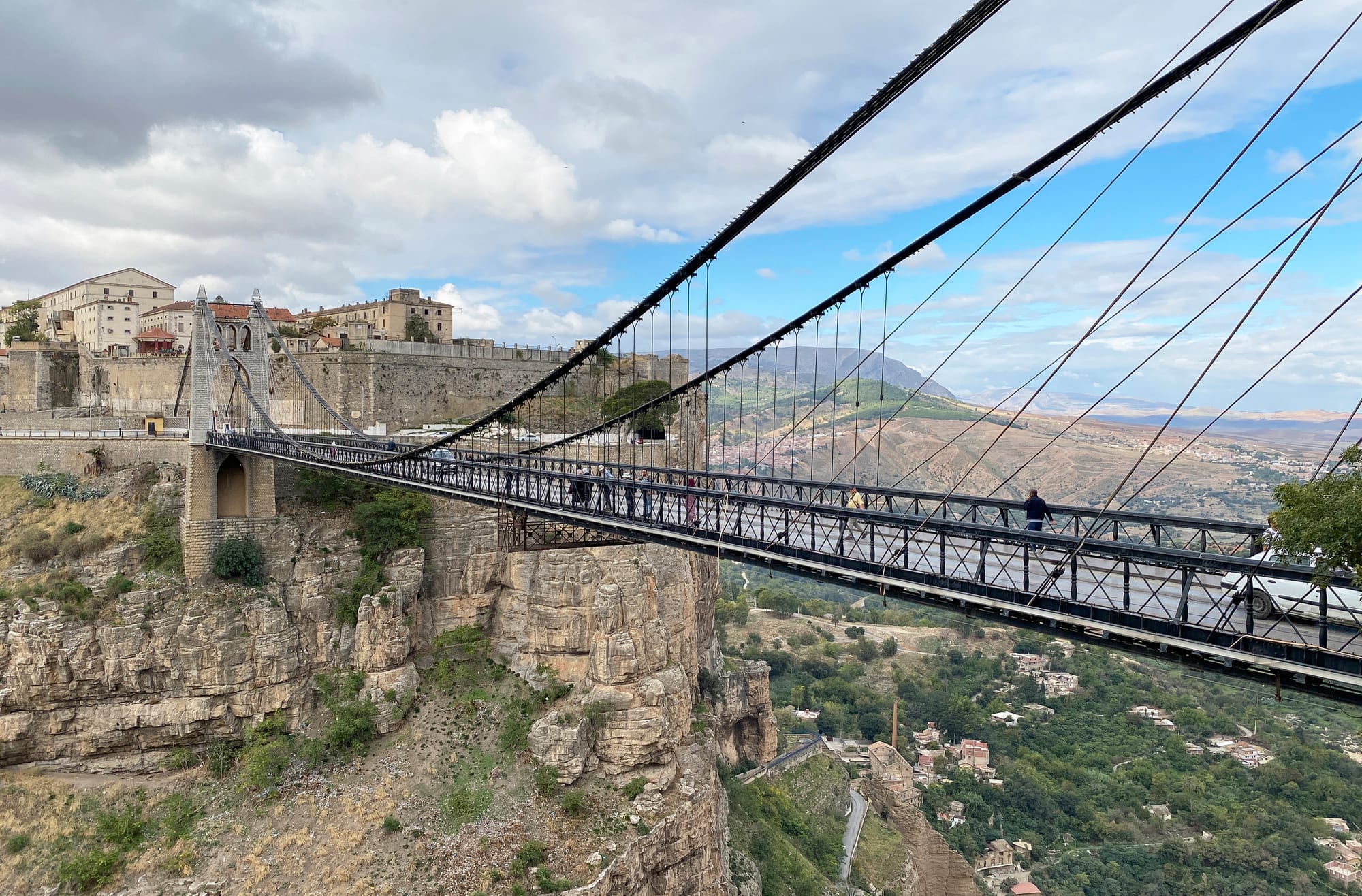
The cable car and the footbridges are the quickest ways between the old town and the districts across the ravine.
🛬 Airport & Station Connections
Mohamed Boudiaf International Airport lies about 9 kilometres south of the city, with flights to Algiers, the Algerian south and several French cities. Trains on the northern line link Constantine with Algiers, Sétif and Annaba, and the East–West Highway carries coaches and shared taxis in every direction. Batna and Timgad are roughly two hours away by road.
🚶 Walkability
The centre and the old town are walked, but this is a city of cliffs, steps and steep lanes, and distances that look short on a map can involve a long climb or a detour to a bridge. The medina's alleys are uneven and some are in poor repair. The bridges and the gorge rim are the best walks in the city, with railings but considerable drops.
🛡️ Safety
Constantine is a calm city by the standards of its size, with ordinary petty crime around markets, the bus station and crowded streets. The real hazards are physical: unguarded drops along parts of the gorge, crumbling buildings in the oldest lanes, and traffic. Police checkpoints on the roads out of the city are routine.
Photography of police, military sites and the airport should be avoided, identification carried, and the gorge paths left alone after dark or in heavy rain. Keep to main roads in the border provinces, cooperate with checkpoints and escorts, and avoid lonely mountain walks without a local guide. Check current official travel advice before travelling.
🌦️ Climate
A semi-arid plateau climate at around 650 metres above sea level, with hot dry summers, cold winters and most rain between autumn and spring. Nights are much cooler than days for most of the year, and the gorge can hold mist in the early morning.
- Summer
- hot and dry, often above 33°C by day, cooling noticeably after dark
- Winter
- cold and wet, roughly 4–13°C, with frost at night and occasional snow
🤝 Local Customs
Constantine is conservative and proud of its religious and scholarly tradition. Modest dress is expected, particularly in the old town and near mosques; greetings are formal and unhurried; and hospitality, with coffee or tea offered first, is a serious matter. Mosques are generally not open to non-Muslim visitors.
Ask before photographing people or inside markets, dress with covered shoulders and knees, expect a different rhythm during Ramadan, and note that alcohol is not sold openly and public drinking is unacceptable.
💳 Common Payment Methods
The currency is the Algerian dinar. Cash is used for nearly everything, and foreign cards are accepted only in a few larger hotels; ATMs that take them are scarce. Travellers change euros or US dollars, and small notes are needed for taxis, cafés and the market.