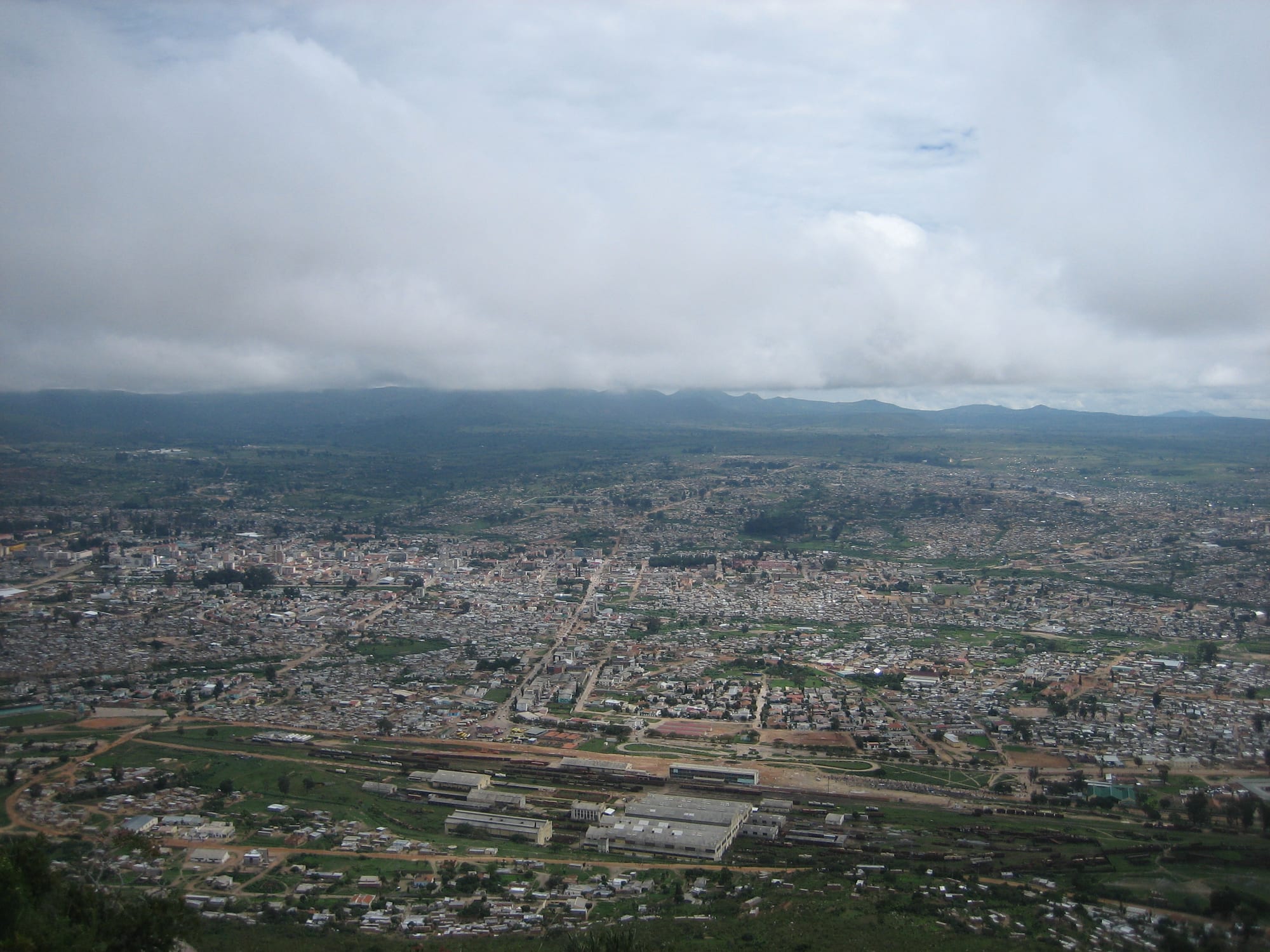
A wide view over Lubango spreading across a green highland basin, with low buildings, a railway yard and hills under heavy cloud

Lubango, Namibe & the South, Angola

Lubango

Lubango seen from the hills above the city, spread across its highland basin in Huíla province. (Erik Cleves Kristensen / Wikimedia Commons · CC BY 2.0)

The capital of Huíla province and the largest city of southern Angola, set in a bowl of the highlands at around 1,760 metres. Settlers from Madeira founded it in the 1880s and it was called Sá da Bandeira until independence. A Cristo Rei statue stands on the hill above it, and the Tundavala gap and the hairpins of the Serra da Leba lie on the escarpment nearby.

Neighbourhoods

  • The centre
    • First-time visitors
    • Architecture
    • Close to transport

    The colonial grid of the old Sá da Bandeira, with low pastel buildings, jacaranda-lined avenues, churches, banks and most of the city's hotels and restaurants. It is flat, compact and busy in the morning, and the streets empty early in the evening.

    Open in Maps
  • The market and station quarter
    • Local life
    • Best for food
    • Street trade

    Around the main markets and the railway yards, where highland produce, dried fish brought up from Moçâmedes and household goods are traded, and where buses and shared taxis for the province gather. Crowded, loud and the cheapest part of the city to eat.

    Open in Maps
  • The slopes below the Cristo Rei
    • Views
    • Quiet and residential

    The residential streets climbing the hillside towards the statue that overlooks the city, a mix of older villas and newer houses with gardens. The road up gives the standard view over the basin and the plateau beyond.

    Open in Maps
  • The outer bairros
    • Local life
    • Everyday Angola

    Self-built districts spreading over the surrounding slopes and out along the highways, grown quickly since the war with people from Huíla, Cunene and further north. Small churches, markets and workshops serve them, and most of the city lives here.

    Open in Maps

Things to do

Landmarks in the city

  • Cristo Rei statuelandmark

    A 30-metre white marble Christ the King figure with outstretched arms on the hill above the city, built in 1957 and inspired by the Christ the Redeemer statue in Rio de Janeiro.

    Open in Maps
  • Capela da Nossa Senhora do Montelandmark

    The chapel of Our Lady of the Mount, dedicated to the city's Catholic patron saint, whose procession is one of Lubango's main religious occasions.

    Open in Maps
  • Lubango Mukanka Airporttransit hub

    The city's airport at the edge of town, with domestic flights to Luanda and the main way into southern Angola for visitors short of time.

    Open in Maps

The escarpment

  • Tundavala Gapviewpoint

    A sheer break in the edge of the plateau north-west of the city, where the rock falls more than a kilometre towards the coastal plain, with views far out over the lowlands.

    Open in Maps
  • Serra da Leba passviewpoint

    The road down the escarpment towards Namibe, a series of tight hairpin bends cut into the mountain face and seen from a viewpoint at the top.

    Open in Maps

Short trips from the city

  • Humpataattraction

    A farming town on the plateau above the city, settled around 1880 by Afrikaner trekkers of the Dorsland Trek and now growing fruit and vegetables for the region.

    Open in Maps
  • Chibiaattraction

    A small town in the cattle country south of the city, a market centre for the Nyaneka and Mwila communities of the plateau.

    Open in Maps

Seasonal events

  • CarnivalFebruary or March

    Neighbourhood groups parade with drums, costumes and dancing in the days before Lent.

  • Independence DayNovember

    Parades, music and family meals mark the anniversary of independence on 11 November.

Eat and drink

Long-standing places and food districts in Lubango. Hours, ratings and directions come from your maps app, always current.

Markets and street food

  • Lubango central marketmarket

    Maize and cassava flour, beans, potatoes, cabbages and fruit from the plateau farms, alongside salted and sun-dried fish carried up from the Namibe coast.

    Open in Maps
  • Grilled food stallsmarket

    Charcoal braziers on street corners selling grilled beef, goat and chicken with piri-piri, bread and cassava chips — the standard cheap meal of the south.

    Open in Maps

Restaurants and cafés

  • Restaurants in the centreneighborhood

    Small restaurants and hotel dining rooms serving funge with meat or fish stews, grilled beef from the southern herds, and fish brought up from the coast.

    Open in Maps
  • Cafés of the old gridneighborhood

    Portuguese-style cafés and bakeries along the colonial avenues, where coffee, bread rolls and pastries start the day.

    Open in Maps

Experience Lubango

History

The Huíla plateau was settled long before the Portuguese by Nyaneka-Nkhumbi farmers and herders, whose descendants still work the countryside around the city. Portuguese interest in the highlands grew in the nineteenth century as a healthier alternative to the coast, and about a thousand settlers from Madeira arrived in 1882 under a government scheme; the town in the basin that became Lubango was established in 1885. It was named Sá da Bandeira after the Portuguese statesman associated with the abolition of the slave trade, and it kept that name until 1975.

The settlement grew as a farming colony of small holdings, orchards and cattle, reinforced from 1880 by the arrival of the Afrikaner Dorsland trekkers, who settled on the Humpata plateau above the town. The Moçâmedes railway had connected the town to the port on the coast by 1923, tying the plateau's produce to the sea, and the colonial administration made the town the capital of Huíla, with schools, seminaries and a garrison. The Cristo Rei statue was raised on the hill above it in 1957.

Independence in 1975 brought the name Lubango, the departure of most of the Portuguese and South African-descended settlers, and a front line not far away: southern Angola saw repeated South African incursions during the war, and the city was a rear base and a refuge for people displaced from the countryside. Since 2002 it has grown quickly, with new districts spreading over the slopes, a rebuilt airport and railway, and a tourism trade built on the escarpment viewpoints.

Culture & Customs

Lubango's identity is a highland one, cooler and more rural in feeling than the coast. The Madeiran and settler past left the grid of avenues, the churches and a strong Catholic calendar of feast days, Masses and processions through the year, one of the most important being the procession of Nossa Senhora do Monte, the city's patron saint; the Cristo Rei above the city is the emblem used on everything from signs to football shirts.

The countryside around brings its own cultures into the markets. Nyaneka and Mwila families come in from the plateau, the Mwila women known across Angola for their distinctive hairstyles and beadwork, and Mucubal herders from the drier south appear at the cattle fairs. Cattle remain the measure of wealth and the centre of marriage and inheritance in the rural south, and the relationship between city and herding country runs through daily life.

The city has a strong student and church-choir culture, with universities, seminaries and training colleges drawing young people from across the south. Music follows the national pattern — semba, kizomba and kuduro — with Namibian and South African sounds crossing the border as well. Football is followed closely, and the cool dry-season evenings are spent walking the avenues or on the road up to the viewpoints above the city.

Daily Life

Lubango is the largest city of southern Angola and the second-most populous in the country after Luanda: the municipality had a population of 890,384 in 2024, and the city centre itself 805,272. It is the seat of the Huíla provincial government, and administration, universities, hospitals, schools and the army provide much of the formal work, alongside trade, transport and food processing.

The plateau around the city is one of Angola's better farming regions, growing maize, beans, potatoes, vegetables and fruit, and keeping cattle on a large scale; markets in the city handle that produce and send some of it north to Benguela and Luanda. The railway and the highway down the escarpment tie the city to the port at Moçâmedes, and dried fish comes up the same route.

Most residents live in the bairros spreading over the slopes, where houses are self-built, water is fetched or trucked in some districts and power supply is uneven. Days start early and cold in the dry season, with wood smoke hanging in the basin, and end early too. Rapid growth has outpaced services, and water supply, housing and the state of the roads are the issues people raise most often.

Food

Southern Angolan cooking is pastoral and plain. Funge here is often made from maize flour or from massambala, sorghum, and is eaten with beans, greens or meat; in the drier country south of the city, millet and sorghum porridges are eaten with soured milk. Beef and goat are more common than in the rest of Angola because this is cattle country, grilled over charcoal at roadside stalls or stewed slowly with onion and tomato.

Fish arrives daily from the coast: fresh from Moçâmedes when transport allows, and above all salted and sun-dried, which is stewed with greens, tomato and palm oil in the style of calulu. Muamba de galinha, chicken cooked in red palm oil with okra, appears on most restaurant menus, and beans in palm oil with rice are the everyday plate.

The Huíla plateau is a fruit and vegetable region, and the markets fill with potatoes, cabbages, tomatoes, strawberries and citrus grown around Humpata and the nearby farms. Kissângua, the lightly fermented maize drink, is sold in markets and villages; the Portuguese inheritance shows in bread, strong coffee and pastries in the cafés of the old centre.

Planning tools

Budget

Lubango has a fair range of hotels at prices well below Luanda's, and local restaurants and markets are inexpensive. The cost rises sharply for trips beyond the city: a car with a driver for the escarpment, and a four-wheel-drive vehicle, guide and supplies for anything into the desert or the far south.

Daily Budget Midrange
USD 150–350 (good hotel, car and driver, a guided 4x4 trip into the desert)
Daily Budget Shoestring
USD 45–80 (guesthouse, local food, buses and shared taxis)

Carry kwanza in cash — cards are accepted only in the larger hotels — and arrange vehicles through a hotel or a known operator rather than at the roadside.

Best Time to Visit

May to October, the dry season, gives the clearest views from Tundavala and the Serra da Leba and the firmest roads, with warm days and cold nights on the plateau. The rains from about November to April bring green countryside, afternoon storms and cloud that can close the viewpoints in.

Suggested Number of Days

Two days suit the city and the escarpment above it. Three or four allow for the plateau and the descent towards the coast. Anyone continuing into the desert or the far south should plan several more days, since distances are long and vehicles must be arranged.

First Visit
2 days
With Surroundings
3–4 days

Transportation

The centre is flat and easily crossed on foot, and candongueiro minibuses and shared taxis cover the outer districts and nearby towns. Almost everyone reaches the viewpoints and the pass by hired car or with a driver. The Moçâmedes railway links the city with the coast and with Menongue in the east, and buses run north to Benguela and Luanda.

Hire a car with a driver for Tundavala and the Serra da Leba, and avoid driving the escarpment road in fog or after dark.

Airport & Station Connections

Lubango Airport, on the edge of the city, has domestic flights to Luanda and other Angolan cities, and is how most visitors arrive. By road the drive up the coast and inland from Benguela takes the best part of a day, and the highway from Moçâmedes climbs the escarpment by the Serra da Leba in about two hours. Trains on the Moçâmedes line reach the city from the coast.

Walkability

The colonial centre is level, gridded and pleasant to walk, with shade from the avenue trees and the main hotels, banks and restaurants within a few blocks. Beyond it the city climbs and spreads, pavements give out and distances grow, so taxis are used for anything further; street lighting is patchy after dark.

Safety

Lubango is one of Angola's calmer cities, though pickpocketing and bag theft occur in the markets and at transport stops, and there is little lighting at night. The greater risks are on the road: the escarpment descent is steep and often misty, and rural areas of the south still carry some legacy of wartime mine contamination away from used tracks.

Crime is the main concern, especially in Luanda: street robbery, carjacking, and theft are common, and visitors are advised not to walk after dark or display valuables. Stay on used roads and tracks in the countryside, never walk into uncleared bush, keep back from the unfenced edges at Tundavala, and avoid night driving. Check current official travel advice before travelling.

Climate

Mild all year because of the altitude, with a single rainy season from about November to April and a long dry season from May to October. Nights in the dry season are genuinely cold by Angolan standards. Southern- hemisphere seasons apply, so summer falls in December to February.

Summer
the rainy season, around 25–28°C by day, with afternoon storms, cloud on the escarpment and green countryside
Winter
dry and sunny, around 20–25°C by day, with cold nights that can approach freezing and clear long views

Local Customs

Portuguese is the common language, with Nyaneka and Umbundu widely spoken. Greetings are unhurried and elders are addressed first. Church is central to the week, Catholic and Protestant alike, and dress for it is modest. The Mwila women of the countryside, with their distinctive hairstyles and ornaments, are often photographed by visitors, which many resent when it is done without asking or paying.

Always ask before photographing people, and do not photograph the airport, military sites or government buildings, where photography is prohibited. Tipping is not expected, though rounding up a bill is welcome.

Common Payment Methods

The currency is the Angolan kwanza (AOA). Cash is used for almost everything — markets, taxis, fuel and small restaurants — while the larger hotels take cards. Banks and cash machines are in the centre, but many visitors bring US dollars to change and carry enough kwanza before heading out of the city.