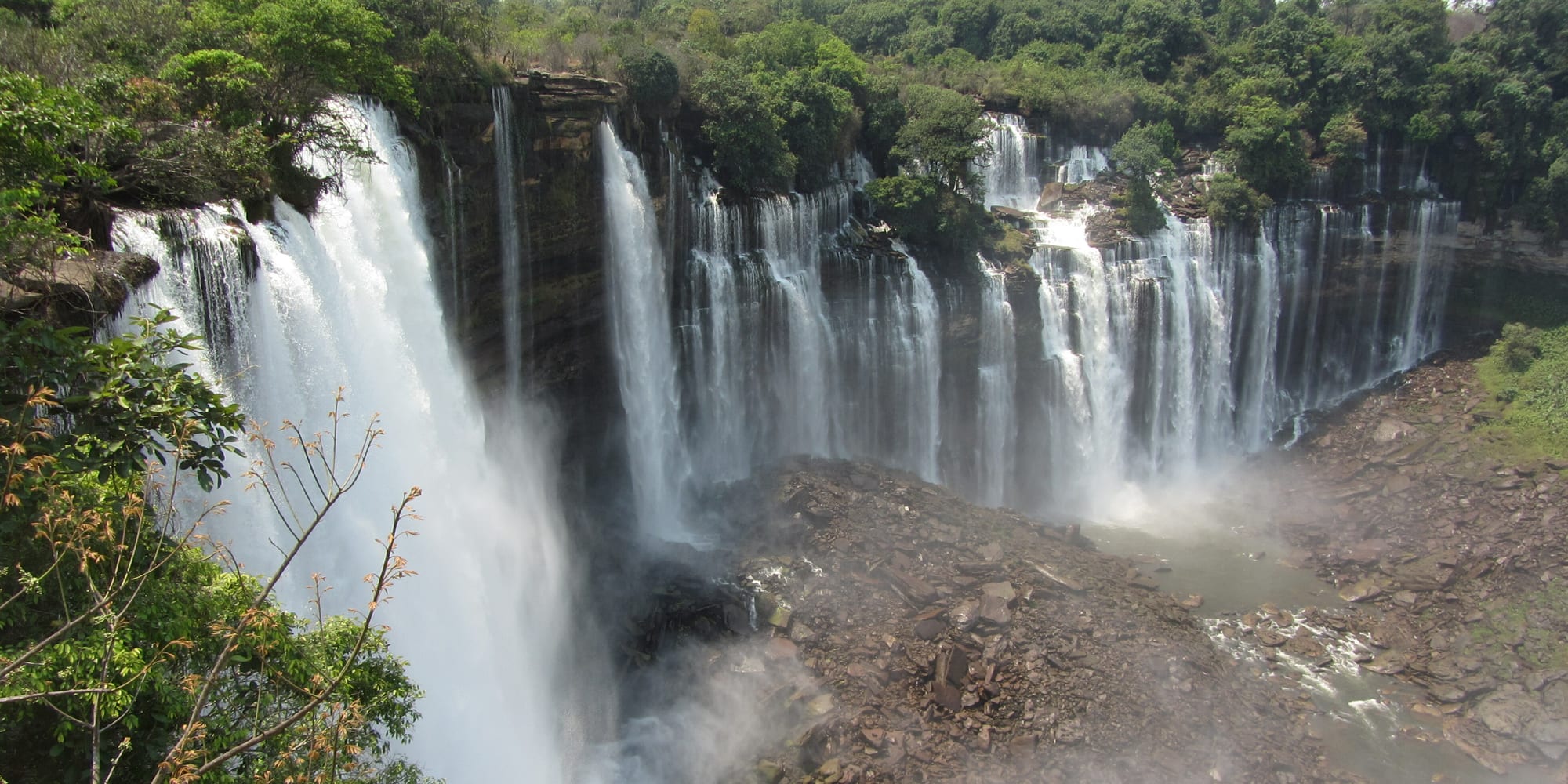
A broad curtain of waterfalls dropping over a semicircular rock face into a green gorge at Kalandula

Angola

Kalandula Falls on the Lucala River in Malanje Province, among the largest waterfalls in Africa by volume. (L. Willms / Wikimedia Commons · CC BY-SA 3.0)

A large Atlantic-facing country in southern Africa, rich in oil and diamonds, rebuilding after twenty-seven years of civil war, with waterfalls, escarpments, and a desert coast still barely visited.

Explore Angola

History

Before the Portuguese arrived, the region was organised into African states, the best known being the Kingdom of Kongo in the north and the Ndongo and Matamba kingdoms inland, the latter defended for decades in the seventeenth century by Queen Njinga, still a national symbol. Portugal founded Luanda in 1576 and, over three centuries, made the city a centre of the Atlantic slave trade, shipping enslaved Africans above all to Brazil.

Effective Portuguese control of the interior came only in the twentieth century and rested on forced labour and a settler economy. An armed independence struggle began in 1961, and when Portugal's own dictatorship fell in 1974 the colonial government collapsed. Independence on 11 November 1975 came with the Portuguese population fleeing almost overnight and three rival liberation movements already fighting each other.

The civil war that followed lasted until 2002 and became a Cold War proxy conflict: the Soviet- and Cuban-backed MPLA government against the US- and South-Africa-backed UNITA rebels. It killed somewhere between 500,000 and 800,000 people, displaced more than a million, and left the countryside heavily mined. Peace came after the UNITA leader Jonas Savimbi was killed in 2002. An oil boom funded a decade of Chinese-financed reconstruction under President José Eduardo dos Santos, in power from 1979 to 2017; his successor João Lourenço has run on anti-corruption and economic diversification.

Culture & Customs

Angolan culture layers Bantu roots with a strong Lusophone overlay — the Portuguese language, Catholicism, and a shared world with Brazil, Mozambique, and Cape Verde. Most Angolans are Christian, Catholic or Protestant, often alongside older beliefs, and the church is a central social institution.

Music is the country's great export. Semba, the swaying dance music that rose to popularity in the 1950s, is the classic sound; kizomba, born from semba and Caribbean zouk, is its slow, romantic cousin, now danced well beyond Angola; and kuduro, fast and electronic, came straight out of Luanda's working-class musseques (shantytowns) in the late 1980s. Carnival in Luanda, with competing neighbourhood groups, is a major annual celebration.

Everyday life places heavy weight on extended family, respect for elders, and hospitality, with a visitor always offered food and drink. Decades of war and displacement shaped a resilient, improvisational urban culture, and Angolan communities abroad, notably in Portugal, keep ideas flowing back.

  • Angola: The Thinker and the Dance Floor — A deeply Christian country that still defers to its elders, negotiates marriages between whole families, gathers for days to mourn its dead, and turns almost every occasion into music and dance

Daily Life

Angola is young and rapidly urbanising, and about a third of the population now lives in Greater Luanda, a crowded, expensive city of gleaming oil-money towers ringed by vast informal settlements. The economy still runs on oil, and the wealth it produces is very unevenly shared; power cuts and water shortages are routine even in the capital.

Much of daily economic life is informal. Street vendors, many of them women carrying goods on their heads, sell everything on the streets, and sprawling markets handle most retail trade. Getting around town means the packed blue candongueiro minibuses and long waits in traffic.

Outside Luanda the pace is rural and slower: farming cassava, maize, bananas, and coffee, herding cattle on the southern plateau, and fishing along the coast. Benguela and Lobito on the coast, and Lubango and Huambo in the highlands, are the other main cities, each with its own character and a stock of faded Portuguese architecture.

  • Angola: A Day Balanced on Someone's Head — A young, fast-growing country where most people earn their living off the books, many extended families share tight quarters in the capital's crowded neighbourhoods, and a basin balanced on a vendor's head is as much a fixture of the street as any shop

Food

The national dish is muamba de galinha — chicken stewed in red palm oil with okra and garlic — served over funge, a smooth porridge of cassava or maize flour that is the staple across most of the country. Calulu, a stew of dried fish cooked with greens, tomato, okra, and palm oil, is the other classic.

Other everyday dishes include moamba de ginguba (a peanut version of the palm-oil stew), beans, grilled fish and chicken with piri-piri, and, on the coast, excellent seafood. The Portuguese legacy is strong in the bread, the coffee, the grilled-meat churrasco, and pastries like pastéis de nata.

Fruit is abundant and cheap — mango, banana, papaya, pineapple, and the small sweet local bananas — and street vendors sell grilled corn, cassava chips, and kitaba, a spiced ground-peanut paste. Angola was once a major coffee exporter.

  • Angola: Food and the National Dish — Chicken stewed in red palm oil, cassava pounded into a starch as central as rice, and long lunches of grilled fish on the beach at Luanda

Attractions & Natural Wonders

Angola's landscapes are its strongest draw, if you have the time and patience to reach them. Kalandula Falls in Malanje Province is one of Africa's biggest waterfalls by volume, a broad cascade some 400 metres wide on the Lucala River; nearby stand the Pungo Andongo "Black Rocks," a cluster of huge dark monoliths on the plain.

In the south, near Lubango, the Tundavala Gap (Fenda da Tundavala) is a sheer break in the escarpment with a drop of about a kilometre and enormous views, and the hairpin Serra da Leba pass nearby is a photographed feat of road engineering. The Namib Desert reaches the country's southwest, where Iona National Park runs down to the Atlantic and the bizarre, ancient welwitschia plant grows.

Closer to the capital, Kissama (Quiçama) National Park was restocked from 2001 with elephants and other animals brought in from Botswana and South Africa and is the easiest place to see wildlife, while the "Miradouro da Lua," an eroded badland of ochre cliffs, is a short drive south of Luanda. The capital itself keeps a colonial old town, a seafront promenade, the hilltop Fortaleza de São Miguel, and the National Museum of Slavery beside the chapel where captives were once baptised before being shipped out.

  • Angola: Ten Attractions and Natural Wonders — A waterfall to rival Iguazú, a moonscape of eroded cliffs, black-rock monoliths on the savannah, and a mountain road that corkscrews down the escarpment in a knot of hairpins

Planning basics

Budget

Angola is expensive for what you get, and Luanda has long ranked among the costliest cities in the world for foreign visitors, mostly because of accommodation. The kwanza has lost most of its value over the past decade, which helps those spending hard currency but makes prices unpredictable. Cards work in Luanda hotels; cash is needed elsewhere.

Source
Traveller and expatriate cost reports, 2022–2024 — verify against a current source.
Daily Budget Midrange
USD 150–300 (business-standard hotel, car hire or domestic flights, restaurants)
Daily Budget Shoestring
USD 70–120 (hard to do; simple guesthouse, local food, shared transport)

Book Luanda accommodation ahead — cheap beds barely exist — and carry US dollars to change as you go.

Source: Traveller and expatriate cost reports, 2022–2024 — verify against a current source.

Visa Requirements

Angola was once one of the hardest countries in Africa to enter, but many nationalities are now visa-exempt and can stay 30 days per visit, up to three visits and 90 days in a calendar year. Everyone else needs a visa from an Angolan mission or a pre-visa applied for online; a tourist visa is valid for 30 days and can be extended once by another 30.

Typical Validity
30 days for tourism, extendable once; visa-free entry for many passports

Check whether your nationality is visa-exempt before you book, and check the vaccination requirements, yellow fever included.

Safety

Crime is the main concern, especially in Luanda: street robbery, carjacking, and theft are common, and visitors are advised not to walk after dark or display valuables. Police checkpoints may seek bribes. Landmines still restrict some rural areas despite years of clearance, and the Cabinda exclave has a long-running low-level separatist insurgency.

Source
US Department of State and UK FCDO travel advisories — check for the latest wording.
Photography
Photographing government buildings, the presidential palace, airports, and military sites is prohibited.

Use hotel or arranged transport in Luanda, avoid overland travel in and around Cabinda, and stay on cleared tracks in former conflict provinces.

Source: US Department of State and UK FCDO travel advisories — check for the latest wording.

Climate

Tropical, with a cool, dry season known as the cacimbo from about May to September and a hot, humid rainy season from October to April. The north and interior are wetter and greener; the south and the coast are arid, and the Namibe region is true desert.

Luanda
hot and humid; rainy season Nov–Apr, drier and slightly cooler May–Sep
Highlands
cooler year-round; Lubango and the Huíla plateau can be chilly at night in the dry season
South Coast
desert; very little rain, cool ocean air

Transportation

Angola has three separate railway systems, the most useful being the Benguela Railway, rebuilt between 2006 and 2014, which runs from the port of Lobito inland to the Congolese border. For long distances most people fly on TAAG or another domestic carrier. Cities are served by blue-and-white candongueiro minibus taxis; intercity roads are much improved but still variable.

Roads
Main corridors rebuilt and paved; secondary roads rough, worse in the rains
Main Hub
Dr. António Agostinho Neto International Airport, 40 km south-east of Luanda

Distances are large and Luanda traffic is severe — allow far more time than the map suggests.

Best Time to Visit

The dry season, roughly June to September, is the time to go: less rain, firmer roads, easier wildlife viewing in Kissama, and comfortable temperatures on the highlands. The rainy season brings the waterfalls to full force but makes upcountry travel harder.

Avoid
The peak of the rains (Feb–Mar) for road trips into Malanje or the interior.

Currency

The currency is the Angolan kwanza (AOA). It has devalued sharply and repeatedly, so quoted prices in kwanza date quickly; think in US dollars and expect the rate to move.

Symbol
Kz
Cash To Bring
US dollars, to change locally
Currency Code
AOA — Angolan kwanza

Language

Portuguese is the official language and is spoken by most of the population, especially in the cities, often as a first language. Alongside it are several Bantu languages — Umbundu is the most widely spoken, followed by Kimbundu and Kikongo.

English
Limited, mostly in the oil industry and top-end hotels
Other Languages
Umbundu, Kimbundu, Kikongo, Chokwe and others
Official Language
Portuguese