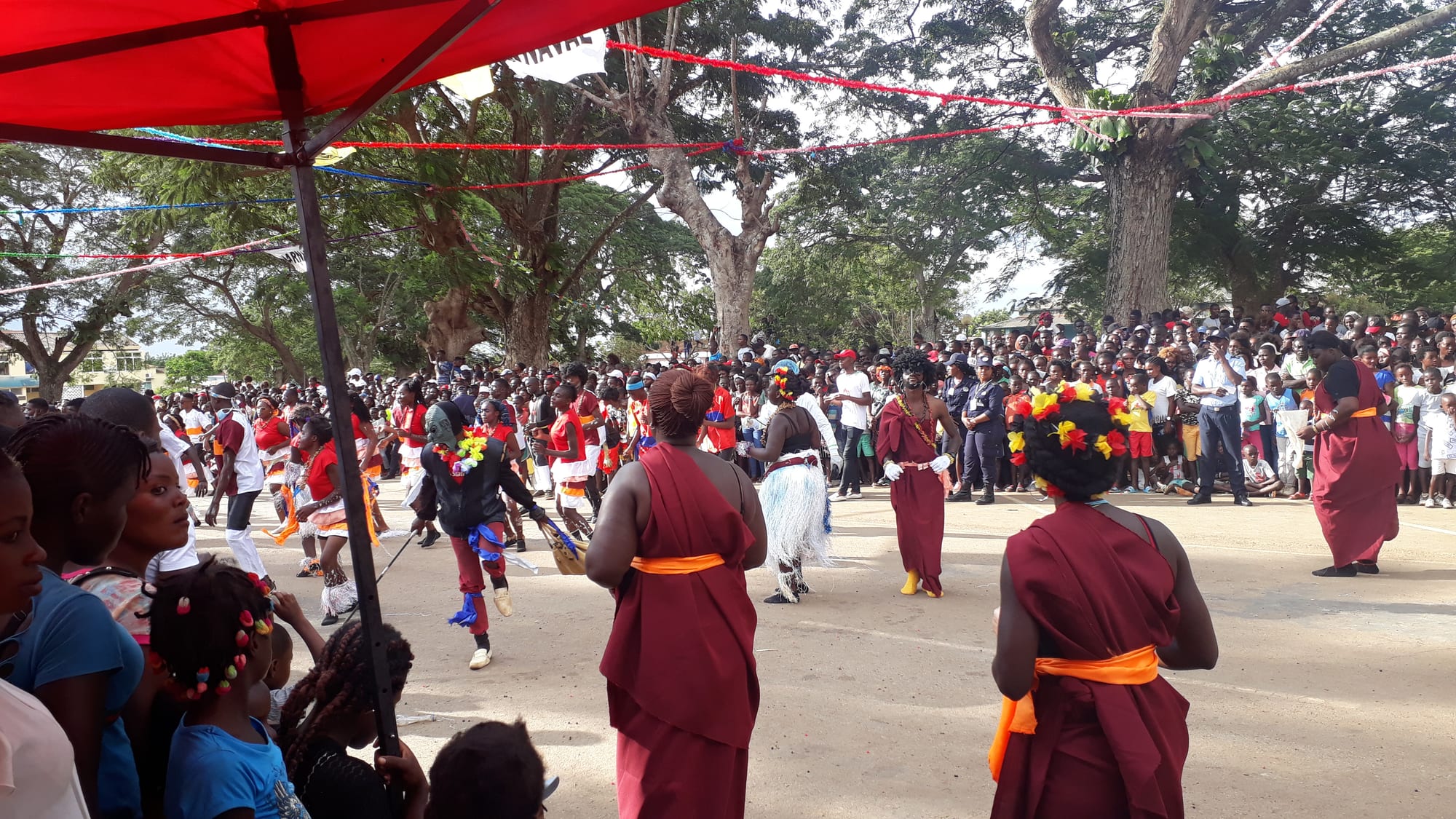
Carnival groups in red costumes dancing on a bare earth square shaded by large trees, watched by a crowd

Luanda & the North, Angola

Mbanza-Kongo

A carnival group parading on a tree-shaded square in Mbanza-Kongo. (André Semeador / Wikimedia Commons · CC BY-SA 4.0)

A hilltop town in Angola's far north, capital of Zaire province and, for centuries, the royal seat of the Kingdom of Kongo. Portuguese ships reached the kingdom in the 1480s and its kings adopted Christianity; the town was called São Salvador from 1570 until 1976. Its royal enclosure, tombs and ruined cathedral became a World Heritage Site in 2017.

Neighbourhoods

  • The old royal quarter
    • First-time visitors
    • Historic district

    The plateau at the top of the town, where the former royal enclosure, the cathedral ruins and the burial places of the kings stand among trees and open ground. It is quiet, largely free of traffic, and treated with respect by residents as much as by visitors.

    Open in Maps
  • Town centre
    • Markets
    • Local life
    • Places to stay

    The grid of streets below the plateau, with the administration buildings of Zaire province, banks, the main market, small restaurants and most of the town's guesthouses. Everything here is within a short walk.

    Open in Maps
  • The outskirts
    • Quiet and residential
    • Views

    Low housing and smallholdings spread along the roads out of town towards the airport and the border, with views over the surrounding plateau and the valleys that fall away towards the Congo river.

    Open in Maps

Things to do

The royal city

  • Kulumbimbi, the cathedral ruinslandmark

    The roofless stone walls of the church begun in 1491 under João I, extended under Afonso I and raised to cathedral status in 1596, which many Angolans hold to be the oldest church in sub-Saharan Africa; it was left in ruins after the city was abandoned in 1678.

    Open in Maps
  • The royal burial ground and the sunguilulandmark

    The ground long held to hold the graves of the Kongo kings, together with the sunguilu, a low rectangular structure where tradition says a king's body was washed before burial; both are places of ceremony rather than display, visited with local custodians.

    Open in Maps
  • Yala Nkuwulandmark

    The manikongo's judgement tree, under which by tradition the kings held court, still standing in the lower part of the town on the grounds of the royal palace and the museum.

    Open in Maps
  • The Royal Museummuseum

    The town's museum of the kingdom, rebuilt as a modern structure on the grounds of the royal palace, holding artefacts of the old kingdom, though many were lost from the earlier building during the civil war of 1976–2002.

    Open in Maps

Around the town

  • The provincial marketmarket

    The main market below the plateau, selling cassava, greens, dried fish, palm oil and goods brought across the nearby border, and the busiest place in town most mornings.

    Open in Maps
  • The plateau edgeviewpoint

    The rim of the escarpment at the edge of town, with long views north over green valleys towards the Congo river basin.

    Open in Maps
  • M'banza Congo Airporttransit hub

    The small airport a short drive from the centre, with domestic flights that are the usual way in from Luanda.

    Open in Maps

Seasonal events

  • CarnivalFebruary or March, before Lent

    Costumed neighbourhood groups parade and compete on the town's squares, a provincial version of the national carnival.

  • Kongo cultural festivalsdry season, June to September

    Gatherings of Bakongo cultural groups, dancers and traditional authorities are held in the royal city in the drier months, with dates that move from year to year.

Eat and drink

Long-standing places and food districts in Mbanza-Kongo. Hours, ratings and directions come from your maps app, always current.

Local kitchens and markets

  • The market food stallsmarket

    Cassava bread, grilled and smoked fish, beans, greens and fruit are sold at and around the market, with women cooking at braziers along its edges.

    Open in Maps
  • Town-centre restaurantsneighborhood

    A handful of simple places near the administrative centre serve funge with fish or chicken, kizaka and grilled goat, with cold beer brought up from Luanda.

    Open in Maps

Experience Mbanza-Kongo

History

Mbanza-Kongo was the capital of the Kingdom of Kongo, a state that ruled a broad belt of country either side of the lower Congo river. The town sits on a flat hilltop with long views and defensible slopes, and around the royal enclosure lived the court, the king's officials and a large population, making it one of the largest urban centres in central Africa before European contact.

Portuguese ships reached the kingdom in the 1480s, and relations began as an exchange of embassies rather than conquest. The ruler Nzinga a Nkuwu was baptised in 1491, taking the name João; his son Afonso I built the kingdom into a Christian state with a Portuguese-speaking court, stone churches and letters exchanged with Lisbon and Rome. The capital came to be called São Salvador, a name used from 1570, and the church begun in 1491 was raised to cathedral status in 1596; its ruins are still known as Kulumbimbi.

The same trade that brought priests and masons also drained the kingdom of people, as the Atlantic slave trade pulled captives through Kongo territory. Defeat by Portuguese forces at Mbwila in 1665 broke royal authority, and the capital was abandoned for a time before a reduced kingship returned. Portuguese rule was formally imposed in the late nineteenth century, and the town spent the colonial period as a quiet district centre called São Salvador, taking back its old name in 1976, the year after independence. In 2017 the historic remains were inscribed on the UNESCO World Heritage List as Mbanza Kongo, Vestiges of the Capital of the former Kingdom of Kongo.

Culture & Customs

The town is the symbolic centre of Bakongo identity, which reaches across the borders into both Congos. Kikongo is the first language of most residents, and many families have relatives in Kinshasa or Matadi and speak French or Lingala from years spent there during the civil war. Portuguese is the language of school, office and administration.

Respect for the Kongo past is not antiquarian here. The royal enclosure, the tombs of the kings and the old court tree are treated as places with living meaning, visited by traditional authorities as well as researchers, and the kingship survives as a ceremonial institution recognised by Bakongo communities. Visitors are expected to move through these places with a custodian and to accept restrictions on where they walk and photograph.

Christianity arrived here earlier than almost anywhere else in sub-Saharan Africa, and Catholic and Protestant churches are both strong, with a prophetic tradition running through the region that produced the Kimbanguist and Tokoist movements. Church choirs, drumming and dance are part of ordinary weekends. Carnival is celebrated in the town's squares before Lent, and Kongo cultural festivals in the drier months bring together dancers, storytellers and craftworkers from across the old kingdom's territory.

Daily Life

Mbanza-Kongo is a provincial capital of modest size — a town of 221,141 people at the 2024 count, including the districts that have grown around the old centre — and it works as an administrative and trading place rather than an industrial one. Provincial government, schools, the hospital and the church are the main employers, along with the market and small building trades.

Most households farm as well, growing cassava, bananas, maize and beans on plots around the town, and cassava in its many forms is the basis of the local economy as much as the local diet. Trade across the nearby Democratic Republic of the Congo border is a mainstay: goods, currency and people move both ways, and prices in the market reflect what is cheaper on the other side.

The day begins early and slows in the heat of the afternoon. Water supply and electricity are unreliable, generators are common, and the roads outside the paved centre become difficult in the rains. Since the World Heritage inscription the town has seen investment in roads, the museum and the protection of the historic area, and visitors, mostly Angolan, are a small but growing presence.

Food

Cooking here belongs to the Bakongo world rather than to Luanda. Cassava is the foundation: the root is dried and pounded into flour for funge, the smooth porridge eaten with the hand, and fermented, wrapped in leaves and steamed to make kikwanga, the dense sour bread shared with the Congos. The leaves are pounded into kizaka, a green stew cooked with palm oil, groundnuts or fish.

Fish comes dried or smoked from the coast and the rivers; chicken, goat and, in villages, game are grilled or stewed with tomato, onion and chilli. Beans cooked in red palm oil, plantains and sweet potato fill out the plate, and jindungo, the small fierce local chilli, is served on the side. Peanuts appear in sauces and as kitaba, a spiced paste eaten with bread.

Fruit is abundant and cheap in season — mango, papaya, pineapple, avocado and small sweet bananas. Palm wine, maluva, is tapped in the villages and drunk fresh, sugar cane spirit is made locally, and bottled beer brewed in Luanda is sold in every bar. Coffee from the Uíge hills to the south-east, once a major export crop, still reaches the market in small quantities.

Planning tools

Budget

Prices are far lower than in Luanda, but choice is limited: the town has a small number of guesthouses and hotels aimed at officials and business travellers rather than tourists, and meals are cheap in local restaurants. The real cost of a visit is getting there, whether by domestic flight or by hiring a car with a driver.

Daily Budget Midrange
USD 120–220 (the better hotels in town, restaurants, a car and driver)
Daily Budget Shoestring
USD 50–90 (guesthouse, market meals, shared taxis)

Cash is essential — cash machines are few and cards are rarely accepted outside the main hotels.

Best Time to Visit

June to September, the dry season, is the most comfortable time: roads are passable, the plateau is cooler and the royal city can be walked without rain. The wet months from October to May are hot and humid, with heavy storms that turn unpaved roads to mud, though the countryside is at its greenest.

Suggested Number of Days

One day is enough for the royal city and the museum, two for a slower look at the town and its market with a guide. Overland travel from Luanda adds most of a day in each direction, so the journey, not the sights, usually decides the length of a visit.

First Visit
1–2 days
With Surroundings
2–3 days

Transportation

The town is small enough to walk, and shared taxis and motorcycle taxis cover the outskirts and the road to the airport. There is no public transport for visitors in any organised sense; a car with a driver, often arranged through a hotel, is the practical way to move between the town and places outside it.

Fuel, spare time and cash for checkpoints are worth allowing for on any road journey in the province.

Airport & Station Connections

Domestic flights from Luanda to M'banza Congo Airport are the usual way in. The overland alternative is a long drive north through Caxito and Uíge on paved highway and slower secondary roads, normally counted as a full day. The Democratic Republic of the Congo border lies close to the north, and crossings need paperwork arranged in advance.

Walkability

The centre and the royal quarter are compact and easily covered on foot, with the plateau a gentle climb above the commercial streets. Pavements are patchy and there is little shade on the open ground of the historic site, so walking is easier early or late in the day.

Safety

The northern provinces are calmer than Luanda, and Mbanza-Kongo has the petty theft of any small town rather than serious crime. Police checkpoints are frequent on the roads, some rural areas still carry landmine risk from the war, and malaria is present throughout the region. Medical facilities are basic.

Crime is the main concern, especially in Luanda: street robbery, carjacking, and theft are common, and visitors are advised not to walk after dark or display valuables. In Mbanza-Kongo the practical points are identification at checkpoints, staying on used tracks and paths in the countryside, asking permission before photographing people or official buildings, and malaria precautions. Check current official travel advice before travelling.

Climate

Tropical and markedly wetter than the coast, with a long rainy season from about October to May and a drier, cloudier season from June to September. The town stands high enough for nights to be cooler than in Luanda. Angola lies in the southern hemisphere, so summer falls in December to February.

Summer
the rainy season, hot and humid at around 27–32°C, with heavy afternoon storms
Winter
drier and milder, roughly 20–28°C, often overcast in the mornings

Local Customs

This is Bakongo country: Kikongo is widely spoken alongside Portuguese, and French or Lingala are common among families who spent the war years in the Congos. The royal sites are sacred as well as historical, and traditional authorities still hold standing in the town. Modest dress is expected, and greetings before questions are the norm.

Visit the royal enclosure and the tombs with a local guide or custodian, follow instructions about where to walk and photograph, and ask before taking pictures of people.

Common Payment Methods

The currency is the Angolan kwanza (AOA), and this is a cash town: markets, taxis and small restaurants take nothing else. Cash machines exist in the centre but can be out of service or out of notes, so kwanza brought from Luanda, along with some US dollars, is the safest arrangement.