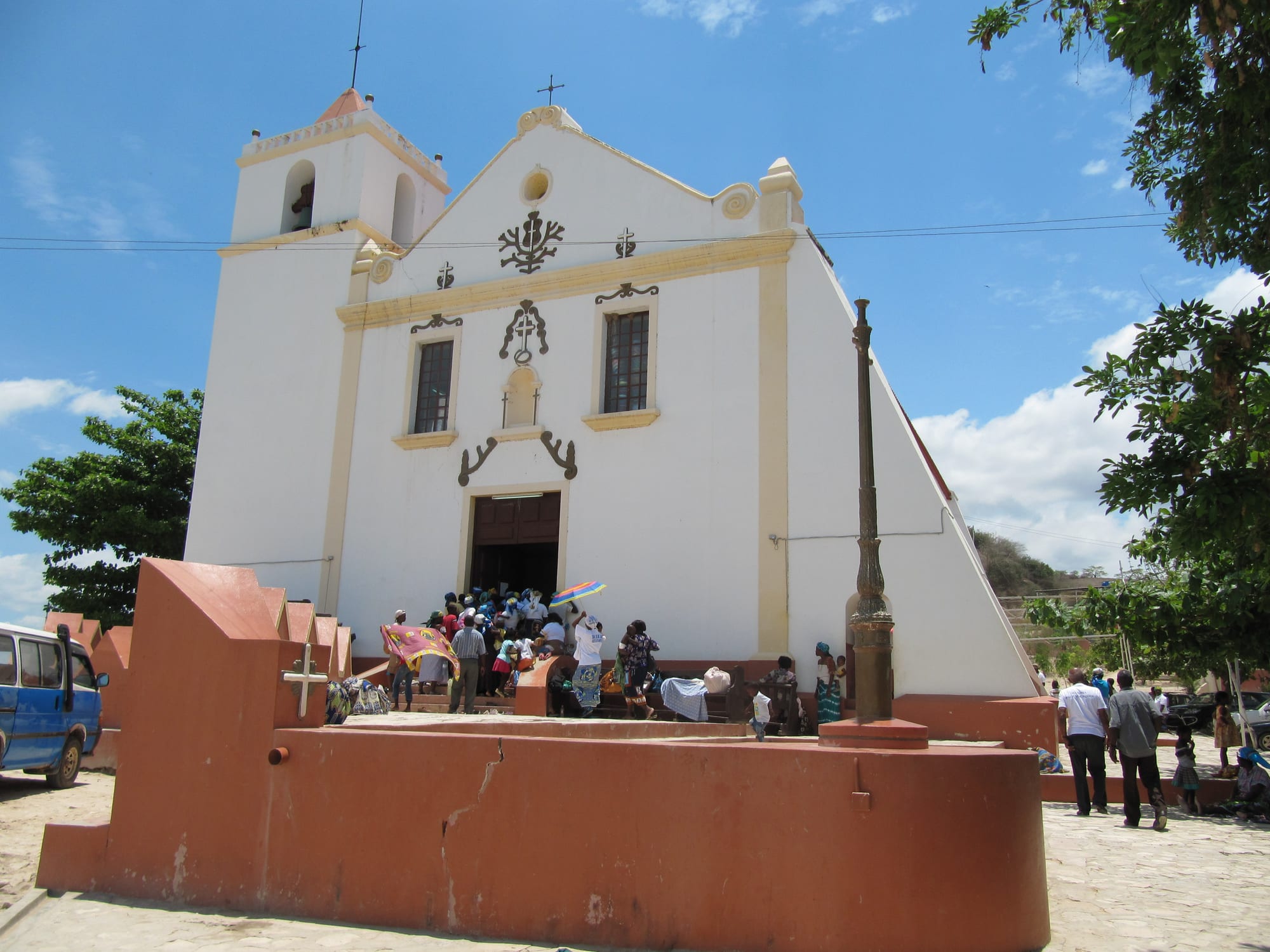
A whitewashed church with a bell tower and scrolled gable on a cobbled terrace, with people gathered at its open door

Luanda & the North, Angola

Muxima

The pilgrimage church of Nossa Senhora da Conceição at Muxima, above the Kwanza river. (Paulo César Santos / Wikimedia Commons · CC0)

A small village on the lower Kwanza river, inland from the Atlantic and some 130 kilometres from Luanda. Its white church, built by the Portuguese in 1599, is a Marian shrine that draws pilgrims from across the country. An old fort stands above the river, and Quiçama National Park lies nearby.

Neighbourhoods

  • The church terrace
    • First-time visitors
    • Historic district

    The raised, cobbled platform around the white church, the centre of village life and the focus of every pilgrimage. Stalls selling candles, rosaries and drinks gather along its edges, and the ground fills with families on the busiest weekends.

    Open in Maps
  • The riverside
    • Quiet and scenic
    • Fishing

    The bank of the Kwanza below the church, where canoes are pulled up, fishermen work the shallows and washing is done. Reeds and trees line the water, and the broad river is the reason a fort was built here in the first place.

    Open in Maps
  • The village and the road
    • Local life
    • Markets

    A scatter of single-storey houses, small shops, bars and a market along the road that runs through the village. It is modest and unhurried, with almost everything within a few minutes' walk.

    Open in Maps

Things to do

The shrine and the old village

  • Church of Nossa Senhora da Conceiçãolandmark

    The whitewashed church above the river, built by the Portuguese in 1599 and long a place of devotion for pilgrims; captives were baptised here before being shipped away during the slave trade.

    Open in Maps
  • Fortress of Muximalandmark

    The Portuguese fort of stone and mortar built in 1599 above the Kwanza to control traffic on the river, with views over the water from its walls.

    Open in Maps
  • Pilgrimage stalls and marketmarket

    Candles, images, rosaries, palm oil, fruit and grilled food are sold from stalls around the church terrace and along the village road, busiest when pilgrims arrive.

    Open in Maps
  • The Kwanza riverbankattraction

    The working waterfront below the village, with dugout canoes, fishermen and long views up and down a river wide enough to feel like a frontier.

    Open in Maps

Short trips from the village

  • Quiçama National Parkpark

    Coastal savanna, baobabs and riverine forest south of the Kwanza, restocked with elephants and other animals after the civil war.

    Open in Maps
  • Kwanza Riverattraction

    Angola's longest river, running past the village and navigable for some 240 kilometres from a mouth on the Atlantic south of Luanda.

    Open in Maps
  • Cabo Ledobeach

    A beach below cliffs on the Atlantic coast beyond the park, in the province of Icolo e Bengo created in 2024.

    Open in Maps

Seasonal events

  • Marian pilgrimagesthroughout the year, with the largest gatherings on feast days

    Pilgrims travel from Luanda and far beyond to the shrine, arriving on foot, by bus and by boat; the biggest occasions fill the church terrace and the village for days.

  • Dry seasonJune to September

    Not an event but the cacimbo, when the roads from Luanda and through the park are at their firmest and visitor numbers are highest.

Eat and drink

Long-standing places and food districts in Muxima. Hours, ratings and directions come from your maps app, always current.

Village kitchens and stalls

  • Riverside fish grillsneighborhood

    Fish from the Kwanza, grilled whole and served with funge, beans in palm oil and boiled cassava, is the staple meal in the village's few small eating places.

    Open in Maps
  • Stalls around the churchmarket

    Grilled corn, fried cassava, skewers, bread, fruit and cold drinks are sold to pilgrims from tables and braziers beside the terrace.

    Open in Maps

Experience Muxima

History

The lower Kwanza was the route by which Portuguese power moved inland from Luanda, and Muxima was one of its first footholds. The Portuguese occupied the site in 1589, and in 1599 built both a fortress of stone and mortar above the river, part of a chain of posts meant to control river traffic and the approaches to the Ndongo kingdom upstream, and the church that stands beside it.

The name comes from the Kimbundu word for heart, and the shrine's devotion to Nossa Senhora da Conceição took root early, drawing both the Portuguese garrison and the Kimbundu-speaking population of the river valley. For three centuries the Kwanza carried captives, ivory and later produce down to the coast; Muxima was a centre of that trade, and the church is where captives were baptised before being deported.

As Portuguese administration moved elsewhere the fort lost its purpose and the village shrank to a rural settlement, but the pilgrimage continued and grew. In the civil war the region between the Kwanza and the coast saw fighting and displacement, and the church served as a refuge and a reason to keep coming back. Since 2002 the roads have been rebuilt, Quiçama National Park nearby has been restocked, and Muxima has become a day trip from Luanda as well as a place of pilgrimage, with the historic buildings the subject of repeated restoration work.

Culture & Customs

Muxima's identity rests almost entirely on its shrine. Pilgrims come from every province, many walking the last stretch, and the arrival of large groups turns the village into a camp of singing, drumming and overnight vigils. Devotion to Nossa Senhora da Conceição is expressed with candles, flowers, photographs of the sick and handwritten petitions left inside the church, and many families return year after year to fulfil a promise made in hard times. Pope Leo XIV led the rosary at the shrine in April 2026, during a papal visit to Angola.

Catholic practice here sits alongside older Kimbundu understandings of ancestors, healing and place, and few people see a contradiction. Music is central: hymns sung in Portuguese and Kimbundu, drums, and the kind of processional singing that carries along the riverbank. Outside the pilgrimage days the village is quiet, its rhythms those of a farming and fishing settlement.

Visitors are welcome but the church is not a monument to be wandered through during prayer, and local custom expects modest dress, quiet voices and permission before photographing worshippers. Greetings are exchanged before questions, and elders are addressed first. Small purchases from the stalls, and a contribution at the shrine, are the customary courtesies of a visit.

Daily Life

A few thousand people live in and around Muxima, in single-storey houses along the river and the road, in the municipality of Quiçama, a district of scattered farming villages that became part of the new province of Icolo e Bengo in 2024 and of which Muxima is the seat. There is a school, a health post, a police station and a market; most other services mean a journey to Luanda or to the larger towns on the coast road.

Livelihoods come from the river and the land. Fishermen work the Kwanza from dugout canoes, families grow cassava, maize, bananas and vegetables on the floodplain, and palm oil is pressed locally. The pilgrimage is the other economy: stalls, transport, food and rooms, concentrated into the busiest weekends, and enough to matter in a place with few other sources of cash.

Water, electricity and mobile coverage are uneven, and generators run in the evenings. The day starts at first light, quietens through the heat of the afternoon and picks up again as the air cools. Young people often leave for Luanda for work or study, and the road that brings pilgrims in also carries produce out to the capital's markets.

Food

Meals here are riverine versions of Angola's staples. Fish from the Kwanza — grilled whole, fried or dried — is eaten with funge, the smooth porridge made from cassava flour, and with feijão de óleo de palma, beans slow-cooked in red palm oil. Boiled cassava, sweet potato and plantain fill out the plate, and a sharp raw onion and vinegar relish is often served alongside.

Calulu, fish or meat stewed with dried fish, greens, tomato, okra and palm oil, appears at family meals and on feast days, as does muamba de galinha, chicken cooked in palm oil with okra and garlic. Kizaka, pounded cassava leaves cooked with groundnuts, is a daily green. Jindungo chilli, ground or steeped in oil, is on every table.

Around the church the food is portable: grilled corn on the cob, fried cassava, skewers of meat, bread, bags of mango, papaya and small bananas, and sweet fried dough. Palm wine, maluva, is tapped in the villages nearby and drunk the same day, kissângua, a lightly fermented maize drink, is made at home, and bottled beer comes up from Luanda.

Planning tools

Budget

Muxima is inexpensive but barely equipped for visitors: accommodation is limited to a few very simple rooms, and most people come for the day from Luanda or stay at a lodge on the Kwanza or in Quiçama. Food at village stalls costs very little; the substantial expense is the vehicle that gets there.

Daily Budget Midrange
USD 150–300 (a river or park lodge, restaurant meals, a car and driver from Luanda)
Daily Budget Shoestring
USD 40–80 (very simple room or a day trip, stall food, shared transport)

Cash in kwanza covers everything here, since there are no cash machines to rely on and cards are not accepted.

Best Time to Visit

The dry cacimbo from June to September gives the firmest roads, the easiest wildlife viewing in Quiçama and comfortable temperatures. The rains from November to April are hot and humid and can make the approach roads rough, although the river is high and the country green. Pilgrimage days are crowded at any season.

Suggested Number of Days

The village and its church take a couple of hours, which is why most visitors come for the day from Luanda. Two or three days make sense only when combined with the national park, the river and the coast, or when a pilgrimage is under way and the village stays busy into the night.

First Visit
half a day
With Surroundings
2–3 days

Transportation

Everything in the village is within walking distance. Beyond it, transport means a hired car with a driver, an occasional shared minibus on the Luanda road, or a boat on the river. There are no taxis waiting, so arrangements for the return journey are made in advance.

A vehicle with decent ground clearance is worth having, since the side roads towards the park and the river are unpaved.

Airport & Station Connections

Muxima lies roughly 130 kilometres from Luanda, usually reached by the coastal highway south, across the Kwanza bridge and then inland on a secondary road — two to three hours in normal conditions, longer leaving the capital in traffic. Some pilgrims arrive by boat up the Kwanza, and tour operators in Luanda combine the village with Quiçama in a single day out.

Walkability

The village is small, flat along the river and easy to walk end to end, with a short climb to the church terrace. Surfaces are cobbles, sand and packed earth, there is little shade at midday, and no street lighting to speak of after dark.

Safety

The village is calm and crime is not the concern it is in Luanda, though crowds on pilgrimage days bring pickpocketing. Malaria is present along the river, the Kwanza has crocodiles and strong currents, police checkpoints are frequent on the roads, and some rural areas of the region still carry landmine risk from the war.

Crime is the main concern, especially in Luanda: street robbery, carjacking, and theft are common, and visitors are advised not to walk after dark or display valuables. Around Muxima the practical points are keeping to used tracks and paths in the countryside, taking local advice before going near or into the river, carrying identification at checkpoints, and malaria precautions. Check current official travel advice before travelling.

Climate

Tropical and hot, a little more humid than the coast because the village sits inland on the river. Rain falls from about November to April and the cacimbo from June to September is dry, overcast and cooler. Angola is in the southern hemisphere, so summer falls in December to February.

Summer
hot and humid, commonly 28–33°C by day, with heavy showers and mosquitoes
Winter
the cacimbo, drier and milder at around 20–27°C, often grey in the mornings

Local Customs

The church is a place of devotion before it is a sight: pilgrims pray, light candles and leave offerings, and many arrive having walked a long way. Modest dress and quiet behaviour inside are expected, and photographing people at prayer requires permission. Portuguese is the common language, with Kimbundu widely spoken in the villages along the river.

Services and pilgrimages take precedence over sightseeing, so visits to the interior of the church fit around them, and offerings left at the shrine are not to be disturbed.

Common Payment Methods

The Angolan kwanza (AOA) in cash is the only practical means of payment. There are no cash machines to count on and cards are not accepted, so money is brought from Luanda; US dollars may be changed informally but at poor rates.