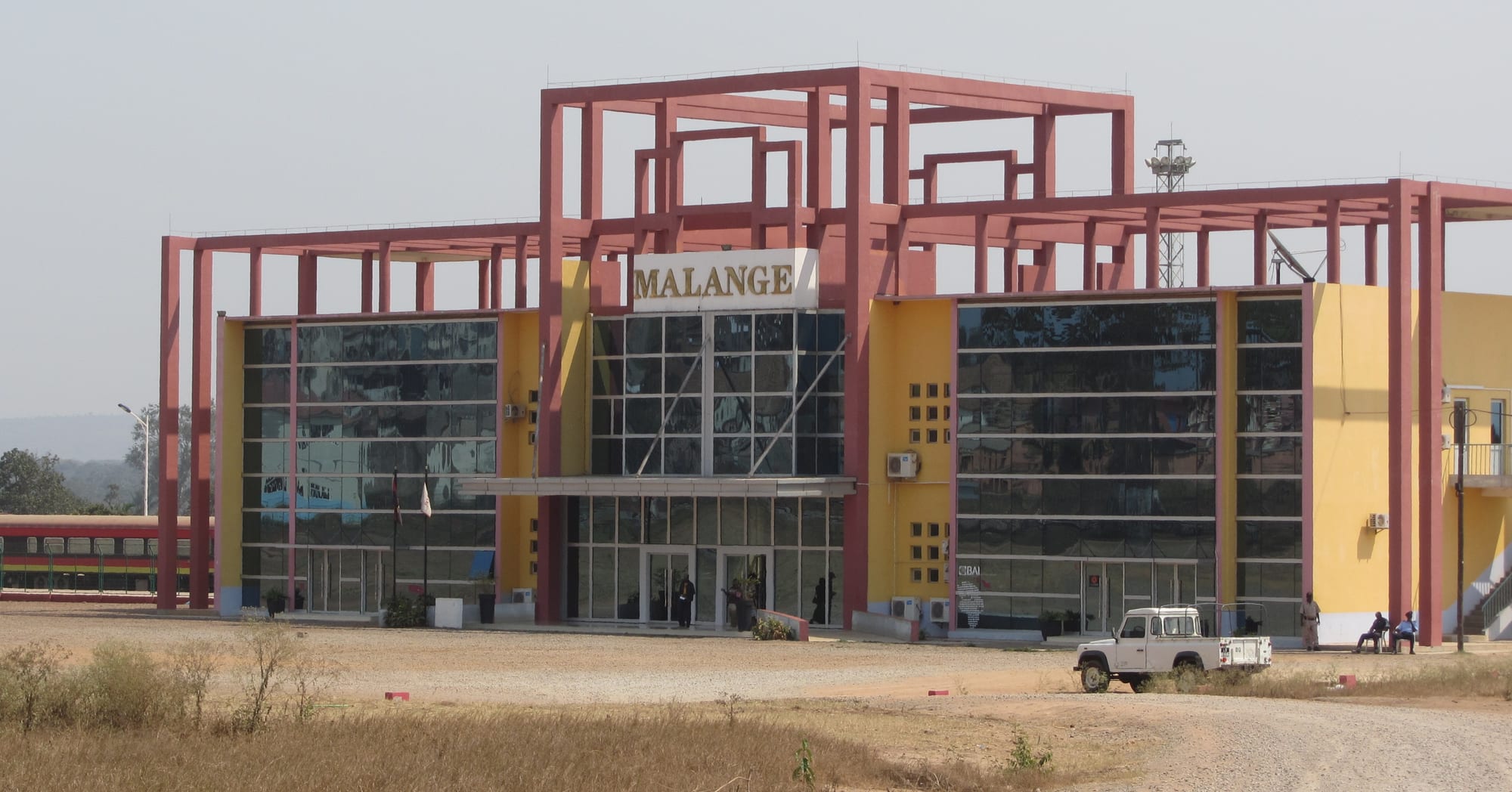
A low modern railway station in pink and yellow with a glass front and a red steel frame above it, under a pale sky

Malanje & the Northeast, Angola

Malanje

The rebuilt railway station at Malanje, the inland end of the line from Luanda. (L.Willms / Wikimedia Commons · CC BY-SA 3.0)

A provincial capital on a plateau in Angola's interior, about 1,100 metres up and reached from Luanda by a paved highway and a rebuilt railway that ends here. Founded as a colonial trading and farming centre in coffee and cotton country, it was fought over in the civil war and now serves as the base for the Kalandula falls and the rocks of Pungo Andongo.

Neighbourhoods

  • The centre
    • First-time visitors
    • Historic district
    • Places to stay

    Wide colonial avenues, gardens with pergolas and palms, pink and white administrative buildings and newer concrete blocks. The cathedral, the provincial government, banks, restaurants and most of the city's hotels are here, within a few streets of one another.

    Open in Maps
  • Around the station
    • Close to public transport
    • Local life

    The area around the rebuilt railway terminus at the edge of the city, busy when trains from Luanda arrive and lined with stalls, shared-taxi ranks and small workshops.

    Open in Maps
  • The market quarter
    • Markets
    • Best for food

    The trading heart of the city, where produce from the surrounding farms — beans, cassava, maize, sweet potatoes and fruit — is sold alongside clothes and household goods, loudest and fullest in the morning.

    Open in Maps
  • The outskirts
    • Quiet and residential

    Low housing, smallholdings and newer estates spreading towards the airport and the roads to Kalandula and Luanda, where many families farm plots as well as working in town.

    Open in Maps

Things to do

In the city

  • Malanje railway stationtransit hub

    The rebuilt terminus of the Luanda line, a landmark of the reconstruction years and the arrival point for passengers from the coast.

    Open in Maps
  • The cathedrallandmark

    The city's Catholic cathedral in the centre, seat of the archdiocese of Malanje, raised from a diocese in 2011, among the colonial-era grid of avenues.

    Open in Maps
  • Malanje Airporttransit hub

    The airport on the edge of the city, built in the colonial era; it has no scheduled flights to Luanda.

    Open in Maps
  • The central marketmarket

    The main produce market, supplied by the farms of the plateau and the source of much of what reaches Luanda's stalls.

    Open in Maps
  • The colonial avenues and gardensattraction

    Tree-lined streets, small public gardens with pergolas and pastel buildings from the Portuguese period, many still marked by the civil war and since repaired.

    Open in Maps

Wildlife and nature

  • Cangandala National Parkpark

    Miombo woodland and dambo grassland south of the city, created in 1970 to protect the giant sable antelope, the palanca negra gigante, which survived the war in tiny numbers.

    Open in Maps

Short trips from the city

  • Kalandula Fallsattraction

    A broad horseshoe of cascades on the Lucala river, about 105 metres high and 400 metres wide, one of the largest waterfalls in Africa by volume, seen from the top and from a path towards the base.

    Open in Maps
  • Pedras Negras de Pungo Andongolandmark

    Huge dark rock towers rising straight from the plain, a stronghold of the Ndongo kings taken by the Portuguese in 1671, with a ruined fort and rock marks linked in legend to Queen Njinga.

    Open in Maps
  • Capanda Damattraction

    A large hydroelectric dam on the Kwanza river, built between 1987 and 2007, with a reservoir behind it.

    Open in Maps
  • Baixa de Cassanjeattraction

    The broad lowland east of the plateau, once the kingdom of Kasanje and later the cotton district where growers rose against forced cultivation in 1961.

    Open in Maps

Seasonal events

  • CarnivalFebruary or March, before Lent

    Costumed groups parade in the city centre in the days before Lent, a provincial version of the national celebration.

  • Colonial Martyrs Repression DayJanuary

    The 4th of January is a national holiday remembering the 1961 uprising in the Baixa de Cassanje east of the city, marked with ceremonies in the province.

  • End of the rainsMarch and April

    Not an event but the season when the Lucala is at its fullest and the Kalandula falls are at their most powerful, while the roads begin to dry out.

Eat and drink

Long-standing places and food districts in Malanje. Hours, ratings and directions come from your maps app, always current.

Malanje kitchens

  • Market food stallsmarket

    Funge with beans and dried fish, grilled meat, fried cassava and sweet potato and seasonal fruit are cooked and sold at the edges of the market.

    Open in Maps
  • Centre restaurantsneighborhood

    Simple places around the avenues serve grilled chicken and goat, calulu, muamba and funge, with Portuguese-style bread and coffee in the mornings.

    Open in Maps

Roadside food

  • Grills on the Luanda roadneighborhood

    Stalls along the highway sell grilled goat and chicken, corn on the cob and bags of fruit to travellers heading to the falls or the coast.

    Open in Maps

Experience Malanje

History

Malanje grew from a Portuguese trading post established on the plateau in the nineteenth century, at the point where caravan routes from the interior met the roads down to the coast. The country around it had been the heartland of Ndongo, the Kimbundu kingdom whose ruler's title, ngola, gave Angola its name, and the rock fortress of Pungo Andongo to the south-west had been a royal stronghold until Portuguese forces took it in 1671.

The colonial town took its modern shape in the twentieth century, laid out with wide avenues and gardens as an administrative centre for a farming province of coffee, cotton, cassava and maize, much of it worked under forced labour. The railway from Luanda reached the city in 1909, making it the inland terminus of the line and the collecting point for produce leaving for the coast. In January 1961, cotton growers in the Baixa de Cassanje lowlands east of the city rose against forced cultivation and were crushed by the colonial army, an event now commemorated nationally on 4 January.

The civil war hit the province hard. The city was partly destroyed in the fighting, production of cotton, coffee and maize collapsed, and much of the surrounding countryside was mined and depopulated. Since the peace of 2002 the railway and the highway to Luanda have been rebuilt, the station reopened, farms have returned to the plateau and the city has become the base for visitors to Kalandula and Pungo Andongo.

Culture & Customs

Malanje is Kimbundu country, and the language is heard in the markets and villages alongside the Portuguese of school and office. Queen Njinga, who fought and negotiated with the Portuguese in the seventeenth century, is a figure of local pride as much as national symbolism, and stories attached to Pungo Andongo — the marks in the rock explained as her footprints — belong to the province's sense of itself.

Most families are Catholic or Protestant and combine churchgoing with respect for ancestors and for local healers, an arrangement few see as a contradiction. Music follows the national pattern of semba, kizomba and kuduro, with rural styles and drumming at weddings, funerals and harvest celebrations, and church choirs are a serious business on the plateau.

The war is close to the surface here in a way it is not on the coast. Older residents lived through the war years, and the reconstruction of the station, the avenues and the roads is talked about as a visible measure of what has changed. Hospitality is expected and returned: visitors are offered food and drink, greetings are exchanged at length before business, and the provincial pace is markedly slower and more formal than Luanda's.

Daily Life

About 455,000 people live in the city and some 507,000 in the wider municipality (2014 census), making it the main urban centre of the interior north-east. Provincial government, schools, the hospital, the market and the railway provide most formal employment, and a large share of households also farm, growing cassava, maize, beans, sweet potatoes and vegetables on plots around the town.

The province supplies produce to Luanda, and lorries loaded with beans, fruit and sacks of cassava flour leave daily for the coast; the planted area on the plateau has grown again since the war. Coffee and cotton, once the colonial mainstays, are now minor crops. Tourism is small but growing, concentrated on the falls and the rocks and on the hotels and drivers who serve them.

Days start early and end at dusk, with many districts relying on generators when the grid fails. Water supply, road conditions in the rains and the cost of goods trucked in from the coast are the recurring complaints, and young people commonly leave for Luanda to study or find work, returning for family occasions and holidays.

Food

Cooking on the plateau is built on funge, the smooth porridge made from cassava flour and eaten with the hand, served with whatever the stew is that day. Kizaka, cassava leaves pounded and cooked slowly with groundnuts or palm oil, is a daily green; beans in red palm oil, fresh river fish from the Lucala and Kwanza, and dried or salted fish brought up from the coast fill out the rest.

Calulu, fish or meat stewed with dried fish, greens, tomato, okra and palm oil, and muamba de galinha, chicken in palm oil with okra and garlic, are the dishes for family meals and feast days. Grilled goat and chicken with jindungo chilli are the standards at roadside stalls, and in the woodland beyond the farms mushrooms, wild greens and caterpillars are gathered in season and sold at the market.

Fruit is abundant — mango, banana, papaya, pineapple and avocado — and Malanje's farms send beans, sweet potatoes and vegetables to the capital. To drink, kissângua, a lightly fermented drink made from sprouted maize, is made at home, palm wine appears where the palms grow, and beer brewed in Luanda is sold everywhere. Coffee from the province's old plantations still turns up in small quantities.

Planning tools

Budget

Malanje is much cheaper than Luanda: simple hotels and guesthouses in the city, a few lodges out towards Kalandula, and meals at local prices. The main expense is transport, since the falls, the rocks and the park all need a vehicle, and most visitors hire a car with a driver for a day at a time.

Daily Budget Midrange
USD 120–250 (hotel or lodge, car and driver to the falls and rocks, restaurants)
Daily Budget Shoestring
USD 50–90 (guesthouse in the city, local food, train and shared taxis)

Kwanza in cash is needed for day trips, where cash machines are scarce and cards are not accepted.

Best Time to Visit

May to September is the easier season, with dry roads and clear days for the rocks and the park. The falls are at their most powerful late in the rains, around March and April, so the start of the dry season combines strong water with passable roads. The rainy months from October to April bring heavy afternoon storms and muddy side roads.

Suggested Number of Days

The city itself is small, and a day or two is enough for it. Three or four allow the falls, the rocks and the park without rushing, since each lies a couple of hours away by road and conditions in the rains can slow every journey.

First Visit
1–2 days
With Surroundings
3–4 days

Transportation

The centre is walkable, and shared taxis and motorcycle taxis cover the rest of the city. Out of town, a hired car with a driver is the practical choice: roads to Kalandula and Pungo Andongo are largely paved but services are scarce. Trains run on the rebuilt line from Luanda, and shared minibuses cover the main highways.

Day trips are best started early, with fuel, water and cash taken along, since there is little on the road between the city and the sights.

Airport & Station Connections

Malanje lies inland from Luanda, a drive of roughly five to six hours on a paved highway, and the rebuilt Caminho de Ferro de Luanda ends at the city's station, a slower but scenic alternative. Malanje Airport, built in the colonial era, has no scheduled flights from the capital, and shared minibuses run from Luanda's terminals through Ndalatando.

Walkability

The colonial centre is flat, laid out in a grid of wide avenues with trees and gardens, and is comfortably walked end to end. Pavements fade beyond it, the station and the outer districts are a drive away, and the plateau sun is strong in the middle of the day even when the air is cool.

Safety

Malanje and the main sights are generally calm, with the petty theft of any Angolan city rather than serious crime. The province saw heavy fighting in the civil war and landmine clearance continued there for years, so rural ground off used tracks is treated with caution. Malaria is present, and road conditions are the most common hazard.

Stay on used roads and paths in rural areas, carry ID at checkpoints, keep back from the wet rock at the falls, and take malaria precautions. Check current official travel advice before travelling.

Climate

A plateau climate at around 1,100 metres, cooler than the coast, with a long rainy season from about October to April and a dry season from May to September. Nights can be genuinely cool in the dry months. Angola lies in the southern hemisphere, so summer falls in December to February.

Summer
the rainy season, around 25–30°C by day, with heavy afternoon storms and humid nights
Winter
dry and sunny, around 25–28°C by day with cool nights on the plateau

Local Customs

This is Kimbundu country, and the language is still widely spoken in the villages alongside Portuguese. Queen Njinga is a figure of regional pride, and the rock marks at Pungo Andongo are pointed out as hers. Churchgoing, Catholic and Protestant, sits alongside respect for ancestors and local healers. Greetings come before questions, and elders are addressed first.

Ask before photographing people, farms or ceremonies, dress modestly away from lodges, and take a local guide at the falls and the rocks, where paths are unmarked.

Common Payment Methods

The currency is the Angolan kwanza (AOA). Cash machines and a few card-accepting hotels exist in the city, but everything outside it — markets, taxis, entry at the sights, roadside food — is cash only, so enough kwanza for a whole day trip is drawn before leaving town.