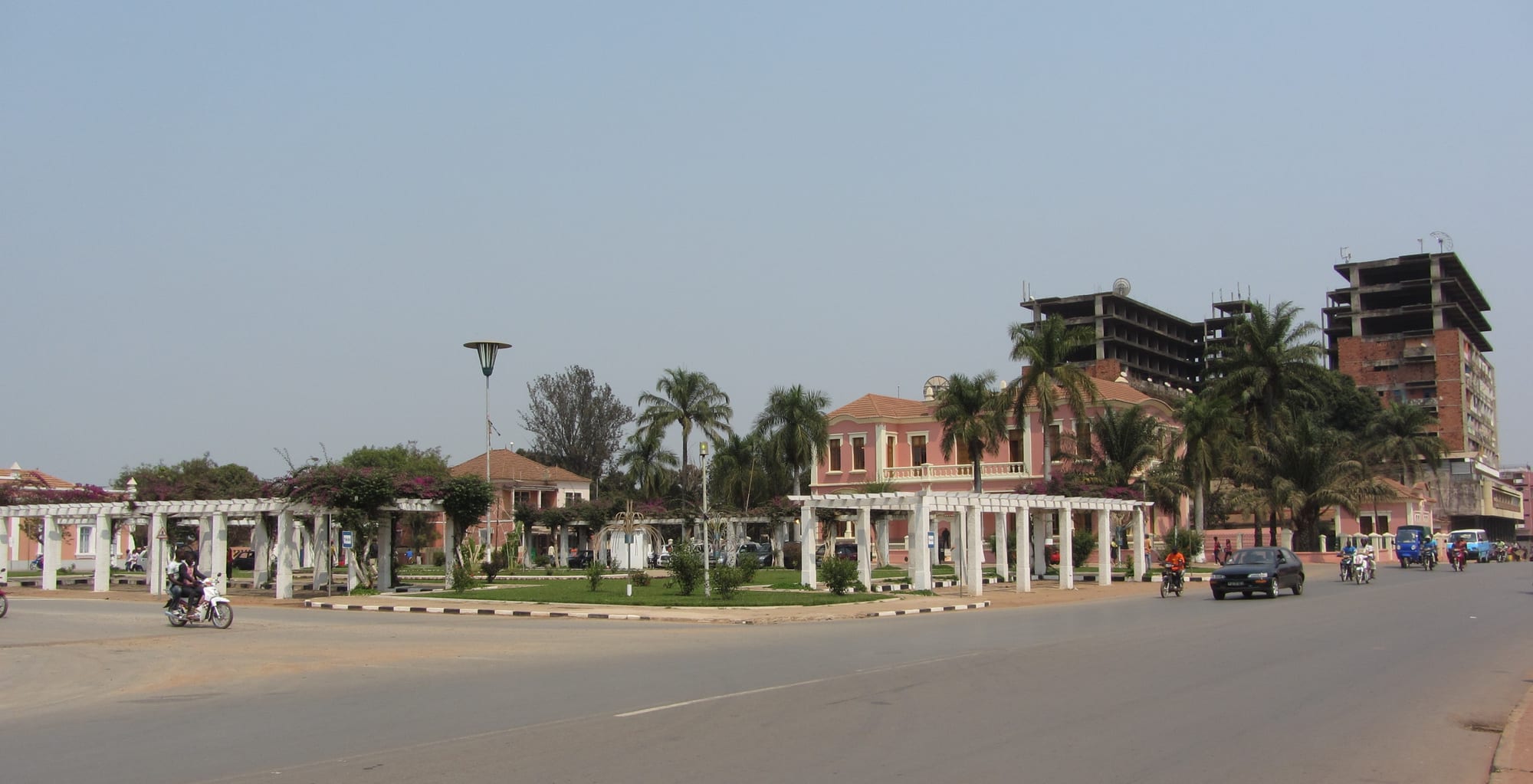
A wide street curving past a small garden with white pergolas, palm trees and pink colonial buildings, with taller concrete blocks behind

Angola

Malanje & the Northeast

The centre of Malanje, with its palm-lined garden and colonial-era buildings. (L.Willms / Wikimedia Commons · CC BY 3.0)

The inland northeast of Angola, from the farming plateau of Malanje — home of the Kalandula falls, the black rocks of Pungo Andongo and the giant sable antelope — east to the diamond provinces of Lunda-Norte and Lunda-Sul on the DR Congo border, heartland of the Ndongo kingdom and of Chokwe art.

Explore Malanje & the Northeast

History

The Malanje plateau was the heartland of Ndongo, the Kimbundu kingdom whose ruler's title, ngola, gave Angola its name. Ndongo resisted Portuguese expansion from Luanda for decades, and in the 17th century Queen Njinga fought and negotiated with the Portuguese before building a new base in Matamba to the north-east. The rock fortress of Pungo Andongo was a royal stronghold until the Portuguese took it in 1671 and set up a garrison there. East of Malanje, in the Baixa de Cassanje, the Imbangala kingdom of Kasanje grew rich as a middleman in the inland slave trade.

The Lunda country to the east belonged to the orbit of the Lunda empire, centred in what is now DR Congo, and later to the expanding Chokwe, who became traders in ivory, wax and rubber in the 19th century. Portugal occupied the region only in the early 20th century, and in 1917 the diamond company Diamang won a vast concession in the Lundas, running it almost as a private state from its headquarters at Dundo.

In January 1961 cotton growers in the Baixa de Cassanje rose against forced cultivation and were crushed by the colonial army; 4 January is now a national day of remembrance. In the civil war, Malanje city held out in 1992–93 while UNITA took the rest of the province, and the diamond fields of the Lundas helped fund UNITA through the 1990s. Since 2002 the railway and roads have been rebuilt and large-scale mining has expanded.

Culture & Customs

Malanje is Kimbundu country, and the language is still widely spoken in villages alongside Portuguese. Queen Njinga is a powerful regional figure, and at Pungo Andongo marks in the rock are pointed out as her footprints. Many families combine Catholic or Protestant churchgoing with respect for ancestors and local healers.

The Lundas are dominated by the Chokwe, whose carvings and masks are among the most admired in African art. The mwana pwo mask, representing an idealised young woman, and the pensive figure known in Portuguese as O Pensador, the most famous piece of Angolan art, both come from this tradition. Masked dancers perform at the end of mukanda, the boys' initiation, and Chokwe storytellers use sona, geometric drawings traced in sand, to illustrate proverbs and tales.

The diamond economy has drawn people from all over Angola and from across the Congolese border, giving towns like Saurimo and Dundo a mixed character.

Daily Life

Malanje city is the main urban centre, with several hundred thousand people, a railway station, a university and a busy market, and it serves a farming province that grows cassava, maize, beans, sweet potatoes and some cotton, with ambitious state-backed agricultural projects on the plateau. Much of the countryside remains poor, and many villages still rely on wells and firewood.

In the east, life revolves around diamonds. Saurimo, capital of Lunda-Sul, grew fast on the mining industry, and the Catoca mine nearby is one of the largest kimberlite diamond mines in the world. Dundo, capital of Lunda-Norte, began as a company town, and informal diggers, the garimpeiros, work riverbeds throughout the province despite repeated crackdowns, including a 2018 crackdown during which hundreds of thousands of Congolese migrants left or were expelled.

For most people the day starts early with farm work or market trading and ends at dusk, when many districts fall back on generators because the power grid is unreliable.

Food

The staple of the region is funge made from cassava flour, eaten with fish, beans, meat or greens. Kizaka, pounded cassava leaves cooked with peanuts or palm oil, is a daily dish, and dried fish brought up from the coast and river fish from the Cuanza and Lucala are common. Malanje's farms supply beans, sweet potatoes and fruit to Luanda's markets.

In the Lundas, Chokwe cooking follows the same cassava base, with game, mushrooms and caterpillars gathered in season from the woodland. Grilled goat and chicken are sold at roadside stalls.

For drinks, kissângua is a lightly fermented drink made from sprouted maize, palm wine appears in the wetter north, and kaporroto is another traditional home-made drink. Commercial beer is brewed in Luanda and elsewhere.

Attractions & Natural Wonders

The Kalandula falls on the Lucala river, about 80 kilometres north-west of Malanje city, are the region's showpiece: a wide horseshoe of cascades around 100 metres high, seen from a viewpoint at the top and from a path down to the base, with a spray-soaked view of the full curtain. Further south, the Pedras Negras of Pungo Andongo rise abruptly from the plain, huge dark rock towers with a ruined Portuguese fort and the rock prints linked to Queen Njinga.

South of Malanje, Cangandala National Park protects miombo woodland and the giant sable antelope, the palanca negra gigante, which survived the war in tiny numbers and is now the focus of a breeding programme. Malanje city itself has a restored railway station and colonial avenues, and the Baixa de Cassanje lowlands lie to the east.

In the Lunda diamond country, the Dundo Museum holds a major collection of Chokwe masks, figures and musical instruments. Saurimo is the main base for the region, though mining restrictions limit where visitors can go.

Cities in Malanje & the Northeast

Planning basics

Budget

Malanje is much cheaper than Luanda, with simple hotels and guesthouses in the city and a few lodges near Kalandula. The Lunda provinces are a different story: diamond-industry demand pushes up hotel prices in Saurimo and Dundo, and distances make flights or a hired vehicle necessary. Cash is essential outside the provincial capitals.

Daily Budget Midrange
USD 120–250 (hotel or lodge, car and driver to the falls and rocks, restaurants)
Daily Budget Shoestring
USD 50–90 (guesthouse in Malanje, local food, train and shared taxis)

Bring enough kwanza (AOA) in cash for day trips to Kalandula and Pungo Andongo, where there are few cash machines.

Safety

Malanje and the main sights are generally calm, though the province saw heavy fighting in the civil war and landmine clearance continued there for years. The diamond areas of the Lundas are a different environment: mining zones are restricted, security forces are prominent, and tensions around informal mining and migrants from the DR Congo recur.

Stay on used roads and paths in rural areas, do not enter mining zones or photograph mine installations, and carry ID at checkpoints. Check current official travel advice before travelling.

Climate

The northeast is wetter and greener than the coast, with a long rainy season from about October to April and a dry season from May to September. Malanje sits on a plateau at around 1,100 metres, so nights are cooler than in Luanda; the Lundas are hot and humid in the rains, with thick grass and miombo woodland.

Summer
the rainy season, around 25–30°C, with heavy afternoon storms and muddy side roads
Winter
dry and sunny, around 25–28°C by day and cool nights on the Malanje plateau

Transportation

Malanje is linked to Luanda by a paved highway, a drive of roughly five to six hours, and by the rebuilt Luanda railway. From the city, roads reach Kalandula and Pungo Andongo in around two hours each. The Lunda provinces are far to the east: Saurimo and Dundo have airports with domestic flights, and the roads between them are long and slow.

Hire a car and driver in Malanje for the falls and rocks rather than rely on irregular shared transport.

Best Time to Visit

May to September is the easier time to travel, with dry roads and clear days for Pungo Andongo and Cangandala. Kalandula is at its most powerful late in the rainy season, around March and April, so a visit at the start of the dry season combines strong falls with passable roads.